
The Ultimate Forklift Buying Guide for Industrial Success in 2026
Posted by United Lift LLC on
What if your next equipment purchase could actually lower your long-term operational costs while meeting the strictest new safety standards? Selecting the right forklift in 2026 is no longer just about lifting pallets; it's about navigating a complex landscape of electrification and real-time behavioral monitoring. You likely feel the pressure of high upfront capital costs and the confusion of choosing between traditional internal combustion and new electric performance. It's frustrating when you just need a reliable machine that fits your aisle width and doesn't sit idle in the shop.
This guide helps you master the complexities of equipment selection to optimize your material handling operations. You'll learn how to balance duty cycles with power sources and find favorable financing terms that keep your cash flow healthy. We'll preview the latest CARB zero-emission regulations, explain the shift toward lithium-ion batteries, and show you how to utilize the 2026 Section 179 deduction limit of $2,560,000 to your advantage. Let's get your fleet ready for the future.
Key Takeaways
- Identify the specific equipment class that fits your facility layout and material handling needs.
- Compare electric and internal combustion forklift performance to find the most cost-effective power source for your shifts.
- Use your daily duty cycle to choose between new machinery or the high-value "sweet spot" of pre-owned units.
- Master the differences between equipment loans and leases to protect your cash flow in 2026.
- Access premium brands like Hyster and Yale through nationwide delivery to streamline your fleet expansion.
Understanding Forklift Types and Their Industrial Applications
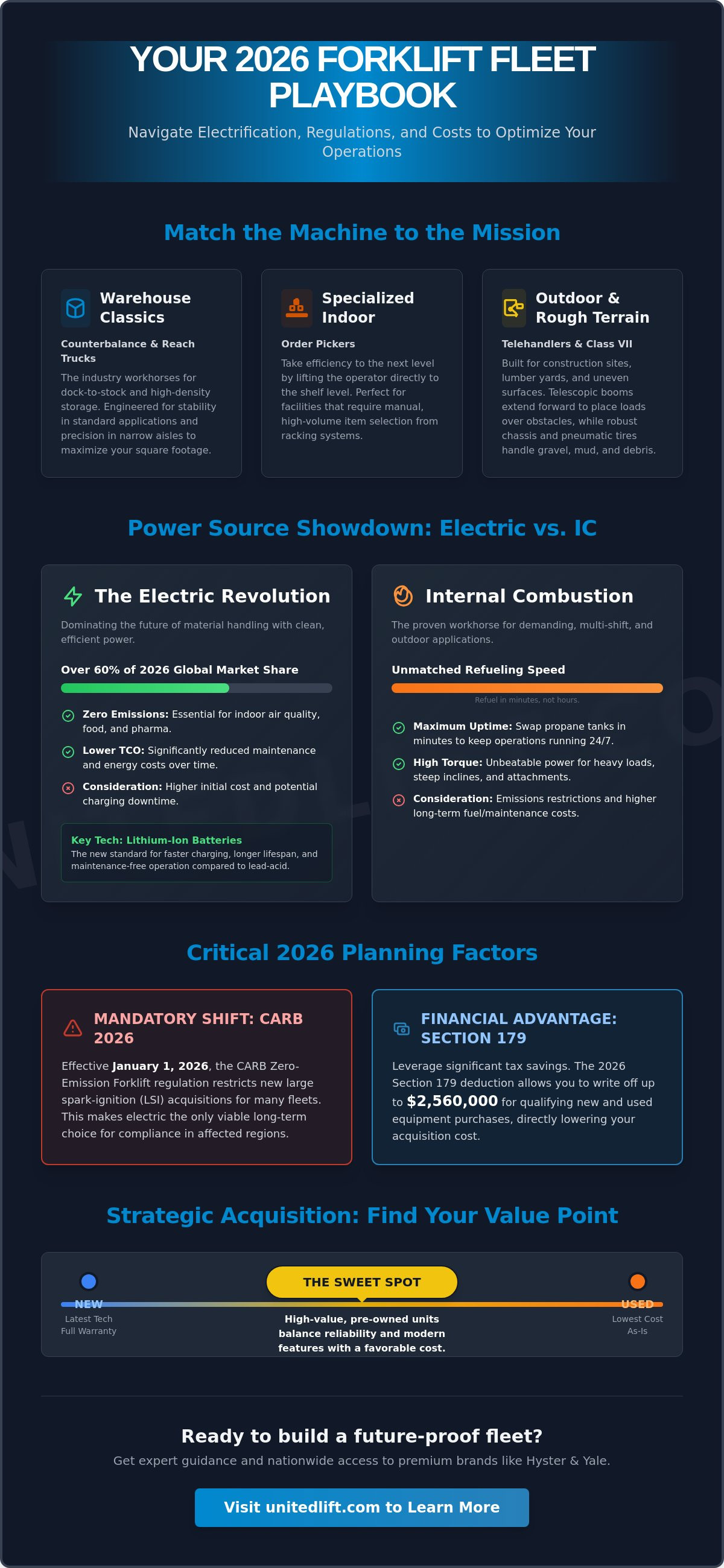
A forklift, technically known as a powered industrial truck, is the backbone of modern logistics. It moves, lifts, and stacks materials with precision, turning manual labor into a streamlined process. Understanding the specific Forklift types and components is the first step in building an efficient fleet. In the United States, equipment is organized into seven distinct classes. These range from electric motor riders (Class I) used in clean environments to heavy-duty rough terrain trucks (Class VII) found on job sites. Choosing the wrong class doesn't just slow you down; it can lead to premature equipment wear or unnecessary safety risks. You need to match the machine to the specific demands of your floor or yard.
Warehouse Classics: Counterbalance and Reach Trucks
The counterbalance model remains the industry workhorse. It features a heavy weight at the rear to offset the load on the forks, making it incredibly stable for standard pallet movement. It's versatile and works well in most dock-to-stock applications. If you're working in high-density storage, you likely need a reach truck. These machines are engineered for narrow aisles. They allow operators to "reach" into racking systems while the base stays stationary. This specialized design drastically reduces your required turning radius. It lets you squeeze more racks into the same square footage without sacrificing speed. Order pickers take this a step further by lifting the operator to the shelf level for manual item selection.
Rough Terrain and Outdoor Solutions
Indoor lifts won't survive on a rugged construction site. For gravel, mud, or uneven surfaces, you need pneumatic tires or specialized Class VII equipment. Telehandlers are a top choice for masonry and framing because of their telescopic booms. They don't just lift vertically; they extend forward to place loads on high scaffolding or across obstacles. If your operations move between a paved yard and a warehouse, a pneumatic tire lift offers the durability required for outdoor material handling. Capacity is also a bigger factor here. Outdoor loads are often bulkier and less uniform than standard warehouse pallets. This requires a machine with a more robust center of gravity and higher ground clearance to prevent bottoming out on debris.
Modern equipment has evolved far beyond the basic lift. Today's specialized machines, from economy lifts for light duty to heavy-duty telehandlers, ensure there's a specific tool for every industrial challenge. Identifying which of these fits your aisle width and surface type is the foundation of a successful purchase strategy.
Selecting the Right Forklift: Capacity and Power Sources
How much can your machine actually lift? Determining your required capacity is the most critical step in the buying process. You must look beyond the basic weight rating and consider the load center. Most standard units are rated at a 24-inch load center. If your loads are oversized or uneven, your effective capacity drops significantly. Miscalculating this is a major safety risk. Always reference OSHA forklift safety regulations to ensure your equipment matches your heaviest pallets. Selecting a forklift with a slightly higher capacity than your heaviest load provides a necessary safety margin and reduces strain on the hydraulic system.
The Electric Revolution: Efficiency and Indoor Air Quality
Electric models now account for over 60% of the global market share in 2026. They're essential for food and pharmaceutical warehouses where zero emissions are mandatory. Stricter rules are also driving this change. Starting January 1, 2026, the CARB Zero-Emission Forklift regulation restricts new large spark-ignition acquisitions for many fleets. This makes electric the only viable long-term choice for many operators. While the upfront cost is often higher, the long-term ROI is clear. You'll spend less on energy and significantly less on maintenance. Electric motors have fewer moving parts than engines; you don't have to deal with oil changes, spark plugs, or radiators. Lithium-ion batteries are the current gold standard. They offer faster charging and a longer lifespan than traditional lead-acid options, which require frequent "watering" and specialized charging rooms.
Internal Combustion: Power for Heavy Duty Cycles
Internal combustion (IC) units still dominate heavy-duty, multi-shift outdoor work. Why? Refueling speed is the primary factor. You can swap a propane (LPG) tank in minutes and get back to work. Charging an electric battery can take hours unless you've invested in expensive fast-charging infrastructure. Diesel and gasoline models also provide the high torque required for steep inclines and heavy outdoor attachments. If your budget is tight and your machines run 24/7 in a yard, IC equipment might be the right call. These units generally have a lower initial purchase price than their electric counterparts. You can browse our full inventory to see which power source fits your current workflow. Whether you need the raw power of diesel or the clean efficiency of lithium-ion, matching the power source to your duty cycle is the only way to ensure industrial success.
New vs. Used Forklifts: A Strategic Fleet Comparison
Does your operation actually need a brand-new machine? Deciding between a new and pre-owned forklift depends entirely on your daily duty cycle. If your equipment runs for more than six hours a day across multiple shifts, the reliability of a new build is often worth the premium. However, many businesses find a strategic "sweet spot" in the used market. High-quality brands like Toyota, Hyster, and Yale are engineered for longevity. Buying these pre-owned can save you 25% to 50% compared to new models while still providing years of dependable service.
When to Invest in New Equipment
New machinery is the right choice for high-intensity environments. You get the full benefit of a factory warranty and the latest technological advancements. In 2026, this is more important than ever. New models now include mandated behavioral monitoring technology to track operator actions in real-time. This helps you stay compliant with the latest safety standards. You also gain the ability to customize your build with specific equipment attachments right from the start. If your facility requires specialized forks or clamps for unique loads, ordering new ensures a perfect fit for your workflow.
The Case for Pre-Owned Machinery
Used equipment is often the best solution for backup roles or low-hour applications. If a machine only runs two or three hours a day, the high upfront cost of a new unit is hard to justify. Pre-owned units offer immediate availability. You don't have to wait months for a factory build to arrive. According to data from the Material Handling Institute (MHI), industry standards for reliability remain high for top-tier brands even after several thousand hours of use. This makes a used forklift an excellent choice for a growing business that needs to add capacity quickly without overextending its capital budget.
What should you look for during an inspection? Start with the hour meter. Check the mast for smooth operation and look for leaks in the hydraulic cylinders. Inspect the tires for chunking and the forks for any signs of structural thinning. Reliability isn't just about the age of the machine; it's about how well it was maintained. Choosing a reputable source for your pre-owned equipment ensures you get a machine that has been vetted for industrial success. Whether you choose new or used, focus on the total cost of ownership over the life of the machine.
Financing Your Lift: Section 179 and Capital Strategy
Buying a forklift is a significant capital investment, but it doesn't have to drain your cash reserves. Modern financing allows you to preserve your working capital while still acquiring the heavy-duty machinery your operations demand. The choice between a loan and a lease often comes down to your long-term goals for the equipment. If you want to build equity and eventually own the machine outright, a standard equipment loan is the traditional path. However, if you prefer to keep your fleet modern and avoid the long-term costs of aging machinery, leasing offers a flexible alternative. Financing also makes it easier to step up to premium brands that offer better reliability and advanced safety features.
Maximizing Your Tax Benefits
The tax code provides a massive incentive for industrial businesses to upgrade their fleets in 2026. Under Section 179, you can deduct the full purchase price of qualifying equipment from your gross income. For 2026, the maximum deduction limit is $2,560,000. This applies to both new and used equipment, provided it is put into service by the end of the year. The deduction begins to phase out only after your total qualifying property purchases exceed $4,090,000. Additionally, 100% bonus depreciation is available for 2026. This allows you to write off the entire cost of the machinery immediately after taking your Section 179 deduction. These rules effectively lower the net cost of your equipment, making it the perfect time to invest in high-capacity lifts.
Leasing as a Strategic Advantage
Leasing is a powerful tool for managing a growing fleet without a massive upfront outlay. Operating leases generally offer the lowest monthly payments and allow you to return the equipment at the end of the term. This is ideal for high-intensity operations that want to rotate their machines every three to five years to avoid high maintenance costs. Capital leases, on the other hand, function more like a loan; you'll typically own the machine for a small fee at the end of the term. As of June 2026, typical APRs for equipment financing range from 6% to 22%. Borrowers with strong credit scores of 700 or higher can often secure rates between 7% and 14%. These predictable monthly costs make cash flow management much simpler for small and mid-sized businesses.
Ready to put these tax advantages to work for your business? View our current selection of premium forklifts and telehandlers to see how your 2026 tax savings can be applied to your next equipment purchase. Our team is ready to help you find the right machine for your specific weight and aisle requirements.
United Lift: Nationwide Access to Premium Forklift Brands
Finding the right machine shouldn't mean being forced into a single brand's ecosystem. Most dealerships only represent one manufacturer. This limits your choices and often results in a machine that is "close enough" rather than a perfect fit. At United Lift LLC, we provide access to a massive inventory of Hyster, Yale, Toyota, and Caterpillar units. We act as your single source for a forklift, boom lift, or telehandler; this ensures you get unbiased expert advice tailored to your specific application. You don't have to jump between multiple vendors to find the right capacity or power source for your facility.
The Advantage of a Multi-Brand Dealer
Different brands excel in different environments. You might prefer Hyster for its legendary durability in heavy-duty outdoor applications, while Yale often leads the way with ergonomic innovation for indoor warehouse shifts. We let you compare these premium brands side-by-side. If your budget is the primary concern for a low-hour application, we also offer economy lifts that provide reliable performance without the premium price tag. Having these options in one place simplifies your procurement process. It ensures your fleet is balanced for both performance and cost. We also supply the necessary equipment attachments and industrial batteries to keep your machines fully operational from day one.
Seamless National Procurement
Serving industrial clients across the United States requires more than just a large inventory. It requires logistical precision. We handle the streamlined shipping and logistics for every piece of heavy machinery we sell. Whether you need a single unit in a rural yard or a full fleet for a new national distribution center, our team manages the delivery details so you don't have to. Our commitment to 7-day-a-week support and expert consultation means we're ready when your business needs us. We understand the urgency of the material handling industry. We value your time as much as you do.
Ready to optimize your material handling? Our specialists are available to provide a tailored fleet quote that accounts for your specific weight requirements and aisle widths. Browse our full range of forklifts, scissor lifts, and telehandlers today to find the exact tools your business needs for long-term success. We're here to help you navigate the complexities of 2026's industrial requirements. Reach out to our team and find your next reliable machine today.
Modernize Your Material Handling Fleet Today
Success in 2026 requires a forklift strategy that balances immediate operational needs with long-term financial benefits. You now understand how to navigate the shift toward electrification and how to utilize the $2,560,000 Section 179 deduction limit to lower your tax burden. Whether you choose the durability of a new Hyster or Yale, or the economy of a pre-owned Toyota, your choice should always prioritize your specific aisle width and load capacity. It's about finding a machine that works as hard as you do.
United Lift is your authorized partner for the industry's most reliable brands. We offer national shipping across the US and provide the flexible financing support you need to maximize your 2026 tax incentives. Don't let outdated equipment slow your growth or lead to unnecessary downtime. Our team is ready to help you find the perfect fit for your warehouse or job site.
Browse Our National Inventory of New and Used Forklifts and connect with our specialists today. We look forward to helping you build a more efficient and profitable operation.
Frequently Asked Questions
How do I determine what forklift capacity I need for my warehouse?
Start with your heaviest load and add a safety margin to prevent hydraulic strain. You must consider the load center, which is usually 24 inches for standard pallets. If your loads are longer or uneven, the rated capacity of the forklift decreases significantly. Measuring your highest shelf and heaviest pallet ensures you choose a machine that handles your daily volume with ease.
Is it better to buy a new or used forklift for a small business?
It depends on your daily operating hours and budget. If your business uses the machine for more than four hours a day, a new unit offers better reliability and full warranty protection. For secondary roles or low-hour use, a pre-owned machine from a reputable brand provides excellent value. This approach lets you save capital for other needs while still maintaining a capable fleet.
What is the difference between cushion and pneumatic forklift tires?
Cushion tires are made of solid rubber and are designed for smooth, indoor surfaces like concrete warehouse floors. They offer a smaller turning radius for tight aisles. Pneumatic tires are larger and filled with air or foam, making them ideal for outdoor gravel or uneven terrain. Using the wrong tire type can lead to poor traction, increased vibration, and faster equipment wear.
Can I use Section 179 tax deductions for a used forklift purchase?
Yes, Section 179 applies to both new and used equipment as long as it is new to your business. For the 2026 tax year, you can deduct the full purchase price up to the $2,560,000 limit. This makes high-quality pre-owned machinery even more affordable for growing companies. Always check with your tax professional to confirm that your specific equipment qualifies before finalizing your purchase.
How long does a typical industrial forklift battery last?
A standard lead-acid battery usually lasts about five years or 1,500 charging cycles with proper maintenance. Modern lithium-ion batteries often last much longer, reaching up to 3,000 cycles or more. Factors like "watering" lead-acid cells and avoiding deep discharges significantly impact longevity. Choosing the right industrial batteries is key to minimizing long-term operational costs and preventing unexpected downtime in your facility.
What are the most reliable forklift brands in 2026?
Toyota, Hyster, and Yale consistently rank as the top brands for reliability and resale value in 2026. These manufacturers offer robust parts availability and have adapted quickly to current safety and emission standards. Caterpillar and Bobcat also provide excellent heavy-duty models for outdoor and construction applications. Selecting a well-known brand ensures your forklift remains a long-term asset for your material handling operations.
Do I need a special license to operate a forklift on my private property?
You don't need a standard driver's license, but OSHA requires all operators to be trained and certified on the specific equipment they use. This rule applies even on private property if employees are operating the machinery. In 2026, regulations also include behavioral monitoring requirements to track safety metrics in real-time. Ensuring your team is properly certified is essential for maintaining a safe and compliant job site.
How often should a forklift undergo a safety inspection?
Operators must perform a visual and operational check at the start of every shift. OSHA also mandates a more thorough annual inspection to check for structural integrity, hydraulic leaks, and brake performance. Regular preventative maintenance every 250 to 500 hours of use is standard for most industrial fleets. Keeping detailed logs of these inspections helps you identify minor issues before they become expensive mechanical failures.
- Tags: buying guide, CARB regulations, electric forklift, equipment financing, forklift, Hyster, material handling, Section 179, warehouse equipment, Yale
