
Equipment Financing for Startups: 2026 Buying Guide
Posted by United Lift LLC on
What if you don't need two full years of tax returns to put heavy machinery on your job site? Traditional commercial banks often reject newer operations right out of the gate, leaving founders worried that buying essential gear will drain their payroll funds. Fortunately, modern equipment financing for startups flips the script. Because industrial assets like forklifts, telehandlers, and scissor lifts hold clear collateral value, asset-backed underwriting lets your machinery qualify on its own merit.
You already know that burning through critical cash reserves upfront isn't an option when you need liquidity to fulfill contracts. In this guide, you'll learn how new businesses secure material handling equipment financing quickly without exhausting early operational capital. We'll clarify the differences between capital and operating leases, show you how to get approved with limited operating history, and review 2026 tax rules so you can put reliable equipment to work immediately.
Key Takeaways
- Asset-backed underwriting allows the machinery itself to serve as collateral, helping newer businesses qualify without two full years of operating history.
- Selecting the right model for equipment financing for startups lets you preserve runway while matching payments to equipment lifecycles.
- Clean business bank statements and solid personal credit profiles serve as reliable underwriting benchmarks to accelerate approvals.
- Current Section 179 and bonus depreciation rules allow eligible startups to deduct full machinery acquisition costs in year one to offset tax liabilities.
- Direct dealer financing facilitation combines equipment sourcing and capital approval into one streamlined step, cutting third-party broker delays.
What Is Equipment Financing for Startups and How Does It Work?
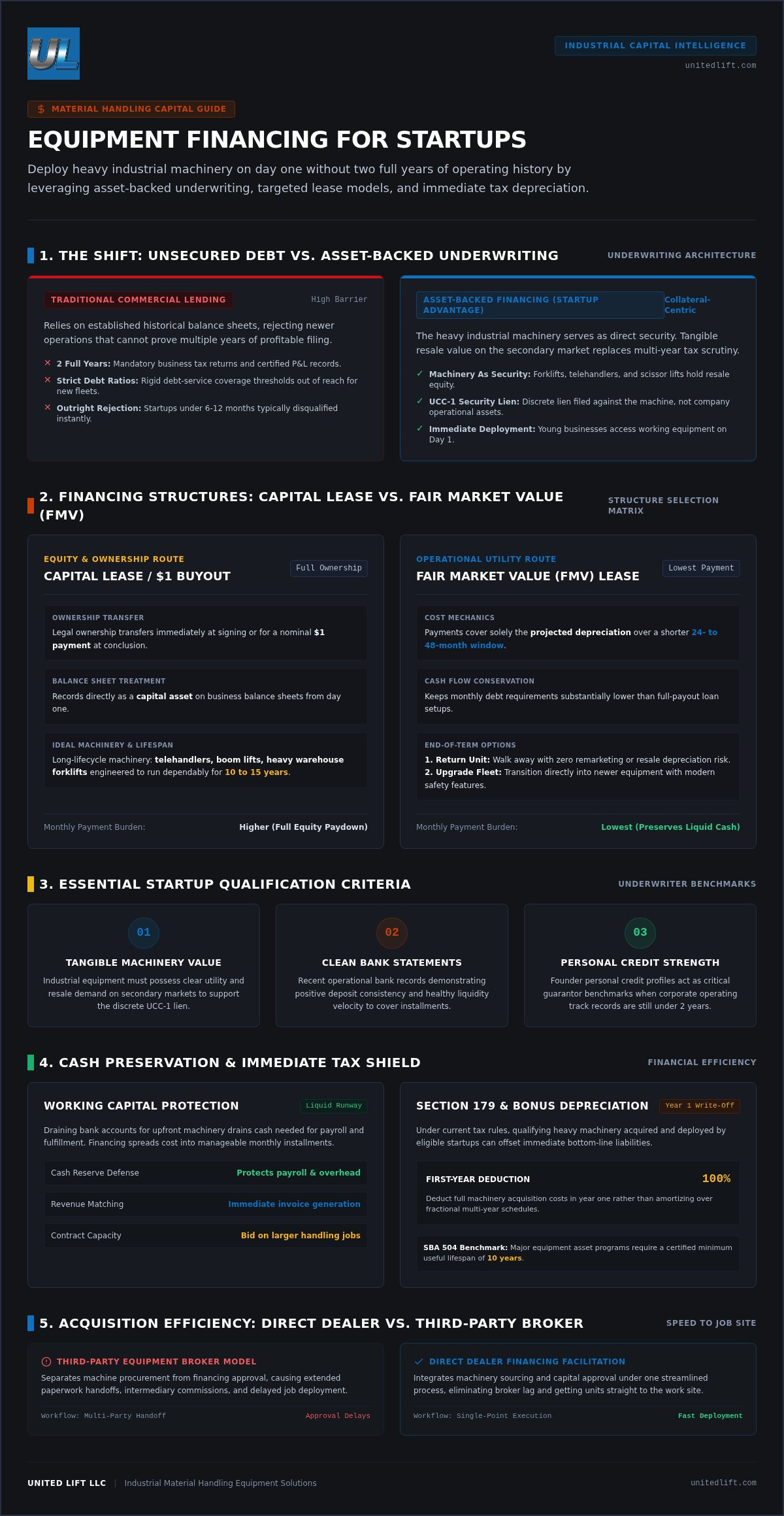
Securing capital for heavy machinery isn't like applying for a standard commercial loan. Equipment financing for startups operates as an asset-backed funding method where the industrial machinery you purchase serves as the direct security for the debt. Instead of scrutinizing multi-year tax records that your young company doesn't have yet, underwriters focus primarily on the tangible resale value of the asset. That distinct shift allows early-stage companies to deploy critical machinery on day one.
Asset-Backed Lending vs. Unsecured Startup Debt
Unsecured business lines and commercial term loans demand extensive operating track records, spotless balance sheets, and strict debt-service ratios. If your business has only operated for six months, traditional institutions will likely decline your application outright.
Asset-backed lending operates on practical collateral. Underwriters file a discrete UCC-1 lien against the specific machine you acquire, such as a forklift, telehandler, or scissor lift. Adopting an established finance lease structure or equipment finance agreement gives lenders a tangible asset with clear secondary market liquidity. Because the machinery itself protects the lender against loss, credit approval depends far less on operating history and much more on the equipment's value and utility.
Preserving Working Capital for Core Operations
Draining your bank accounts to buy heavy machinery outright introduces severe operational risk. Every dollar tied up in physical machinery is capital unavailable for payroll, inventory, or unexpected operational friction. Structured equipment financing for startups replaces heavy initial capital drains with manageable, predictable monthly installments.
- Cash preservation: Protects liquid reserves to navigate seasonal slowdowns and cover emergency overhead.
- Revenue alignment: Lets the equipment generate immediate invoice revenue while you distribute payments over time.
- Contract execution: Enables you to bid on larger material handling jobs without waiting years to accumulate retained earnings.
Predictable monthly payments insulate your business from fluctuating credit markets. You maintain working capital, deploy reliable equipment immediately, and build an established commercial credit profile from your first payment.
Comparing Startup Equipment Financing Structures: Loans vs. Leases
Every dollar counts in early operations. The financing structure you choose dictates your monthly payment burden, balance sheet leverage, and end-of-term machinery ownership. Rather than relying on generic credit lines, selecting the right model for equipment financing for startups depends on how hard you plan to run your machinery and how long you intend to keep it.
Equipment Loans and Capital Leases ($1 Buyout)
Equipment finance agreements and capital leases function very similarly to traditional commercial vehicle purchases. Your business assumes full legal ownership either immediately at signing or transfers clear title at the contract's conclusion for a nominal one-dollar payment. Both vehicles and machinery count directly as capital assets on your balance sheet from day one.
This structure works best for durable, long-lifecycle equipment such as telehandlers, boom lifts, and heavy warehouse forklifts. These machines often operate dependably for ten to fifteen years when maintained properly. Before selecting a financing term, check out The Ultimate Forklift Buying Guide for Industrial Success in 2026 to accurately estimate machine lifespans across internal combustion and electric units. For long-term capital investments, programs like the SBA 504 loan program also finance major equipment assets requiring a certified minimum useful life of 10 years.
Fair Market Value (FMV) Operating Leases
Fair Market Value leases focus entirely on operational utility and cash flow conservation. Instead of paying toward full equity, you pay solely for the machine's projected depreciation over a shorter 24- to 48-month window. This setup keeps your monthly payments substantially lower than full-payout loan structures.
When the lease concludes, you retain total flexibility:
- Return the unit: Walk away without lingering remarketing headaches or used-asset depreciation risks.
- Upgrade the fleet: Roll into updated machinery models with current safety features and factory coverage.
- Purchase outright: Exercise your option to acquire the equipment at its current fair market price.
FMV arrangements excel in high-hour environments like continuous warehouse distribution, where heavy daily cycle times make regular equipment turnaround essential to prevent compounding maintenance bills. If you want to evaluate terms across both lease and purchase paths, you can browse available machinery through unitedlift.com to discuss which financing model aligns with your operational run rate.
Essential Startup Qualification Criteria for Equipment Financing
Underwriters understand that emerging businesses don't have multi-year tax archives. When evaluating equipment financing for startups, lenders balance risk by reviewing the founder's track record, recent cash activity, and the physical asset invoice. Preparing these practical qualification benchmarks in advance accelerates credit approvals significantly.
Personal Credit Scores and Personal Guarantees
When an operating entity has minimal corporate credit, lenders use the owner's personal credit score as an underwriting foundation. Maintaining a personal credit score between 600 and 680 or higher shows underwriters that you manage debt responsibly.
Most commercial financing programs require a personal guarantee from anyone holding a 20% or greater equity stake in the company. That backing reassures underwriters during early operating phases. Making consistent, on-time machinery payments establishes an independent commercial credit score for your business, simplifying future capital requests.
Documenting Business Viability and Cash Reserves
Lenders examine three to six months of business bank statements to confirm daily cash liquidity. They check for steady deposits, positive average daily balances, and zero overdraft charges. Clean bank activity proves your company can handle recurring monthly obligations.
Supplying signed customer contracts or purchase orders demonstrates immediate equipment utilization and predictable revenue flow. Underwriters also review the equipment quotation to verify serial numbers, specifications, and asset condition against established IRS Publication 946 depreciation guidelines for qualifying tangible property. Maintaining three to six months of estimated monthly payments in reserve provides extra assurance on newer files.
The Role of Down Payments in Securing Approvals
Providing upfront equity remains one of the simplest ways to resolve a thin business operating history. Established corporations frequently qualify for zero-down agreements, but startups typically contribute a 10% to 20% down payment.
- Lowers loan-to-value: Immediate cash equity protects underwriters against early secondary-market depreciation.
- Reduces finance costs: Smaller principal balances yield lower total borrowing costs and more manageable monthly obligations.
- Bypasses tax filing hurdles: Strong down payments compensate for a lack of prior annual tax returns, allowing underwriters to issue rapid approvals based on asset value.
Maximizing Cash Flow: Section 179 and Tax Incentives
Federal tax incentives offer one of the most powerful financial levers for growing industrial businesses. When you leverage equipment financing for startups, you don't have to wait years to write off machinery depreciation. Pairing asset-backed financing with IRS tax breaks lets you generate immediate positive cash flow during your first year of operation.
How Section 179 Operates on Financed Machinery
Section 179 permits businesses to deduct 100% of qualifying equipment costs in the tax year the machinery is placed in service. For 2026, the maximum deduction limit stands at $2,560,000, with the equipment phase-out threshold beginning at $4,090,000. Both new and pre-owned material handling assets, including forklifts, telehandlers, boom lifts, and scissor lifts, qualify under IRS rules.
The real financial advantage lies in how financing interacts directly with this deduction:
- Immediate write-off: Deduct the complete equipment purchase value from your taxable income during year one.
- Fractional cash outlay: Claim the entire purchase deduction even if you only paid a down payment and regular monthly installments during the year.
- Tax savings surplus: First-year tax savings often exceed the total finance payments made during those first twelve months, preserving critical working capital.
Bonus Depreciation and First-Year Operational Write-Offs
Section 179 cannot exceed your company's aggregate net taxable income to create a tax refund. If your startup is pre-profit or reinvesting heavily, 100% Bonus Depreciation provides a crucial alternative. Reinstated permanently under federal tax legislation, 100% first-year bonus depreciation applies to qualifying new and used equipment. Unlike Section 179, bonus depreciation can create or expand a net operating loss (NOL) that carries forward to offset future taxable earnings.
Consult a certified public accountant or tax specialist to verify annual deduction limits for your specific entity. When you're ready to secure dependable machinery before year-end, visit unitedlift.com to facilitate your equipment financing and get your machinery onto the job site without delay.
Streamlining Equipment Acquisition with Direct Dealer Financing
Working with independent loan brokers often introduces frustrating communication gaps. Brokers pass paperwork between lenders who rarely understand industrial machinery, dragging out delivery timelines while your contracts wait. Direct dealer financing facilitation solves that friction by combining equipment sourcing, mechanical verification, and credit underwriting under one roof. When you need equipment financing for startups, pairing your equipment supplier directly with funding eliminates middleman delays.
Turnkey Procurement: Matching Machines and Funding
Dealership specialists know the true market value of material handling machinery. Because the equipment supplier already understands the lifting specs, condition, and resale potential of the asset, underwriters review quote packages without secondary appraisal delays. You can select forklifts, telehandlers, boom lifts, or scissor lifts while simultaneously finalizing your financing terms.
Turnkey dealer facilitation also solves the problem of hidden out-of-pocket setup expenses. Modern equipment agreements let you bundle vital supporting items directly into the total financed amount:
- Specialized attachments: Finance side shifters, rotators, fork positioners, or bale clamps right alongside the host machine.
- Industrial battery packages: Include extra batteries and charging stations for electric units so your facility runs multiple shifts immediately.
- Freight logistics: Roll nationwide freight and transport costs directly into your monthly schedule instead of burning upfront reserves.
Financing New vs. Quality Pre-Owned Machinery
Brand-new machinery isn't always the smartest play when launch budgets are tight. Sourcing inspected, pre-owned material handling equipment cuts your total borrowed capital while delivering reliable job site performance. Premium manufacturers like Toyota, Yale, Hyster, Caterpillar, Genie, and JLG are engineered to operate for thousands of metered hours.
Financing used inventory lets startups secure heavy-duty, dependable equipment without taking on massive introductory invoices. You get the exact lift capacities your jobs demand, achieve lower monthly installments, and keep your total balance sheet debt lean.
Taking the Next Step with United Lift
United Lift serves as your no-nonsense partner for nationwide equipment acquisition and financing facilitation. Instead of wrestling with detached lenders or endless phone trees, you work directly with equipment professionals ready to assist seven days a week by phone and email.
Whether you need warehouse forklifts, rough-terrain telehandlers, or versatile scissor lifts, our team matches your operational needs with accessible equipment financing for startups. Contact United Lift today to discuss our diverse machinery inventory and get your next machine delivered directly to your job site.
Power Your Startup Operations Without Draining Cash
Launching and expanding an industrial operation requires smart capital allocation. Relying on asset-backed equipment financing for startups ensures you acquire the machinery you need right now without depleting your early operating reserves. Whether you select a capital lease to build long-term equity or an operating lease to keep monthly commitments lean, you protect payroll funds while leveraging immediate first-year tax write-offs.
You don't have to tackle equipment procurement alone. United Lift provides nationwide equipment delivery and direct dealer financing access across premier brands including Toyota, Yale, Hyster, Genie, and JLG. Our dedicated customer support team is available seven days a week via phone and email to guide your equipment acquisition from initial quote to final delivery. Ready to keep your projects on schedule? Connect with United Lift to explore equipment financing options for your business and put dependable machinery on your job site today.
Frequently Asked Questions
Can I qualify for equipment financing if my startup has been open for less than six months?
Yes, startups under six months old can qualify because the physical machinery serves as direct loan collateral. Underwriters file a discrete lien against the equipment rather than relying solely on years of established revenue history. Providing clean recent business bank statements and an upfront down payment makes qualifying straightforward for newer operating entities.
How much down payment do lenders typically require for startup equipment loans?
Most commercial lenders require a 10% to 20% down payment from newer businesses. Injecting immediate equity reduces the lender's exposure to initial depreciation on material handling units like boom lifts or telehandlers. Providing a larger down payment often helps reduce your ongoing monthly finance charges.
Can my startup finance used material handling equipment or only brand-new machinery?
Startups can finance both new and pre-owned industrial equipment. Financing inspected used machinery from proven manufacturers like Toyota, Yale, Hyster, and Caterpillar helps you cut total debt while securing reliable lifting power. Lenders readily approve used machinery provided it remains in good operational condition with clear resale value.
Is an equipment lease or an equipment loan better for a new company?
The best choice depends on whether you prioritize long-term asset ownership or minimal monthly overhead. A capital lease or equipment loan suits heavy machinery you plan to keep for a decade or more. A Fair Market Value lease works best for startups wanting lower initial payments and the option to upgrade every few years.
What minimum personal credit score is required to secure startup equipment financing?
Lenders generally look for a founder credit score of 600 to 650 for alternative commercial underwriting, while prime equipment programs prefer 680 or higher. Because young businesses lack deep corporate credit profiles, underwriters rely on the founder's personal payment history alongside a standard personal guarantee to approve equipment financing for startups.
How quickly can a startup receive approval and secure funding for industrial equipment?
Application approvals often arrive within 24 to 48 hours when using digital-first application portals. Asset-backed equipment financing agreements typically finalize within one to four weeks. That timeline moves substantially faster than conventional unsecured commercial bank loans, which frequently take two to three months to process.
What happens if our business needs to upgrade equipment before the finance term ends?
Most modern equipment financing agreements allow mid-term upgrades through structured trade-in allowances or early lease payoffs. Your equipment dealer can evaluate the remaining balance against current machine equity, rolling the difference directly into a new finance package for higher-capacity forklifts, telehandlers, or scissor lifts.
- Tags: asset backed loans, equipment financing, equipment financing for startups, equipment leasing, heavy machinery, material handling, Section 179, small business finance, startup funding
