
Used Forklift Trucks: Complete Commercial Buyer Inspection and Fleet Guide
Posted by United Lift LLC on
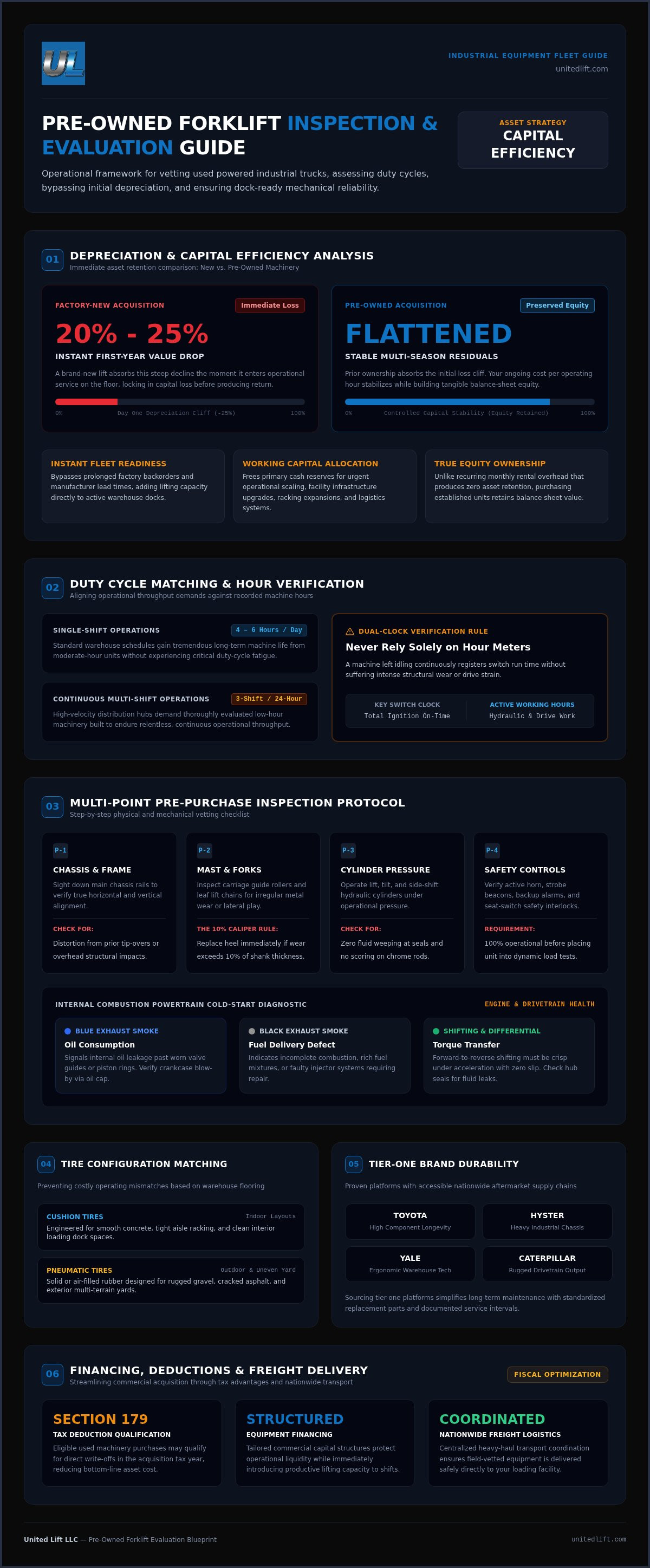
A brand-new lift can lose 20% to 25% of its value the moment it enters service. That immediate depreciation makes sourcing quality used forklift trucks one of the smartest ways to scale your operations, provided you aren't gambling on concealed mechanical wear. The real challenge is knowing how to secure dependable machinery that won't fail when shift demands peak.
It's completely natural to hesitate. You shouldn't have to guess whether an hour meter reflects brutal duty cycles, nor should you worry about inheriting weak hydraulic seals or depleted battery cells that stall your warehouse floor. Sound fleet management turns equipment acquisition from an anxious roll of the dice into a repeatable, objective verification process.
In this guide, you'll learn how to inspect, evaluate, and finance used forklift trucks to maximize fleet productivity without paying new machinery prices. We'll cover hands-on component vetting, mast and tire configuration for tight aisle layouts, and practical ways to secure streamlined equipment financing with reliable nationwide freight coordination.
Key Takeaways
- Learn how acquiring quality used forklift trucks bypasses steep initial asset depreciation and lengthy factory lead times.
- Master a step-by-step physical inspection checklist to uncover hidden structural stress, hydraulic leaks, and battery degradation before signing off on a purchase.
- Match power systems and tire configurations directly to your operating environment, avoiding costly mismatches between cushion and pneumatic setups.
- Identify why tier-one brands like Toyota, Hyster, Yale, and Caterpillar deliver superior long-term durability and simplified aftermarket parts sourcing.
- Navigate commercial financing options, take advantage of qualifying Section 179 tax deductions, and coordinate seamless nationwide freight delivery.
Evaluating Used Forklift Trucks: Capital Efficiency and Duty Cycles
Acquiring used forklift trucks gives operations an immediate advantage: instant fleet readiness. Factory-ordered models often face extended manufacturer backorders that stall warehouse expansion for months. Opting for vetted, pre-owned machinery puts lifting capacity on your dock right away while preserving critical working capital. Unlike recurring rental overhead that builds zero asset value, purchasing proven equipment secures balance sheet equity you control.
Pre-owned equipment also sidesteps the aggressive early value drop that hits factory-new assets. Once a new powered industrial truck goes into service, that initial loss is locked in. Well-maintained pre-owned units retain stable residual value across multiple operating seasons. For an in-depth framework on aligning machinery with operational targets, consult the ultimate forklift buying guide for industrial success in 2026. The key is verifying duty cycle requirements against maintenance histories to eliminate unexpected downtime.
Balancing Operating Hours Against Daily Shifts
Never rely solely on an hour meter reading. Check key switch hours against active hydraulic and drive hours, since a machine left idling registers run time without experiencing structural wear. Single-shift operations running four to six hours daily gain tremendous longevity from moderate-hour units. In contrast, round-the-clock, three-shift distribution hubs demand lower-hour machinery that has undergone thorough mechanical evaluation to withstand relentless throughput cycles.
Calculating True Cost of Ownership Versus New Equipment
Evaluating long-term asset value requires comparing purchase price alongside standard upkeep:
- Upfront capital preservation: Choosing pre-owned equipment frees capital reserves for facility upgrades, racking additions, and technology deployments.
- Budgeted wear items: Account for regular maintenance items such as hydraulic fluid flushes, steer axle bushings, and periodic drive tire replacements.
- Flattened depreciation curve: Because the original buyer absorbed the initial 20% to 25% depreciation hit, your ongoing cost per operating hour remains remarkably low.
Tracking complete service logs ensures you secure dependable performance. When machines have documented fluid analysis, regular greasing, and timely chain adjustments, they deliver the daily output of new machinery without the crippling capital outlay.
Essential Multi-Point Mechanical Inspection for Pre-Owned Forklifts
A thorough physical evaluation separates field-ready used forklift trucks from hidden mechanical liabilities. Before starting the engine or cycling the hydraulics, walk the perimeter to examine structural stress points. Sighting down the chassis rails verifies proper alignment, ensuring the frame never suffered distortion from tip-overs or overhead impacts. Follow safety standards by applying an Essential Multi-Point Mechanical Inspection across all warning systems: test the horn, backup alarms, strobe lights, and seat switch interlocks to confirm functional compliance before putting the machine through dynamic load cycles.
Inspecting the Mast Assembly, Carriage, and Forks
Begin by measuring the fork blade thickness at the heel using calipers. If wear exceeds 10% of the original shank thickness, replace the forks immediately. Check the mast channels, carriage guide rollers, and leaf lift chains for irregular metal wear or excessive lateral play. Confirm the lift, tilt, and side-shift hydraulic cylinder seals show zero fluid weeping or scoring along the chromed rods under operational pressure.
Assessing Engine, Transmission, and Drive Axle Health
For internal combustion machinery, start the engine cold and watch the exhaust for warning signs:
- Exhaust emissions: Blue smoke signals internal oil consumption, while black smoke points to fuel delivery issues. Remove the oil cap to verify minimal crankcase blow-by.
- Transmission shifting: Shift between forward and reverse under acceleration. Shifting should feel crisp, with zero slippage or delayed torque transfer.
- Differential integrity: Inspect the drive axle housing, hub seals, and differential casing for fresh fluid seepage or metal shaving accumulation.
Evaluating Electric Forklift Batteries and Electronic Controls
Electric units demand a dedicated battery assessment. Open the compartment to inspect cell tops for white corrosion, acid boil-over, and cracked terminal posts. Check that the battery's voltage and amp-hour capacity match your daily shift demands, and verify charger phase compatibility with your facility's electric panel. Turn the key switch to ensure the digital display clears diagnostic checks without active fault codes, then confirm smooth motor acceleration across all travel directions.
Taking the time to verify these mechanical standards ensures reliable uptime on your job site. If you want to bypass the guesswork of unvetted listings, explore our inspected inventory of used forklift trucks to find certified equipment ready for immediate nationwide freight delivery.
Used Forklift Configurations: Matching Power Systems and Tires
Every job site introduces unique operating constraints that dictate your machinery specs. Selecting used forklift trucks without analyzing your facility floor, overhead clearance, and airflow profile risks costly operational bottlenecks. If your business handles food, beverage, or pharmaceuticals, strict ventilation mandates require zero tailpipe emissions, making electric power essential. Outdoor lumber yards or scrap processors require internal combustion engines that withstand unpredictable weather and continuous rough terrain. Aligning your powertrain and chassis with industry benchmarks from groups like the Material Handling Industry ensures you invest in machinery engineered for your facility's physical demands.
Always verify the hydraulic spool valve configuration before adding specialty attachments like carton clamps, rotators, or side-shifters. A standard mast typically carries three hydraulic functions: lift, tilt, and auxiliary. If you plan to run advanced attachments requiring independent hydraulic flow, verify the carriage features a fourth valve and intact hydraulic hosing to avoid expensive retrofit expenses later.
Internal Combustion (LPG/Diesel) Versus Electric Forklifts
Your operating schedule determines which power system generates the best return:
- Liquid Propane Gas (LPG): LPG units offer fast tank swaps and steady torque output. They excel in cross-docking hubs that transition smoothly between indoor staging areas and outdoor loading bays.
- Electric Powertrains: Battery-powered trucks eliminate localized exhaust fumes, operate quietly, and lower fuel expenditures. They are ideal for high-density multi-level warehousing with smooth flooring.
- Diesel Engines: Diesel machinery generates superior low-end pulling power. These heavy-duty trucks dominate outdoor operations, handling bulky building supplies across uneven soil.
Cushion Tires Versus Solid Pneumatic Tires
Never run cushion tires on rough gravel or broken asphalt. Smooth cushion rubber is engineered specifically for poured indoor concrete floors. Because cushion tires sit on smaller diameter wheel hubs, they give the forklift a tight turning radius and low center of gravity. This makes them the clear choice for navigating narrow warehouse aisles.
Solid pneumatic tires provide deep traction treads and higher ground clearance. Made from durable solid rubber, they eliminate the risk of puncture flats around outdoor job sites, rail yards, and scrapyards. When inspecting pre-owned machinery, examine all tires closely for chunking, sidewall splits, and flat spots from aggressive braking. Replacing an entire drive wheel assembly immediately cuts into your initial acquisition savings, so inspect tire tread integrity during your initial walkthrough.
Evaluating Top Used Forklift Brands for Longevity and Parts Availability
Manufacturer pedigree directly governs how well pre-owned equipment holds up under continuous operational strain. Well-established equipment manufacturers design their chassis, hydraulic valving, and drivetrains specifically for second-life rebuilds. When you source used forklift trucks from recognized tier-one builders, you avoid the parts bottlenecks that turn budget machinery into inactive warehouse monuments. Standardized assemblies, accessible diagnostic architecture, and deep aftermarket support protect your machine's resale value across multi-year cycles.
Brand choice also dictates your ongoing parts sourcing speed. Independent mechanics and national component distributors stock wear items for market-leading platforms as routine inventory. Choosing equipment backed by robust domestic distribution networks means replacement starter motors, hydraulic packing kits, or mast bearings can reach your maintenance bay overnight.
Toyota, Hyster, and Yale Warehousing Workhorses
Toyota, Hyster, and Yale represent the operational foundation of high-density logistics facilities:
- Toyota: Known for ergonomic cab layouts and internal combustion powertrains that routinely surpass 10,000 to 15,000 operating hours when serviced according to schedule.
- Hyster: Built with heavy structural steel cross-members and high-capacity mast channels engineered to withstand torsional twisting during high-reach pallet racking maneuvers.
- Yale: Shares foundational mechanical engineering with Hyster while offering refined, operator-friendly electronic control modules and responsive hydraulic valving.
Caterpillar and Heavy-Duty Industrial Material Handlers
Heavy fabrication yards, brick distribution centers, and commercial lumber facilities require reinforced counterweights and rigid structural iron. Caterpillar lift trucks excel under these demanding outdoor cycles. Their drivetrains generate substantial low-rpm torque, while their sealed planetary drive axles keep out rock dust and abrasive grit. Standardized hydraulic lever layouts also simplify cross-training across rotating operating crews, minimizing shift disruptions.
Partnering with an equipment provider that carries multiple tier-one brands helps you pinpoint the right balance of lifting tonnage, mast height, and fuel economy. Ready to add proven machinery to your staging dock? Browse our inspected used forklift trucks to find field-ready units supported by direct seven-day communication and reliable freight coordination.
Securing Equipment: Financing, Section 179, and Nationwide Delivery
Completing an equipment acquisition requires a clear commercial path from funding approval to loading dock arrival. Rather than draining working capital on single cash outlays, businesses use asset-backed equipment financing to lock in fixed monthly structures. This approach preserves liquidity for seasonal labor spikes, incoming inventory, and facility improvements while putting required machinery to work immediately. When structured correctly, your equipment pays for itself through daily production gains.
Asset-based financing treats the machinery as primary collateral. This framework simplifies qualification requirements compared to unsecured business lines. Direct communication with equipment specialists removes guesswork before paperwork is signed, ensuring carriage ratings, attachment hydraulic plumbing, and mast clearances match your facility dimensions perfectly.
Leveraging Equipment Financing and Tax Deductions
Pre-owned equipment purchases qualify for significant tax depreciation advantages under federal revenue guidelines:
- Predictable monthly cash flow: Streamlined financing structures convert major capital acquisitions into consistent, manageable overhead expenses.
- Section 179 expensing: Eligible companies can write off the full purchase price of qualifying pre-owned equipment during the tax year it is placed in service, rather than depreciating it slowly over years.
- Bonus depreciation benefits: Additional first-year bonus depreciation write-offs can often be applied alongside Section 179 to maximize upfront tax liability reductions.
Always consult your certified tax professional before closing year-end transactions to confirm specific deduction limits and eligibility timelines for your business structure.
Streamlined Nationwide Logistics and Dealer Support
Sourcing machinery outside your immediate geographic region unlocks substantially better equipment selection and competitive asset pricing. Dedicated logistics coordination manages the entire freight process, utilizing flatbed or specialized drop-deck trailers to transport heavy industrial trucks directly to your dock door. Rigorous freight scheduling ensures proper tie-downs, transit permits, and scheduled dock-level unloading across the country.
Having reliable customer communication seven days a week keeps your logistics timeline on track. If you are ready to expand your operational throughput with vetted machinery, check out the nationwide inventory of used forklift trucks at United Lift LLC. You can verify machine histories, match attachments, and coordinate delivery with one direct phone call or email.
Scale Your Fleet Operations with Proven Machinery
Smart equipment acquisition boils down to methodical evaluation. When you inspect mast wear, verify hydraulic integrity, and match the correct tire compound to your floor conditions, buying used forklift trucks becomes an unbeatable way to expand capacity. Paired with asset-backed financing and tax write-offs, you preserve critical working capital while keeping daily freight moving.
You don't have to navigate equipment sourcing alone. United Lift connects you directly to premium pre-owned machinery from leading manufacturers like Toyota, Hyster, Yale, and Caterpillar. Our team assists clients seven days a week by phone and email, providing straightforward answers on machine specs, streamlined equipment financing facilitation, and coordinated nationwide freight delivery right to your facility doors.
Ready to strengthen your material handling capabilities without paying new equipment premiums? Find Your Next Heavy-Duty Forklift at United Lift and secure dependable lifting power today.
Frequently Asked Questions
How many operating hours is considered high for a used forklift?
Operating hours above 10,000 hours typically represent late-stage lifecycle use for internal combustion models, while electric units can often push past 12,000 hours with proper care. However, maintenance quality matters far more than the raw meter number. A forklift with 5,000 poorly serviced hours often poses a bigger financial risk than a 9,000-hour machine with complete maintenance records. Always compare key switch hours to active hydraulic hours.
Can I use Section 179 tax deductions on pre-owned forklifts?
Yes, qualifying pre-owned equipment purchases are eligible for Section 179 tax deductions under IRS guidelines. Your business can deduct the full purchase price of used forklift trucks during the tax year you put them into service, rather than slowly depreciating them across several operating seasons. This deduction frees cash reserves immediately. Always speak directly with a certified tax professional to verify deduction limits and eligibility details for your current filing year.
What is the main difference between cushion and pneumatic tires on used lifts?
Cushion tires feature smooth, solid rubber molded directly onto steel bands. They sit on smaller wheel hubs, giving the truck a tight turning radius designed specifically for smooth, poured warehouse concrete. Pneumatic tires feature deep treads, larger outer diameters, and higher ground clearance. They provide the necessary traction and puncture resistance needed to navigate uneven gravel, cracked asphalt, and outdoor industrial lumber yards without losing stability.
Is an electric forklift practical if my warehouse lacks specialized charging stations?
Many lighter-capacity electric lifts run on standard single-phase 110V or 220V plug-in battery chargers that connect straight into conventional wall outlets. Heavier three-phase industrial batteries require dedicated electrical supply lines and charging bays. Before purchasing an electric unit, check your building's breaker panel amperage and phase rating. Matching machine battery charging requirements to your facility's utility setup prevents unexpected electrical installation expenses after delivery.
How do I verify the load capacity of a used forklift truck?
Check the manufacturer data plate stamped on the dashboard or protective chassis cowl. This plate outlines the maximum lifting capacity based on mast height, tilt angles, and standard 24-inch load centers. If previous owners added specialized attachments, such as rotators, side-shifters, or carton clamps, the used forklift truck must display an updated data plate reflecting the derated lifting capacity to avoid severe facility safety hazards.
What should I look for when inspecting a forklift mast and lift chains?
Inspect mast channel rails for grooves, flaking metal, and uneven roller clearance. Measure leaf lift chain elongation using a chain wear gauge; if the links stretch past 2% to 3% of original pitch length, replace them immediately. Scan all hydraulic lift and tilt cylinders for fluid weeping or pitted chrome rods. Ensure the carriage travels smoothly up and down without sticking or binding across every mast stage.
Does United Lift facilitate nationwide delivery and equipment financing?
Yes, United Lift coordinates flatbed and specialized freight transport for machinery across the entire country, bringing equipment directly to your loading facility. We also provide streamlined equipment financing facilitation to help your business manage monthly capital expenses while securing dependable machinery. Our team is available seven days a week by phone and email to review current inventory specs and answer technical machinery questions.
- Tags: equipment financing, equipment inspection, fleet management, forklifts, material handling, used forklift trucks, warehouse logistics
