
Forklift Attachments for Paper Rolls and Other Loads
Posted by United Lift LLC on
The right attachment changes what a forklift can move and how it handles a load. Common types of forklift attachments include paper roll clamps, carton clamps, side shifters, fork positioners, fork extensions, drum clamps, and push-pull attachments for slip-sheet loads.
Choose an attachment based on the load’s shape, packaging, and handling requirements. Paper roll clamps use curved arms to grip rolls horizontally or vertically; some also rotate rolls for positioning. Other attachments shift forks sideways, adjust their spacing, or extend their reach. Every attachment affects available lifting capacity, so the attachment and forklift must work as a compatible pair.
This guide explains which attachments suit common loads, how paper roll clamps handle rolls, and why an attachment can reduce lifting capacity. It also covers what to consider when matching an attachment to a forklift, helping you narrow down a setup for your material handling needs.
Key Takeaways
- Match attachment function to the load: fork positioners adjust fork spacing, while clamps grip certain loads from the sides.
- Paper roll clamps use curved arms to grip rolls and can rotate them to support handling and positioning.
- Factor in attachment weight and its effect on load center when assessing a forklift’s capacity.
- Check that the attachment’s mounting system and class fit the forklift before selecting a setup.
What are the common attachments for a forklift?
Common options include hydraulic fork positioners, fork extensions, and rotators. Each changes how the forklift places or handles a load.
Fork Positioners and Extensions
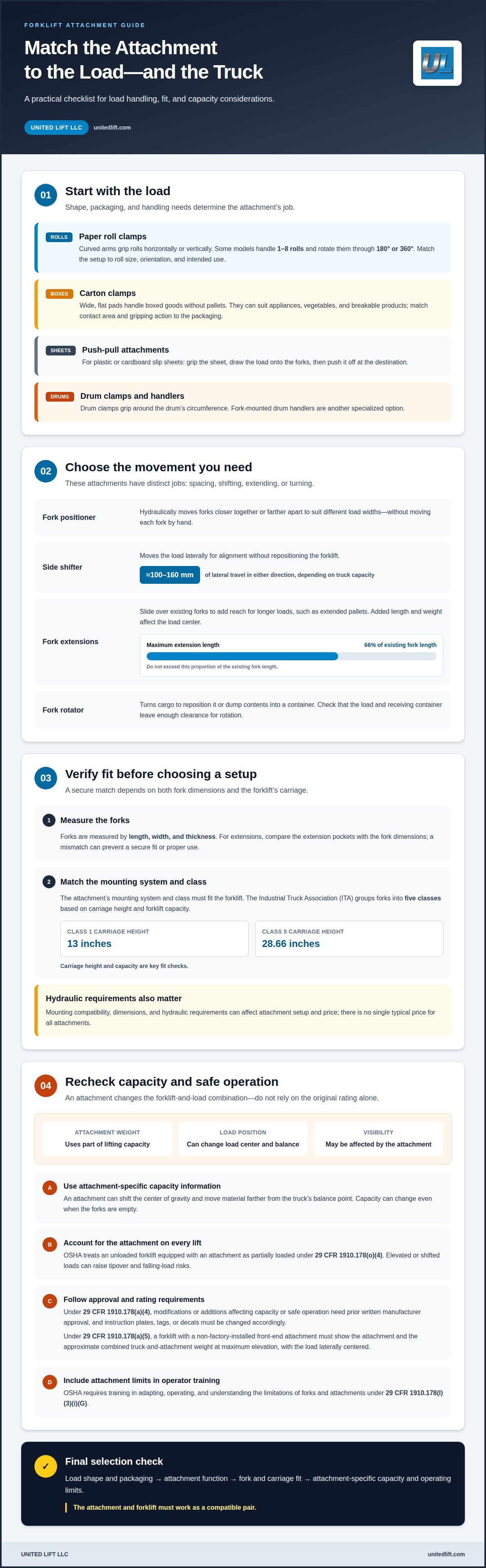
Hydraulic fork positioners move forks closer together or farther apart to suit different load widths. This lets operators adjust fork spacing without repositioning each fork by hand. Fork extensions slide over existing forks and add reach for longer loads, such as extended pallets. Their added length and weight affect the load center, so extensions should not exceed 66% of the existing fork length.
Rotating and Dumping Loads
Fork rotators turn cargo to reposition it or empty it into a container. For dumping, the attachment rotates the load until its contents fall out, then returns it to carrying position. Check that the load and receiving container leave enough clearance for rotation. The rotator’s weight and the load’s changed position also affect the forklift’s capacity.
Fork dimensions and carriage fit are essential selection details. Forks are measured by length, width, and thickness, while the attachment’s mounting system and class must match the forklift. For extensions, compare the pockets with the fork dimensions. A mismatch can prevent a secure fit or proper use.
The Industrial Truck Association (ITA) groups forklift forks into five classes based on carriage height and forklift capacity. Class 1 carriage height is 13 inches; Class 5 carriage height is 28.66 inches. These class differences make carriage height and capacity key fit checks.
Forklift attachment prices in the United States vary by attachment type and setup. Mounting compatibility, dimensions, and hydraulic requirements can also affect the price, so there is no single typical figure for all attachments.
Paper roll clamps
Paper roll clamps use curved arms to grip rolls without relying on fork tips. They can handle rolls horizontally or vertically, depending on how the load must be stored or moved. Some models handle one to eight rolls at a time, and can rotate them through 180° or 360°. The right setup depends on roll size, orientation, and the clamp’s intended applications.
Other clamps grip loads from the sides, with designs suited to different shapes and surfaces. Carton clamps use wide, flat pads to handle boxed goods without pallets. They can suit appliances, vegetables, and breakable products that forks might damage. Match the contact area and gripping action to the load so the clamp holds securely without concentrating pressure on the packaging.
For pallet-free handling, push-pull attachments move loads on plastic or cardboard slip sheets. The attachment grips the sheet and draws the load onto the forks, then pushes it off at the destination. This supports workflows that use slip sheets instead of pallets. Drum clamps grip drums around their circumference for transport; fork-mounted drum handlers are another specialized option.
Before selecting a clamp, consider the load’s shape, packaging, and weight. Paper rolls need curved contact, cartons need broad pads, and drums need a grip around their circumference. These differences affect handling and can support productivity during repeated tasks. Rotators turn loads but are not clamps designed for a specific shape. Work platforms serve a different purpose: lifting personnel for elevated tasks rather than gripping cargo. Choose an attachment for the actual operation, not just its broad category.
Attachment capacity and forklift load limits
OSHA requires forklift capacity ratings to account for attachments that change how the truck lifts or carries a load. Under 29 CFR 1910.178(a)(4), modifications or additions affecting capacity or safe operation need prior written manufacturer approval, and instruction plates, tags, or decals must be changed accordingly. Under 29 CFR 1910.178(a)(5), a forklift with a non-factory-installed front-end attachment must show the attachment and the approximate combined truck-and-attachment weight at maximum elevation, with the load laterally centered.
An attachment uses part of the truck’s lifting capacity through its own weight and the position of the load. It can also change the forklift’s center of gravity and visibility. OSHA treats an unloaded forklift equipped with an attachment as partially loaded under 29 CFR 1910.178(o)(4). Operators should use the truck’s attachment-specific capacity information, not assume its original rating still applies.
Multiple load handlers can add two or three side-by-side fork sets, allowing a forklift to carry several pallets in one trip. That can make material handling more efficient, but the combined pallet weight and attachment still need to fit the truck’s rated capacity. A side shifter moves the load laterally for alignment without repositioning the forklift. Depending on truck capacity, its lateral travel can range from approximately 100 to 160 mm in either direction.
Load position matters. An attachment that moves material farther from the truck’s balance point can raise tipover and falling-load risks, especially when the load is elevated or shifted. OSHA requires operators to be trained in adapting, operating, and understanding the limitations of forks and attachments under 29 CFR 1910.178(l)(3)(i)(G). The operator should account for the attachment during every lift, including when the forks are empty. This capacity check helps the truck perform its intended job while preserving safe handling across changing loads and platforms.
Common forklift attachment types
Beyond clamps and rotators, attachments can measure loads, move unusual materials, and handle multiple tasks. The right choice depends on what the forklift must lift and how the load is packaged.
A side shifter moves the load left or right for alignment; a fork positioner adjusts the spacing between forks. A rotator turns a load to reposition or dump it. Each attachment has a distinct job: shifting, spacing, or rotation.
Other common options serve specific industrial handling needs:
- Weigh forks: Measure load weight during transport, helping operators track loads against forklift capacity.
- Rollerforks: Use two layers of rollers to help secure a load during movement.
- Foam clamps: Adjust grip pressure to hold lightweight foam and similar materials without damaging them.
- Bale clamps: Grip materials that aren't palletized, such as hay bales.
- Container dumpers: Tip bins, barrels, or containers to empty their contents, reducing manual handling.
A forklift work platform serves a different purpose from a load attachment: it lifts personnel for elevated maintenance or construction tasks. Choose an attachment for the job. Moving hay calls for a bale clamp, while emptying a bin points to a container dumper. A weigh fork suits operations that need to track load weight during transport.
Check the forklift’s operator manual for instructions on attachment use, and ensure operators understand the attachment’s function and limitations. For selecting an attachment around a specific material or task, explore equipment attachment options.
United Lift: Forklifts
United Lift LLC offers forklifts and equipment attachments for material handling. Turn to United Lift LLC when selecting a forklift, choosing an attachment, or determining how the two should work together for your loads. The right setup depends on the material, handling method, and capacity requirements discussed in this guide. Sharing those details helps narrow the options to equipment suited to your operation. United Lift LLC also offers boom lifts and telehandlers for other equipment needs, though they serve different tasks from forklift attachments.
Contact United Lift LLC to find a forklift or attachment suited to your operation.
Plan for the work ahead
Plan beyond the next load. An attachment suited to today’s material flow should also make sense if your product mix or handling sequence changes. Before settling on types of forklift attachments for your operation, identify which tasks must stay consistent and which may vary. This gives you a practical basis for planning equipment around the work, rather than forcing the work to fit one setup.
Use that plan to focus the conversation about your equipment needs. Describe the loads, how they need to move, and how the work may change over time. A clear starting point helps narrow the next decision and keeps equipment choices tied to real operating demands.
Contact United Lift LLC about attachments to discuss your material handling needs. You’re ready to take the next step.
Frequently Asked Questions
Who Needs a Side Shifter and Fork Positioner?
Warehouses that regularly align pallets in racks can benefit from a side shifter, while operations handling different pallet widths may need a fork positioner. For example, a receiving area with mixed pallet sizes may need adjustable fork spacing, while a small placement correction calls for lateral movement. The key distinction is whether the task changes fork spacing or load position. The attachment must also suit the forklift and its work.
What are the most common types of forklift attachments?
Common choices include side shifters, fork positioners, extensions, rotators, clamps, and push-pull attachments. Other options address specific tasks: multiple pallet handlers carry pallets side by side, weigh forks measure load weight during transport, and waste bins collect and empty debris. Start with the material and how it must move, then choose an attachment by its function. A general-purpose fork setup will not meet every handling need.
Which forklift attachments handle drums, bales, rolls, and cartons?
Drum-handling attachments grip drums, bale clamps handle materials such as hay, paper roll clamps grip rolls, and carton clamps handle boxed goods. The load’s shape and surface help determine the right attachment. For example, a carton clamp’s broad pads suit boxes that fork tips could damage, while curved paper roll clamps are made for cylindrical rolls. Match the contact surface to the load.
What are the main types of forklift clamps and their uses?
Clamp styles include paper roll, carton, drum, bale, and foam clamps. Each grips a different load: curved arms hold paper rolls, broad pads grip cartons, and drum clamps secure drums around their circumference. Bale clamps handle unpalletized bales, while foam clamps use adjustable pressure for delicate, lightweight materials. The key factors are the load’s shape, packaging, and tolerance for gripping pressure.
How do forklift attachments affect load capacity and the load center?
An attachment adds weight and may move the load farther from the forklift’s balance point, reducing capacity for cargo and changing stability. For example, a long-reaching setup can alter the load center compared with standard forks. Use capacity information for the forklift-and-attachment configuration rather than relying on the forklift’s original rating. Both attachment fit and load position matter during lifting.
How to choose the right forklift attachment for a specific load and job?
Start by identifying the load’s shape, packaging, weight, and required movement. A roll that needs turning calls for a different setup than cartons moved without pallets. Next, match the attachment’s mounting system and class to the forklift, and account for its effect on capacity and visibility. Consider the full work cycle, from pickup and travel to placement or dumping, to ensure the attachment suits the task.
- Tags: carton clamps, fork positioners, forklift attachments, forklift capacity, material handling, paper roll clamps, side shifters, types of forklift attachments, warehouse equipment
