
Forklift fleet management to improve upkeep, tracking and battery care
Posted by United Lift LLC on
A well-managed forklift fleet brings equipment use, maintenance needs, location, and battery charging into one clear view. The best forklift fleet management practices use this information to schedule service, identify underused or overworked trucks, and manage battery charge cycles consistently.
Battery care is easy to overlook when the priority is keeping trucks moving. But charging and rotation affect battery availability across shifts. Managing them alongside maintenance and equipment tracking gives teams a fuller picture of fleet performance.
This guide explains how fleet data can support preventive maintenance, forklift tracking and geofencing, and practical battery rotation. It also shows how operating records can inform workload and equipment decisions, whether you run a single truck or a larger fleet.
Key Takeaways
- Use operating-hour and condition records to spot trucks that need replacing, rebalance workloads, and identify where operators may need further training.
- Build maintenance reminders around manufacturer schedules and usage records so service is planned before issues disrupt work.
- Use location and boundary alerts to improve visibility into truck movements and identify routes or areas that may need attention.
- Track battery use and charging patterns to guide rotation and avoid wasting charge cycles on undercharged batteries.
1. Why use a smart forklift fleet management system?
A management system turns operating records into decisions about upgrades, staffing, and daily productivity. Compare each truck’s operating hours, utilization, service history, and recorded impacts. A generally accepted productive-utilization benchmark is 60-80% of available shift hours. Below that range, review workload and seasonal demand before adding equipment; consistently heavy use may point to a need for more capacity. Historical data also helps identify aging trucks to phase out and operators who may benefit from additional coaching.
Track operator hours, compliance, and impact events alongside truck status. Compare impact records by operator, shift, and facility area, then investigate recurring events. Telematics can show when a vehicle is logged on, off, or in service, while inspection checklists record completed checks. Use these patterns to adjust routes, review operating practices, and plan training. The aim is to make proactive decisions based on fleet activity, not assumptions about an individual operator.
OSHA requires forklift safety training. Fleet systems can restrict truck access to operators recorded as having required certification and training, and help managers track completion and impact records. Use those records to address training needs and support consistent workplace safety procedures.
Telematics and access control can support safer operations by connecting vehicle activity with operator access. Managers can review operating time and impact events, then investigate recurring incidents. Records showing who used a truck and when give teams clearer information for follow-up.
Leasing spreads equipment payments over an agreed term, while buying gives a business ownership and potential resale value. Compare the full terms with expected use, maintenance responsibilities, and how long the truck is needed. No single cost calculation suits every fleet.
Match forklift features to the work environment before upgrading. In demanding recycling settings, protected brakes and undercarriages, rugged housings, and tires suited to rough surfaces may address challenging conditions. Consider floor quality, debris, loads, and routes when selecting equipment. Fleet data can connect these operating needs with upgrade and training decisions.
2. Preventive maintenance scheduling
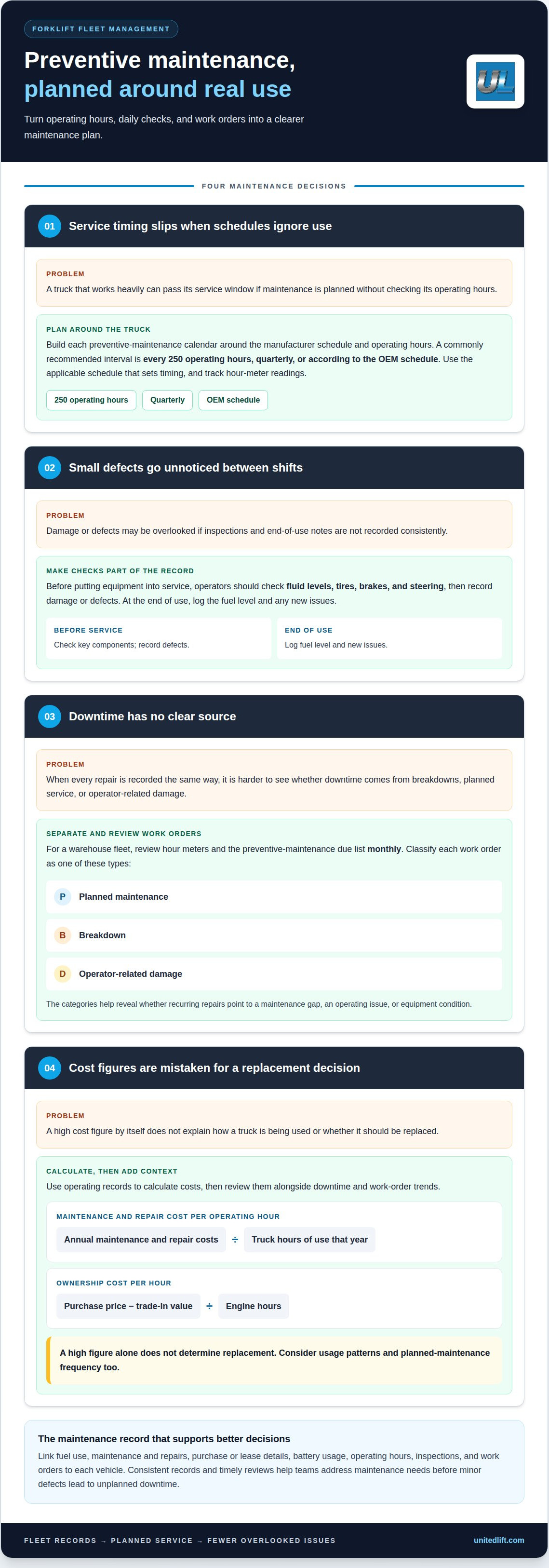
Build each forklift’s preventive maintenance calendar around its manufacturer schedule and operating hours. A commonly recommended interval is every 250 operating hours, quarterly, or according to the original equipment manufacturer’s schedule. Use whichever applicable schedule sets the maintenance timing, and track hour-meter readings so heavily used trucks don’t wait too long between services.
Operators should complete a preshift inspection before putting equipment into service. Check fluid levels, tires, brakes, and steering, and record any damage or defects. At the end of use, log the fuel level and any new issues. These daily records help maintenance teams distinguish routine wear from developing problems and keep repairs from being overlooked.
For a warehouse fleet, review hour meters and the preventive-maintenance due list monthly. Classify each work order as planned maintenance, a breakdown, or operator-related damage. This separation helps show where downtime originates and whether recurring repairs point to a maintenance gap, an operating issue, or equipment condition. Historical operating data can also help schedule work before a problem takes a truck out of service.
Keep current records of fuel use, maintenance and repairs, purchase or lease details, and battery usage. Compare battery use across trucks and shifts; uneven patterns may reveal inconsistent rotation or charging. Link records to each vehicle, including its operating hours, so maintenance decisions reflect actual use rather than assumptions.
Calculate maintenance and repair cost per operating hour by dividing annual costs by the truck’s hours of use that year. To estimate ownership cost per hour, subtract trade-in value from the purchase price, then divide by engine hours. Review both measures alongside downtime and work-order trends. A high figure alone does not determine whether to replace a truck; usage patterns and planned-maintenance frequency matter too.
Common fleet risks include missed service, unreported damage, and recurring breakdowns. Reduce them with preshift checklists, regular service intervals, accurate records, and timely reviews of overdue work. Consistent monitoring helps teams address maintenance needs before minor defects lead to unplanned downtime.
3. GPS tracking and geofencing
GPS tracking gives managers visibility into forklift locations. Geofencing sets a boundary around a designated area and can alert managers when a truck leaves it. Telematics transmits vehicle data to a central system, helping teams review movement, idle time, and route efficiency. Together, these tools show where equipment is working and where travel patterns may need attention.
To assess utilization, compare engine hours with time logged in service, then review idle periods and movement patterns. Fleet management systems can bring GPS, telematics, and equipment records together. Keep each truck’s make, model, serial number, purchase details, components, maintenance history, and engine hours in one record. Accurate records provide context for efficient decisions, rather than relying on location data alone.
Track operating costs with consistent calculations. Divide total maintenance costs by engine hours to find maintenance cost per hour. Review cost per hour and utilization quarterly, comparing similar trucks and their work patterns. A high maintenance figure for one model does not automatically mean replacement is the right choice. Consider planned-maintenance frequency and how the equipment is used.
Record planned maintenance, repairs, and breakdowns as separate work-order types. Each year, compare work orders or invoices with the prior year to assess the balance between planned maintenance and breakdowns. A rise in breakdowns alongside scheduled service records may signal a need to review the maintenance approach or equipment condition. These trends provide a stronger basis for replacement decisions than a single repair record.
Make tracking actionable by assigning responsibility for telematics alerts. A recommended practice is to assign an owner to act on alerts within 24 hours. For example, a geofence alert can prompt a location review, while repeated idle periods can trigger a route or scheduling assessment. Use the combined data to adjust workflows, investigate unusual activity, and decide whether each truck’s current role still fits the fleet’s needs.
4. Battery rotation and charge-cycle management
Battery rotation helps distribute work across a fleet instead of repeatedly relying on the same batteries. Track each battery’s charge cycles, assignment, and condition, then use a rotation schedule that reflects truck demand and shift patterns. New forklift batteries typically have a lifespan of around 2,000 charging cycles, so avoid wasting a cycle on an undercharged battery. An undercharged battery can provide less operating time before recharging while still using a complete cycle.
Set charging procedures around the battery manufacturer’s instructions. After a full charge, discharge the battery only to its recommended minimum capacity of 20 percent. Equalizing needs vary by manufacturer and application, so include those instructions in the battery schedule rather than applying one routine to every unit. Clear handling steps help operators return batteries consistently and prevent ad hoc charging choices.
Watering and cleaning also affect battery condition. Avoid letting water levels drop so low that plates are exposed, as this can cause sulfation. Don’t overfill batteries, since electrolyte boil-over can contribute to capacity loss. Washing batteries helps prevent surface short circuits that dissipate energy and can cause corrosion. Record care tasks alongside charging and assignment history so missed maintenance is visible.
In multi-shift operations, match battery availability to shift schedules and truck demand. Rotate batteries according to actual use, not operator preference alone, and review assignments to find batteries that sit unused or carry a disproportionate workload. Facilities with up-to-date battery handling equipment should ideally be able to use a battery for five years or more. Consistent handling, rotation, and care are practical priorities.
Make the process easy to follow: identify each battery, log its use and care, apply the correct charging and watering routine, then review records for uneven use. This gives managers a clearer view of battery availability and helps protect charge cycles. For equipment planning that supports your operation, explore forklift options.
United Lift: Forklifts
United Lift offers forklifts for businesses adding equipment or replacing trucks as fleet needs change. Use utilization, maintenance, and battery records to identify where capacity or equipment type may need a fresh look. Then consider how workload, facility layout, and operating conditions should guide your equipment choice.
United Lift also offers boom lifts, telehandlers, and scissor lifts for material handling and access needs beyond forklift work. The right equipment category depends on the task, work area, and loads your operation handles. Clear fleet records can help define those needs before you choose equipment.
If your fleet review points to an equipment change, contact United Lift to discuss your needs.
Put your fleet data to work
Make your records part of a regular decision-making routine. Assign responsibility for reviewing fleet information, noting workload changes, and bringing emerging equipment needs to the next planning discussion. Treat forklift fleet management best practices as an ongoing operating habit, not a one-time project. This keeps equipment decisions connected to how the work changes.
When a review points toward adding or replacing equipment, match the choice to the job, facility, and operating conditions. United Lift offers forklifts, boom lifts, and telehandlers for different material handling and access needs. To discuss your options, describe the work your operation needs to handle and the equipment you’re considering.
Contact United Lift to discuss your fleet. A clear conversation can help you consider equipment options for your operation. Keep building a fleet plan that supports your team’s day-to-day work.
Frequently Asked Questions
Why use a smart forklift fleet management system?
A shared view of equipment activity and operating needs helps managers coordinate work. If a shift supervisor sees a truck marked out of service, for example, they can assign the task to available equipment instead. Over time, recorded patterns can also help managers decide whether workload changes call for adjusting fleet size or equipment assignments.
How Do I Know If I Have Too Many Forklifts?
Look for trucks that remain lightly used across shifts while other equipment handles most of the work. For example, three trucks averaging 30% utilization across every shift may indicate excess capacity. Check operating-hour records alongside seasonal demand, workload, and downtime before deciding. Keep enough equipment available for unexpected interruptions, but use those records to identify trucks that may no longer fit the operation.
How Does Forklift Telematics Work?
Forklift telematics uses wireless technology to collect and transmit data from individual trucks to a central management system. Depending on the system, managers can view engine hours, fuel use, maintenance alerts, impact events, and vehicle movements. Location data, for example, may show a truck repeatedly traveling between distant work areas, giving supervisors evidence to review routes and task coordination.
What Data Does Fleet Management Software Track?
Fleet management software can organize equipment use, service schedules, utilization, and operational data. Records may show whether each truck is logged on, off, or in service, alongside operator activity and impact events. Some connected systems also capture equipment health and product movement. Choose data that supports a clear decision, such as identifying a truck that needs attention or reviewing a recurring workflow issue.
What Is a Good Forklift Utilization Rate?
A generally accepted benchmark for productive forklift utilization is 60-80% of available shift hours. Treat it as a comparison point, not a target that overrides safe operation or actual workload. Review each truck’s use across shifts and demand periods. A low rate can reflect excess capacity, seasonal variation, or a mismatch between truck assignments and current tasks.
What are the best practices for managing a forklift fleet?
Make forklift fleet management best practices a repeatable routine: keep equipment records current, review utilization and service needs, and track battery assignments. Set clear policies for vehicle access and end-of-shift reporting. A consistent return checklist, for example, can record fuel level and newly noticed damage, giving the next operator and fleet manager useful information before the truck returns to work.
- Tags: battery care, battery rotation, fleet operations, forklift fleet management, forklift fleet management best practices, forklift tracking, geofencing, preventive maintenance
