
Forklift buying checklist for warehouse managers: choose a fuel type
Posted by United Lift LLC on
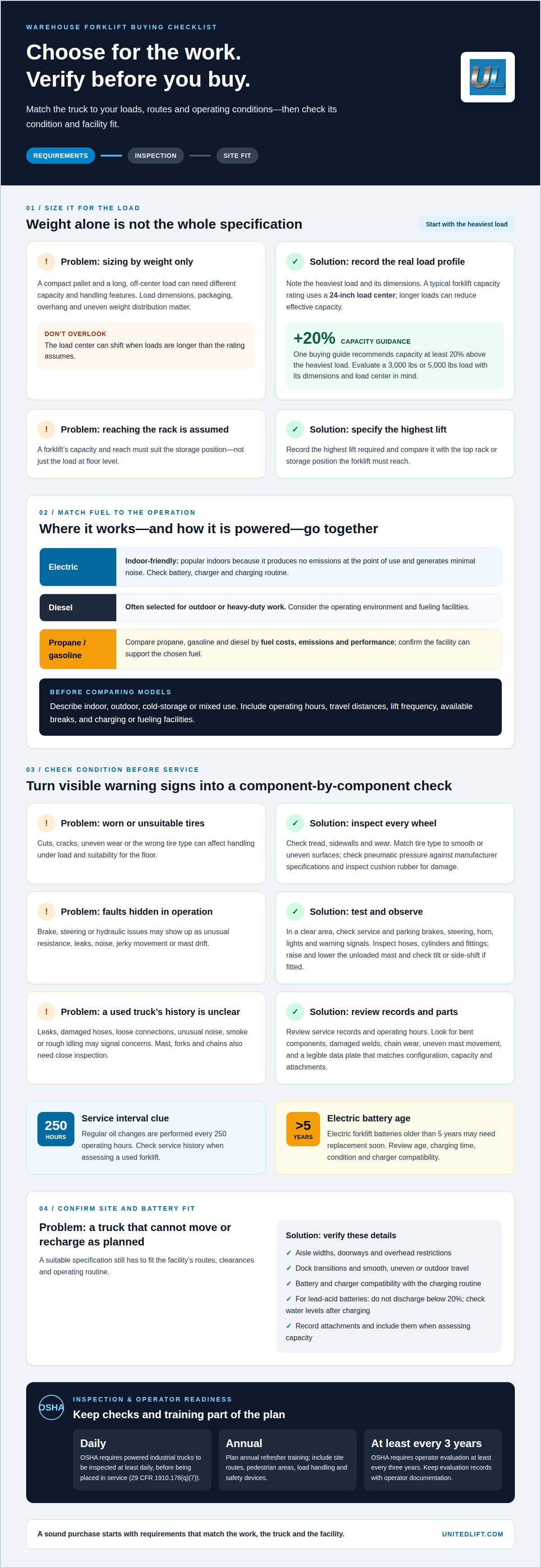
An electric forklift is an obvious choice for an indoor warehouse, but it is not always the whole answer. A forklift buying checklist for warehouse managers should compare electric, propane, and diesel models based on where the truck operates, how intensively it works, and how it will be charged or fueled. Electric forklifts produce no emissions at the point of use and are popular indoors; diesel is often chosen for outdoor or heavy-duty work. Propane, gasoline, and diesel differ in operating costs, emissions, and performance, so the right fuel depends on your operation.
Fuel choice is only one part of a sound purchase. Match the forklift’s rated capacity and lift height to your loads and storage, then make sure its dimensions and condition suit your warehouse. This checklist helps you weigh fuel options, verify key specifications, and assess equipment against site conditions. Use it to define your requirements before comparing forklifts, so your choice fits the work, not just the sales description.
Key Takeaways
- Match electric, propane or diesel to where the forklift will operate and how your warehouse handles charging or fueling.
- Use your heaviest load, its dimensions and required lift height to assess capacity and reach.
- Inspect the power source, mast, forks, chains, brakes and hydraulics, and review maintenance history for used equipment.
- Measure aisles, doorways, overhead restrictions and dock transitions to identify forklifts that can move safely through your facility.
Choosing forklift capacity, lift height, tires, and fuel type
A useful forklift buying checklist for warehouse managers starts with the heaviest load and the route it travels. Record each load’s dimensions, including packaging, and note uneven weight distribution, overhang, or special handling needs. A compact pallet and a long, off-center load may call for different capacity and handling features.
Match rated capacity to the real load, not just its weight. A typical forklift capacity rating uses a 24-inch load center; longer loads can shift the center and reduce the truck’s effective capacity. One buying guide recommends choosing capacity at least 20% above the heaviest load. For example, evaluate a 3,000 lbs or 5,000 lbs load with its dimensions and load center in mind.
- Record the highest lift required. Compare it with the top rack or storage position the forklift must reach.
- Match tires to the operating surface. Note whether floors are smooth, uneven, or include outdoor travel, since tire choice affects suitability.
- Describe the work environment. Identify indoor, outdoor, cold-storage, or mixed use, plus charging or fueling facilities.
Electric forklifts are popular indoors because they produce no emissions at the point of use and generate minimal noise. Diesel models are often selected for outdoor or heavy-duty work. Compare propane, gasoline, and diesel by fuel costs, emissions, and performance, then consider whether your facility can support the chosen fuel or charging routine.
Include operating hours, travel distances, lift frequency, and available breaks in your requirements. Discuss expected demand with suppliers and carriers, and consider whether their capacity can support it. This helps align equipment planning with supply-chain needs.
Compare brands at equivalent capacities and configurations, then review warranty coverage, exclusions, and dealer support. Two models with similar ratings may differ in the coverage and support included, so compare the details before deciding.
Buying can suit steady, ongoing warehouse work; leasing may fit temporary needs or uncertain demand. Base your choice on how consistently the equipment will operate and how long you expect to need it.
Checking tires, hydraulics, brakes, and safety features
Start with the tires. Examine tread, sidewalls, and wear on each wheel, then compare the tire type with your facility’s smooth or uneven surfaces. Look for cuts, cracks, or uneven wear that could affect handling under load. For pneumatic tires, check pressure against the manufacturer’s specifications; for cushion tires, inspect the rubber for damage.
Test the brakes and controls in a clear area before assessing normal operation. Confirm that the service brake slows the forklift smoothly, the parking brake holds it stationary, and steering responds without unusual resistance. Check the horn, lights, and warning signals, then test each installed safety device. These checks can help identify faults that contribute to accidents.
Examine hydraulic hoses, cylinders, and fittings for leaks, cracks, or loose connections. Raise and lower the unloaded mast, listening for unusual noises and watching for jerky movement or drift. Check tilt and side-shift functions, if fitted. Address visible fluid leaks or inconsistent movement before the forklift handles material.
- Review the data plate. Make sure it is legible and matches the forklift’s configuration, capacity, and attachments.
- Inspect the mast assembly. Look for damaged rollers, loose hardware, and uneven movement as the mast travels forward and back.
- Check the load backrest and overhead guard. Look for visible damage or missing parts that could affect the intended handling task.
For seasonal staff, plan safety instruction before operators begin work and schedule annual refresher training. Cover site-specific routes, pedestrian areas, load handling, and the forklift’s safety devices. According to the Occupational Safety and Health Administration (OSHA), operator evaluation is required at least every three years. Keep evaluation records with the facility’s operator documentation.
Record inspection findings by component, including tire condition, brake response, hydraulic leaks, and device operation. If a forklift’s condition or configuration raises questions, review suitable forklift options for your material-handling needs.
Inspecting engines, batteries, masts, forks, and chains
Check the engine compartment for leaks, damaged hoses, loose connections, and unusual noise. Review service records and operating hours, especially on a used forklift. Regular oil changes are performed every 250 operating hours. Look for smoke or rough idling during a controlled test, and note repairs that may affect reliable operation.
In the United States, the Occupational Safety and Health Administration (OSHA) requires powered industrial trucks to be inspected at least daily, before being placed in service, under 29 CFR 1910.178(q)(7). Use that inspection to examine the mast, forks, chains, and power source. Watch for bent components, damaged welds, chain wear, or uneven movement while raising and lowering the mast.
For electric models, review battery age, charging time, condition, and compatibility with the charger. Electric forklift batteries older than 5 years may need replacement soon. Lead-acid batteries should not be discharged below 20%; check water levels after charging, since hot water expands and can overflow. Lithium-ion batteries are popular for longer life and faster charging.
- Match battery and charger. Confirm the charger suits the battery and the facility’s charging routine.
- Check attachments. Record each attachment and include it when assessing capacity and the forklift’s configuration.
- Measure fork wear. Remove forks from service if wear exceeds 10% of their original thickness.
- Inspect chains and mast parts. Look for rust, damaged links, leaks, and loose fittings before operating the truck.
Ask for maintenance history and hours of use when evaluating used equipment. These records help assess wear and likely remaining service life. Consider the working environment too: rough terrain places different demands on equipment than smooth warehouse floors. Document battery condition, charger details, attachments, and visible faults so your team can compare equipment consistently and plan maintenance.
Assessing warehouse conditions, aisle widths, and door clearances
Map each truck’s route from receiving docks to storage locations. Measure clear aisle widths, door openings, overhead restrictions, the highest rack level, and loading-dock transitions. Record the narrowest point on each route, not just the warehouse’s average aisle width. These measurements show whether a forklift can turn, pass through openings, and reach stock without striking structures or disrupting nearby work.
Check the full operating path, including indoor surfaces, ramps, thresholds, and outdoor sections. A smooth concrete aisle presents different handling conditions from a rough dock approach. Note floor changes, slopes, and tight turns, then identify where trucks must stop or reverse. This site profile helps you match turning ability and truck dimensions to daily workflows and move materials efficiently through the facility.
- Measure clear aisle width. Include protruding pallets, rack guards, and other fixed obstructions.
- Measure door and overhead clearance. Account for the forklift’s height and any overhead limits along its route.
- Record rack access. Note the highest storage level and the approach space required at each rack face.
- Check dock transitions. Document thresholds, ramps, and changes between indoor and outdoor surfaces.
Compact models or forklifts with tighter turning radii can be important in small warehouses and narrow aisles. Compare measured routes with each candidate’s dimensions and turning requirements. A model that reaches the rack but cannot maneuver into position may disrupt picking and increase congestion.
Share clear dimensions with your equipment supplier. Photos and drawings can help explain the layout, but they don’t replace precise measurements. Include the truck’s full route and operating constraints, such as low beams or maintenance equipment occupying an aisle. This helps focus the selection on actual facility conditions, rather than a floor plan alone. Bring your measurements to United Lift and discuss forklift options for your warehouse.
United Lift: Forklifts
United Lift offers new and used forklifts for warehouse operations with defined load, fuel, and facility requirements. Once you’ve recorded capacity needs, lift height, operating conditions, and aisle clearances, use those details to narrow your options. They provide a practical starting point for comparing forklift types and configurations, rather than focusing on one specification in isolation.
When you’re ready to compare forklifts against your warehouse checklist, talk with United Lift. Describe the work the truck must handle and its operating conditions, including indoor or outdoor use and charging or fueling needs. These details give the discussion a clear starting point grounded in your site’s requirements.
Contact United Lift to discuss your forklift requirements.
Put your forklift requirements into action
Before choosing a truck, turn your warehouse requirements into a concise equipment brief. Include the loads it will handle, operating environment, shift demands, route measurements, and charging or fueling setup. Share the brief with everyone involved in purchasing and operations. A common set of requirements makes it easier to compare options and avoid basing the decision on just one feature.
This forklift buying checklist for warehouse managers can also guide future equipment planning as workflows change. If your operation needs equipment beyond forklifts, United Lift also offers boom lifts and telehandlers. Start with the job each machine needs to do, then use that requirement to guide your next equipment discussion.
Ready to discuss equipment for your warehouse? Contact United Lift to talk through your requirements. A clear starting point can help you move toward a confident purchasing decision.
Frequently Asked Questions
Electric, propane or diesel?
Compare the energy source with your facility’s infrastructure and work schedule. For example, consider whether charging fits naturally into operator breaks or whether fuel supply and refueling routines better suit your shifts. Also account for noise, ventilation, and how often trucks move between work areas. A short operating profile can reveal practical constraints that a fuel label alone will not.
How Much Does a Forklift Cost?
There is no single purchase price for every forklift; total cost depends on configuration, condition, and buying terms. To compare options fairly, request offers for the same equipment scope, including attachments and a battery or charger where applicable. Budget separately for the upfront purchase and ongoing ownership expenses. Financing options can also help businesses plan an equipment purchase.
What are the running costs?
Track energy use, scheduled maintenance, battery care where relevant, and downtime to understand operating costs. A simple monthly record can show whether expenses change with workload or shift patterns. Compare similar periods and include service items rather than looking only at fuel or electricity. This gives warehouse managers a clearer basis for forecasting operating budgets and reviewing equipment use.
What forklift capacity and lift height does a warehouse need?
Use a task profile to identify the capacity and lift range needed for routine work and occasional exceptions. Review product records, unusual pallet configurations, and the busiest picking periods, then compare the forklift’s rated capacity in the intended configuration. A model suited to typical tasks may not handle every special load, so document exceptions before narrowing your options.
How to choose between electric, propane, diesel, and gas forklifts?
Build your comparison around facility priorities: energy supply, operating schedule, emissions, noise, and type of work. Record actual operating hours and travel patterns, then weigh them against each fuel option’s performance. Include the practical effort of keeping energy available throughout shifts. This makes the choice specific to your operation rather than based on a general rule.
What forklift types suit different warehouse layouts and aisle widths?
Start by mapping traffic flow, not just aisle dimensions. Mark intersections, pedestrian crossings, staging areas, and places where operators must queue or turn with a load. Then assess how the forklift’s dimensions and configuration fit those movements. A layout with frequent crossings may require different traffic planning from a dedicated route between receiving and storage.
- Tags: diesel forklifts, electric forklifts, equipment inspection, forklift buying checklist for warehouse managers, forklift buying guide, forklift capacity, propane forklifts, warehouse management
