
Forklift Battery Watering Systems: 2026 Buying Guide
Posted by United Lift LLC on
The most automated forklift battery watering system isn’t automatically the best fit for your fleet. If your team maintains several batteries, manual cell-by-cell watering can take time, and inconsistent checks can create avoidable maintenance issues. Automation only helps when the system matches the battery and your charging routine.
Start with compatibility: flooded lead-acid batteries require regular watering, while lithium-ion batteries don’t. That distinction can quickly narrow your options. This guide compares manual, single-point, and automatic approaches, then explains what to check before choosing, including battery fit, fleet workload, and safe maintenance procedures.
You’ll also learn how watering timing and consistency affect maintenance, what precautions belong in a charging-area routine, and how to weigh convenience against upkeep. The goal is a system your team can use correctly over time, not simply the most elaborate option. Since battery needs depend on a forklift’s duty cycle and operating requirements, include those demands in your decision. United Lift offers industrial batteries, which you can consider as you review your fleet’s battery needs.
Key Takeaways
- Confirm battery chemistry and manufacturer guidance before deciding whether watering equipment is appropriate.
- Compare manual, single-point, and automatic methods by labor, battery access, training needs, and routine checks.
- A forklift battery watering system should match the battery model and cell layout, with accessories approved by the battery maker.
- Weigh potential time savings against compatibility, inspection, installation, and ongoing upkeep requirements.
- Set a repeatable maintenance routine and verify PPE, ventilation, water quality, and charging sequence using current manufacturer instructions.
What Is a Forklift Battery Watering System, and Which Batteries Need One?
A forklift battery watering system replenishes water in the cells of a compatible, serviceable flooded lead-acid battery. Depending on its design, it may direct water to cells individually or through connected fill points. It does not charge the battery, clean it, or replace other maintenance checks.
Watering depends on battery chemistry and construction. Before selecting equipment or setting a routine, check the battery label and manufacturer’s instructions. A forklift’s duty cycle and operating requirements can inform battery selection, but they don’t determine by themselves whether that battery needs water.
Do all forklift batteries need watering?
No. Serviceable flooded lead-acid batteries need periodic checks because water in their electrolyte can be lost during use and charging. The lead-acid battery uses electrolyte around its internal plates, but not every lead-acid design is intended to be opened and watered.
Sealed lead-acid batteries generally aren’t maintained through routine cell watering, and lithium-ion batteries don’t require water replenishment. Don’t assume batteries used with the same forklift or charger have identical maintenance needs. Check each battery’s label or documentation to confirm its chemistry and instructions before proceeding.
What does battery watering protect?
In a serviceable flooded cell, the electrolyte needs to cover the plates as directed by the battery maker. If the level falls too low, plates may become exposed, potentially contributing to damage or reduced battery performance. Adding too much water can also cause problems, so follow the specified fill level rather than topping up by guesswork.
Watering is only one part of battery care. It doesn’t recharge a battery, remove dirt and corrosion, or replace inspections and other manufacturer-directed maintenance. Check the battery maker’s instructions for approved water quality, when to inspect levels, and when to add water. Use those instructions to establish your process before selecting a watering method.
How Forklift Battery Watering Systems Work: Manual, Single-Point, and Automatic Options
Watering methods differ in how water reaches compatible battery cells and how much attention the process needs from staff. A forklift battery watering system must match the battery’s model, cell layout, and manufacturer specifications. No method removes the need for routine checks or trained handling.
| Method | Labor and access | Training and routine checks |
|---|---|---|
| Manual | Staff inspect and fill cells individually. Each cell needs to be accessible during the procedure. | Staff need to follow the correct inspection and filling technique. Check each cell as directed by the battery maker. |
| Single-point | Connected fill points supply compatible cells from a central connection. Staff need access to the connection and system components. | Staff must know how to connect and use the system correctly. Continue checking the battery and watering equipment according to instructions. |
| Automatic | A system manages water delivery automatically, but setup and access requirements depend on the battery and design. | Staff still need to understand operation, monitor the system, and complete manufacturer-directed inspections. |
Manual watering versus single-point watering
With manual watering, a worker checks and fills cells one at a time. This can suit a battery when cell access is practical and staff can follow the required steps consistently. The method depends on careful inspection and a repeatable filling technique.
A compatible single-point setup connects cells so water can be supplied through a central fill point. It changes how staff access and fill the battery, but it doesn’t remove the need to confirm compatibility. Check that the system fits the exact battery and follow its approved procedure. Neither method is automatically better. Compare the work involved with your battery layout and maintenance routine.
When is an automatic watering system worth considering?
Consider how many batteries your team maintains, how often they need attention, whether staff can reach them easily, and who is responsible for checks. Automation may be worth evaluating when the routine is difficult to manage consistently across the fleet. A manual process may remain practical when battery access is straightforward and staff can reliably complete the required checks.
Before comparing options, confirm battery specifications and identify what your team needs the process to handle. If you’re also reviewing battery choices for a forklift’s duty cycle, you can discuss industrial battery needs with United Lift. The company offers industrial batteries, but watering-system compatibility should be confirmed with the battery manufacturer.
Forklift Battery Watering System Pros and Cons: What Should Buyers Compare?
A watering method should address a real workflow issue without adding more complexity than your team can maintain. For a compatible battery, centralized or automatic filling may make the procedure easier to repeat. Fit, access, staff training, inspections, and upkeep matter as much as convenience. Use the comparison below to identify the trade-offs that suit your operation.
| Approach | Potential advantages | Limitations to check | Best fit |
|---|---|---|---|
| Manual | Uses a direct cell-by-cell process and doesn’t depend on a connected watering setup. | Staff must access and inspect each cell, then follow the correct filling procedure consistently. | Operations with manageable battery workloads, accessible cells, and a reliable manual checklist. |
| Single-point | Connects compatible cells to a central fill point, which can simplify the filling procedure. | Must fit the battery’s model and layout. Staff still need to check the system and follow its instructions. | Operations seeking a centralized process for batteries confirmed as compatible. |
| Automatic | Can manage water delivery with less cell-by-cell handling, depending on its design. | Requires verified battery fit, correct setup, staff familiarity, and ongoing inspections and upkeep. | Operations where battery workload or access makes a compatible automated process worth evaluating. |
What are the advantages and limitations of automated watering?
Centralized filling can make the steps easier to repeat, and an automatic approach may reduce direct cell-by-cell handling. These are potential workflow benefits, not guaranteed time savings or fewer errors. The outcome depends on the battery, the system design, and whether staff use and inspect the equipment as instructed.
There are trade-offs. The system must be approved for the specific battery, and installation or setup requirements may affect access. Employees need to understand how it operates, what to inspect, and how to recognize a problem. The battery manufacturer’s guidance determines whether a particular battery can use a specific watering system.
Which operating factors matter more than feature lists?
Look at the work your team actually does. Identify the batteries that need attention, consider how charging schedules shape maintenance windows, and decide who owns the checks. Assess whether staff can reach each cell comfortably and consistently. A large fleet with difficult access may have different needs from a smaller operation with an established manual routine.
Ask whether your current checklist is practical and followed reliably. If it is, automation may add upkeep without addressing a real bottleneck. If checks are difficult to complete consistently, compare compatible options and their inspection requirements before deciding. The right forklift battery watering system fits the battery and the routine your team can maintain.
How to Choose a Forklift Battery Watering System: A Buyer Checklist
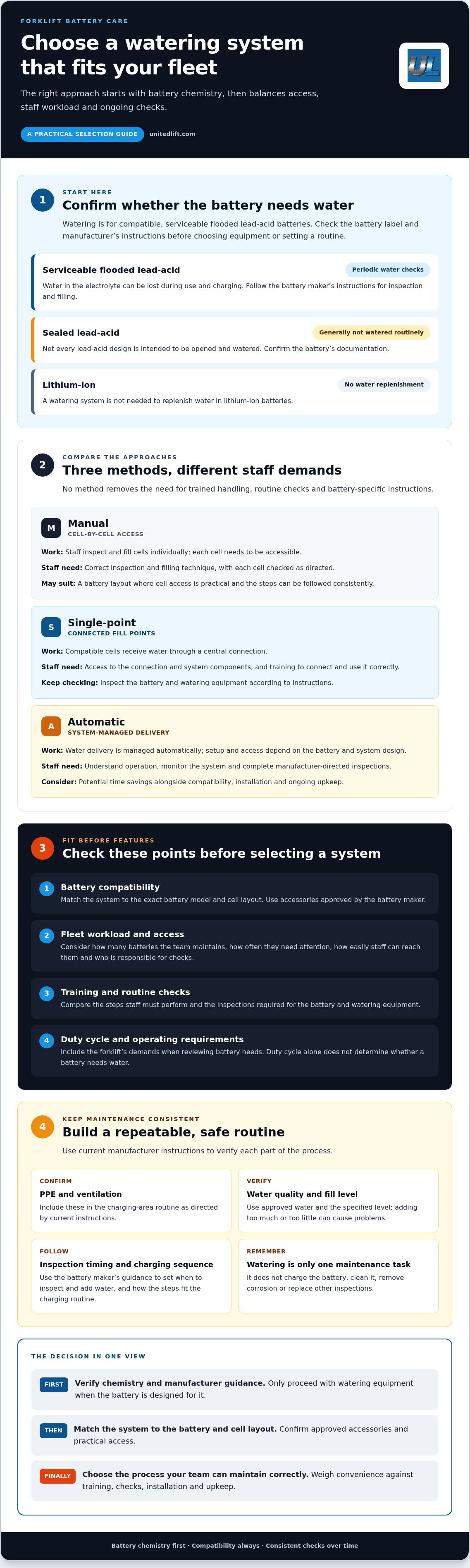
Start with the battery, not a product brochure. A forklift battery watering system makes sense only if it’s designed for your battery and your team can maintain it correctly. Use this checklist to confirm fit, understand the ongoing work, and get clear answers before you buy.
Start with the battery, not the watering-system brochure
Gather the details for each battery under consideration. Don’t assume units in the same fleet share a configuration or maintenance requirements.
- 1. Identify the chemistry. Confirm whether the battery is a serviceable flooded lead-acid type that requires watering.
- 2. Record the battery details. Note the manufacturer, model, and cell configuration or layout. Include the forklift and operating environment so requirements can be assessed in context.
- 3. Check the manufacturer’s documentation. Confirm watering instructions and whether the battery maker approves a compatible watering system or accessories.
- 4. Confirm physical fit. Review connection points, access to cells, fill indicators, and any clearance needed to use or inspect the equipment.
Before purchase, ask the system supplier to confirm compatibility in writing for the exact battery model and cell layout. Resolve unclear documentation first. Don’t rely on a general claim that a system fits a battery type.
Check the workflow, support, and total ownership requirements
A suitable system must fit your daily process, not just the battery. Map who waters, who performs inspections, and how checks are recorded. Include shift handoffs so responsibility doesn’t fall between teams.
- 5. Verify the water and fill process. Confirm the manufacturer-approved water quality, the correct fill procedure, and how staff should read or check fill indicators.
- 6. Review access and cleaning. Check whether staff can reach connection points and cells, and ask how the system should be cleaned and inspected.
- 7. Confirm training and upkeep. Find out what staff need to know, which routine checks are required, and whether parts may need replacement. Ask the supplier what upkeep the system requires.
- 8. Compare current ownership requirements. Review purchase details and ongoing upkeep with the supplier. Use current information rather than relying on assumptions or price estimates.
Battery choice also affects the wider equipment decision. Review United Lift’s industrial battery buying guide alongside the forklift’s duty cycle and operating requirements. To discuss industrial battery needs, contact United Lift about battery options. Confirm watering-system compatibility separately with the battery maker and system supplier.
Safe Forklift Battery Watering: Set Up a Routine and Confirm Your Next Step
A safe process starts with the battery maker’s instructions, not a one-size-fits-all schedule. Watering timing and charging sequence can vary by battery and system, so check current manufacturer guidance before setting the routine. Verify required personal protective equipment (PPE), ventilation, and water quality against that guidance and applicable workplace safety procedures.
What should a battery watering checklist include?
Keep the checklist simple enough to complete every time, including at shift handoffs. Assign trained personnel to the task and make responsibility clear. Record each check so the next person knows what was inspected and whether anything needs follow-up.
- Battery identity: Record the battery’s identifier and confirm its maintenance instructions.
- Inspection details: Note the inspection date and water-level findings.
- Corrective action: Record any water added, issue found, or follow-up needed, in line with the manufacturer’s procedure.
- Safe work conditions: Confirm staff know the required PPE, ventilation arrangements, approved water quality, and charging sequence before work begins.
Use current battery instructions and applicable workplace safety guidance to confirm the right steps for your equipment. Don’t assume a process approved for one battery or a particular forklift battery watering system applies to another.
When should you speak with an equipment dealer?
Speak with a dealer when assessing a battery for a forklift’s duty cycle or application, or when you need to confirm whether a particular battery type can be supplied. Share the forklift and battery details, how the equipment operates, and any requirements your team needs to meet. Ask the dealer to confirm current availability and whether the battery matches your application. Confirm watering-system compatibility with the battery maker and system supplier.
United Lift offers industrial batteries. For a practical discussion about matching battery needs to forklift use, discuss your industrial battery needs with United Lift.
Choose a Battery Care Plan Your Team Can Maintain
The right forklift battery watering system starts with compatibility, not automation. Confirm the battery chemistry, model, and manufacturer-approved accessories before choosing a method. Then compare manual, single-point, and automatic options against your fleet’s workload, cell access, and ability to complete regular checks.
Keep safety and consistency at the center of the decision. Follow the battery maker’s guidance for water quality, watering timing, charging sequence, and protective measures. Assign trained staff and document inspections so responsibilities stay clear across shifts.
Battery choice matters too. Match it to the forklift’s duty cycle and operating requirements, then verify the battery type and availability for your application. United Lift offers industrial batteries and material-handling equipment from established manufacturers. To discuss your battery requirements, talk with United Lift about your industrial battery needs. With the right information and a maintainable routine, you can make a practical choice for your fleet.
Frequently Asked Questions
What is a forklift battery watering system?
A forklift battery watering system replenishes water in compatible cells of a serviceable flooded lead-acid battery. Depending on its design, it may fill cells individually, through a shared connection, or automatically. It doesn’t charge the battery or replace inspections and other maintenance. Before choosing a system, confirm the battery’s chemistry, model, cell layout, and manufacturer-approved accessories. A system that doesn’t match the battery can’t be assumed suitable.
Do all forklift batteries need to be watered?
No. Serviceable flooded lead-acid batteries need periodic electrolyte-level checks and water replenishment as directed. Sealed lead-acid batteries generally aren’t routinely watered, and lithium-ion batteries don’t require water replenishment. Don’t rely on the forklift type or appearance to identify the maintenance routine. Check the battery label and manufacturer’s instructions to confirm its chemistry and whether it’s designed to be watered.
How often should you water a forklift battery?
Follow the battery manufacturer’s recommended inspection and watering schedule. There isn’t one interval that applies to every battery, because requirements depend on the battery and its use. Check levels as directed and record findings so staff can track maintenance consistently. Avoid waiting until plates are exposed, and don’t add water by guesswork. If the schedule isn’t clear, confirm it with the battery maker.
Should you water a forklift battery before or after charging?
Use the sequence specified by the battery manufacturer. Watering timing can vary by battery and watering system, so a universal before-or-after rule may not fit your equipment. The instructions should explain when to check levels, when to add water, and how the process relates to charging. Follow that procedure consistently, and make sure staff know it before they handle the battery.
Can you use an automatic watering system with any forklift battery?
No. Use an automatic watering system only if it’s compatible with the specific battery and approved by its manufacturer. Confirm the battery model, chemistry, cell layout, and approved accessories before purchase or use. Also check the system’s setup and inspection requirements. Don’t assume a system advertised for one battery type will fit another, even if both batteries are used in forklifts.
Is a forklift battery watering system worth it?
It depends on battery compatibility and the work your team needs to manage. A centralized or automatic system may suit a fleet where cell-by-cell access and routine checks create a practical challenge. A manual process may remain appropriate when batteries are accessible and staff can follow a consistent checklist. Compare setup, training, inspections, and upkeep. Automation isn’t automatically a better fit.
What kind of water should be used in a forklift battery?
Use water that meets the battery manufacturer’s stated quality requirements. Don’t assume ordinary tap water is suitable, since the acceptable specification depends on the battery instructions. Check the manual or contact the battery maker if the requirement isn’t clear. Follow the approved fill procedure and level indicators as well. Using the correct water and amount helps avoid introducing materials or excess water that the manufacturer warns against.
- Tags: fleet management, forklift battery maintenance, forklift battery watering system, lead-acid batteries, material handling equipment, single-point watering, warehouse safety
