
2026 Bonus Depreciation Guide for Heavy Equipment Owners
Posted by United Lift LLC on
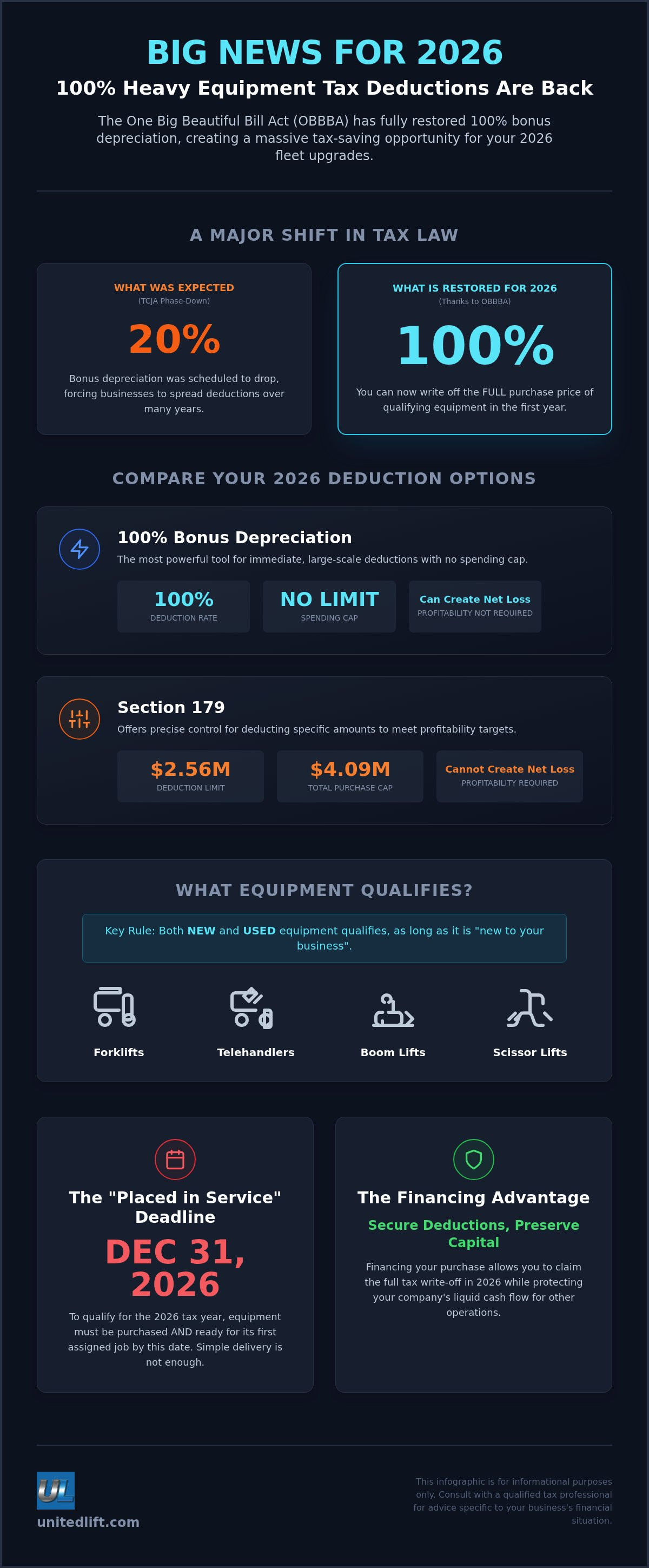
The 20% bonus depreciation rate you were bracing for in 2026 is officially a thing of the past. Thanks to the One Big Beautiful Bill Act (OBBBA), 100% bonus depreciation for heavy equipment has been fully restored, giving your business a massive window to upgrade your fleet. If you've been putting off a new forklift or telehandler purchase because you feared losing those tax advantages, the landscape has changed in your favor.
We know that keeping track of the TCJA phase-down schedule felt like trying to hit a moving target while managing rising capital costs. It's tough to justify a major investment when you aren't certain about the return on your tax forms. This guide promises to clear the confusion and help you maximize every available dollar before the year-end deadline.
You'll learn exactly how to apply the restored 100% rate to your 2026 purchases and whether the $2,560,000 Section 179 limit is a better fit for your specific strategy. We also clarify which used boom lifts and scissor lifts qualify, so you can stop worrying and start growing your inventory with confidence.
Key Takeaways
- Learn how the restoration of 100% bonus depreciation for heavy equipment in 2026 allows for immediate, full-value write-offs on your next fleet addition.
- Compare Section 179 and bonus depreciation to determine which incentive offers the best flexibility for your business's specific spending caps.
- Identify the specific types of new and used material handling equipment, from boom lifts to telehandlers, that qualify for these significant tax savings.
- Discover why financing is a powerful tool to secure a 2026 tax deduction while preserving your company's liquid capital.
- Master the "placed in service" deadline to ensure your equipment is fully deductible on your 2026 tax return.
The 2026 Heavy Equipment Tax Landscape: What Changed?
The tax landscape for heavy equipment owners underwent a massive shift recently. For years, the industry watched the Tax Cuts and Jobs Act (TCJA) phase-down schedule with concern. Many expected 2026 to be the year of the "Tax Cliff," where bonus depreciation would plummet to 20% or even disappear entirely. This would have forced businesses to spread equipment costs over many years, draining immediate cash flow. However, the One Big Beautiful Bill Act (OBBBA) of 2025 stepped in to restore the 100% rate, providing a major win for fleet managers.
Bonus depreciation is an accelerated tax deduction that allows you to deduct a large percentage of the purchase price of eligible assets in the first year they are placed in service. Because the OBBBA reversed the planned phase-down, bonus depreciation for heavy equipment remains at full strength for 2026. This means you don't have to settle for partial write-offs on your next fleet upgrade. You can still claim the entire cost of a new or used telehandler or boom lift immediately, provided it's new to your business.
Bonus Depreciation vs. Standard MACRS
Standard tax rules usually require you to follow the Modified Accelerated Cost Recovery System (MACRS). This system spreads the cost of your machinery over several years, typically five to seven for material handling units. While MACRS is the baseline, 2026 requires a more tactical approach to acquisition. Choosing bonus depreciation for heavy equipment allows you to bypass that long timeline. You get a massive cash flow advantage today rather than waiting until the 2030s to see the full tax benefit of your investment. This immediate liquidity helps you reinvest in more inventory or attachments sooner.
The Role of Section 179 in 2026
Section 179 remains a cornerstone for small and mid-sized operations because it offers unique flexibility. For the 2026 tax year, the maximum Section 179 deduction limit is $2,560,000. This is often the preferred choice for forklift buyers because it allows you to choose exactly how much you want to deduct to hit a specific taxable income target. The incentive begins to phase out once your total equipment purchases for the year exceed the $4,090,000 threshold. If your spending stays below that cap, Section 179 can often be more precise than bonus depreciation for managing your year-end bottom line.
Comparing Section 179 and Bonus Depreciation for 2026
Choosing between these two incentives depends on your specific profit goals for the year. While Section 179 has a deduction limit of $2,560,000 for the 2026 tax year, it offers a level of control that bonus depreciation lacks. Conversely, bonus depreciation for heavy equipment has no dollar limit. This makes it the primary tool for large fleet expansions that exceed the Section 179 phase-out threshold of $4,090,000. Both methods require you to have the machinery on-site and ready to work by the December 31 deadline.
Flexibility and Profitability Requirements
Section 179 is unique because it allows you to pick and choose which dollars to deduct. If you only need to zero out $150,000 in taxable income to stay in a lower bracket, you can apply the deduction to just a portion of your purchase. However, it's limited by your business's profitability. Section 179 cannot create a net loss for your company; it can only bring your tax liability down to zero. You can review the underlying rules in this IRS overview of TCJA business tax changes.
Restored 100% bonus depreciation works differently. It doesn't have a profitability requirement, meaning it can actually create a net operating loss. This is a strategic advantage if you want to carry that loss forward to offset income in future years. Because of these powerful benefits, Q4 is always the busiest season for equipment sales. Most owners wait until they see their final revenue numbers before committing to a purchase, but waiting too long risks missing the delivery window.
New vs. Used Equipment Eligibility
A common misconception is that these tax breaks only apply to brand new machinery. In reality, used forklifts, telehandlers, and boom lifts qualify for both Section 179 and bonus depreciation. The IRS follows the "first time use" rule, which means the equipment only needs to be new to your business. If you buy a pre-owned scissor lift that has never been on your books before, it counts.
The catch is that you must meet the "placed in service" requirement. The IRS defines "placed in service" as the specific date the equipment is ready and available for its first assigned job. Simply paying for the machine or having it sit in a shipping yard isn't enough. If you want to secure these deductions, you should browse our current inventory early to ensure your equipment arrives and is ready for work before the clock runs out on 2026.
Which Heavy Equipment Qualifies for Tax Write-Offs?
To secure bonus depreciation for heavy equipment, your machinery must meet the "Tangible Property" rule. This rule covers physical assets used in your trade or business. Crucially, the IRS requires a "Business Use" threshold of more than 50%. If you use a forklift for personal projects on the weekend, you can only deduct the portion dedicated to business operations. Most commercial fleet owners easily clear this bar, especially when buying specialized machinery meant for warehouse or job site work.
The restoration of the 100% rate is a massive shift from the official bonus depreciation phase-out schedule originally set by the TCJA. Because of this change, almost every category of material handling equipment we sell is eligible for a full first-year write-off. This includes new and used inventory, which is a major advantage for businesses looking to save on capital costs without sacrificing quality. Even smaller assets like economy lifts and industrial batteries qualify as tangible property under these rules.
Forklifts and Warehouse Equipment
Electric and internal combustion (IC) forklifts are prime candidates for full first-year deductions. You aren't limited to the chassis alone. Attachments like side shifters, rotators, and paper roll clamps can be bundled into the total purchase price for a larger write-off. This allows you to customize your fleet for specific tasks while maximizing your tax benefit. For a deeper dive into selecting the right model for your facility, check out The Ultimate Forklift Buying Guide for Industrial Success in 2026.
Aerial Lifts: Scissor, Boom, and Telehandlers
High-value assets like JLG and Genie boom lifts often represent the largest capital expenditures for a company. These units are built for longevity, but the tax code allows you to recover their cost immediately. Telehandlers are particularly popular for 2026 tax planning. These versatile machines handle everything from pallet loading to high-reach construction, making them easy to justify as 100% business-use assets. Scissor lifts used for facility maintenance also qualify. Even though they are smaller than a massive boom lift, the deductions they generate help lower your year-end tax bill. This immediate recovery also applies to specialized construction assets; for example, you can visit Anteng México to see high-tech piling equipment that qualifies for these same incentives. Whether you are buying a used telehandler or a new scissor lift, the key is ensuring the machine is on your property and ready to work before December 31.
For contractors requiring specialized concrete solutions, Equipcon provides concrete pumping machinery that is equally eligible for these restored 100% bonus depreciation benefits.
One of the biggest myths in the material handling industry is that you need a massive cash reserve to benefit from bonus depreciation for heavy equipment. That simply isn't true. The IRS allows you to claim the full purchase price of a machine the year you place it in service, regardless of whether you paid cash or financed the entire amount. This creates a "Buy Now, Pay Later, Deduct Today" scenario that can significantly boost your company's liquidity when you need it most.
Consider this example. Imagine you acquire a $50,000 forklift through a loan with $0 down. Even though you've only made a few monthly payments by the end of 2026, you can still deduct the full $50,000 from your taxable income. This deduction could potentially lower your tax bill by $10,000 or more, depending on your specific tax bracket. United Lift facilitates financing through our network of partners to ensure you can secure the machinery you need while the 100% deduction rate is still active.
The Power of Equipment Loans
Taking out an equipment loan is a smart way to preserve your working capital for other operational needs. The IRS focuses on the date you take ownership and place the unit in service. It doesn't matter if a lender holds the title. By taking the full tax hit upfront, you effectively use the tax savings to help pay for the equipment. When you calculate the ROI of a financed purchase, you'll often find that the first-year tax savings cover a significant portion of your first year's loan payments. It's a high-impact move for growing fleets that want to scale without draining their bank accounts.
Lease-to-Own and Section 179
Not all leases are created equal. To qualify for Section 179 or bonus depreciation, you generally need a Capital Lease, such as a "$1 Buyout" lease. These agreements are structured so that you own the machine at the end of the term. In contrast, an Operating Lease is treated like a rental. In that case, you only deduct the monthly payments as they occur rather than the full purchase price. If your goal is a massive year-one write-off, the language in your contract matters. Always consult your tax professional to review the specific terms of your United Lift finance agreement. To get started on your next acquisition, contact our team to discuss financing options for our current inventory of forklifts and aerial lifts.
Next Steps: Maximizing Your Fleet Investment with United Lift
Your 2026 tax strategy should focus on both speed and selection. While the restoration of 100% bonus depreciation for heavy equipment is a significant advantage, many owners still choose to pivot toward Section 179 for smaller, more targeted deductions. Combining these incentives with the purchase of used machinery is the most effective way to stretch your capital. You get reliable equipment from brands like Hyster, Yale, and Toyota at a lower entry price while still claiming a full first-year deduction.
The Q4 rush is a critical time for material handling businesses. Every year, we see a surge in demand as owners scramble to get equipment on-site by December 31. This is why United Lift offers 7-day support during the peak of the tax season. We understand the urgency of your deadlines and the need for immediate communication. Getting your quote and delivery finalized early ensures you aren't stuck waiting on a shipping dock when the year ends. Our inventory of JLG boom lifts and Genie scissor lifts is ready for quick dispatch to help you hit your targets.
Preparing Your 2026 Tax Documentation
Organization is key to a smooth tax season. You'll need to keep every invoice and delivery receipt for your new or pre-owned assets. Document the exact date your equipment was first used on-site to satisfy the "placed in service" requirement. This documentation is vital if you are audited or if you need to prove the asset was ready for work before the new year. United Lift provides all necessary purchase records for your CPA to ensure your filing is accurate and complete.
Contact United Lift for a National Quote
Our team is standing by to help you find the right machinery for your specific application. We maintain a diverse inventory of forklifts, boom lifts, and telehandlers ready for immediate national shipment. Our goal is to facilitate fast delivery to your job site, helping you meet the strict Dec 31 deadline with ease. Don't wait until the final week of December to secure your tax-ready machinery. Browse our current forklift and lift inventory today to find the right fit for your business and your bottom line.
Lock in Your 2026 Tax Savings Today
The restoration of 100% bonus depreciation for heavy equipment represents a massive opportunity to upgrade your fleet while drastically lowering your tax liability. By acting before the December 31 deadline, you ensure your business keeps more of its hard-earned capital for future growth. Remember that used machinery qualifies just as well as new units, provided they are new to your books. This flexibility, combined with the high Section 179 limits, makes 2026 a landmark year for equipment acquisition.
United Lift is here to act as your reliable facilitator through every step of the process. We offer expert financing facilitation to help you secure assets with minimal upfront cash. With national delivery on major brands like Hyster, Yale, and JLG, we make it easy to get your equipment on-site and ready for its first job. Our support team is available 7 days a week to answer your questions and provide the documentation your CPA needs. Don't let the year-end rush pass you by without a plan.
View Our Inventory & Get a Tax-Ready Quote to start your fleet expansion. We look forward to helping you maximize your investment and grow your business with confidence.
Frequently Asked Questions
Is bonus depreciation still available for heavy equipment in 2026?
Yes, 100% bonus depreciation for heavy equipment is available for the 2026 tax year. The One Big Beautiful Bill Act (OBBBA) signed in July 2025 restored this rate. It replaced the previous phase-down schedule that would have dropped the deduction to 20%. This restoration provides businesses with significant tax certainty when planning fleet upgrades. You can now deduct the entire cost of qualifying machinery in a single year.
What is the Section 179 limit for 2026?
For the 2026 tax year, the maximum Section 179 deduction limit is $2,560,000. This incentive begins to phase out on a dollar-for-dollar basis once your total qualifying property purchases exceed $4,090,000. The deduction is completely unavailable once your total equipment spending reaches $6,650,000. These thresholds allow small and mid-sized operations to write off substantial investments in material handling machinery without hitting immediate caps.
Can I claim bonus depreciation on a used forklift?
You can definitely claim these deductions on a used forklift. The IRS rules specify that equipment must be "new to the taxpayer" rather than brand new from the factory. If you purchase a pre-owned Hyster or Yale unit that your business has never owned before, it qualifies for both Section 179 and bonus depreciation. This makes high-quality used inventory an excellent choice for maximizing your tax-saving potential.
Do I have to pay for the equipment in full to get the 2026 deduction?
You don't have to pay for the equipment in full to claim the 2026 deduction. Tax laws allow you to deduct the full purchase price even if you finance the machinery with $0 down. The deduction is based on the total cost of the asset rather than the amount of cash you've paid out. This strategy lets you keep your liquid capital for operations while still receiving the full tax benefit.
What happens if I buy equipment in 2026 but it's not delivered until 2027?
If your equipment is not delivered and ready for work until 2027, you cannot claim the deduction on your 2026 tax return. The IRS requires assets to be "placed in service" by December 31 of the tax year. This means the machinery must be on your property and available for its first job. Simply paying for the unit in 2026 is not enough; physical possession and readiness are mandatory requirements.
Can I combine Section 179 with bonus depreciation in 2026?
Combining these two incentives is a very common and effective strategy. Most businesses apply the Section 179 deduction first to reach their desired taxable income level or hit the $2,560,000 limit. If there's a remaining balance on the equipment cost, they then apply 100% bonus depreciation for heavy equipment to the rest. This approach allows for maximum flexibility in managing your company's year-end bottom line and total tax liability.
Does industrial lift equipment like scissor lifts qualify for these tax breaks?
Industrial lift equipment like scissor lifts and telehandlers absolutely qualifies for these tax breaks. These machines are considered tangible personal property used for business purposes. As long as the equipment is used more than 50% for your business operations, it meets the eligibility criteria. This includes everything from warehouse forklifts to high-reach boom lifts and attachments. United Lift provides the necessary records to help your CPA document these qualifying purchases.
How does equipment financing work with these tax deductions?
Equipment financing works seamlessly with tax deductions to improve your cash flow. When you use a capital lease or a loan facilitated by United Lift, you get the equipment immediately and the full tax write-off in year one. You then pay for the machine over time using monthly installments. In many cases, the tax savings from the first year can cover a significant portion of your initial loan payments.
- Tags: 2026 tax guide, bonus depreciation, bonus depreciation for heavy equipment, business taxes, construction equipment, heavy equipment, material handling, section 179, tax deductions
