
Used Boom Lift Buying Checklist: 2026 Inspection Guide
Posted by United Lift LLC on
A low price on a used boom lift is often a trap that leads to thousands in hidden repair costs and failed safety inspections. Buying pre-owned equipment is a smart way to scale your fleet, but the fear of inheriting someone else's mechanical nightmares is real. You need to know if that machine will actually pass an OSHA inspection or if it's just a polished liability. This is where our used boom lift buying checklist comes in to bridge the gap between a risky gamble and a sound investment.
We understand that you can't afford a machine that sits idle in the shop. You're looking for a reliable workhorse that meets ANSI A92.24 standards and stays on the job site. This guide provides a comprehensive roadmap to master the inspection process. We'll show you how to verify actual machine hours, spot structural red flags, and ensure the hydraulic systems are truly job-ready. By the end of this 2026 guide, you'll have the confidence to secure a machine with a clear lifespan while maximizing your Section 179 tax benefits. Whether you're looking for a JLG or a Genie, these steps ensure your next purchase is a tool, not a project.
Key Takeaways
- Match platform height and horizontal reach to your specific job site needs before you start shopping.
- Use our used boom lift buying checklist to spot structural cracks or hydraulic leaks that signal high future repair costs.
- Learn to test function controls properly to ensure smooth operation and full compliance with OSHA safety standards.
- Verify machine hours against physical wear and confirm the unit has a current ANSI annual inspection report.
- Calculate the total cost of ownership and use financing strategies to protect your business's working capital.
Pre-Inspection: Aligning the Machine to Your Job Site
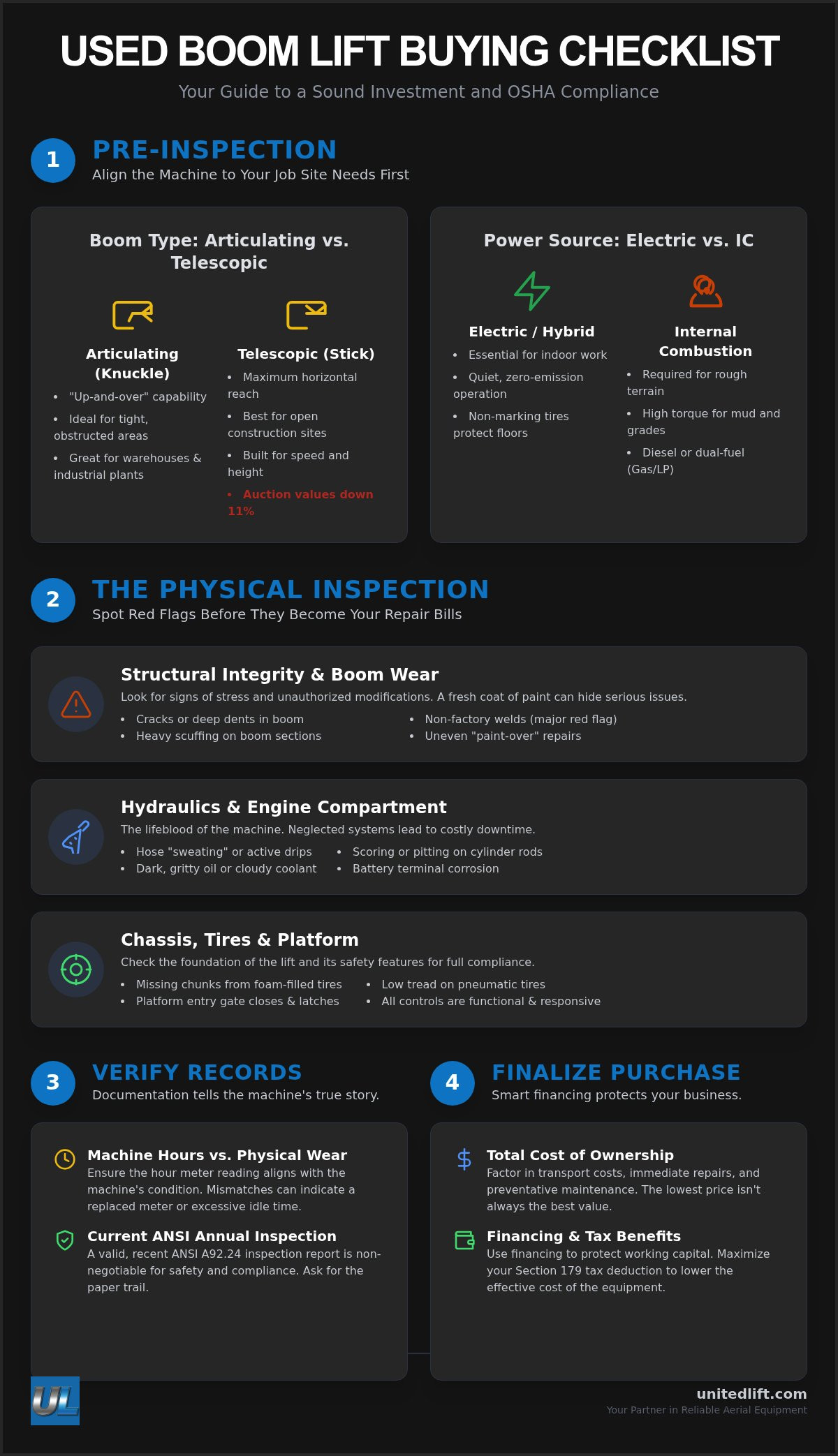
Don't start your search by looking at a machine. Start by looking at your job site. A common mistake is purchasing a lift based on price alone, only to realize it can't reach the work area or is too heavy for the floor. Your used boom lift buying checklist must begin with a clear assessment of your physical workspace. You need to determine your maximum platform height and, more importantly, your horizontal reach requirements. Reaching straight up is easy; reaching over a permanent fixture requires specific geometry. Choosing the right Aerial Work Platform (AWP) requires matching these specs to your daily tasks before you ever turn a key.
Articulating vs. Telescopic Boom Lifts
Articulating booms, often called "knuckle booms," use multiple sections that hinge. They're the best choice for reaching over and around obstacles like HVAC ducting or structural beams. If you're working in a crowded warehouse or a complex industrial plant, you need that "up-and-over" capability. Telescopic booms, or "stick booms," offer maximum reach and straight-line height. They're built for speed and height on open construction sites. As of late 2026, auction values for used telescopic lifts have dropped by over 11% year-over-year, making them an attractive option for high-access jobs where horizontal flexibility isn't the priority.
Power Source Selection: Electric vs. IC
The environment dictates your engine choice. Electric or hybrid models are essential for indoor work. They offer quiet operation and come with non-marking tires to protect finished floors. If you're working in noise-sensitive areas like hospitals or schools, electric is the only way to go. Internal Combustion (IC) engines, typically diesel or dual-fuel, are necessary for rough terrain. These machines have the torque to handle mud and steep grades. Dual-fuel options provide the versatility of propane for indoor use and gasoline for outdoor power. Always check the machine's weight before buying. A diesel-powered rough terrain lift might be too heavy for a standard concrete slab or a transport trailer you already own.
Verify the machine's weight against your transport capabilities. Freight costs can quickly erase any savings you found on the purchase price. Knowing the floor-loading limitations of your job site is also critical. A machine that's too heavy won't just damage the floor; it's a major safety violation under current ANSI A92.24 standards. Start with these specs to narrow your search to machines that can actually do the work.
The Physical Inspection Checklist: Chassis to Platform
Once you've matched the machine specs to your job site, it's time for the hands-on walk-around. This is the most critical phase of your used boom lift buying checklist. You aren't just looking for a clean machine; you're looking for signs of structural stress and neglected maintenance. A coat of fresh paint can hide a lot of history, so look closer at the joints and welds. You need to be the expert who spots the problems before they become your repair bills.
Structural Integrity and Boom Wear
Start with the boom sections. Look for any cracks, deep dents, or welds that don't look like they came from the factory. Non-factory welds are a major red flag because they often violate OSHA Aerial Lift Regulations and can compromise the machine's safety rating. Check for "scuffing" on the sides of the boom sections. Heavy scuffing usually means the internal wear pads are worn down or missing, which leads to metal-on-metal contact. You should also watch for "paint-over" repairs. If you see thick, uneven paint around a critical load-bearing joint, it might be hiding a hairline fracture or structural corrosion that could fail under load.
Hydraulics and Engine Compartment
If your inspection reveals excessive pin play or worn bores in the boom joints, Bore Repair Systems, Inc. - Bore Repair Made Easy with our USA made Lineboring and Boreweld solutions offers the specialized equipment needed to restore these critical components to their original specifications.
Open every cowling and access door. You're looking for more than just the engine; you're checking the lifeblood of the machine. Examine the hydraulic system for "sweating" or active drips. A light film of oil on a hose might be old, but a fresh drip at a fitting suggests a seal is failing. Inspect the hydraulic cylinders for scoring or pitting on the chrome rods. Any damage to these rods will eventually tear the seals and cause a pressure loss. While you're in the engine compartment, check the oil and coolant levels for clarity. Dark, gritty oil or cloudy coolant suggests a lack of routine service. Don't forget to inspect the battery health and check for terminal corrosion, which can lead to intermittent electrical failures on the job.
Check the chassis and tires next. Foam-filled tires shouldn't have large chunks missing, and pneumatic tires need deep tread to handle rough terrain. Move to the platform and test the entry gate; it must close and latch automatically. The platform floor should be solid without excessive rust or holes. To check for pin play in the turret rotation, observe the swing bearing for any excessive movement or shuddering while the boom is slowly rotated at full extension. If you're unsure about a machine's history, it's worth browsing a vetted inventory from a dealer who performs these checks before the machine hits the lot.
Operational Testing: Assessing Performance Under Load
A machine can look pristine on the outside and still fail the moment it's put to work. This stage of your used boom lift buying checklist involves moving beyond the visual and into active performance testing. You need to operate every function from both the ground controls and the platform station. If the ground controls work but the platform joystick is sluggish, you're looking at an electrical or hydraulic issue that could cost thousands to diagnose. Don't skip the ground test; it's your primary override in an emergency.
Watch the boom extension carefully. It should slide out with a consistent, smooth motion. If the sections jerk or seem to "hunt" for the right position, the wear pads are likely shot or the internal cables are stretched. These aren't just annoyances. They're safety risks that lead to platform instability at high elevations. Test the drive and brake systems on an incline if the seller allows it. The machine should hold its position immediately when you release the drive joystick. If it drifts even slightly, the brakes are worn. This is a non-negotiable safety item that must be addressed before the machine enters service.
Function and Speed Checks
Efficiency matters on the job site. You should time the lift speed against the manufacturer's original specifications. A significantly slower lift time usually points to a tired hydraulic pump or a clogged filter. During this test, pay close attention to the following:
- Turret Rotation: Listen for grinding or hesitation in the swing motor. The movement should be quiet and fluid.
- Platform Leveling: The platform should stay level automatically as you raise or lower the boom. If it tilts, the slave cylinder or leveling sensors are failing.
- Control Response: Joysticks should return to neutral immediately. Any "stickiness" is a major safety hazard.
Safety System Validation
Safety systems aren't optional. You must verify the "Deadman Switch" and all emergency stop buttons are fully functional before ending the test. If these fail, the machine is a liability. Your used boom lift buying checklist should also include these specific validations:
- Tilt Alarm: Manually trigger the tilt sensor to ensure the alarm sounds and functions cut out as designed.
- Pothole Protection: On electric scissor-style booms or relevant models, ensure the protection bars deploy fully when the platform is raised.
- Visual and Audible Cues: Ensure the backup alarm and strobe lights are operational to maintain job site visibility.
- Attachment Points: Inspect harness attachment points for deformation. Any bending suggests the machine was involved in a fall or was used for heavy towing.
Operational testing is where you'll find the most leverage for price negotiations. A machine that needs a new swing motor or hydraulic pump isn't necessarily a bad buy, but the price must reflect those upcoming repair costs. If the machine feels "loose" or unresponsive, it's better to walk away and find a unit that has been properly maintained.
Evaluating Service Records and Hour Meters
A machine can pass a physical test today and fail tomorrow if it hasn't been maintained. This phase of your used boom lift buying checklist focuses on the history that the paint job can't hide. You're looking for a consistent paper trail that proves the previous owner valued their investment. Without service records, you're essentially buying a mystery box. Always cross-reference the machine's Serial Number with manufacturer databases from JLG or Genie to check for open recalls. A single unresolved safety recall can ground your machine before it even reaches the job site.
The Truth About Machine Hours
Don't take the hour meter at face value. It's common for digital meters to be replaced or for machines to idle for long periods without moving. Compare the reading to the physical wear on the foot pedals and joystick grips. If a machine shows only 800 hours but the controls are worn smooth, the meter might not be original. You must also consider the environment. 2,000 hours on a rough terrain diesel lift working in a coastal environment is significantly harder on the chassis than 2,000 hours on an indoor electric lift. If you're serious about a high-capital purchase, consider an oil analysis. This simple test reveals internal engine wear and contamination that a standard visual check will miss.
Compliance and Certification
Documentation is your ticket to a regulated job site. You must request the ANSI Annual Inspection report. Under current standards, this inspection must have occurred within the last 13 months to be valid. Check the machine for the corresponding decal, but don't stop there. Verify that the weather-resistant storage box on the platform contains the correct Operator’s Manual. If it's missing, you're technically out of compliance. You also need to ensure that all safety decals and load charts are legible. If a load chart is unreadable, an operator might accidentally exceed the machine's capacity, leading to a catastrophic tip-over. Review the maintenance log for consistent oil changes and filter replacements every 250 to 500 hours, depending on the manufacturer's guidelines.
Managing this level of detail is exhausting for a busy fleet manager. If you want a machine that is already vetted and job-ready, view our current boom lift inventory to find units with documented histories and clear inspection reports.
Finalizing the Purchase: Financing and Logistics
The final step in your used boom lift buying checklist isn't just signing a check. It's calculating the Total Cost of Ownership (TCO). Many buyers focus on the asking price but forget to factor in freight and immediate maintenance needs. A used telescopic boom lift might be priced well, but if it's across the country, specialized transport can add thousands to your bottom line. These machines require low-boy or RGN trailers because of their height and weight. Always get a firm shipping quote before you commit. You don't want a surprise bill that erases the savings you found during the negotiation phase.
You also need to plan for the first 250 hours of operation. Even a well-maintained machine will eventually need filters, oil, and potentially a new set of wear pads as we discussed in the structural inspection. Setting aside a maintenance reserve ensures your new asset stays job-ready without straining your monthly cash flow. It's about looking at the long-term reliability of the machine, not just the entry price.
Maximizing Your Investment
Small businesses often hesitate to buy high-capital equipment because of the upfront cost. In 2026, equipment financing interest rates typically range from 7% to 14%. This allows you to scale your fleet while preserving your working capital for daily operations. One of the biggest advantages of buying this year is the tax incentive. You can use Section 179: Forklift Tax Deductions You Need to Know to potentially write off the entire purchase price of your used machinery in the year you buy it. This deduction applies to both new and pre-owned equipment, making a high-quality used lift even more affordable for your 2026 tax strategy.
The United Lift Advantage
Buying from a private auction often feels like a gamble because there's no support after the hammer falls. We position ourselves as a "Reliable Facilitator" for businesses that need vetted equipment without the auction-day stress. Our inventory includes top brands like JLG, Genie, and Caterpillar. We handle the logistical heavy lifting, from financing facilitation to arranging national delivery. You aren't just getting a machine; you're getting a partner that understands the urgency of your work. Our team is available seven days a week to answer questions and ensure your investment meets every safety standard on your used boom lift buying checklist. Ready to upgrade your fleet? You can browse our current used boom lift inventory today to find a reliable, job-ready machine.
Secure Your Next High-Reach Asset with Confidence
Buying a pre-owned machine shouldn't feel like a gamble. By following this used boom lift buying checklist, you've learned how to look past a fresh paint job to find real mechanical value. You now know how to verify structural integrity, test operational functions under load, and ensure your documentation meets strict 2026 ANSI standards. These steps protect your business from unexpected downtime and high repair costs while ensuring your fleet remains OSHA-compliant.
Finding a reliable machine is easier when you work with a partner that does the heavy lifting for you. We maintain a vetted inventory of top brands including JLG, Genie, and Caterpillar. Our team makes the process seamless with national delivery on all industrial lifts and financing options available for business sizes of all kinds. Don't let a bad purchase ground your crew or drain your maintenance budget. Start your next project with a machine that's actually ready to work.
View Our Vetted Used Boom Lift Inventory
Frequently Asked Questions
What is a high number of hours for a used boom lift?
Generally, over 5,000 hours is considered high for internal combustion models. Electric units often last longer because they have fewer moving parts in the drivetrain. However, the working environment matters as much as the meter. A lift with 2,000 hours in a corrosive coastal area may be in worse shape than a machine with 4,000 hours from a dry warehouse. Always use a used boom lift buying checklist to verify physical wear against the meter reading.
Can I buy a used boom lift without an ANSI inspection?
You can technically purchase one, but you cannot legally operate it on a regulated job site. ANSI A92.24 standards require a documented annual inspection to ensure the machine is safe for use. If a seller doesn't have a report from within the last 13 months, you must factor the cost of a professional inspection into your budget. Buying from a dealer that vets their inventory ensures you aren't stuck with a non-compliant machine.
What is the difference between an articulating and telescopic boom?
Articulating booms use multiple hinged sections to reach up and over obstacles like HVAC units or structural beams. They're built for tight, complex spaces. Telescopic booms extend in a straight line and offer greater horizontal reach and height. They're more efficient for construction jobs where you need to reach a high point quickly without navigating around obstructions. Your choice depends entirely on the specific clearance and height needs of your job site.
Are used electric boom lifts reliable for outdoor use?
Electric lifts are primarily designed for indoor use on flat, finished surfaces. While some modern hybrid models handle light outdoor tasks, standard electric units lack the ground clearance and rough terrain tires needed for mud or gravel. They also rely on battery power, which drains faster in cold outdoor temperatures. If your work is primarily outdoors on unfinished sites, an internal combustion diesel or dual-fuel model is a more reliable and productive choice.
How do I transport a boom lift after I buy it?
Professional freight is required because boom lifts are oversized and heavy. You'll need a specialized low-boy or RGN trailer to accommodate the machine's height and weight. Attempting to move these with standard equipment can lead to accidents or legal fines. We facilitate national delivery on all our industrial lifts to ensure your equipment arrives safely and ready for work. Always confirm the transport dimensions and weight with the carrier before booking.
What are the most common repair costs for a used boom lift?
Hydraulic system leaks and worn wear pads are the most frequent issues. Replacing hydraulic hoses or seals is relatively affordable—especially when sourcing high-quality components from manufacturers like Abbey Extrusions—but a failing main pump or a damaged boom section is a major expense. You should also budget for battery replacement on electric models, which can cost several thousand dollars. Using a used boom lift buying checklist helps you identify these red flags and negotiate the price before you finalize the transaction.
Yes, Section 179 tax deductions apply to both new and used equipment in 2026. This allows businesses to deduct the full purchase price of qualifying machinery in the year it's placed in service. It's a powerful tool for small businesses looking to scale their fleet while reducing their tax liability. Always consult with a tax professional to confirm the current limits and how they apply to your specific equipment purchase and business structure.
Which brands of boom lifts hold their value best?
JLG and Genie are the industry leaders for resale value. Their parts are widely available, and most technicians are familiar with their systems, which makes them easier to maintain over time. Caterpillar also holds strong value due to its reputation for rugged engine performance and durability. Choosing a well-known brand ensures that when you're ready to upgrade your fleet, you'll find a healthy market of buyers for your pre-owned equipment.
- Tags: Aerial Lifts, Boom Lift, Buying Guide, Equipment Inspection, Genie, JLG, OSHA Compliance, used boom lift buying checklist, Used Equipment
