
Boom Lift vs. Scissor Lift for Painting: Which Should You Buy in 2026?
Posted by United Lift LLC on
Are you still losing a massive chunk of your project margin to recurring rental fees and delivery charges? With equipment rental rates projected to rise by 4.5% in 2026, many professional painters are realizing that the old "rent as you go" model is eating their profits. You already know that sticking to ladders or outdated scaffolding isn't just slow. It's a safety risk that makes it nearly impossible to hit those awkward angles on modern architectural designs. Choosing between a boom lift vs scissor lift for painting is about more than just height. It's about finding the right work zone to maximize your crew's efficiency.
We understand that investing in your own fleet is a major decision. You need a reliable machine that ensures crew safety while offering high resale value down the road. This guide clarifies the critical differences between these two platforms so you can choose the most cost-effective option for your specific job sites. We'll compare vertical reach, platform capacity for heavy supplies, and the specialized maneuverability needed for complex exteriors. By the end, you'll know exactly which lift will help you paint more square footage per hour and keep your overhead under control.
Key Takeaways
- Learn how aerial stability directly impacts cut-in precision and your final project quality.
- Understand why scissor lifts excel at high-volume vertical painting where platform space for sprayers and supplies is a priority.
- Discover how the horizontal reach of a boom lift allows your crew to navigate over landscaping and architectural obstacles with ease.
- Evaluate the core differences of a boom lift vs scissor lift for painting to select the machine that maximizes your daily square footage.
- See how moving from rentals to ownership builds business equity and offers significant tax advantages for your 2026 fleet.
The Painter’s Choice: How Lift Selection Affects Your Bottom Line
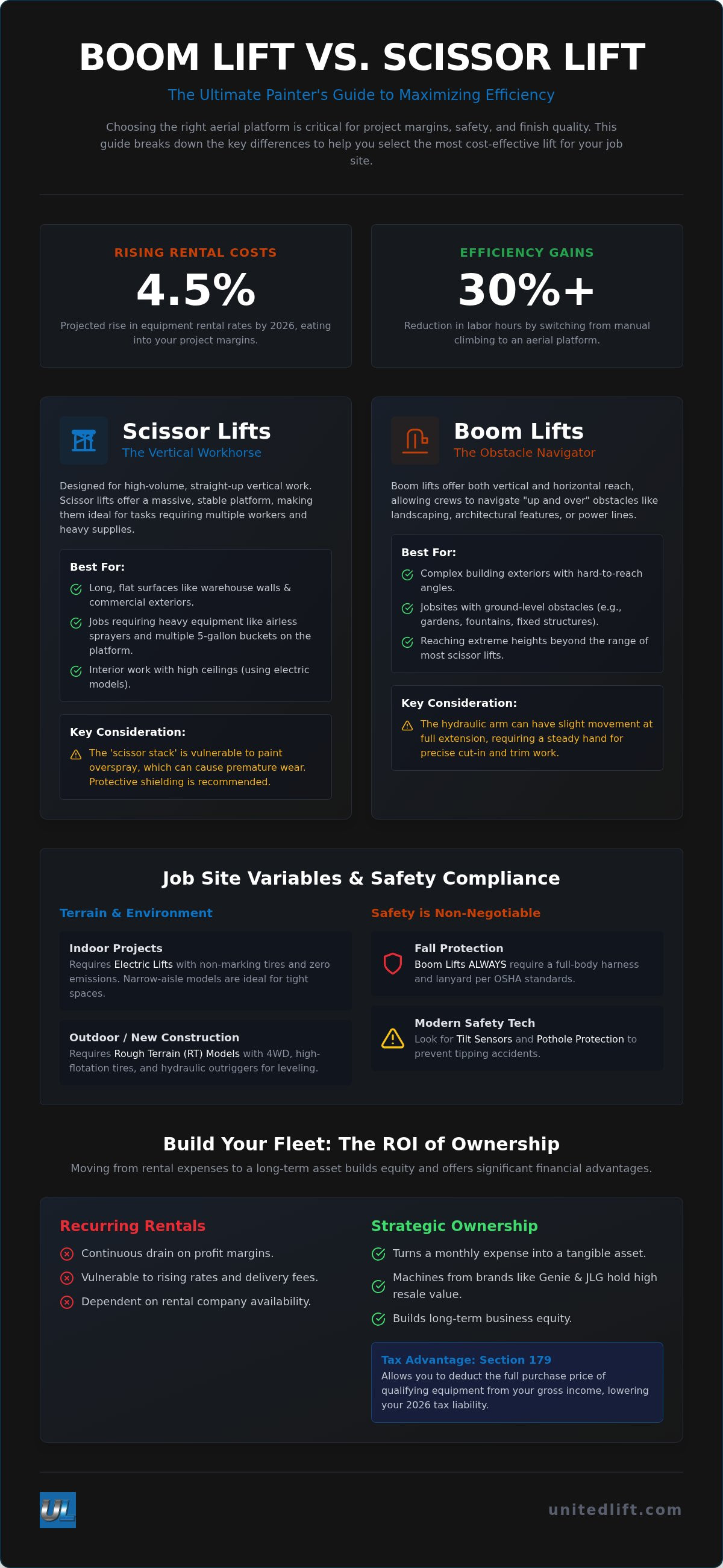
Scaffolding is quickly becoming a relic of the past for professional painting crews. By 2026, the industry has shifted decisively toward aerial lifts to combat rising labor costs and tighter project deadlines. Choosing the right boom lift vs scissor lift for painting is the fastest way to protect your profit margins. When your crew spends less time moving planks and more time pulling triggers on sprayers, your efficiency skydives. Estimates show that switching from manual climbing to an aerial platform can reduce labor hours by 30% or more on large commercial contracts.
Finish quality depends on platform stability. If a basket shakes or sways, your cut-in precision disappears. Scissor lifts provide a massive, rigid base that feels like standing on solid ground, which is ideal for detailed trim work. Boom lifts offer the reach you need, but they require a steady hand to manage the slight movement of the hydraulic arm at full extension. You also have to evaluate your terrain. Indoor projects require electric motors and non-marking tires to protect flooring. Outdoor jobs often involve mud or gravel, requiring rough-terrain models with 4WD and oscillating axles to keep the platform level.
Safety Standards for Painting at Height
OSHA regulations are strict regarding aerial work. Operators must follow 29 CFR 1926.453 for construction sites and 29 CFR 1910.67 for general maintenance. While scissor lifts are often classified as mobile scaffolds, boom lifts always require active fall protection with a full-body harness and lanyard. Modern equipment includes critical safety tech like tilt sensors that lock out functions if the machine is on a dangerous slope. Pothole protection on electric models provides a mechanical stop to prevent tipping if a wheel drops into a floor opening or a drain.
Calculating the ROI of Ownership vs. Rental
Buying a used lift turns a monthly expense into a long-term asset. If your project pipeline is steady, owning a machine from a reliable brand like Genie or JLG ensures you aren't at the mercy of rental availability or rising delivery fees. These machines maintain high resale value due to their durable engineering and simple service requirements. When it comes to your year-end finances, Section 179 allows you to deduct the full purchase price of qualifying equipment from your 2026 gross income to lower your total tax liability. This makes ownership a strategic move for contractors looking to scale their operations without the burden of constant rental overhead.
Scissor Lifts: The Gold Standard for High-Volume Vertical Painting
A scissor lift is a vertical-only aerial platform designed to carry heavy loads and multiple workers. When you're comparing a boom lift vs scissor lift for painting, the choice usually hinges on your needed workspace. Scissor lifts are the champions of high-volume, straight-up vertical work. Their main draw is the massive platform. You can stage multiple 5-gallon buckets and airless sprayers while still leaving room for two painters. This stability leads to better production rates on long warehouse walls or commercial interiors.
Maintenance is a specific concern for painting contractors. The 'scissor stack' is the machine's core and it's vulnerable to wet paint. If overspray builds up on pivot points or cylinders, it causes premature wear. Use protective plastic shielding or specialized covers to keep your equipment in top condition. If you want to scale your business, you can view our available scissor lifts to find a machine that fits your budget and project needs.
Electric Scissor Lifts for Interior Commercial Work
Interior projects demand specific equipment. Electric scissor lifts use non-marking tires to protect floors in retail centers or warehouses. These machines offer zero-emission operation, which is mandatory for enclosed sites. Narrow-aisle models are perfect for reaching high ceilings in tight layouts where a standard machine won't fit. Most electric models provide enough battery life for a full 8-hour shift, so your crew stays productive from start to finish. These units are also much quieter, allowing for work in occupied buildings without causing major disruptions.
Rough Terrain Scissor Lifts for Exterior Siding
Rough Terrain (RT) models are essential for exterior siding and new construction. These machines use four-wheel drive and high-flotation tires to navigate mud and gravel. Stability is the priority when you're working outdoors. Look for models with hydraulic outriggers to level the base on uneven grades. Platform extension decks are also vital. They let your painters reach across wider wall sections without moving the machine, which saves significant time throughout the day. This extra reach is particularly helpful when working over small shrubs or architectural features that prevent the machine from sitting flush against the wall.
Boom Lifts: Navigating Obstacles and Extreme Heights
While scissor lifts dominate vertical walls, the boom lift provides a three dimensional work zone. This machine features a hydraulic arm that offers both vertical and horizontal reach. When you're weighing a boom lift vs scissor lift for painting, the "reach gap" is often the deciding factor. If your project involves multi story residential exteriors or commercial buildings with deep setbacks, a boom lift is the only tool that gets the job done safely. You don't have to park the machine right against the wall to reach the peak.
The "up and over" advantage is a game changer for professional painters. Imagine trying to paint a second story dormer over a pristine rose garden or a parked car. A scissor lift can't get there without risking property damage. A boom lift allows you to position the base on a driveway or lawn and extend the arm over the obstacle. For fine tuned work near eaves and trim, use the "jib." This small, secondary boom at the end of the arm provides incredible precision, allowing the operator to nudge the basket into the perfect position without moving the entire machine.
Articulating vs. Telescopic Booms for Painters
This level of precision is also a major benefit for other exterior maintenance tasks; for example, you can explore Window Cleaning Tools from J Racenstein to find professional equipment that helps your crew deliver a spotless finish on every floor.
Articulating booms, often called knuckle booms, are best for complex commercial facades. They have multiple joints that let you reach around corners or over rooflines. If you're painting a structure with varied heights and deep overhangs, this flexibility is essential. Telescopic or "stick" booms offer maximum horizontal outreach. They're faster at reaching full elevation on long, flat walls. For high pressure spray painting, telescopic booms generally provide superior stability at extreme heights, reducing the "bounce" that can ruin a smooth finish.
Brand Spotlight: Genie and JLG Boom Performance
Genie is famous for its Z-boom technology. These models are a favorite for maneuvering in tight spaces where every inch of clearance matters. JLG is known for its rugged durability in harsh outdoor environments and intuitive controls. The JLG 460SJ typically offers faster boom functions than comparable Genie models, which helps your crew move between sections more efficiently. Both brands are staples in our inventory because they hold their value and perform reliably on demanding job sites. Investing in these top tier brands ensures your team has the best equipment to handle any architectural challenge.
Head-to-Head: Choosing Based on Job Site Variables
Deciding on a boom lift vs scissor lift for painting requires a look at your specific job site variables. Height is the obvious starting point, but horizontal reach and platform capacity are often more important for daily production. A scissor lift offers a high weight capacity, allowing you to carry heavy sprayers and two workers. However, it lacks the horizontal flexibility of a boom. If you can't drive the machine directly to the base of the wall because of a fence or a ditch, a scissor lift is useless. You need the "reach" of a boom arm to bridge that gap.
Repositioning frequency also dictates your labor costs. Determining the winner in the boom lift vs scissor lift for painting debate depends entirely on the obstacles between your machine and the wall. A boom lift with 360-degree rotation allows a single painter to cover a vast section of a building from one parking spot. Conversely, a scissor lift requires the operator to lower the platform and drive the machine every few feet to continue a horizontal run. While a scissor lift allows for a second set of hands on deck, the time lost to constant setup often negates that advantage on complex exteriors.
When to Choose a Scissor Lift
Scissor lifts are your best bet for straight vertical walls and interior warehouse painting. The "Scissor Advantage" lies in the workspace. You get a larger deck for tools, paint buckets, and a helper. This makes it the superior choice for high-volume jobs where you're applying consistent coats over massive flat surfaces. For businesses expanding their material handling capabilities beyond aerial work, check out The Ultimate Forklift Buying Guide for Industrial Success in 2026 for more fleet-building tips.
When to Choose a Boom Lift
Choose a boom for multi-story residential exteriors or sites with obstacles. The "Boom Advantage" is the extreme horizontal flexibility. You can reach over landscaping, porches, or sloped ground that would be unsafe for a vertical lift. Because the boom's base can stay on stable, level ground while the arm extends to the work zone, it's often the safer choice for painting over uneven terrain. It's the precision tool for high-reach trim work where accuracy is non-negotiable. If you're ready to secure a machine for your next big contract, browse our current boom lift inventory to find a reliable model that fits your budget.
Building Your Fleet: Why Buying Your Own Lift Makes Sense
Relying on rentals for every project is a short term solution that often limits your long term growth. When you own your equipment, you stop paying for someone else's asset and start building equity in your own business. The decision between a boom lift vs scissor lift for painting often comes down to your most frequent project types. By purchasing a used machine from a reputable dealer, you secure a reliable tool at a fraction of the cost of new equipment. This allows you to bid more competitively on contracts since you won't have to factor in thousands of dollars in recurring rental and delivery fees.
Brands like Genie, JLG, and Skyjack are industry standards for a reason. Their parts are widely available; their engineering is built to last through decades of service. For a growing painting company, a used lift offers the best balance of performance and resale value. You get a professional grade machine that your crew already knows how to operate, backed by the support of a national dealer network.
Financing and Investment Strategies
In addition to upgrading your equipment, consider how your job site presence affects your marketing. Using professional A-frame signs from Banner 4 Sale is an easy way to attract new business from the local community while your team is on the lift.
Cash flow is the lifeblood of any painting contractor. Modern equipment financing allows you to preserve your liquid capital for payroll, high quality coatings, and supplies. Instead of a massive upfront hit to your bank account, you can manage predictable monthly payments that align with your project revenue. Buying from a national dealer like United Lift LLC ensures you get a machine that has been thoroughly inspected and is ready for the job site. We also help you understand the necessary maintenance schedules to keep your investment running smoothly for years to come.
Getting Started with United Lift LLC
Ready to take control of your equipment needs? You can browse our current inventory of Genie, JLG, and Skyjack lifts to see what fits your current project load. Whether you need a compact electric scissor for interior retail work or a rugged boom for multi story exteriors, we have options for every budget level. Our process is designed for speed and clarity:
- View a wide selection of premium and economy lifts.
- Get a fast quote and financing approval for your next machine.
- Connect with our 'No-Nonsense Experts' to match a lift to your specific painting needs.
Don't let rental availability dictate your schedule. Contact us today to find the perfect boom lift vs scissor lift for painting and start building your fleet for 2026 and beyond.
Scale Your Painting Operations in 2026
Choosing the right equipment is the difference between a profitable contract and a logistical headache. When you evaluate a boom lift vs scissor lift for painting, focus on your most common work zones. Scissor lifts deliver the platform space needed for high volume vertical walls, while boom lifts offer the specialized reach required for modern, complex architecture. Transitioning from rentals to ownership builds real equity in your business and protects your margins from rising industry rates.
United Lift LLC is here to help you secure a reliable machine that fits your specific project needs. We are an authorized dealer for top brands like Genie, JLG, and Yale, ensuring you get quality equipment every time. With expert financing available for all credit types and nationwide shipping and support, we make it easy to grow your fleet without the stress. It's time to stop paying for someone else's assets and start investing in your own success.
Browse Our Full Inventory of New and Used Boom and Scissor Lifts
Take the next step for your business today. Our team of experts is ready to help you find the most efficient and cost-effective platform for your professional painting projects. We look forward to helping you reach new heights.
Frequently Asked Questions
Which lift is better for painting a two-story house: boom or scissor?
A boom lift is the superior choice for most residential exteriors. It allows you to reach over porches, shrubs, and uneven landscaping that would block a vertical lift. While a scissor lift provides a larger platform, it requires a flat, solid surface directly beneath the work area. For a standard two story house, the horizontal reach of a boom arm saves your crew hours of setup time and prevents property damage.
Can I use an electric scissor lift for exterior painting projects?
You can use an electric scissor lift for exterior work only if you are working on a level concrete or asphalt surface. These machines have low ground clearance and use non marking tires that don't provide traction on dirt or gravel. For most outdoor job sites, a Rough Terrain (RT) model with four wheel drive is necessary. It handles uneven grades and provides the stability your painters need to stay safe on the job.
What is the maximum reach of a typical articulating boom lift for painters?
Typical articulating boom lifts used in the painting trade offer a vertical reach between 34 and 60 feet. The horizontal outreach is often more critical, usually ranging from 20 to 30 feet. This "up and over" capability allows you to position the base away from the building while still reaching peaks or dormers. Larger telescopic models can reach much higher, but they lack the knuckle joints needed for complex architectural angles.
How much weight can a scissor lift platform hold compared to a boom lift?
Scissor lifts are built for high capacity loads, often supporting 500 to 1,500 pounds depending on the model size. This allows for two painters, multiple 5 gallon buckets, and heavy airless sprayers on one deck. In the boom lift vs scissor lift for painting comparison, boom lifts are more restricted. Most boom baskets have a weight limit of 500 pounds, which generally limits the platform to two people and minimal equipment.
Is it better to buy a new or used lift for a painting business in 2026?
Buying a used lift is often the smartest move for a growing painting business in 2026. Pre owned machines from top brands like JLG or Genie offer incredible reliability at a significantly lower purchase price than new models. This lower entry cost improves your immediate return on investment. You can also use Section 179 tax deductions to write off the full purchase price, making a used machine a highly tax efficient asset for your fleet.
Do I need a special license to operate a boom lift for my painting crew?
OSHA requires all aerial lift operators to be trained and authorized by their employer. While there isn't a single "national license" issued by the government, your crew must complete a safety program that meets OSHA 29 CFR 1926.453 standards. This training covers equipment inspection, fall protection, and safe operation. Keeping your team certified is essential for maintaining a safe job site and avoiding heavy fines during inspections.
How do I protect my lift from paint overspray and damage?
Preventing paint damage starts with proper shielding. Use specialized platform covers and plastic wrap to protect the controls, cylinders, and the "scissor stack" from overspray. It's much easier to replace a plastic sheet than to scrape dried enamel off hydraulic seals. Daily cleaning is also vital. Wiping down the machine at the end of each shift prevents buildup that can interfere with the mechanical movement of the lift arm or platform.
What are the financing options for buying a used JLG boom lift?
United Lift LLC provides comprehensive financing options for all credit types. We offer equipment loans and leasing structures that allow you to manage your cash flow while building equity in your machine. Our national support team can help you secure a fast quote and approval for a used JLG boom lift. This financial flexibility ensures you can get the equipment you need for your next big contract without a massive upfront capital outlay.
- Tags: aerial lifts, boom lift, boom lift vs scissor lift for painting, equipment purchasing, exterior painting, painting contractor, painting equipment, scissor lift
