
Boom Lift vs. Telehandler: Which Machine Does Your Project Need?
Posted by United Lift LLC on
The machine with the longest reach might actually be the one that slows your job site to a crawl. When you're staring at a project that requires working at height, the boom lift vs telehandler debate often comes down to more than just vertical feet. It's easy to assume these machines are interchangeable because both can put a worker or a pallet forty feet in the air. However, choosing the wrong tool based on overlapping specs leads to expensive delays and unnecessary safety risks.
It's common to feel stuck when both machines seem capable of doing the job. You want to avoid the high cost of a mistake that stalls your timeline. We'll help you identify exactly when you need the precision of an articulating boom and when the lifting capacity of a telehandler is the better investment. This guide provides a clear decision-making framework to help you choose the most efficient machine for your specific needs. You'll also learn how specific attachments can maximize the utility and ROI of your equipment fleet.
Key Takeaways
- Learn to distinguish between machines designed for precision personnel elevation and those built for high-capacity material handling.
- Compare the horizontal and vertical reach capabilities of a boom lift vs telehandler to avoid equipment limitations on the job site.
- Identify which attachments turn your machinery into a versatile tool for increased productivity across different project phases.
- Use our decision-making framework to determine which machine offers the best ROI for your specific structural or maintenance tasks.
- Explore how strategic financing for new or pre-owned inventory can help you expand your fleet while preserving your operational cash flow.
Boom Lift vs. Telehandler: Understanding the Core Differences
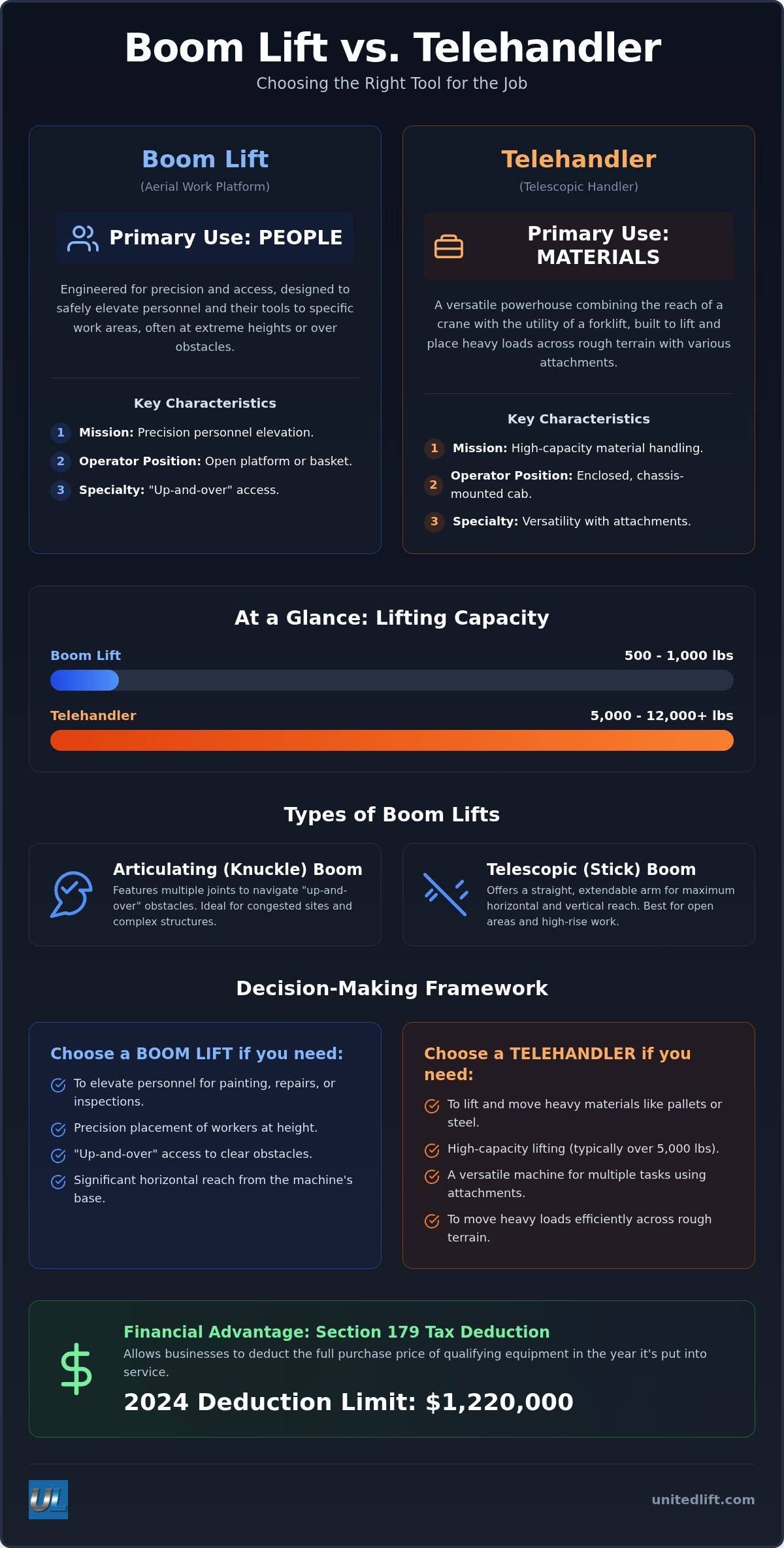
The choice between a boom lift vs telehandler begins with a simple question: are you moving people or pallets? While both machines feature extendable arms, they serve entirely different roles on a job site. A boom lift is a dedicated aerial work platform built to safely elevate personnel and their tools. In contrast, a telehandler is a high-capacity material mover designed to lift and place heavy loads with forklift-style forks or other attachments. Understanding these design philosophies is the first step in optimizing your fleet's efficiency.
The operator's environment also highlights these differences. Boom lift operators work from an open platform or basket, using a harness and lanyard for fall protection. They have direct access to the work surface, which is ideal for tasks like painting or electrical repairs. Telehandler operators sit in a chassis-mounted cab, which is often enclosed and climate-controlled. This setup provides better protection during heavy material handling but offers less direct visibility for precision tasks at height.
Beyond the technical specs, buying this equipment offers significant financial advantages through Section 179 tax deductions. This incentive allows businesses to deduct the full purchase price of qualifying new or pre-owned equipment in the year it's put into service. For 2024, the IRS has set a deduction limit of $1,220,000. This makes expanding your inventory a smart move for your balance sheet, especially when you need to scale up for larger contracts quickly.
What is a Boom Lift? (Aerial Work Platform)
A boom lift is engineered for precision and access. These machines come in two main types: telescopic and articulating. Telescopic booms offer straight, long-range reach, while articulating "knuckle" booms feature multiple joints to clear obstacles. Their primary goal is to get a worker into a specific spot, often using "up-and-over" capabilities to reach over rooftops or machinery. Because they focus on personnel safety, their weight capacities are usually limited to 500–1,000 pounds, enough for a crew and their immediate supplies.
What is a Telehandler? (Telescopic Handler)
A Telescopic handler, or telehandler, is the Swiss Army knife of the construction site. It combines the reach of a crane with the utility of a forklift. These machines are built for muscle, with load capacities typically ranging from 5,000 to over 12,000 pounds. They are often the first machines on a site, used for unloading trailers and moving heavy materials across rough terrain. While you can add a work platform attachment, their core design is meant for structural tasks like masonry, framing, and steel placement where lifting tons of material is the priority.
Mechanical Capabilities and Lift Performance
Performance on a job site depends on how well a machine's mechanical limits match your task. When comparing a boom lift vs telehandler, the load capacity is the most dramatic differentiator. A boom lift might carry two workers and a tool chest, totaling about 500 to 1,000 pounds. A telehandler can easily lift 10,000 pounds or more. This difference exists because boom lifts prioritize reach and personnel safety while telehandlers prioritize leverage and material weight.
Horizontal reach is another critical factor where these machines diverge. Boom lifts can extend significantly further sideways than telehandlers. This allows you to park the machine far from the building while still reaching the work area. Telehandlers generally need to be positioned closer to their targets to maintain stability. For a broader look at equipment options and how they fit into your site plan, you can consult this guide to construction lifts.
Chassis design plays a major role in these capabilities. Most modern units feature four-wheel drive and oscillating axles to handle mud and uneven soil. To maintain safety at maximum extension, many models use outriggers or stabilizers. These hydraulic arms widen the machine's footprint, preventing the unit from tipping when the center of gravity shifts during a high lift.
Articulating vs. Telescopic Booms
Articulating booms use multiple "knuckles" to reach over obstacles like walls, ductwork, or existing machinery. They are the best choice for congested sites where you need to navigate tight spaces. Telescopic models offer higher speeds and greater vertical reach for work on skyscrapers or bridge projects. The jib is a short, final boom section that provides an extra range of motion for precise platform positioning near the work surface.
Telehandler Load Charts and Stability
Reading a load chart is a non-negotiable skill for any telehandler operator. These charts show how capacity drops as the boom extends or the boom angle decreases. A machine that lifts 10,000 pounds at a high angle might only handle 2,000 pounds when reaching straight out. While standard models have a fixed boom, rotating telehandlers offer 360-degree rotation. This allows you to place materials across a wide radius without repositioning the chassis. If you're looking to upgrade your fleet's versatility, you can browse our latest inventory of high-performance lifting solutions.
Attachments, Versatility, and Site Adaptability
The true value of a boom lift vs telehandler often reveals itself through adaptability. While their core functions are distinct, the right accessories can transform these machines into specialized tools for almost any trade. For fleet managers, this versatility means a single machine can handle multiple phases of a project, reducing the total number of units needed on site. This flexibility is what makes these machines essential for maintaining a high ROI throughout the construction lifecycle.
Most modern units feature quick-attach systems that allow operators to swap tools in minutes. However, safety is paramount during these transitions. Every attachment changes the machine's center of gravity and weight distribution. Operators must consult the specific load chart for each attachment to ensure they stay within safe operating limits. Some specialized tools also require auxiliary hydraulic lines to power moving parts, so verify your machine's hydraulic capacity before investing in new work tools.
Maximizing Telehandler Utility
The telehandler is often called the Swiss Army knife of the job site because of its massive attachment catalog. Standard pallet forks are the baseline for material handling, but they're just the beginning. You can swap forks for a bucket to handle site cleanup or light earthmoving tasks. For structural steel or HVAC installation, a truss boom or a lifting hook turns the telehandler into a mobile crane capable of placing suspended loads with high precision. To complement this on-site accuracy, many contractors utilize Velocity Sheet Metal for BIM-integrated fabrication that ensures components are built to exact project specifications. These options allow one machine to serve as a forklift, loader, and crane all in the same afternoon.
Boom lift accessories focus on making the person in the basket more productive. Many premium models come with on-board power and air lines pre-installed. This allows workers to use pneumatic tools or electric grinders without dangling hazardous hoses and cords over the side of the platform. For specific trades, you can add pipe cradles to hold heavy conduits or glazier kits designed for the safe transport and installation of large glass panels. If your project requires 24-hour operation, platform-mounted work lights are a vital addition for ensuring safety and accuracy during nighttime or indoor maintenance tasks.
Expanding your capabilities doesn't always require a brand-new machine. High-quality equipment attachments can breathe new life into your existing fleet. Whether you need to lift wider loads or provide power at eighty feet, the right tool makes the difference between a stalled project and a finished job.
Choosing the Right Machine for Your Project Requirements
Selecting the right equipment depends on your project's current phase. During initial site prep and the structural phase, the telehandler is usually the first machine to arrive. It's the workhorse that unloads trailers and carries heavy bundles of lumber, steel, or masonry across rough terrain. In specialized timber projects, such as those handled by Bourbon Bigfoot Woodworking, this equipment is essential for managing the sheer weight of raw logs and custom-cut slabs. Without its lifting capacity, your ground crew would spend hours manually moving materials that a telehandler can place in seconds.
Site conditions often dictate your tire and power choices. Rough terrain telehandlers thrive in mud and on steep slopes thanks to their aggressive tire treads and high ground clearance. If you're working on finished indoor floors, an electric boom lift with non-marking tires is the standard. These units prevent floor damage and eliminate exhaust fumes in enclosed spaces. For outdoor work on gravel or dirt, consider foam-filled tires to avoid the downtime caused by punctures on active construction sites.
Total Cost of Ownership (TCO) Factors
Evaluating the total cost of ownership helps you understand the long-term ROI of your fleet. Diesel-powered machines generally have higher fuel costs and more intensive maintenance schedules compared to electric models. However, they provide the raw power needed for heavy lifting. Common wear parts like hydraulic seals and tires should be factored into your budget regardless of the machine type. In the used market, both machines hold their value well, but telehandlers often see higher resale demand due to their versatility across multiple industries. If you're ready to expand your fleet, you can view our current inventory of new and pre-owned lifts to find the perfect fit for your next job.
Investing in Your Fleet: Buying and Financing Strategies
Deciding between a boom lift vs telehandler is only half the battle. Once you've identified the right machine, you need a strategy to bring it into your fleet without draining your cash reserves. Buying equipment is a long-term play for stability. It moves your business away from the volatility of rental market pricing and availability. Whether you choose a new, high-spec model or a reliable pre-owned unit, the goal is to maximize your operational uptime. We help you navigate these choices to ensure your balance sheet remains as strong as your machinery.
Smart buyers use Section 179 to offset the cost of their investment significantly. This tax incentive allows you to deduct the full purchase price of qualifying equipment in the first year it's put into service. It's a powerful tool for accelerating your fleet expansion. By leveraging these deductions alongside flexible financing, you can acquire high-quality machinery while preserving liquidity for other business needs. This strategy turns a major capital outlay into a manageable, tax-advantaged growth opportunity for your company.
The Benefits of Equipment Ownership
Ownership builds real equity in your company. You aren't just paying for a temporary solution; you're acquiring a permanent asset that holds value. Owning your machinery also eliminates the stress of rental scheduling conflicts that often stall progress. You won't have to worry about a project stopping because a rental unit isn't available in your area. Plus, you can customize your machines with specific attachments to fit your niche. This level of control ensures you always have the exact tool needed for every unique job site challenge.
Financing Your Purchase with United Lift
Finding the right partner is critical when you're ready to buy. United Lift LLC serves as a national partner for Hyster, Yale, and Genie sales. We provide flexible loan and lease options tailored to businesses of all sizes and credit profiles. Our team understands the urgency of the material handling industry. That's why we offer 7-day-a-week support to assist with your acquisition. We don't just sell equipment; we act as a reliable facilitator for your growth. We offer both premium brands and economy solutions to ensure you find a machine that fits your budget and your workload. Reach out today to see how our financing can put the right lift in your hands.
Scale Your Fleet with the Right Lifting Solution
Deciding on a boom lift vs telehandler comes down to the specific demands of your project phase. Telehandlers provide the heavy-duty muscle needed for material handling and site preparation. Boom lifts offer the precision and reach required for high-access maintenance and finishing tasks. By understanding these core differences, you can select the machine that maximizes your daily productivity and long-term ROI.
United Lift is your national partner for high-quality equipment from trusted brands like Hyster, Yale, Genie, and JLG. We simplify the acquisition process with flexible financing options and expert support available 7 days a week. Whether you're looking for articulating booms or high-capacity telescopic handlers, we have the inventory to meet your industrial needs. Our team is dedicated to helping you find reliable solutions that keep your operations moving forward efficiently.
Browse our inventory of new and used boom lifts and telehandlers today. We're here to ensure you have the right tools to tackle your next project with confidence.
Frequently Asked Questions
Can a telehandler be used as a boom lift?
A telehandler can function as a boom lift if you equip it with a certified work platform attachment. This setup is useful for basic tasks, but it doesn't offer the articulating joints or "up-and-over" capabilities of a dedicated boom lift. If your job requires navigating around obstacles or reaching into tight spaces, a dedicated boom is safer and more efficient. Telehandlers remain primarily material movers first.
Do I need a special license to operate a boom lift vs a telehandler?
Yes, OSHA requires operators to have specific training and certification for both machines. A standard driver's license doesn't qualify you to operate heavy machinery on a job site. While United Lift doesn't provide operator training, we recommend ensuring your crew is fully certified before using new equipment. Each machine has unique controls and stability requirements that operators must master to maintain a safe working environment and avoid accidents.
What is the maximum reach of a typical telescopic boom lift?
Reach depends on the specific model you choose for your project. Most standard telescopic boom lifts offer a vertical reach between 40 and 80 feet. Specialized high-reach models from premium brands can extend over 180 feet for extreme applications. When comparing a boom lift vs telehandler, remember that boom lifts generally provide much greater horizontal reach. This allows you to access work areas from a distance without repositioning the chassis.
How much weight can a standard construction telehandler lift?
Standard construction telehandlers typically offer lifting capacities ranging from 5,000 to 12,000 pounds. These machines are built for heavy material handling rather than personnel elevation. It's vital to remember that capacity drops as you extend the boom further away from the chassis. Always consult the machine's load chart to determine the safe lifting limit for your specific boom angle and extension length. This ensures site safety and prevents tipping.
Is a telehandler the same thing as a Lull or Skytrak?
Yes, Lull and Skytrak are simply brand names for specific telehandler models. Much like people use the word "Crock-Pot" to describe a slow cooker, these names became industry shorthand for telescopic handlers. While different brands offer unique features like the "traversing carriage" on a Lull, they all fall under the same category of material handling equipment designed for reach and high-capacity lifting across rough terrain.
What are the safety requirements for using a fall arrest harness on a boom lift?
Safety regulations require every person on a boom lift platform to wear a full-body harness with a lanyard. This lanyard must be attached to a factory-installed anchor point within the basket. This system protects workers from being ejected if the lift is struck or if the chassis moves over uneven ground. Telehandler operators in enclosed cabs typically don't need a harness, but workers in platform attachments always do.
How does the Section 179 tax deduction apply to used telehandlers?
The Section 179 tax deduction is a powerful incentive that applies to both new and pre-owned equipment. For the 2024 tax year, businesses can deduct up to $1,220,000 of the purchase price from their taxable income. This applies as long as the equipment is put into service by December 31st. It's an excellent way to reduce the net cost of expanding your fleet with high-quality used machinery.
Which is better for indoor warehouse work: a boom lift or a telehandler?
An electric boom lift is almost always the superior choice for indoor warehouse maintenance. These units feature non-marking tires and produce zero emissions, making them safe for enclosed environments. Telehandlers are typically diesel-powered and much larger, which creates ventilation issues and maneuverability challenges. For high-density storage areas, a compact articulating boom provides the precision needed to work around racking and inventory without causing damage.
- Tags: Aerial Lifts, Boom Lift, boom lift vs telehandler, Construction Equipment, Equipment Comparison, Job Site Safety, Material Handling, Telehandler
