
Hyster vs JLG Telehandler: Which Heavy Lifter Wins for Your Fleet in 2026?
Posted by United Lift LLC on
Is the most expensive telehandler on the market actually the cheapest one to own? When you're staring down a six-figure investment for your 2026 fleet, the stakes couldn't be higher. You need a machine that works as hard as you do, not one that sits idle because of maintenance complexity or confusing capacity ratings. Deciding between a Hyster vs JLG telehandler isn't just about picking a color; it's about matching a specific engineering philosophy to your daily job site demands.
We know that high capital outlay is a risk you can't take lightly. You want a clear path to high resale value and efficient financing that protects your cash flow. This comparison dives deep into the technical specs and real-world performance of both brands. We'll show you exactly which manufacturer wins for your specific industry. By the end, you'll have the confidence to choose the heavy lifter that keeps your projects moving and your bottom line healthy.
Key Takeaways
- Match your machine to your specific environment; Hyster thrives in heavy industrial yards while JLG's reach is built for complex construction sites.
- Evaluate a Hyster vs JLG telehandler based on boom engineering and specific load chart performance at your most common lift heights.
- Reduce long-term expenses by comparing daily serviceability features like ground-level access and manufacturer-recommended maintenance intervals.
- Protect your fleet's value by understanding which models maintain the highest resale price in the 2026 pre-owned market.
- Learn how to leverage in-house financing to upgrade your heavy equipment without draining your business's liquid capital.
Hyster and JLG: Understanding the Brand Heritage
Brand heritage is more than a history lesson; it's the blueprint for how your machine handles a load. When you weigh a Hyster vs JLG telehandler, you aren't just comparing paint colors or horsepower. You're looking at two different engineering philosophies born from different industrial needs. One brand comes from the high-cycle world of shipping ports and steel yards. The other grew up on the muddy, vertical-focused residential construction site. For a foundational Telescopic handler overview, it's clear these machines are the Swiss Army knives of material handling, but their DNA dictates where they truly shine.
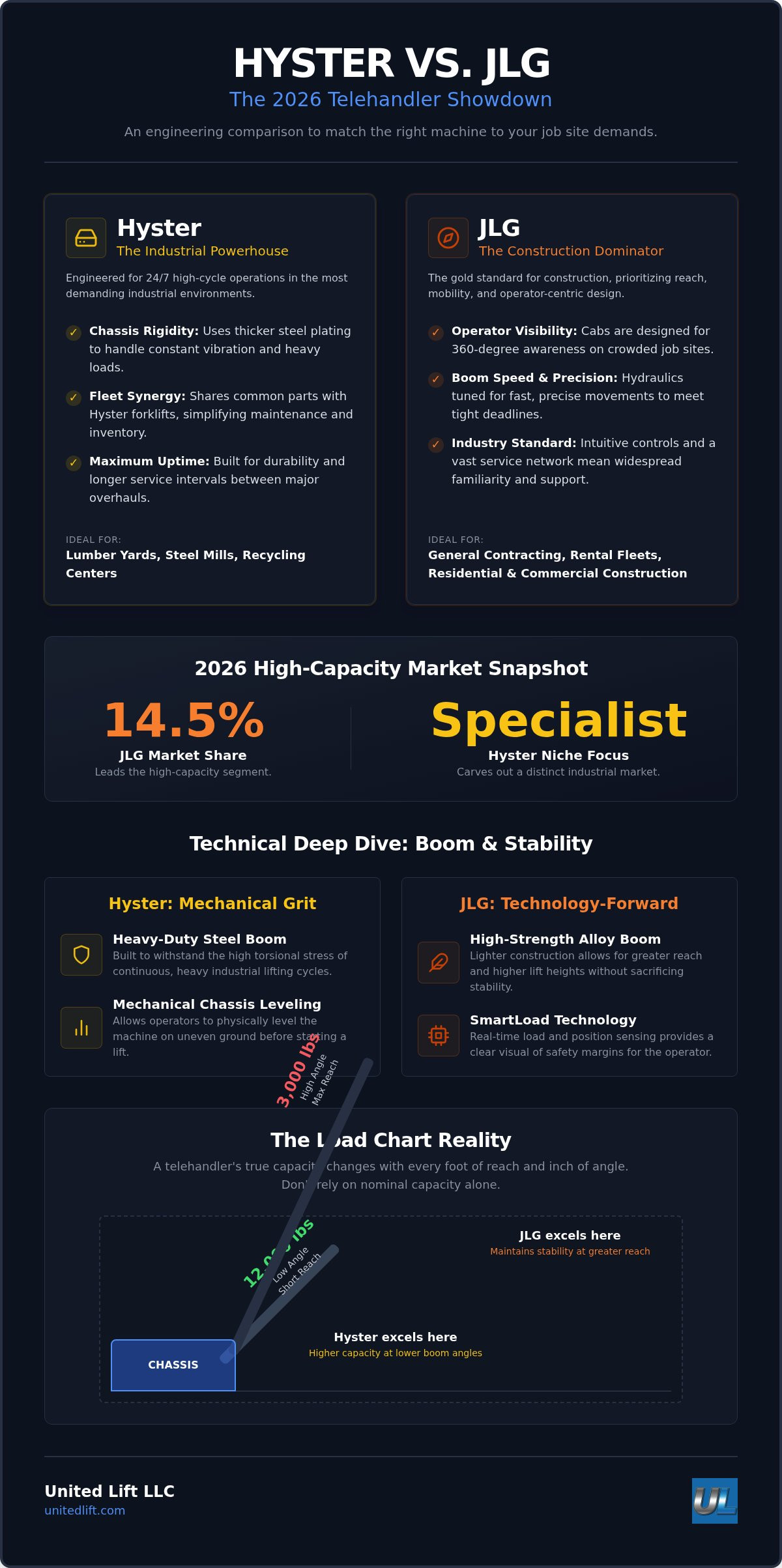
In 2026, JLG continues to lead the market with a 14.5% share in the high-capacity segment. They are the construction site standard. Hyster has carved out a distinct niche as a "Compact Specialist," focusing on industrial reliability. Choosing between them requires an honest look at your daily operations. Do you need a machine that can reach over a house, or one that can move heavy pallets in a warehouse all day without a break?
The Hyster Industrial Advantage
Hyster built its reputation on "High Capacity." Their machines are designed for 24/7 high-cycle operations in demanding environments like lumber yards and recycling centers. They don't just build telehandlers; they build heavy-duty industrial tools. Here is why industrial managers choose Hyster:
- Chassis Rigidity: Hyster uses thicker steel plating and a reinforced chassis to handle the constant vibration of industrial yards.
- Fleet Synergy: Many Hyster telehandlers share components with their world-class forklifts. This means your mechanics only need to stock one set of common filters and parts.
- Durability: These machines are engineered to stay in the field longer between major overhauls, prioritizing uptime over flashy tech.
The JLG Construction Dominance
JLG is the pioneer of the aerial work platform. Their telehandlers reflect a focus on reach, visibility, and rough-terrain mobility. They are the gold standard for general contractors and rental houses for several reasons:
- Operator Visibility: JLG cabs are designed for 360-degree awareness, which is critical on crowded construction sites.
- Boom Speed and Precision: Their hydraulic systems are tuned for fast extension and retraction, helping crews hit tight deadlines.
- Familiarity: Most operators have spent time in a JLG cab. The controls are intuitive, and the widespread service network means help is always nearby.
By 2026, the gap between these brands has narrowed, but their core strengths remain. Hyster is your go-to for industrial grit. JLG is your partner for construction versatility. At United Lift, we help you navigate these differences to find the right fit for your fleet's specific demands.
Technical Performance: Lift Capacity vs. Maximum Reach
Nominal lift capacity is often a misleading metric. When comparing a Hyster vs JLG telehandler, the real story lives in the load chart. A machine rated for 12,000 pounds, like the JLG 1255, only hits that number at a specific angle and height. As you extend the boom horizontally, that capacity drops significantly. Hyster’s industrial-first design focuses on maintaining higher capacities at lower boom angles. This makes them ideal for moving heavy steel or lumber across a yard. JLG’s high-strength alloy booms are lighter; this allows for greater reach and higher lift heights without sacrificing overall machine stability.
Hyster uses heavy-duty steel plating in their boom construction. It's built to withstand the torsional stress of high-cycle industrial work. JLG opts for lightweight, high-strength alloys that prioritize reach. This difference affects boom speed. JLG hydraulics generally feel snappier; they are tuned for the fast-paced environment of a residential job site. For 2026, both brands utilize Tier 4 or Tier 5 engines, such as the Cummins turbo diesel, ensuring compliance with strict emission standards while providing the torque needed for rough terrain.
Stability and Load Management Systems
Hyster prioritizes mechanical stability. Their chassis leveling systems allow operators to compensate for uneven ground before the lift begins. JLG takes a tech-forward approach with their SmartLoad technology. This system provides real-time sensing of the load and boom position, giving the operator a clear visual of their safety margins. This technology is a game-changer for operator confidence during high-lift maneuvers. If you want to see how these systems feel in person, you can browse our current telehandler inventory to compare models side-by-side.
Turning Radius and Maneuverability
Maneuverability is where these brands diverge based on their target environment. Both offer standard 4-wheel steer modes: crab, circle, and front-only. However, JLG’s compact models, like the G5-18A, are specifically engineered for tight urban construction footprints where every inch of turning radius matters. Hyster’s footprint is typically larger. This provides a more stable base for high-capacity warehouse yards but requires more room to navigate. Choosing the right machine depends on whether you're threading the needle between buildings or hauling heavy pallets across an open industrial lot.
Durability and Total Cost of Ownership (TCO)
Buying a machine is just the start of your investment. The real cost of ownership reveals itself over five years of hard operation. When you compare a Hyster vs JLG telehandler, you're looking at two different maintenance philosophies. JLG focuses on rapid serviceability to minimize downtime on fast-moving construction sites. Hyster builds for extreme longevity. They often use over-engineered components designed to survive the grit of harsh industrial environments. Both brands aim to lower your TCO, but they take different paths to reach that goal. To protect your equipment's vital components, you can learn more about Rida Lubricants for premium industrial lubricants.
JLG is well-regarded for its "service-friendly" design. Their engine pods often swing out or open wide. This provides clear, ground-level access to filters, belts, and fluid checks. You don't need to be a contortionist to perform routine service. This simplicity directly reduces labor costs and keeps your operators focused on moving material. JLG’s boom wear pads are also designed for quick replacement, which prevents boom play from becoming an expensive shop visit.
Hyster machines are built like industrial vaults. Their heavy-duty frames and chassis are incredibly hard to damage in a collision. However, the dense packaging of their high-capacity components can sometimes make deep repairs more complex than a standard construction unit. Hyster utilizes drivetrains and axles pulled from their high-capacity forklift lines. These are built for 24/7 cycles. If your operation requires constant movement rather than occasional reaching, Hyster’s drivetrain often offers superior long-term durability.
Long-Term Fleet Value
Resale value is where JLG frequently takes the lead in the general market. JLG holds a 14.5% market share in the high-capacity segment. This massive footprint creates a secondary market where parts are plentiful and buyers are always waiting. This high demand keeps auction prices strong for 5-year-old units in 2026. Hyster holds its price best in specialized industrial sectors. Buyers in steel and lumber specifically seek out Hyster's rigid chassis for its stability and heavy-duty lift reputation.
Analyzing Hyster vs JLG telehandler resale value is a critical KPI for fleet owners because it directly impacts your total return on investment when it’s time to upgrade. At United Lift, we help you factor in these long-term projections so your financing plan matches the actual life cycle of the machine.
Application Guide: Choosing Based on Your Job Site
The choice between a Hyster vs JLG telehandler often comes down to the ground beneath your tires and the obstacles in your way. If you're operating in a paved industrial yard moving heavy steel beams, your needs are vastly different from a contractor lifting roofing materials over a two-story house. Both brands offer incredible versatility through attachments like pallet forks, buckets, and work platforms, but their base engineering favors specific environments. You need to match the machine's DNA to your daily workflow to maximize your return on investment.
Industrial and Warehousing Applications
Hyster is the heavy-duty champion for the industrial sector. Their telehandlers are built for the high-frequency demands of loading docks and manufacturing yards. If you need precision lifting for high-value machinery, Hyster’s rigid chassis provides the stability required for millimeter-perfect placement. These machines handle the transition from indoor warehouse floors to outdoor gravel yards seamlessly. They are designed to survive the 24/7 cycle of industrial work without the structural fatigue that can plague lighter machines. For heavy steel and lumber, the Hyster industrial build is often the superior choice.
Rough Terrain and Construction
JLG owns the construction site for a reason. When you're navigating mud, steep slopes, and unpaved surfaces, JLG’s rough terrain capabilities and operator visibility win the day. Their booms are engineered to lift materials over obstacles on multi-story projects with speed and precision. Operator comfort is a major factor here too. JLG cabins are designed for long shifts in extreme weather, offering ergonomic controls that reduce fatigue. The compact footprint of JLG models makes them ideal for residential sites where space is at a premium and you need to reach over a finished structure.
Dust and debris are the main enemies in agricultural settings. JLG models often feature high-mounted air intakes and cooling systems designed to handle the chaff and grit of farming operations without clogging. While Hyster is capable, JLG’s focus on diverse attachments makes it a favorite for handling everything from hay bales to site cleanup. Regardless of your industry, choosing a Hyster vs JLG telehandler requires looking at your most frequent task. Are you reaching high over obstacles, or are you moving heavy loads across a flat yard? Ready to see the difference for yourself? Browse our current telehandler inventory to see these powerhouses in action.
Acquisition Strategy: Buying New vs. Used
Deciding between a new or used Hyster vs JLG telehandler is the final hurdle for your fleet expansion. New machines offer the latest smart-load technology and full factory warranties. However, a well-maintained pre-owned unit from a trusted dealer provides immediate availability and a lower entry cost. Buying used allows you to bypass the steep initial depreciation while still securing a high-capacity lifter that holds its resale value. We specialize in both; this gives you the flexibility to choose based on your current project timelines and cash flow requirements.
Before you sign the paperwork, use this inspection checklist to ensure the machine is job-site ready:
- Inspect the boom sections for stress cracks or structural damage.
- Check hydraulic cylinders and hoses for leaks or signs of wear.
- Review the service history for the Cummins turbo diesel engine.
- Test all three 4-wheel steering modes: circle, crab, and front-only.
- Verify that the load management system is calibrated and responsive.
Financing and Leasing Options
Don't let the sticker price stall your operations. In September 2026, equipment financing rates are starting as low as 6.45% APR. This makes it a prime time to acquire premium machinery without draining your liquid capital. You can also take advantage of the Section 179 deduction. For the 2026 tax year, the deduction limit is $2,560,000, with a phase-out threshold starting at $4,090,000. Additionally, the 100% bonus depreciation for qualifying new and used equipment remains a powerful tool for offsetting your investment. Many fleet owners prefer a lease-to-own structure to gain these tax advantages while keeping monthly payments manageable.
Expert Consultation
Choosing a Hyster vs JLG telehandler shouldn't be a guessing game. Talking to a multi-brand dealer gives you an unbiased look at which machine matches your specific job site. We help you compare load charts and maintenance schedules side-by-side to ensure the specs meet your actual lifting needs. If you're unsure which model fits your footprint, we can provide a site assessment or schedule a demo. Our team operates seven days a week to ensure your questions are answered when you're ready to move. We're here to facilitate the transaction and help you find the most efficient financing path for your business.
Power Your Fleet for 2026 and Beyond
Choosing between a Hyster vs JLG telehandler comes down to your primary work environment. If you need industrial grit for high-cycle loading, Hyster is your powerhouse. If your priority is vertical reach and visibility on a construction site, JLG remains the standard. Both brands offer incredible long-term value, but matching the machine's engineering to your daily tasks is what protects your profit margins and ensures operator safety.
At United Lift, we make this investment easy with expert support available seven days a week. We offer comprehensive financing options for all business sizes to help you secure the equipment you need without straining your cash flow. With national shipping and a diverse inventory of new and pre-owned units, we're ready to facilitate your next purchase. Browse our full inventory of Hyster and JLG telehandlers today and take the next step toward a more efficient fleet. We look forward to helping you find the perfect heavy lifter for your business.
Frequently Asked Questions
Which telehandler brand has better resale value, Hyster or JLG?
JLG generally commands a higher resale value in the broad secondary market because of its massive 14.5% market share and widespread parts availability. This high demand ensures that pre-owned JLG units sell quickly at auction. While Hyster retains strong value within specialized industrial sectors like steel and lumber, JLG's popularity with rental houses and general contractors makes it the safer bet for overall liquidity when it's time to upgrade your fleet.
Is a Hyster telehandler better for industrial use than a JLG?
Hyster is specifically engineered for high-cycle industrial environments where chassis rigidity and frame durability are the top priorities. Their machines thrive in 24/7 operations like ports or manufacturing yards. While a JLG can perform these tasks, Hyster’s components are often shared with their heavy-duty forklift lines. This makes them more resilient to the constant vibration and heavy pallet movement found in industrial settings compared to the intermittent reaching of construction sites.
Can I use the same attachments on Hyster and JLG telehandlers?
Not always, as it depends on the specific coupler system installed on each machine. Many modern models use a universal quick-attach interface, but you must verify the hydraulic flow requirements and weight ratings for each tool. While pallet forks are often interchangeable with the right adapter, proprietary attachments like specialized work platforms or high-capacity buckets may be brand-specific. Always check the mounting interface before purchasing new attachments for your Hyster vs JLG telehandler.
How much lift capacity do I need for a standard construction site?
Most standard construction sites require a lift capacity between 6,000 and 10,000 pounds to handle common materials like palletized bricks or roofing bundles. The JLG 1055 is a frequent choice because it offers a 10,000-pound maximum capacity and a 55-foot reach. If you're working on larger multi-story industrial projects, you might need to scale up to 12,000 pounds to ensure you have enough capacity at full boom extension.
What are the main maintenance differences between Hyster and JLG?
Maintenance differences center on access and component origin. JLG designs its machines with accessible engine pods and ground-level fluid checks to minimize downtime on construction sites. Hyster uses heavy-duty drivetrains and axles from its industrial forklift lines. These parts are exceptionally durable but can be more densely packed within the frame. This means Hyster might require more specialized mechanical knowledge for deep repairs, whereas JLG is built for rapid field serviceability.
Is it better to buy a new or used telehandler in 2026?
Buying a used telehandler in 2026 is often the smarter move for businesses looking to preserve capital and avoid long lead times. Used units qualify for the same Section 179 tax deductions and 100% bonus depreciation as new equipment. While new machines offer the latest telematics and warranties, a certified pre-owned unit from a reputable dealer provides immediate job-site readiness at a significantly lower entry price, allowing you to grow your fleet faster.
Does JLG offer better reach for multi-story construction?
JLG is widely recognized for superior reach and boom precision on multi-story projects. Their use of lightweight, high-strength alloy booms allows for greater extension at higher angles without compromising the machine's center of gravity. Models like the JLG 1255 reach up to 55 feet, providing the height needed for three and four-story construction, such as when installing high-end architectural systems from Hawaii Architectural Sales. Hyster focuses more on low-angle, high-capacity lifts, which makes them less specialized for high-reach residential or commercial building tasks.
Financing for a used telehandler works through specialized equipment loans or lease-to-own agreements that help spread the high capital cost over several years. Rates in late 2026 can start as low as 6.45% APR for buyers with strong credit. At United Lift, we facilitate this process by connecting you with tailored financing options. This allows you to acquire a premium Hyster vs JLG telehandler while keeping your monthly payments predictable and your cash flow healthy.
- Tags: Construction Equipment, Equipment Comparison, Fleet Management, Heavy Equipment, Hyster, Hyster vs JLG telehandler, JLG, Telehandler, Total Cost of Ownership
