
Construction Equipment Financing Options and Cash Flow
Posted by United Lift LLC on
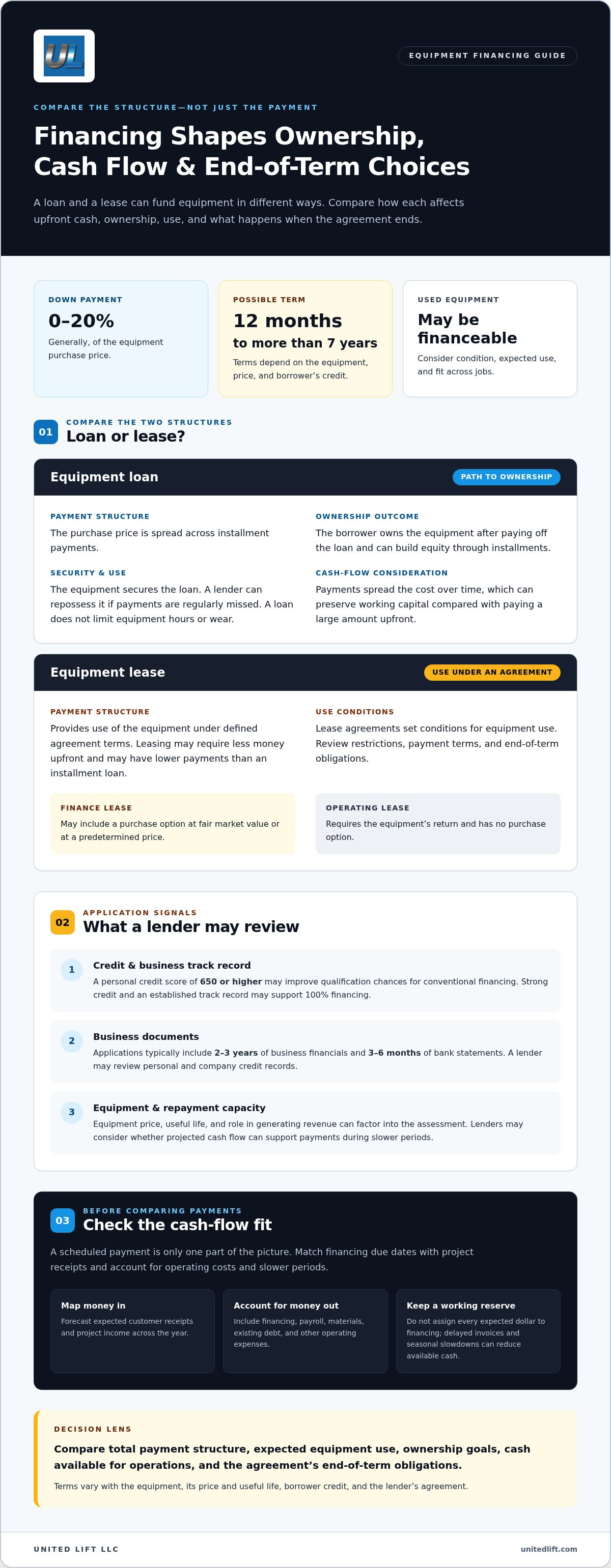
Used equipment can be financed, not just new machinery. Construction equipment financing options commonly include equipment loans and leases, with down payments generally ranging from zero to 20% of the purchase price. Terms can run from 12 months to more than 7 years, depending on the equipment, its price, and the borrower’s credit.
Look beyond the machine’s price and consider its effect on cash flow. A lower upfront payment can preserve working capital, while loan payments may build ownership over time. Lenders may review business financials, bank statements, and personal and company credit when assessing an application.
This guide explains how equipment loans and leases work, what lenders may consider, and how down payments affect your budget. It also covers financing used equipment and tax considerations that may shape a purchase. Use these points to compare payment structures, ownership, and cash-flow impact before choosing a financing path.
Key Takeaways
- Compare a loan’s path to ownership with a lease’s payment structure and end-of-term choices.
- Prepare business financials and bank statements, and account for both personal and company credit in the application process.
- Estimate the down payment alongside ongoing payments so financing fits your project cash flow.
- Used equipment may be financeable; weigh its condition, expected use, and fit across your jobs against the need for newer technology.
- Tax treatment can affect the cost of ownership, so understand how depreciation rules apply before choosing a financing structure.
Credit, cash flow, and business-history requirements
Construction equipment financing options depend on factors such as credit, operating history, and the equipment’s role in generating revenue. Lenders may also assess whether projected cash flow can support payments during slower periods.
Credit and Business History Requirements
Credit and business history help lenders estimate whether a contractor can repay financing from business income. A personal credit score of 650 or higher may improve qualification chances for conventional financing, while strong credit and an established track record may support 100% financing.
Applications typically include two to three years of business financials and three to six months of bank statements. For a lease, review both personal and company credit records before applying. A lender may also consider the equipment’s price and useful life when assessing repayment capacity.
What risks, penalties, and lender restrictions should borrowers consider? The equipment secures a loan, and a lender can repossess it if payments are regularly missed. Lease agreements also set conditions for equipment use, so review payment terms, restrictions, and end-of-term obligations before signing.
For example, a contractor with uneven project revenue should compare payment dates with expected customer receipts, not just annual totals. An advisor can help organize financial statements and explain how different financing structures affect available capital and repayment obligations.
Financing for Seasonal Cash Flow
Seasonal financing structures are designed to align payment obligations with a contractor’s revenue cycle. This can matter when winter work slows or project income arrives in stages, since payment timing affects funds available for payroll, materials, and other operating costs.
Map expected receipts and expenses across the year before comparing terms. A contractor with a busy summer schedule, for example, can estimate which months bring the strongest revenue and whether regular payments remain manageable in quieter months. The lender’s terms determine whether payment timing can be adjusted.
Seasonal planning does not remove the repayment obligation. It helps show whether the business can cover scheduled payments during low-revenue periods, including months when project work is delayed. Forecast each major project separately so one late customer payment does not distort the overall cash-flow picture.
Financing and Cash-Flow Planning
Financing can preserve working capital by spreading equipment payments over time rather than using a large amount of cash upfront. Plan for regular payments while accounting for project income, operating expenses, and the equipment’s contribution to revenue.
Build a payment forecast around the equipment’s planned use. If a machine supports a project with staged customer payments, for example, compare each expected receipt with financing due dates. This can flag a shortfall before it affects payroll or material purchases.
Compare the payment structure with the business’s full cash needs, not just equipment payments. Existing debt, seasonal slowdowns, and delayed invoices can all reduce available capital. Include a working reserve in the forecast instead of assigning every expected dollar to financing.
These checks help contractors compare financing structures beyond the scheduled payment. A plan that preserves cash for operating costs may fit better than one that uses available funds for a larger upfront contribution. Update the forecast as project schedules and customer receipts change.
How does construction equipment financing work?
Contractors can finance equipment with a loan, a lease, or a structured program. The choice affects payments, ownership, and how the machine supports revenue.
Equipment Loans, Leases, and Structured Capital
An equipment loan spreads the purchase price across installment payments. A lease provides use of the equipment under an agreement with defined end-of-term terms. Each structure affects cash commitments and whether the business builds ownership.
Equipment loans are a common way to finance equipment purchases. Manufacturers may also offer financing programs to end users or dealers, providing another potential route to capital. Terms depend on equipment life, borrower credit, and equipment price. Compare these factors with expected use, project revenue, and how long the machine is likely to remain productive.
Loan Security and Ownership Outcomes
An equipment loan uses the purchased equipment as collateral, giving the lender a claim if payments are regularly missed. The borrower owns the equipment after paying off the loan and can build equity through installments.
A loan does not limit the equipment’s hours or wear, although regular use still affects its condition and resale value. Lease outcomes depend on the agreement: a finance lease may include a purchase option at fair market value or a predetermined price, while an operating lease requires the equipment’s return without a purchase option. Decide whether ownership or end-of-term flexibility matters more.
Financing Heavy Equipment
Heavy equipment financing commonly uses loans or leases, with terms generally ranging from 12 months to more than 7 years. The equipment’s useful life, price, and borrower credit help determine the structure and repayment period.
A loan may suit a contractor who expects to use the machine across projects and wants to own it after payoff. Leasing may require less money upfront and can provide lower payments than an installment loan. At lease-end, the customer may return the equipment or exercise a purchase option, depending on the contract. Compare the full term with the machine’s expected working life, not just the initial payment.
For example, a contractor planning frequent equipment replacement may value a lease’s return option. A contractor relying on the same machine across jobs may prefer to build equity through a loan. Include attachments in the equipment scope when they are part of the planned setup, and review equipment attachments alongside the machine.
Banks, Dealers, and Online Lenders
Contractors can seek financing through banks, specialized loan companies, and equipment dealers. Online lenders offer another channel, while dealer programs may connect financing with an equipment purchase. Compare terms, collateral requirements, and the ownership outcome.
Start by matching the funding source to the purchase and the business’s needs. A bank or specialized loan company may provide a separate loan, while a manufacturer’s program may serve end users or dealers. Compare each proposal’s payment schedule, total obligations, and lease-end choices to understand how the structure affects revenue and future equipment decisions.
Financing customer purchases and down payments
Down payments affect the amount financed and the cash left for operations. Construction equipment financing down payments generally range from zero to 20% of the purchase price.
Compare the upfront amount with payment timing, contract costs, and expected project income. The right balance depends on the financing terms and the business’s available working capital.
Down Payments and Financing Amounts
A down payment is the portion of the purchase price paid upfront, reducing the balance financed. A larger down payment means a smaller loan balance, while a smaller one preserves more funds for operating needs.
For example, compare two proposals for the same machine: one requiring a larger initial contribution and another financing more of the purchase. Review the resulting payments alongside payroll, materials, and project receipts. Financing providers may also help customers finance down payments, changing how much cash the purchase requires upfront.
Down Payments and Financing Terms
A down payment works alongside the interest rate, repayment period, and payment schedule to shape total borrowing costs. Comparing these terms helps contractors assess whether a lower upfront amount results in a manageable payment plan.
Construction and heavy equipment financing terms generally range from 12 months to more than 7 years. Current interest rates depend on factors such as borrower credit, equipment price, equipment life, and financing structure. Compare offers using the same purchase amount and repayment period where possible, then assess the full payment schedule rather than focusing only on the monthly figure.
Total costs can include the down payment, financed balance, interest, contract fees, and any amount due at lease-end. Review itemized charges and payment obligations in the agreement to understand the full commitment before signing.
Down Payments and Full Financing
Full financing covers 100% of the equipment cost, preserving cash for other business needs. It matters when retaining working capital is more important than minimizing the amount financed.
Some construction equipment financing covers 100% of equipment cost, although it comes at a higher cost. Borrowers with strong credit and an established track record may qualify for 100% financing. Newer businesses or borrowers with credit challenges should plan for a 10% to 20% down payment, or potentially more. Compare the cash retained against the added financing expense.
Skip-Payment Scheduling
A skip-payment schedule sets periods when a borrower does not make a scheduled installment. It can matter to contractors with seasonal revenue, but a skipped payment does not automatically erase the amount owed.
Read how the agreement handles each skipped installment: it may defer the amount or change later payment obligations. Map a proposed schedule against expected project receipts and slower periods. Before choosing this structure, check whether interest continues to accrue and how the skipped amount affects total repayment.
Tax treatment and depreciation
Tax treatment depends on ownership, equipment type, and when the asset is ready for use. For a financed purchase, compare federal depreciation rules with your state’s treatment before estimating the after-tax cost.
Loan Depreciation and Balance-Sheet Treatment
With a traditional equipment loan, United Lift LLC or any similar business owns the asset, records it on its balance sheet, and can generally capitalize and depreciate it. This matters because depreciation deductions and loan payments affect different parts of the financial picture.
A finance lease can also result in owner-like tax treatment, including potential depreciation deductions on the asset’s tax basis. For financial reporting, finance leases fall under ASC 842, which requires the lessee to recognize a right-of-use asset and corresponding lease liability. Compare those entries with cash payments when evaluating a financing structure.
Construction equipment is generally classified as five-year or seven-year MACRS property. The correct classification depends on the equipment, so identify the actual asset and its intended use before estimating depreciation. An asset must be ready and available for its specified use to count as placed in service for Section 179 or bonus depreciation.
Tax Deductions and Depreciation
Section 179 and bonus depreciation may let a business deduct qualifying equipment costs sooner than standard depreciation schedules. The timing matters: an accelerated deduction may reduce taxable income in the year equipment is placed in service, even when loan payments continue over several years.
For qualifying property placed in service in 2025 and beyond, the Internal Revenue Service says the OBBBA set the maximum Section 179 expensing limit at $2.5 million. The Internal Revenue Service also says the Section 179 deduction phases out dollar for dollar when qualifying property placed in service during the year exceeds $4 million.
Qualified property acquired and placed in service after January 19, 2025, is eligible for 100% bonus depreciation under IRC Section 168(k), according to the Internal Revenue Service. Section 179 applies before bonus depreciation, which applies to the remaining basis. However, Section 179 deductions can’t exceed taxable income from active business conduct; a disallowed amount carries forward and doesn’t create a net operating loss.
State treatment can differ from federal rules. Many states decouple from federal bonus depreciation and require separate state depreciation schedules under MACRS. A business operating across state lines should compare each applicable state schedule with its federal calculation.
Before choosing an equipment loan or finance lease, model the actual placed-in-service timing, deduction method, and payment schedule together. Tax elections, including Section 179 and a bonus-depreciation opt-out, generally must be made on a timely filed return. The election can’t usually be changed retroactively without filing Form 3115 for a change in accounting method.
Financing used construction equipment
Used equipment can be financed, but assess the machine’s condition, useful life, and expected workload carefully. Weigh those factors against the loan’s interest, repayment period, and effect on cash flow.
Start with the machine itself. Review its age, operating condition, maintenance records, and hours of use. These details help you assess its remaining productive life and suitability for upcoming projects. A lender may also evaluate the asset as collateral, so clear records can support a complete application.
Then compare the financing terms with the equipment’s expected use. A longer repayment period can spread payments, but avoid paying for equipment beyond its useful working life. For example, a contractor planning to use a machine across recurring jobs can compare its expected revenue contribution with payments over the full term. Include downtime and maintenance needs in the operating forecast.
Used equipment financing can involve a purchase loan or refinancing an asset the business already owns. With a loan-funded purchase, the borrower owns the equipment after payoff and can sell or trade it at any time. That flexibility can matter if project needs change or the machine no longer suits the work mix.
Compare these details before choosing a structure:
- Condition: Match the machine’s wear and maintenance history to the work it must handle.
- Useful life: Align the repayment period with expected productive use.
- Interest and payments: Compare the full schedule, not just the initial payment.
- Collateral: Understand that the financed equipment secures the loan.
Tax treatment deserves attention, too. A used machine’s eligibility for depreciation deductions depends on the asset and its tax treatment. Coordinate the purchase date, placed-in-service timing, and Section 179 assumptions with the business’s records. Keep the lender’s loan documents and equipment purchase records together, so the financing and tax files reflect the same asset and transaction.
For example, a contractor replacing one machine with another can compare the used unit’s expected working life with the remaining needs of current projects. If the business uses a loan, it can later sell or trade the equipment, but the outstanding loan balance and sale proceeds still affect its final cash position. Include this possibility in the ownership plan.
Before committing, compare the equipment’s condition, planned use, financing period, and expected cash contribution as one decision. If attachments are part of the setup, explore equipment attachments that match the work the machine needs to handle.
United Lift: Forklifts
United Lift LLC can help when your financing decision involves material handling equipment. Its new and used inventory includes forklifts, boom lifts, telehandlers, and scissor lifts, giving you equipment types to compare with the work ahead.
Consider the tasks, project demands, and expected use for each machine before settling on a financing structure. United Lift LLC also offers financing options, so equipment selection and financing can be part of the same purchasing conversation. If a forklift is your priority, begin by matching its capacity and intended workload to your operation.
Contact United Lift LLC to discuss equipment and financing for your business.
Choose Equipment That Fits Your Next Move
Start your financing decision with the work your business needs to handle next. Match the equipment to your projects, then consider how the purchase fits your operating plans and future capital needs. This gives your financing conversation a clear starting point.
United Lift LLC offers forklifts, boom lifts, and telehandlers. If you’re comparing construction equipment financing options for a material-handling purchase, discuss the equipment you need and your business priorities with the team.
Contact United Lift LLC to discuss financing and explore equipment for your operation. Take the next step with a clearer view of what your work requires.
Frequently Asked Questions
What construction equipment financing options are available in the U.S.?
The main construction equipment financing options are equipment loans, finance leases, and operating leases. Eligible U.S. businesses may also explore SBA 7(a) and 504 government-backed loan programs, whose eligibility requirements, limits, and terms vary. Manufacturers may offer financing programs to equipment buyers or dealers. Compare each structure by ownership outcome, payment schedule, and how much flexibility your business needs after the project ends.
What credit score and business requirements do equipment lenders require?
Requirements vary by lender, but a personal credit score of 650 or higher may improve the chance of qualifying for conventional financing. Lenders commonly review two to three years of business financials and three to six months of bank statements. Equipment dealers check personal and company credit for leases. Before applying, organize those records and make sure your cash-flow forecast shows how payments fit alongside project expenses.
What down payment is typically required for construction equipment financing?
Down payments generally range from zero to 20% of the purchase price. A newer business or borrower with credit challenges should plan for 10% to 20%, or potentially more. Some programs finance 100% of equipment cost, though that comes at a higher cost. Compare the amount due upfront with the cash your business needs for materials, payroll, and other project commitments.
How do equipment loans compare with leasing and equipment lines of credit?
An equipment loan finances a specific purchase and can lead to ownership after payoff. A lease provides use under an agreement, with return or purchase choices set by its terms. An equipment line of credit works differently: the borrower draws funds as needed, subject to the lender’s limit and repayment rules. Consider whether you need one machine or flexible access to capital across purchases.
Can businesses finance used or privately purchased construction equipment?
Yes, used construction equipment can be financed through banks, specialized loan companies, or equipment dealers. For a private sale, prepare the seller’s details, purchase agreement, equipment identification, and ownership records. These documents help the lender assess the asset and transaction. Compare the machine’s condition and expected working life with the financing period before committing.
What tax deductions or depreciation benefits apply to financed construction equipment?
Qualifying equipment may be eligible for Section 179 expensing or bonus depreciation, depending on tax rules and when it is placed in service. The Internal Revenue Service sets the Section 179 limit at $2.5 million for qualifying property placed in service in 2025 and beyond; the deduction phases out above $4 million. Qualified property acquired and placed in service after January 19, 2025, may qualify for 100% bonus depreciation under IRC Section 168(k). State rules can differ.
How can a business apply for construction equipment financing, and what documents are needed?
Start by identifying the equipment and financing structure, then assemble business financials covering two to three years and three to six months of bank statements. Lenders may also request personal and company credit information. A clear equipment quote or purchase agreement connects the financing request to the asset. Prepare a cash-flow forecast showing how scheduled payments fit with project income and operating expenses.
What are current interest rates and typical loan terms for construction equipment?
Construction equipment financing terms generally range from 12 months to more than 7 years, depending on the equipment’s life and price and the borrower’s credit. The material provides no interest-rate figures.
- Tags: business loans, cash flow management, construction equipment, construction equipment financing options, equipment financing, equipment leasing, heavy machinery, used equipment
