
Forklift fuel consumption comparison for runtime and costs
Posted by United Lift LLC on
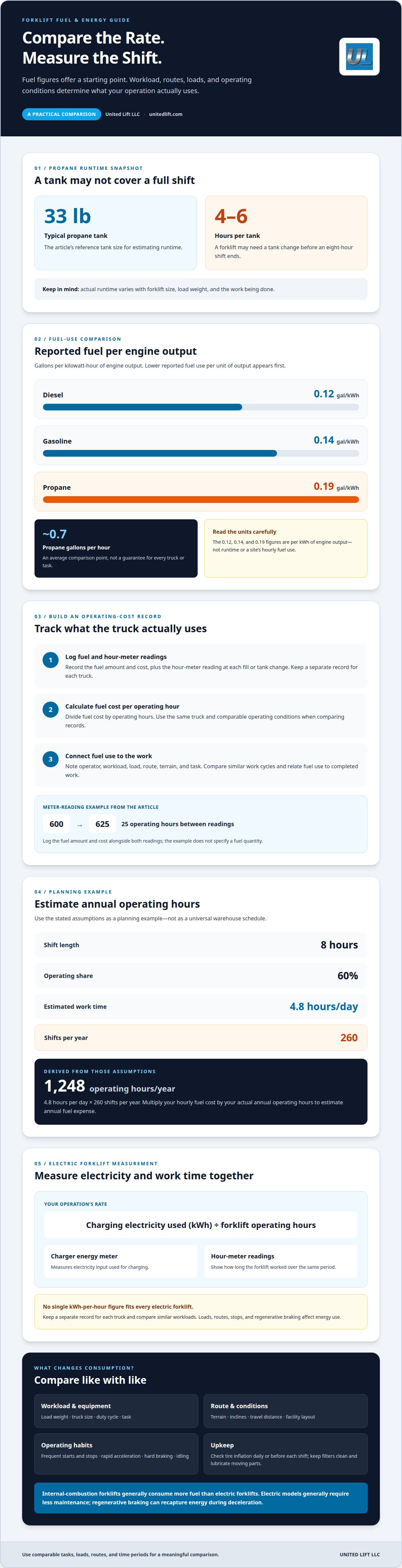
A typical 33-pound propane tank lasts 4 to 6 hours, so a forklift may need a tank change before an eight-hour shift ends. A useful forklift fuel consumption comparison looks beyond runtime to how much fuel each type uses and what that means for operating costs.
It’s easy to focus on the fuel bill alone. But forklift size, load weight, and the work being done all affect consumption, so the same fuel type won’t deliver identical runtime in every operation.
Here, you’ll learn how to estimate propane runtime, track fuel use by operating hour, and calculate fuel cost per hour. Then compare propane, diesel, gasoline, and electric forklifts to see how their energy use differs and which factors matter when choosing equipment for your work.
Key Takeaways
- Use fuel added and operating hours to track consumption and build a realistic cost-per-hour estimate.
- Compare propane, gasoline, diesel, and electric forklifts based on energy use and the demands of your operation.
- Factor in workload, load weight, and operating conditions when estimating how efficiently a forklift will run.
- For electric models, assess electricity use alongside charging needs to judge how well a forklift fits your shifts.
2. Calculating forklift fuel costs
Track fuel cost per operating hour to compare forklifts consistently. Record fuel used and hour-meter readings, then divide the fuel cost by operating hours. Keep each calculation tied to the same truck and operating conditions. Loads, truck size, and warehouse tasks affect fuel use, so a single shift may not represent every shift.
The hour-meter readings might be 600 at the start and 625 when the tank is replaced. Log both readings at each change, alongside the fuel amount and cost. This creates a record you can compare across shifts.
To estimate annual fuel expense, multiply hourly fuel cost by the hours worked per shift and shifts per year. One planning example assumes the truck works 60% of an eight-hour shift, or 4.8 hours per day, across 260 shifts per year. Treat this as an estimate based on those operating assumptions, not a universal warehouse figure.
Review the log by shift and operator. Note changes in fuel use alongside workload and operating conditions. Heavier loads require more energy to lift and move. Tracking consumption per hour helps distinguish higher fuel prices from changes in engine efficiency.
Emissions standards are separate from fuel-cost calculations. According to the U.S. Environmental Protection Agency, you may certify hand-startable, air-cooled, direct injection engines below 8 kW to an optional Tier 4 PM standard of 0.60 g/kW-hr. The U.S. Environmental Protection Agency also states that the EPA Tier 2 large spark-ignition engine standard for HC+NOx is 2.7 g/kWh. Neither figure is a fuel price or consumption rate, so keep emissions data distinct from your operating-cost worksheet.
3. Fuel consumption differences by forklift type
Load weight, duty cycle, truck size, terrain, and operator habits all affect consumption. Heavier material, inclines, frequent starts and stops, rapid acceleration, hard braking, and idling increase energy demand. A shift-by-shift log helps connect these conditions with fuel efficiency and productivity.
Gasoline, propane, and diesel forklifts use internal-combustion engines; electric models draw power from a battery. Internal-combustion forklifts generally consume more fuel than electric forklifts. A propane forklift averages about 0.7 gallons per hour, but actual use depends on the task, load, and operating conditions. That rate is a comparison point, not a guarantee for every truck.
Electric forklifts with regenerative braking can recapture energy during deceleration and use it to recharge the battery. This affects energy use during repeated travel and stopping, but does not eliminate the effect of the work cycle. Compare fuel or power use for the same material-handling task, route, and load to get a useful result.
Maintenance needs vary by power type. Electric forklifts generally require less maintenance than internal-combustion models. Check tire inflation daily or before each shift, keep filters clean, and lubricate moving parts to limit avoidable inefficiency.
For a practical comparison, separate operating conditions from equipment differences. Record fuel use by shift and operator, and note the loads, routes, and tasks completed. If consumption rises during a shift, consider whether the work involved heavier material, rough terrain, inclines, or excess idling. Facility layout and travel distance matter, too. Test alternate routes under comparable workloads to see whether shorter travel reduces fuel use without disrupting productivity. This makes the fuel-cost comparison more meaningful than relying on a single average.
3. How does diesel forklift fuel consumption compare with LPG and gasoline?
Reported fuel-use figures put diesel lowest per unit of output, followed by gasoline, then propane. The comparison is 0.12 gallons per kilowatt-hour for diesel, 0.14 for gasoline, and 0.19 for propane. A forklift fuel consumption comparison is clearest when all three figures use the same unit, rather than mixing gallons per hour with liters per hour.
These rates describe fuel consumed for each kilowatt-hour of engine output, not guaranteed runtime. A truck’s workload, load weight, and operating cycle affect the output it needs. For a fair comparison, match forklift capacity and task, then record fuel use and operating hours over equivalent shifts. Moving heavy loads on inclines differs from handling lighter loads on level routes.
Diesel’s lower reported figure can inform fuel planning, but it doesn’t determine the equipment choice on its own. Use the forklift fuel consumption comparison alongside the work pattern, route, and material handled. Measure fuel consumed against completed work, such as loads moved, rather than relying only on an engine rating.
Keep the comparison consistent:
- Record each truck’s fuel type, quantity used, and hour-meter readings.
- Compare forklifts performing similar tasks, with similar loads and routes.
- Calculate fuel consumed per operating hour, then relate it to completed work.
- Review shift records to identify workload or operating-condition changes.
Keep units distinct. The 0.12, 0.14, and 0.19 gallons-per-kilowatt-hour figures describe fuel use relative to output. An hourly log measures actual site consumption. Using both views helps separate reported engine consumption from the fuel used in your operation, and gives you a more practical basis for comparing equipment across equivalent workloads.
4. How much electricity does an electric forklift use per operating hour?
There’s no single kWh-per-hour figure for every electric forklift. Calculate your operation’s rate by recording electricity used for charging, then dividing total kilowatt-hours by forklift operating hours. A charger energy meter measures the site’s electricity input, while hour-meter readings show how long the truck worked.
For a useful result, collect both readings over the same period. Add the charging electricity used and operating hours for that period, then divide kWh by hours. Keep a separate record for each truck. Loads, routes, stops, and regenerative braking affect energy use, so compare similar work cycles.
Charging time is another part of the operating picture. A typical lead-acid forklift battery can take 4 to 6 hours to fully charge via opportunity charging. A lithium-ion battery can charge from 30% to 100% in as little as 1 hour. These are charging durations, not electricity consumption rates. Use metered kWh to determine actual energy use.
Battery type also shapes longer-term planning. Lead-acid forklift batteries generally last 3 to 5 years when conventionally charged, while lithium-ion batteries can last 10 years or longer. Electric forklifts require less maintenance than internal-combustion models. Include charging access, battery replacement timing, and maintenance needs when assessing total operating requirements.
For a practical comparison, log charger kWh and hour-meter readings for each shift. Note the truck’s workload and whether it used regenerative braking. Then compare kWh per operating hour across equivalent routes and tasks. This gives you a site-specific figure, rather than relying on a generic rate that may not match your material-handling cycle. To match electric forklift options to your operation, compare forklift options.
United Lift: Forklifts
United Lift LLC offers forklifts for operations evaluating fuel use, runtime, and workload before choosing equipment. The right match depends on the tasks, loads, routes, and power source required for your material-handling work. Use the consumption and cost calculations above to define those needs, then consider how each option fits your shifts and facility.
United Lift LLC can help you explore forklift options for your operation. This is a practical next step when your current equipment no longer fits the work or when you’re comparing power types for a new material-handling requirement. Share the tasks and operating conditions you’re planning around to focus the discussion.
Contact United Lift LLC to discuss forklift options for your operation.
Make your next equipment decision with confidence
Use your operating records to prepare a clear equipment brief before choosing a replacement or adding capacity. Identify the work the truck must handle, the performance your shifts require, and the operating costs your team needs to manage. A forklift fuel consumption comparison is most useful when it informs those real decisions, rather than being treated as a standalone figure.
United Lift LLC offers forklifts, boom lifts, and telehandlers for different material-handling and site needs. If your priorities have changed, use your brief to guide the conversation toward equipment suited to the work ahead.
Contact United Lift LLC today to discuss your equipment needs. Take the next step with a clear view of what your operation requires.
Frequently Asked Questions
How Long Will a Forklift Run on Propane?
A typical 33-pound propane tank commonly runs a forklift for 4 to 6 hours. Actual runtime changes with engine load, travel, lifting, and idle time. A truck moving heavy loads continuously may use fuel faster than one with intermittent tasks. For shift planning, track tank changes alongside operating hours, then use those records to estimate how often your own operation needs a replacement tank.
What Fuels Do Forklifts Run On?
Forklifts can run on gasoline, propane or LPG, diesel, and electricity. Some internal-combustion models are designed for dual-fuel operation. The practical choice depends on the work environment, duty cycle, refueling or charging setup, and loads being handled. Electric models draw power from a battery, while combustion models use an engine. Compare options against the same tasks and operating conditions for a useful evaluation.
How much fuel does a forklift use per hour by fuel type?
Reported fuel-use figures per kilowatt-hour are 0.12 gallons for diesel, 0.14 gallons for gasoline, and 0.19 gallons for propane. Another operating estimate gives internal-combustion forklifts about 6 pounds of LPG per hour. These measures use different units and describe different contexts. Keep the units separate, and compare machines doing similar work rather than treating either figure as a guaranteed hourly rate.
What is the average LPG forklift fuel consumption in gallons per hour?
An LPG forklift averages about 0.7 gallons per hour. That figure is a broad operating estimate, not a fixed rate for every shift. Load weight, travel distance, starts and stops, and idle time all affect consumption. For a useful site estimate, calculate the LPG used over a recorded period and divide it by the forklift’s operating hours during that same period.
What are typical fuel and electricity costs per hour for forklifts in the United States?
Treat it as an example, not a universal U.S. rate. Electric cost per hour depends on electricity consumed and the applicable price per kilowatt-hour. Multiply measured kWh per operating hour by your electricity rate. Fuel and electricity prices, workload, and consumption all shape the result.
How do forklift fuel costs compare over a year or total cost of ownership?
Estimate annual fuel expense by multiplying fuel cost per operating hour by actual operating hours for the year. For total cost of ownership, include energy, scheduled maintenance, and battery replacement needs alongside the equipment purchase cost. Compare models over the same ownership period and workload. This helps show whether lower hourly energy expense offsets other operating costs over time.
- Tags: diesel forklifts, electric forklifts, forklift fuel consumption, forklift fuel consumption comparison, forklift operating costs, gasoline forklifts, propane forklifts, warehouse equipment
