
How to Explain Which Forklift Fits Your Job
Posted by United Lift LLC on
A forklift request is strongest when it’s an operations case, not a personal preference. To explain how to convince your boss you need a new forklift, connect the equipment gap to work the business needs done: document where the current machine falls short, compare it with a suitable replacement, and show the expected return alongside benefits such as speed and operator experience. Bring specific examples and a clear recommendation.
You may already know the current forklift makes a difficult job slower or harder. The challenge is showing your boss how that problem affects business priorities, then making a practical case for change. This guide will help you build workplace support and prepare for management’s questions.
Use the SCORe model to shape your pitch, compare measurable and less tangible benefits, and weigh the proposed machine against the limitations of the one you have. You’ll also learn how to present the numbers and day-to-day impact clearly, giving your boss a useful basis for deciding.
Key Takeaways
- Build support by documenting how the current forklift affects the work and bringing respected coworkers’ observations into the discussion.
- Compare the proposed machine with the current one, including the costs of implementation, training, and managing the change.
- Use the SCORe model to give your pitch a clear structure and connect the equipment need to workplace priorities.
- Weigh measurable gains, such as speed and maintenance needs, alongside less tangible benefits like operator experience and safety.
1. Build support among colleagues and middle managers
Start with evidence from the people who use the forklift. Ask operators and managers to record recurring breakdowns, delays, difficult tasks, and safety concerns. Specific examples carry more weight than a general claim that a replacement would make work easier. A respected coworker can support your recommendation or present it if they can clearly explain the operational impact.
Show how the equipment affects available resources. Track when work waits for a forklift, which tasks fall behind, and whether deadlines are at risk. Connect those observations to business priorities, such as keeping production moving. Build credibility by doing your current job reliably, documenting examples accurately, and presenting a practical recommendation rather than demanding a specific machine.
For a safety case, describe hazards observed during actual work and how equipment condition contributes. OSHA estimates forklifts cause about 85 fatal accidents per year, 34,900 accidents resulting in serious injury, and 61,800 accidents classified as non-serious. These figures provide context, but your proposal should focus on your workplace’s documented risks. A replacement makes a stronger case when recurring failures, downtime, or task demands show the existing forklift no longer fits the work. The Industrial Truck Association reports a lift truck’s useful life is about eight years, a reference point rather than a stand-alone replacement rule.
Build the ROI case with the formula: net return divided by investment costs, multiplied by 100. Use your workplace’s figures for downtime, repairs, and expected gains. Compare the total costs of repairing, renting, and replacing by including purchase or rental charges, repair expenses, operating costs, and disruption. The balance depends on usage, repair frequency, rental duration, and the replacement’s fit.
Compare electric, propane, and diesel options against shift patterns, worksite conditions, and available charging or refueling arrangements. A forklift’s cost in the United States depends on its configuration and intended work, so use a specific proposal rather than a generic estimate. Gather breakdown records, downtime, task requirements, and safety observations. Present those findings, your return-on-investment calculation, and a suitable option to management.
2. How to Convince Your Boss to Give You the Right Tools
Frame the proposal around a problem management already tracks, such as delayed orders, missed production targets, or workflow bottlenecks. Show how the current forklift contributes, then explain how a better-fit machine could address that specific issue. A recommendation tied to output or schedule priorities is easier to assess than one based only on operator preference.
Include the transition work, not just the equipment purchase. List the practical tasks management would need to plan for:
- Operator familiarization with the replacement’s controls and daily procedures.
- Changes to charging or refueling routines and worksite setup.
- Time to transfer attachments, adjust workflows, and communicate the change.
- Temporary productivity effects while operators learn the new routine.
These are planning categories, not assumed costs. Explain what applies to your operation and how each item could affect shifts or output. For example, if charging arrangements need to change, describe the work required and who would coordinate it. That level of detail helps management understand the full implementation plan.
Build credibility with a concise proposal and evidence you can explain. Aristotle’s Rhetoric describes three modes of persuasion: ethos, pathos, and logos. Apply them by showing your track record, explaining the operational impact, and supporting the recommendation with records or a clear comparison. Address likely challenges directly, including transition disruption and the consequences of keeping the current setup.
If management wants proof before committing, propose a limited trial with defined success criteria. A trial could run for a week or a month, with measures such as completed work, delays, and operator feedback. Present the evaluation plan upfront, then report results honestly. If your manager has maintained current operations for 12 months, explain what changed in workload, task requirements, or equipment performance to make the request timely. For a practical comparison, review forklift options against the work your team needs to complete.
3. Structure a pitch with the SCORe storytelling model
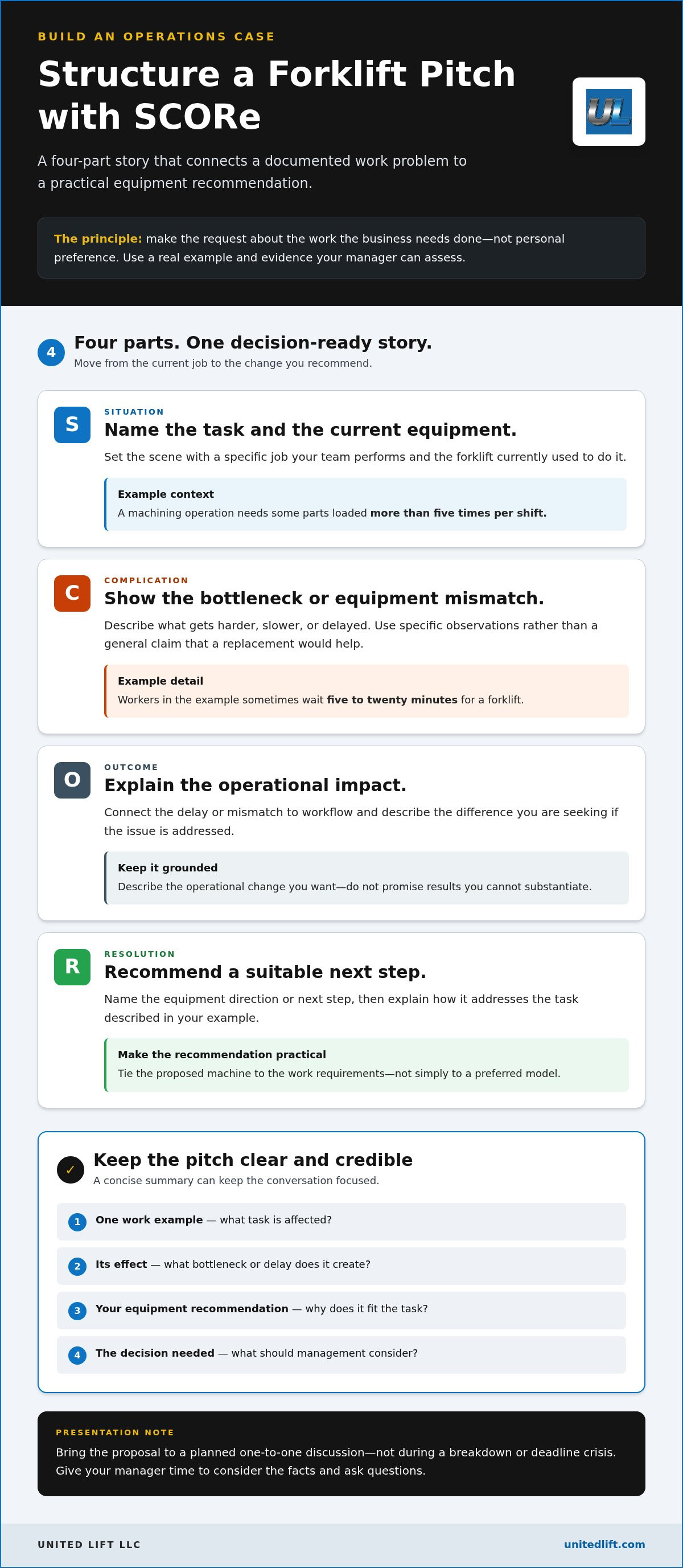
Use SCORe to shape your forklift recommendation into a short, decision-ready story: Situation, Complication, Outcome, and Resolution. In Situation, name the task and current equipment. In Complication, explain the specific bottleneck or mismatch. Outcome describes what may change if the problem continues or is solved. Resolution names the equipment direction and the decision you want. Tie each part to a documented work example.
For example, a machining operation may need some parts loaded more than five times per shift. Workers in this scenario sometimes wait five to twenty minutes for a forklift. Put those details in Situation and Complication, then explain how the delay affects workflow. Your Outcome should describe the operational difference you’re seeking, not promise results you can’t substantiate. In Resolution, recommend a suitable next step and explain why it addresses the task.
Choose a meeting time and setting based on when your boss is most receptive to suggestions. Bring the proposal to a planned one-to-one discussion rather than raising it during a breakdown or deadline crisis. Use a concise written summary to keep yourself on track: one work example, its effect, your equipment recommendation, and the decision needed. Give your manager time to consider the facts and ask questions.
Make urgency specific, not dramatic. Explain which workload, deadline, or repeated task makes a decision timely, then distinguish immediate needs from longer-term benefits. If a real purchasing window or operational deadline applies, state its date and consequence accurately. Don’t invent a countdown or imply that a discount exists. Close with a clear request, such as approval to compare a defined equipment option with the work requirements. A focused SCORe story helps management see the problem, the desired outcome, and the action you’re asking them to take.
4. Compare tangible and intangible benefits
Compare the proposed machine with the current forklift across measurable outcomes and workplace effects. Tangible benefits are easier to show in records: work completed, delays, maintenance demands, energy use, and consumables. Less tangible benefits still matter, but connect each one to an observable change. For example, a more suitable machine may make assigned tasks easier to carry out, while a better fit for the work could address a documented safety concern.
Build a side-by-side comparison using the same work requirements for both machines. Include:
- Speed and output: Identify tasks delayed by the current machine and how those delays affect schedules.
- Maintenance and consumables: Compare recorded service needs and the materials each machine uses.
- Energy efficiency: Assess energy use against the demands of your operation.
- Automation and competitiveness: Explain whether the proposed equipment supports the process or production goals management values.
Then explain less tangible gains without presenting them as guaranteed results. Operator experience can influence how comfortably and consistently a task gets done. Prestige may matter if modern equipment supports a customer-facing or recruitment goal, but it should not outweigh operational evidence. For safety, describe the hazards workers encounter and explain how a better-suited machine could address the task mismatch. Don’t claim that a new forklift eliminates risk.
Make each comparison specific to the job. If operators handle repeated loads, describe where the current process slows down and what the proposed machine is intended to improve. If energy efficiency is a priority, connect it to the operating pattern and available infrastructure. Keep assumptions separate from recorded facts. This helps management distinguish directly measurable benefits from those based on workplace experience.
Close with a balanced summary: name the strongest operational gains, the transition considerations, and the benefits that are harder to quantify. A clear comparison helps management judge the full case rather than focusing on one feature. Explore forklift options that fit the work your team needs to handle.
United Lift: Forklifts
United Lift LLC offers new and used forklifts for businesses assessing an equipment change. Once your proposal identifies the job requirements, compare forklift options against the loads, work environment, and daily tasks your team handles. A good fit matters more than features your operation won’t use. Bring management’s priorities and your documented work needs into the selection discussion, keeping the decision tied to the case you’ve built. If the work involves access or material handling beyond a standard forklift’s role, United Lift LLC also offers boom lifts, telehandlers, and scissor lifts.
Contact United Lift LLC to discuss forklift options for your operation.
Turn your recommendation into a clear next step
Your proposal can move the conversation forward, but the equipment choice still needs to match the work. Before management makes a decision, turn your findings into practical selection criteria: the tasks the forklift must handle, the conditions it will operate in, and the workflow it needs to support. That keeps the next discussion focused on fit, not preference.
If you’re deciding how to convince your boss you need a new forklift, make the request specific and give management a clear way to evaluate it. You don’t need to have every answer. You do need to show what decision you’re asking for and what information will help your team move ahead.
United Lift offers forklifts, boom lifts, and telehandlers, giving you equipment options to consider as your operation’s needs take shape. Contact United Lift to discuss your forklift needs and take the next step with a clear, job-focused plan.
Frequently Asked Questions
How do I convince my boss to give me the right tool for my job?
Show how the equipment fits a specific task and supports a workplace priority. For example, connect repeated load handling to delays, awkward workflows, or missed production targets. Explain why the current equipment creates the problem and what capability the proposed option adds. If you’re deciding how to convince your boss you need a new forklift, make the request about the job’s needs, not personal preference.
So, What’s The Solution?
Match the equipment decision to the operational problem, then agree on a practical next step. If the current machine can still meet essential needs, management might compare alternatives or set a review point. If it cannot safely or reliably support the work, present replacement as the option to evaluate. Define who needs to decide, what evidence they need, and how the team will assess the choice.
How do I calculate forklift downtime costs and lost productivity?
Record each outage, the tasks delayed, and the people or processes affected. Estimate lost productivity by comparing completed work during normal operation with output during the interruption. Add directly attributable expenses, such as repair charges or paid waiting time, using company records. Keep assumptions visible and avoid counting the same delay twice. Separate confirmed losses from estimates so management can judge the calculation.
How can I estimate the ROI and payback period for a new forklift?
Calculate ROI by dividing net return by investment costs, then multiplying by 100. Estimate payback by comparing the investment with the savings it is expected to generate over time. Build the estimate from workplace figures, including reduced downtime or operating expenses, and account for transition costs. State the period used and show assumptions clearly. If savings vary by workload, compare realistic operating scenarios rather than relying on one projection.
What safety risks and OSHA requirements apply to old or unreliable forklifts?
Potential hazards include collisions, struck-by incidents, and crushing injuries, especially when equipment condition or task assignment creates risk. A forklift’s age alone doesn’t establish whether it meets applicable requirements. Document observed defects and hazardous work conditions, then follow workplace safety procedures and applicable OSHA requirements. Include the affected task, location, and equipment condition in the report so the safety review can address the actual exposure.
How can a newer forklift improve fuel efficiency, emissions, and operating costs?
A newer forklift may reduce energy use or operating expense if it better matches the workload, but compare actual performance rather than assuming savings. Track fuel or electricity consumed for similar tasks, along with idle time and operating hours. Consider emissions in relation to the energy source and work environment. Include any changes needed for charging or refueling, then evaluate the full operating picture against the current machine.
- Tags: business case, equipment upgrades, forklift replacement, forklifts, how to convince your boss you need a new forklift, material handling, warehouse operations, workplace safety
