
JLG Telehandler for Sale: Buyer’s Guide & Financing
Posted by United Lift LLC on
Did you know that global procurement for heavy-duty earthmoving equipment jumped by 22% in the first quarter of 2026? This surge means more competition for the best machinery on the market. If you're currently hunting for a JLG telehandler for sale, you're likely feeling the pressure of high capital investment and the fear of choosing a model that doesn't match your specific reach needs. It's frustrating to navigate similar model numbers while worrying about long-term maintenance costs and potential downtime.
We understand that you need a reliable workhorse that maintains a high resale value. This guide provides an expert breakdown of the 2026 JLG lineup, including high-capacity staples and the new E313 electric models. You'll learn how to identify the right reach class for your job site and understand financing strategies that leverage the $2,560,000 Section 179 deduction limit. We'll show you how to secure a machine that strengthens your fleet and protects your cash flow.
Key Takeaways
- Learn why JLG is the industry standard and how to decode model numbers to match reach and capacity to your job site.
- Master a critical inspection checklist for pre-owned equipment that covers boom health, hydraulic leaks, and engine diagnostics.
- Identify the right JLG telehandler for sale while maximizing your ROI through the latest Section 179 tax deductions.
- Compare leasing and buying strategies to determine which path preserves the most working capital for your operations.
- Understand how national inventory access and seven-day support help you secure a machine with high resale value.
Why JLG Telehandlers are the Industry Standard for Material Handling
Reliability isn't just a marketing buzzword for JLG; it's a financial strategy. On North American job sites, these units are prized for their high resale value and rugged construction. When you look for a JLG telehandler for sale, you're investing in equipment that holds its worth better than almost any other brand in the material handling space. This durability is a major reason why global procurement of heavy-duty equipment jumped by 22% in the first quarter of 2026. Beyond the steel, JLG focuses heavily on the operator experience. Their engineering prioritizes wide-angle visibility and intuitive, single-joystick controls. This reduces operator fatigue and improves safety on crowded sites. Because JLG is a dominant market leader, parts are easy to find. You won't be waiting weeks for a specialized seal or hydraulic hose, which keeps your projects moving.
The Evolution of the JLG Telehandler Lineup
The JLG journey moved from the early Skytrak acquisitions to the modern, high-capacity G-series models seen on sites today. Each generation has seen a tighter integration of safety technology. Modern models like the 1055 or the 1255 include automatic load sensing and stability systems that monitor every boom extension. In 2026, the shift toward smarter fleet management is the new standard. JLG's ClearSky SmartFleet™ system allows owners to track machine health, fuel levels, and precise locations through IoT-enabled sensors. This transition from simple lifting to data-driven fleet management helps contractors avoid unexpected downtime. It turns a piece of iron into a predictable asset that reports its own maintenance needs before a failure occurs.
Telehandlers vs. Standard Forklifts: When to Upgrade
A standard warehouse forklift is excellent for moving pallets on flat concrete, but it fails the moment you hit mud or need to reach a third-story balcony. Telehandlers provide the rough terrain capability necessary for undeveloped job sites. They combine the vertical lift of a forklift with the reach and versatility of a crane. If your project involves lifting materials over obstacles or onto elevated decks, a standard mast won't cut it. You need the telescopic boom to bridge the gap. Attachment versatility is another reason to upgrade. By swapping forks for a grapple bucket or a work platform, a single JLG unit replaces multiple specialized machines. This consolidation is a key trend in 2026 as contractors look to reduce the total number of machines they need to transport and maintain.
Comparing JLG Telehandler Models: Reach, Capacity, and Class
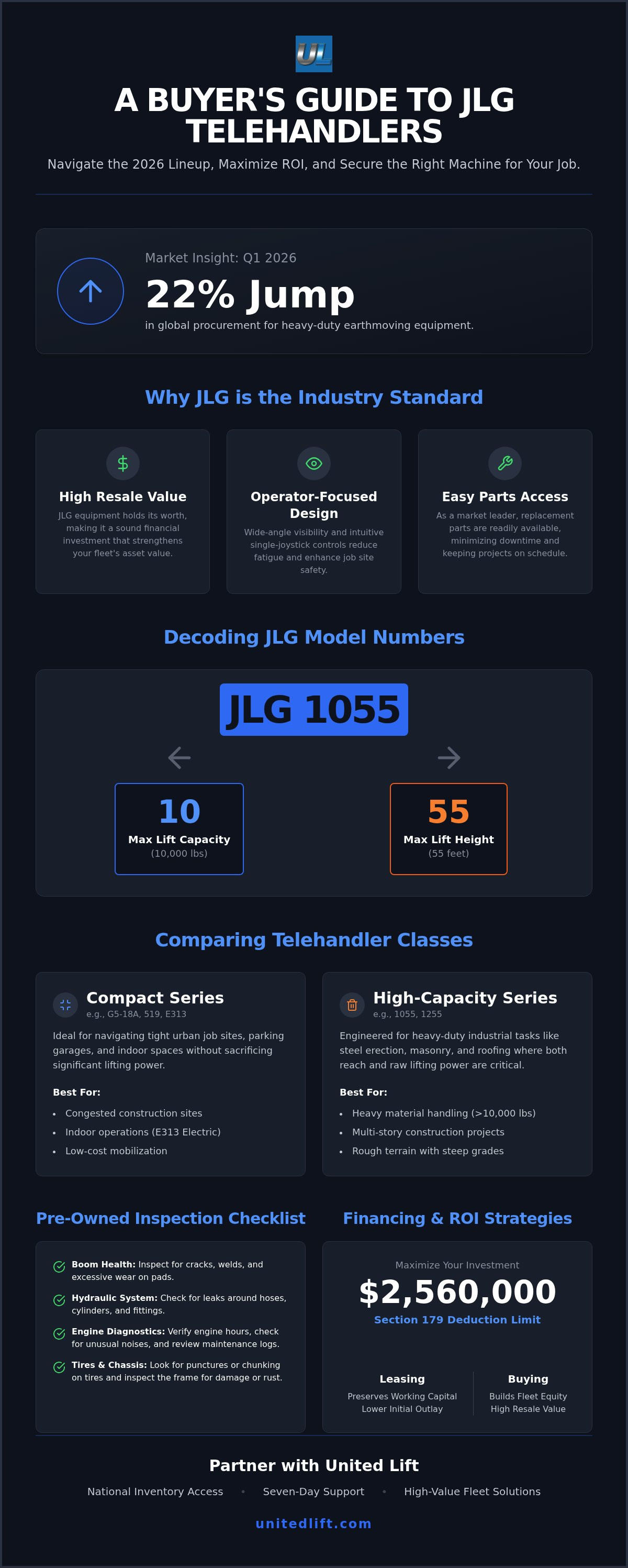
Understanding JLG's model numbering system is the first step toward a smart purchase. Most units follow a predictable pattern. The first one or two digits tell you the maximum lift capacity in thousands of pounds. The final two digits indicate the maximum lift height in feet. A 1055 model, for instance, handles 10,000 pounds and reaches 55 feet. This clarity makes it much easier to find a JLG telehandler for sale that fits your load charts exactly. Selecting a machine based on these clear indicators prevents the common mistake of over-investing in capacity you don't need or under-powering your job site.
Compact Telehandler Series (e.g., G5-18A, 519, E313)
These machines thrive where space is at a premium. If you're navigating parking garages or tight urban alleys, a compact unit is your best tool. Models like the G5-18A or the 519 are narrow enough to fit through standard openings but powerful enough for significant material movement. They feature a tight turning radius for navigating congested sites. Their smaller footprint also means they're easier to transport between jobs using standard trailers. This keeps your mobilization costs low and your logistics simple. The 2026 E313 electric model even allows for indoor operation without the need for complex exhaust ventilation.
High-Capacity and High-Reach Models (e.g., 1055, 1255)
When your project involves heavy masonry, roofing, or steel erection, you need more than just reach. High-capacity models like the 1055 and 1255 are designed for these heavy-duty industrial tasks. They offer maximum lift capacities exceeding 10,000 lbs for handling heavy pallets at height. Stability is key here. These units come equipped with outriggers and chassis leveling systems to ensure the machine stays grounded when the boom is extended up to 55 feet. This prevents the tip-overs that can occur when heavy loads are shifted at high angles.
Your choice of tires and engine power should reflect your job site's ground conditions. Foam-filled tires are essential for avoiding downtime from punctures on construction sites littered with debris. If you're working on soft or sensitive turf, pneumatic tires might be the better choice for flotation. All modern JLG units now utilize Tier 4 Final engines. These provide the necessary torque for climbing steep grades while meeting the strict 2026 emissions regulations. If you need help deciding between a compact or high-reach unit, explore our national inventory to compare specific model capabilities side-by-side.
Key Features to Inspect When Buying a Used JLG Telehandler
Finding a reliable JLG telehandler for sale requires more than a quick visual walk-around. You need a systematic approach to identify hidden wear that could lead to project delays. While JLG units are built for longevity, their service life depends entirely on how the previous owner managed daily maintenance. Start your evaluation at the boom. Look for cracks in the welds, especially near the pivot points and cylinder mounts. Any sign of structural repair or re-welding should be a red flag that requires further investigation.
A smooth extension depends on the condition of the internal wear pads. If these pads are neglected, the boom can chatter or bind. This leads to expensive repairs down the road. Check the boom sections for scoring or deep scratches that indicate debris has been trapped inside. You should also examine the tire condition carefully. Foam-filled tires are common on job sites, but they aren't indestructible. Look for "chunking" where large pieces of rubber have been torn away, or dry rot on the sidewalls. Replacing a full set of heavy-duty tires is a significant expense you should account for in your initial offer.
Fluid analysis tells the true story of the engine and transmission. Pull the dipstick. Look for milky oil, which suggests coolant contamination, or a burnt smell in the transmission fluid. During your test drive, pay attention to the shift quality. The machine should move through gears without lurching or hesitation. If the transmission feels "soft" or slow to engage, the internal clutches may be nearing the end of their life.
The Critical Hydraulic System Check
The hydraulic system is the heart of any telehandler. Perform a drift test by lifting a rated load and shutting off the engine. If the boom sinks more than a fraction of an inch over several minutes, the valve integrity is likely compromised. Inspect every hydraulic hose for weather-checking or fraying. Sun exposure eventually makes the outer rubber brittle, leading to high-pressure leaks. Finally, verify the load stability indicator. This system is a vital safety feature that prevents the operator from extending too far for the current load weight. If it isn't calibrated or functional, the machine isn't job-site ready.
Operator Cab and Safety Systems
Structural integrity extends to the operator's environment. The ROPS/FOPS cab structure must be free of dents or unauthorized modifications like drilled holes or welded brackets. Test every joystick function to ensure the controls are responsive and precise. Don't forget the basics. The backup alarm, work lights, and safety cut-off switches must be fully operational to meet site safety requirements. A machine that fails these simple tests often indicates a broader pattern of maintenance neglect.
Don't overlook the hour meter and service records. Compare the hours to the wear on the foot pedals and the operator’s seat. If a machine shows 1,500 hours but the cab is shredded and the pedals are worn smooth, the meter may not be accurate. A complete service log is the best proof that the machine will remain a reliable asset for your fleet.
Financing Your Purchase: Section 179 and ROI Strategies
Investing in a JLG telehandler for sale is a significant capital commitment, but the right financing strategy turns that cost into a competitive advantage. One of the biggest benefits of choosing JLG is the brand's historically high resale value. This reduces your total cost of ownership because you'll likely recover a larger portion of your initial investment when it's time to upgrade your fleet. We also understand that construction income is often seasonal. Because of this, we recommend structuring your payment schedule to match your cash flow, allowing for higher payments during peak project months and lower obligations during the off-season.
Understanding Section 179 for Heavy Equipment
Section 179 is a vital tool for construction fleet growth. For the 2026 tax year, the maximum deduction limit has been adjusted for inflation to $2,560,000. This allows you to deduct the full purchase price of qualifying new or pre-owned JLG telehandlers in the very first year they are placed in service. Instead of waiting years for standard depreciation, you get an immediate tax break that can save you tens of thousands of dollars on a six-figure equipment investment. This deduction only begins to phase out once your total equipment purchases for the year exceed $4,090,000, making it an accessible strategy for small and medium-sized businesses.
Financing Options for Small and Medium Businesses
Deciding whether to lease or buy depends on how you want to manage your balance sheet. A standard equipment loan allows you to build equity immediately and eventually own the asset outright. As of August 2026, well-qualified borrowers with strong credit scores can expect interest rates between 6% and 15% for new equipment. If you're looking at used models, rates typically range from 7% to 14%. A higher down payment can often help you secure the lower end of these ranges.
Alternatively, a fair market value (FMV) lease preserves more working capital by offering lower monthly payments than a traditional loan. This is an excellent choice if you prefer to rotate your equipment every few years to keep your fleet modern. No matter which path you choose, having the right financial partner makes the process seamless. Explore our industrial lift equipment financing options to find a plan that protects your cash flow while giving you the lifting power you need.
Our team acts as a reliable facilitator to help you navigate these high-capital purchases with confidence. We focus on your practical needs and move quickly to get your equipment on the job site. Talk to our financing experts today to see how we can help you secure your next JLG telehandler.
Finding Your Next JLG Telehandler at United Lift
Finding a JLG telehandler for sale shouldn't be a guessing game. You need a partner who understands that every day your fleet is incomplete is a day of lost productivity. At United Lift LLC, we act as a reliable facilitator for your high-capital equipment needs. Our national inventory includes a wide range of new and pre-owned JLG models, ensuring you find the exact reach and capacity class discussed earlier in this guide. We prioritize your immediate requirements, moving you quickly from identifying a need to securing a point of contact.
We don't just list machines; we provide the expert advice needed to match a unit to your specific application. Whether you need a compact model for urban work or a high-reach workhorse for industrial masonry, we help you navigate the options. Our team is available seven days a week to answer your questions. This constant availability means you won't lose a weekend waiting for a response while a project deadline looms. We value your time and understand the urgency of the construction industry. Our professional yet approachable staff is ready to assist whenever your business needs a lift.
National Reach and Equipment Sourcing
We source high-quality JLG units from across the country to maintain a diverse selection of machinery. This allows us to offer both economy and premium lift solutions, catering to different budget requirements and project scales. You aren't limited to what's available locally. Our national scope gives you access to a broader variety of configurations and attachment options. The United Lift LLC advantage is our hands-on expertise. We understand the material handling industry because we're deeply integrated into the logistical needs of our clients. Every machine in our inventory is vetted to ensure it meets the reliability standards your business demands.
Ready to Expand Your Fleet?
Preparing for a high-value acquisition requires clear communication and fast action. Our streamlined financing facilitation is designed to move your machine to the job site as quickly as possible. We work with you to handle the paperwork and logistics so you can stay focused on your projects. If you've identified the right capacity and reach for your next job, the next step is simple. Reach out to our team to inquire about our current stock and get a detailed breakdown of available units. We're here to make the transaction as efficient as the machines we sell. Browse our JLG telehandlers for sale today and let us help you secure a reliable asset with high resale value.
Secure Your Next Fleet Asset Today
Choosing the right machinery is the difference between a profitable project and a costly delay. You now have the tools to decode JLG model numbers, perform a rigorous hydraulic inspection, and leverage tax incentives like Section 179 to protect your bottom line. Investing in a JLG telehandler for sale secures an asset known for its durability and high resale value across North America. It's about more than just lifting; it's about building a fleet that works as hard as you do.
United Lift is ready to help you find the perfect match for your specific job site requirements. We offer financing options for all credit types and provide expert support seven days a week to keep your operations moving. With our national delivery facilitation, getting a high-quality machine to your site is faster and easier than ever. We're here to act as your reliable facilitator for every high-capital purchase.
View Our Current JLG Telehandler Inventory and take the next step in growing your fleet with confidence. Your next project deserves the reliability and reach of a JLG.
Frequently Asked Questions
What is the difference between a JLG telehandler and a Skytrak?
JLG acquired the Skytrak brand to offer two distinct styles of machinery. JLG models typically feature more advanced technology, integrated safety systems, and single-joystick controls. Skytrak units are known for their simple, rugged design and traditional mechanical levers. Both brands are manufactured by JLG Industries, so you get the same reliable parts availability. Choosing between them depends on whether your operators prefer a high-tech interface or a straightforward, mechanical workhorse.
How much can a JLG 1055 telehandler lift at maximum reach?
While the 1055 model has a maximum capacity of 10,000 pounds, that capacity drops as the boom extends. At its maximum lift height of 55 feet, the capacity is approximately 3,000 pounds when the outriggers are deployed. Always check the specific load chart located inside the cab before starting a lift. Understanding these limits is vital when you search for a JLG telehandler for sale to ensure the machine safely handles your heaviest materials.
Is it better to buy a new or used JLG telehandler for a startup?
Buying a used JLG telehandler is often the best choice for a startup to preserve working capital. These machines are built for longevity and maintain high resale value, making them a safer investment than many off-brand alternatives. If you have the budget for a six-figure investment, new models offer the latest 2026 technology and full factory warranties. Most startups find that a well-maintained pre-owned unit provides the best balance of performance and affordability.
What are the most common attachments for JLG telehandlers?
The most common attachments include pallet forks for standard material movement and grapple buckets for site cleanup. Many contractors also use lifting hooks to perform light crane work or work platforms for elevated maintenance tasks. These attachments allow a single machine to replace multiple specialized units on a job site. Swapping tools is a fast process, which maximizes the utility of your machine and improves your overall return on investment.
How often does a JLG telehandler require professional servicing?
Operators should perform a visual walk-around inspection every day before use. Professional servicing typically occurs at 250-hour or 500-hour intervals, depending on how hard the machine is working. These service calls focus on hydraulic fluid health, filter changes, and boom lubrication to prevent wear on the internal pads. Regular maintenance is the most effective way to prevent unexpected downtime and ensure your machine remains job-site ready for years to come.
Can I finance a used JLG telehandler through United Lift?
Yes, we facilitate financing for both new and pre-owned equipment through our national network of lenders. We work with all credit types to find a payment structure that fits your business needs. As of August 2026, interest rates for used heavy equipment generally range from 7% to 14% APR for qualified borrowers. Our team is available seven days a week to help you navigate the application process and get your machine to the site faster.
What safety certifications are required to operate a JLG telehandler?
OSHA requires all operators to be trained and certified by their employer before using a telehandler. This process involves both formal classroom instruction and a practical evaluation on the specific machine type. While we don't provide this training directly, we encourage all owners to ensure their staff understands how to read load charts and operate stability systems. Proper training is the most important factor in preventing tip-overs and ensuring a safe working environment.
How does the Section 179 deduction apply to telehandler purchases in 2026?
In 2026, the Section 179 deduction limit is $2,560,000 for qualifying equipment like a JLG telehandler for sale. This allows you to deduct the full purchase price of the machine in the first year it's placed in service. This tax benefit applies to both new and used equipment, provided your total annual purchases don't exceed the $4,090,000 phase-out threshold. It's a significant financial tool that helps businesses grow their fleets while reducing their total tax liability.
- Tags: Buyer's Guide, Construction Equipment, Equipment Financing, Heavy Equipment, JLG, JLG Models, JLG telehandler for sale, Section 179, Telehandler
