
20k Telehandler with 45' Reach: How to Choose the Right Machine
Posted by United Lift LLC on
Could a 20k telehandler 45' reach lift your load where the job needs it? The headline numbers can be misleading: 20,000 pounds is a maximum rated capacity, not the capacity available at every boom position. And 45 feet may describe maximum lift height, not horizontal forward reach.
Start with capacity and reach, then verify the lift using the machine’s load chart. The chart shows what the telehandler can handle at a specific boom position and configuration. Choose based on the chart capacity at your lift point, not the biggest number in a listing.
This guide explains what the 20,000-pound and 45-foot specifications mean, how to read a load chart, and which machine details to compare before buying. You’ll also learn how to account for the load, attachment, terrain, and worksite, then compare new and pre-owned telehandlers. United Lift sells both, with financing options available through the dealership. Begin with the lift your job requires, then use the specifications to identify a suitable machine.
Key Takeaways
- Separate rated capacity from the load a machine can handle at the required boom position.
- For a 20k telehandler 45' reach listing, determine whether 45 feet means lift height or forward reach.
- Use the machine’s load chart to check capacity for your lift height, reach, and configuration.
- Compare job-critical specifications, including dimensions, tires, and attachment setup, with your load and worksite.
- Use the same task checklist for new and pre-owned options to focus on fit, configuration, and ownership needs.
What Does a 20k Telehandler with 45' Reach Actually Mean?
A listing’s headline figures are a starting point, not a complete description of what a machine can do. “20k” should mean a 20,000-pound rated capacity only when the listing identifies pounds and confirms that rating. The phrase 20k telehandler 45' reach still leaves a key question unanswered: does 45 feet refer to vertical lift height or horizontal forward reach?
A telehandler uses a telescoping boom to move loads up and outward. For a basic overview of its design and uses, see Telescopic handler. To choose a machine, define the lift: the load’s weight, where it must be placed, how high it must go, and the worksite conditions.
Does 45 feet mean lift height or forward reach?
Lift height is the vertical height to which the machine can raise a load. Forward reach is the horizontal distance from the machine to the load. They describe different measurements, so one does not establish the other. Check the specifications for the exact term and measurement. If the job requires placing a load high and away from the machine, verify both dimensions.
What does a 20,000-pound rating tell you?
A rated capacity is tied to operating conditions and boom position. It describes a specified limit, not a promise that the telehandler can lift 20,000 pounds at every height or extension. Capacity can decrease as the boom extends, so use that machine’s load chart to find the capacity for your lift. Treat “20k” as a search shorthand, not proof of performance at a particular reach.
For example, a load placed beyond the machine’s front tires and raised to a platform requires more than a weight check. The required forward reach, lift height, boom position, attachment, and site conditions all matter. A level, open work area presents different operating conditions from uneven or restricted terrain.
Before comparing machines, identify the placement point and measure the height and horizontal distance the load must travel. Then compare those requirements with the machine’s specifications and load chart for the intended configuration. The right choice is the one whose chart supports the actual lift, not simply the one with the largest numbers in its listing.
How to Read the Load Chart at 45 Feet
A load chart turns a machine’s specifications into a task-specific capacity check. It shows how much the telehandler can handle at different boom positions and configurations. Allowable capacity changes as the boom extends or moves to a different angle, so the maximum rating alone can’t tell you whether a lift works at a particular reach.
For a 20k telehandler 45' reach, don’t assume the chart’s 45-foot measurement refers to the distance you need. First determine whether your job requires a specific horizontal reach, vertical lift height, or both. Then use the chart for the exact machine to check capacity at that position.
How do you check capacity at the required reach?
Start with the load’s verified weight, including the attachment used to handle it. Measure the horizontal distance from the machine to the placement point and the height where the load must land. Find those measurements on the applicable chart, using its diagram, grid, or other format. The marked capacity for that position must accommodate the load and attachment weight.
Why can attachments change the lift calculation?
An attachment changes the machine’s operating configuration and may reduce available capacity. Its weight counts as part of the lift, and its design can position the load farther from the carriage. Follow the load-chart guidance for the specific attachment and telehandler combination. Don’t assume a chart for standard forks applies to a different setup.
Use this sequence:
- Confirm the load weight and include the attachment’s weight.
- Measure the required horizontal reach and vertical placement height.
- Locate the required boom position on the correct load chart.
- Read the capacity limit for that chart zone and configuration.
- Review chart notes, restrictions, and attachment guidance before treating the lift as suitable.
Charts vary by machine, and their labels or diagrams may differ. Read the chart supplied for the exact telehandler rather than applying a generic chart or a capacity figure from another machine. If the required position falls between marked points, or a chart note is unclear, don’t estimate capacity from the headline rating. Follow the manufacturer’s chart guidance and applicable operating procedures. The telehandler safety standards resource offers further safety context.
Once you’ve established the chart requirements for your lift, compare them with telehandlers and configurations suited to the task. Explore United Lift telehandlers as you narrow down your purchase options.
Compare 20k Telehandlers by the Specs That Affect Your Job
Once you know the lift requirements, compare machines against the same checklist. A headline capacity or familiar brand name can help narrow a search, but neither shows whether a specific configuration suits your work. Prioritize verified chart performance, site fit, and the attachment setup you’ll use.
| Specification | What to compare | Priority |
|---|---|---|
| Capacity | Rated capacity and chart capacity at the required boom position and configuration | Must-have |
| Reach and lift height | Verified horizontal reach and vertical height for your placement point | Must-have |
| Dimensions | Machine width, height, and length against access routes, work zones, and transport limits | Must-have |
| Tires and ground clearance | Tire type, clearance, and traction suited to the site surface and terrain | Must-have |
| Attachment setup | Compatible attachment and load-chart guidance for the complete configuration | Must-have |
| Cab and controls | Visibility, control layout, and ease of operator access | Usability factor |
Which specifications matter beyond capacity and reach?
Check the route into the work area, not just the lift location. A machine that meets the chart requirement may still be unsuitable if its dimensions don’t fit through an entrance or around an obstacle. Match tires, traction, and ground clearance to the actual surface. Then consider cab visibility, controls, and operator access as usability factors, not substitutes for essential lift requirements.
How should you compare attachments and configurations?
Choose forks or another attachment based on the load’s shape and handling method. Compare the complete setup, since attachment weight and position can affect available capacity. Check that the machine’s chart applies to that attachment and configuration. Don’t assume an attachment can be transferred between machines without checking compatibility and chart guidance.
Separate must-have requirements from preferences. Chart fit, reach, height, dimensions, terrain suitability, and attachment compatibility determine whether a candidate can perform the task. Convenience features can help distinguish between machines that already meet those requirements. Brand and model matter less than verified specifications and configuration.
For broader material-handling purchases, use the same disciplined comparison: define the task, check the specifications, and consider how the equipment fits your operation. Review applicable workplace requirements, including OSHA’s powered industrial truck standard. Apply this checklist to every 20k telehandler 45' reach candidate, so headline figures don’t distract from the details your job depends on.
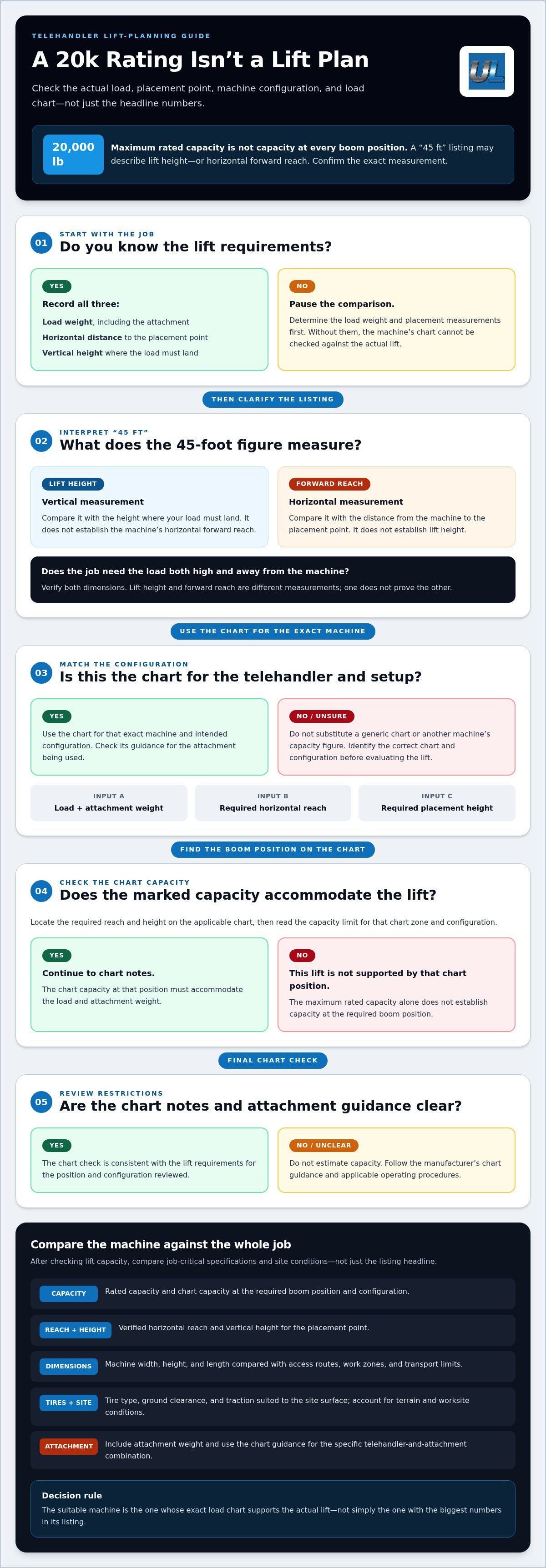
Use This Jobsite Checklist Before Choosing a 20k Telehandler
Turn the worksite into a clear set of requirements before comparing machines. Record routine lifts as well as the most demanding task you expect the telehandler to handle. This gives you a practical basis for comparing a 20k telehandler 45' reach listing with your work, instead of relying on headline specifications.
- 1. Define the load. Record the heaviest load and its verified weight. Include the attachment used to handle it, and note the load’s shape and pickup method.
- 2. Mark pickup and placement points. Identify where the load starts and where it needs to go. Measure the horizontal distance and required clearance around each point.
- 3. Record lift height and forward reach. Measure the vertical placement height and horizontal distance from the machine to the load. Keep these as separate measurements to compare listings and specifications accurately.
- 4. Describe the ground and route. Note surface conditions, gradients, confined access, turning constraints, and overhead obstacles. These details can affect which machine fits the work area.
- 5. Check access and transport dimensions. Record the limits for entrances, work zones, and transport. Compare them with each candidate machine’s verified dimensions.
- 6. Capture recurring work. List frequent lifts and identify the most demanding routine task. A machine that fits only an occasional lift may not be the best match for daily work.
- 7. Compare machines against the complete job. Use the same load, reach, height, terrain, access, and attachment requirements to review each candidate’s specifications and applicable load chart. Apply this checklist to new and pre-owned options.
Keep your measurements, notes, and machine documents together. For each prospective telehandler, compare the exact configuration with the job requirements and review the manufacturer’s manuals and applicable safety requirements. This checklist is for purchase planning, not an operating procedure. Operators should follow the instructions and limits for the specific machine and task.
With your requirements documented, focus your purchase on machines that suit the worksite and recurring lifts. Explore telehandler purchase options and compare candidates against your checklist.
Buying a 20k Telehandler: Match the Machine to Your Operation
A suitable purchase comes down to four checks: the load chart supports your lift, the machine fits the jobsite, the configuration matches the task, and the ownership plan suits your operation. A 20k telehandler 45' reach listing is only a starting point. Base your decision on the exact machine’s verified specifications and the work you need it to do.
Before comparing purchase options, gather your recurring lift requirements: load weight, placement point, lift height, forward reach, terrain, access dimensions, and attachment. Use the same task checklist for every candidate. This keeps the comparison consistent and focuses it on machine fit rather than a headline rating or purchase category.
Should you consider a new or pre-owned telehandler?
Review new and pre-owned telehandlers against the same job requirements. Compare each option’s applicable load chart, reach, lift height, dimensions, and attachment configuration with your needs. For pre-owned equipment, consider available condition information alongside your intended workload. Age or category alone doesn’t establish whether a machine suits the task. Evaluate the particular machine and configuration, not just whether it’s new or used.
What is the next step toward a suitable purchase?
Bring your measurements and lift requirements into the purchase conversation. Include the heaviest routine load, where it must be placed, required height and reach, site conditions, and attachment setup. These details focus the discussion on suitable telehandler specifications instead of broad capacity claims.
United Lift sells telehandlers, including new and pre-owned equipment from major brands, and facilitates equipment financing options. Consider how the machine will support your operation’s workload and equipment plan, then compare purchase paths using the same verified requirements. Keep the load chart, jobsite fit, configuration, and ownership plan in view throughout the decision.
Explore telehandlers and discuss your equipment needs with United Lift to take the next step toward a machine matched to your operation.
Choose Your Telehandler with Confidence
The right 20k telehandler 45' reach is the one that fits your lift, not just the one with the biggest headline numbers. Confirm whether 45 feet refers to vertical lift height or forward reach, then use the exact machine’s load chart to verify capacity at the boom position and configuration your task requires.
Before comparing options, write down the load weight, placement point, site conditions, access dimensions, and attachment needs. Use those same requirements to assess each machine, whether new or pre-owned. This keeps the decision focused on chart fit, jobsite fit, configuration, and an ownership plan that works for your operation.
United Lift sells telehandlers, including new and pre-owned equipment, and offers financing options through the dealership. Bring your job requirements into the purchase conversation and explore telehandlers and discuss your equipment needs with United Lift.
With the right specifications in hand, you can move forward knowing what your operation needs and why. Make your next equipment decision with confidence.
Frequently Asked Questions
Can a 20,000-pound telehandler lift 20,000 pounds at 45 feet?
Not necessarily. A 20,000-pound rating describes a specified maximum capacity, not the capacity available at every boom position. At 45 feet, allowable capacity depends on whether that measurement means vertical lift height or horizontal forward reach, along with the boom position and configuration. Check the load chart for the exact machine and setup to see whether it supports the load at your placement point.
Does 45-foot reach mean a telehandler can lift 45 feet high?
No. “Reach” may refer to horizontal forward reach, the distance from the machine to the load. Lift height describes how high the load can be raised vertically. A listing’s “45-foot reach” wording can be ambiguous, so review the machine specifications to identify the exact measurement. If your task requires placing a load both high and away from the machine, verify lift height and forward reach separately.
How do I read a telehandler load chart?
Start with the chart for the exact machine and configuration. Find the boom position, reach, and lift height needed for the task, then read the capacity shown for that position or chart zone. Compare that limit with the load’s verified weight, including the handling attachment. Review chart notes and restrictions as well. Don’t use a chart from a different machine or assume the maximum rated capacity applies throughout the boom’s working range.
What affects a telehandler’s capacity at full reach?
Capacity at full reach depends on the machine’s load chart for that boom extension, boom angle, and operating configuration. The attachment also matters: its weight and the position of the load relative to the carriage can affect available capacity. Site conditions and operating limits matter too. For a 20k telehandler 45' reach, use the chart and guidance for the exact machine and attachment rather than estimating from its rated capacity.
What should I compare when buying a 20k telehandler?
Compare chart capacity at your required lift, verified forward reach and lift height, machine dimensions, tires, ground clearance, and attachment setup. Match dimensions to access routes and work zones, and consider whether the tires suit the terrain. Review cab visibility and controls for usability, but prioritize specifications that determine whether the machine fits the task. Use the same checklist for each candidate so headline numbers don’t drive the decision.
Should I buy a new or used telehandler for a demanding job?
Either can suit demanding work if the specific machine meets the lift requirements and its condition fits the intended workload. Compare new and pre-owned options using the same specifications, load-chart fit, attachment setup, dimensions, and jobsite requirements. For pre-owned equipment, consider available condition information alongside the task. United Lift sells new and pre-owned telehandlers and facilitates equipment financing options for business customers.
- Tags: 20k telehandler, 20k telehandler 45' reach, construction equipment, equipment buying guide, heavy equipment, load charts, material handling, telehandlers
