
Forklift Carpet Pole Attachment: A Practical Buying Guide
Posted by United Lift LLC on
The longest pole may be the wrong choice for your forklift and load. A forklift carpet pole attachment needs to match the carpet rolls you handle and the truck carrying them, not just look suitable on paper. The wrong combination can affect fit, usable lifting capacity, and safe operation.
Before choosing, check whether the mount fits your forklift, how much capacity remains with the attachment installed, and what pole length suits your rolls and handling space. This guide walks through those decisions so you can identify a setup that fits the job.
We’ll cover pole length, mounting styles, load requirements, and the forklift information to verify before you buy. We’ll also explain why OSHA’s 29 CFR 1910.178(a)(4) requires prior written manufacturer approval for modifications or additions that affect capacity or safe operation, along with updated capacity information. United Lift LLC sells forklifts and equipment attachments, so you can also confirm current carpet pole availability and discuss compatibility using your machine and load details.
Key Takeaways
- Record each roll’s weight, outside diameter, and core diameter to narrow down suitable pole dimensions.
- Compare each forklift carpet pole attachment by mounting style, usable insertion depth, application fit, and documented capacity.
- Gather your forklift model and serial information, then confirm carriage fit and rated capacity using manufacturer documentation.
- Check that the proposed setup suits your handling frequency and work area before deciding on a configuration.
- Confirm current attachment availability and specifications with United Lift before ordering.
What a Forklift Carpet Pole Attachment Does for Roll Handling
A forklift carpet pole attachment is a projecting pole fitted to a forklift to handle suitable rolled materials by entering the roll’s core. Rather than supporting a roll from underneath on forks, the pole engages it through the center for lifting and movement. Whether a roll is suitable depends on its dimensions, condition, weight, and stability.
A pole changes how the load is supported, so consider the forklift and attachment together. A forklift carries loads using its lifting system, but adding an attachment can change the setup and the load’s position. The attachment documentation and forklift manufacturer’s guidance help establish whether the combination is appropriate.
How a carpet pole attachment handles rolled material
The pole enters the roll’s core, and the roll rests on it as the forklift raises and moves the load. The core must be large enough to accept the pole, and the roll must be in suitable condition to remain supported during handling. A damaged or unstable roll may not be appropriate for this method. Compare the pole dimensions with your roll measurements instead of assuming all carpet rolls are interchangeable.
A carpet pole is different from a fork extension. Extensions lengthen the forklift’s forks, which continue to support a load from underneath. A pole is designed to engage a compatible roll through its core. Other attachments may suit different load shapes or handling needs, so they aren’t automatic substitutes.
When a carpet pole can improve material handling
A carpet pole may suit workflows that move compatible rolls between storage, staging, and work areas. For example, a crew might move a roll from storage to a cutting or installation area, then reposition it as the job progresses. Handling the roll through its core may fit this process better than placing it on forks, depending on the roll and available space.
The right choice depends on the full application, not just the material name. Consider the roll’s weight and dimensions, how often it must be moved, the travel path, and the forklift’s operating conditions. Tight turns, limited clearance, or a roll that can shift may affect whether a pole is suitable. Review the load and work area, then verify machine-specific fit and capacity against the manufacturers’ documentation.
Match Carpet Pole Specifications to the Roll and Forklift
Start with the load, then check the forklift and proposed attachment as a combination. A forklift carpet pole attachment that suits one roll may not work for another if the core, width, weight, or handling conditions differ. Gather actual measurements before comparing options, including variations in the products and packaging you expect to handle.
Which roll measurements and operating details matter?
Record the heaviest expected roll, its outside diameter, and its core diameter. If roll sizes vary, measure representative loads and note the largest and heaviest examples. Also describe how each roll is picked up and placed, how often it moves, and where the forklift must travel.
A useful application check includes:
- Roll details: weight, outside diameter, core diameter, width, and condition.
- Handling pattern: pickup and placement points, frequency, and travel distance.
- Work area: aisle width, turning room, floor conditions, and storage layout.
These details help determine whether the pole can reach far enough into the core while leaving room to maneuver and place the roll. They also give the attachment supplier and forklift dealer practical information for checking a proposed setup.
How do pole length and mounting affect the choice?
Compare pole length with the roll’s width and core depth, but don’t assume the full pole length is usable insertion depth. The roll must be supported as intended by the attachment manufacturer, and the setup must provide enough clearance at pickup, during travel, and at placement. A longer pole isn’t automatically better if it makes maneuvering or positioning difficult.
Next, identify how the attachment mounts. Check the forklift’s model and serial information, carriage details, and any mounting requirements against both the forklift and attachment manuals. Confirm that the specific attachment configuration is approved for the machine. OSHA’s regulations for forklift attachments require prior written manufacturer approval for additions or modifications that affect capacity or safe operation.
Capacity also needs verification. The attachment’s own weight and the position of the load can change the forklift’s available lifting capacity. Don’t estimate remaining capacity from the truck’s original rating alone. Use the manufacturer’s documentation and confirm the rated capacity for the proposed combination and load position.
Before choosing, share the roll measurements and forklift details with the supplier. United Lift sells forklifts and equipment attachments, and you can discuss forklift and attachment compatibility while confirming current availability and specifications.
Compare Carpet Pole Options Without Guessing at Capacity
Compare each configuration with the roll and forklift you actually plan to use. Look beyond advertised pole dimensions. Mounting style, usable insertion depth, attachment weight, and documented load suitability all matter. Separate confirmed specifications from details that still need checking for your machine.
What should buyers compare between attachment configurations?
Use a short comparison checklist. Ask for written specifications and note which details are confirmed for the exact attachment and forklift combination.
| Buyer priority | Question to ask | Documentation to check |
|---|---|---|
| Roll fit | Do the pole dimensions and usable insertion depth suit the rolls’ core and width? | Attachment specifications and the roll measurements you recorded |
| Mounting | Does the attachment match the forklift carriage, and are hydraulic or electrical connections required? | Forklift and attachment manuals, including mounting requirements |
| Load suitability | Is the proposed configuration documented for the intended load and position? | Manufacturer capacity information for the specific setup |
| Machine match | Is this configuration approved for the forklift’s model and serial details? | Manufacturer approval and updated capacity information, as applicable |
Don’t treat an unconfirmed specification as a match. If a listing doesn’t state the mounting requirements or capacity for your combination, ask the supplier to check them against the manufacturers’ documentation. The Material Handling Industry (MHI) provides industry resources. For machine-specific decisions, rely on the forklift and attachment manufacturers’ instructions and applicable standards.
Why does an attachment change the capacity calculation?
An attachment adds weight to the forklift and can move the load farther from the truck’s load center. That changes the leverage acting on the machine, so its original rated capacity may not apply with the attachment installed. There isn’t one generic capacity figure that safely covers every forklift, pole, and roll.
Check the forklift’s data plate and the approved capacity information for the attachment configuration. OSHA’s powered industrial truck requirements in 29 CFR 1910.178 address approval and updated capacity information when an addition affects capacity or safe operation. Also consult applicable ANSI/ITSDF B56.1 requirements. Don’t rely on the forklift’s base rating or an estimate. Confirm the approved rating for the specific setup before use.
Verify Fit and Safe Use Before Ordering a Carpet Pole
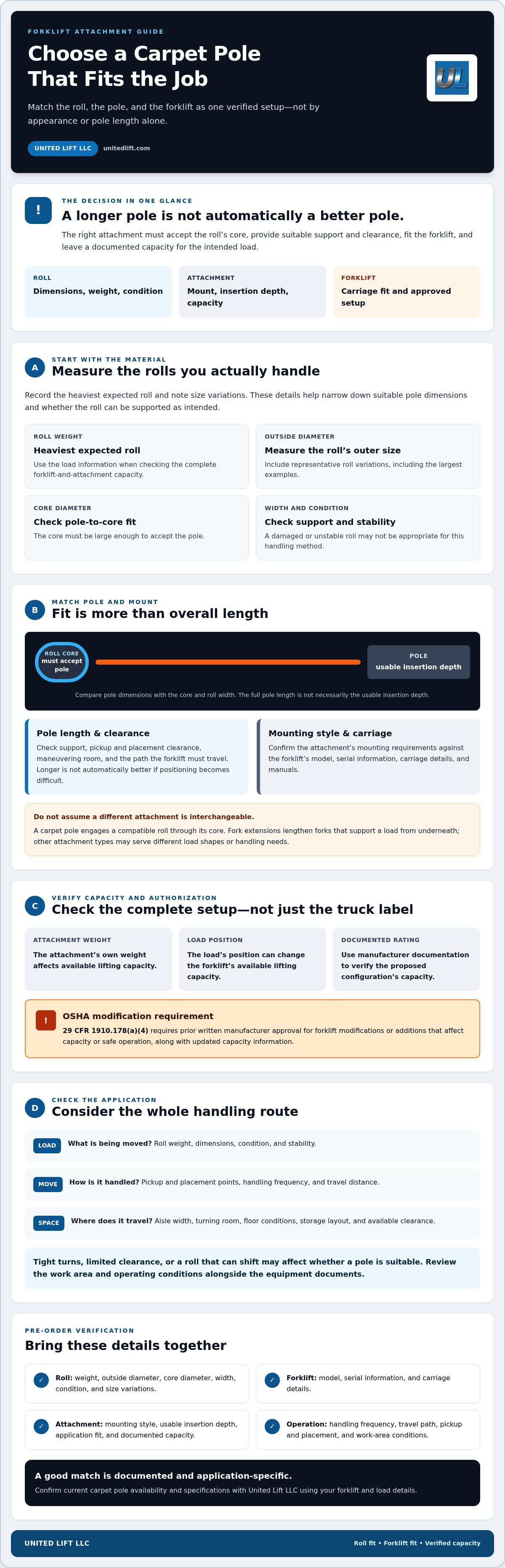
Before ordering a forklift carpet pole attachment, give the supplier enough detail to check the machine, attachment, and load as a complete combination. A visual match or the forklift’s original capacity rating isn’t enough. Use this checklist to organize the information and identify what still needs manufacturer verification.
Pre-order checklist
- Identify the forklift. Record its make, model, serial number, capacity plate details, and carriage information. Include any existing attachment or configuration that could affect fit.
- Describe the carpet rolls. Provide the maximum expected roll weight, outside diameter, width, core diameter, and condition. Note any variation in packaging or roll dimensions.
- Explain the handling conditions. Describe how rolls are picked up and placed, how often they move, and the aisle space, travel path, floor conditions, and storage layout.
- Confirm attachment fit. Ask the supplier to verify mounting and carriage compatibility for the specific forklift. Check the attachment documentation for required connections or operating limitations.
- Verify approval and capacity. Confirm the attachment is approved for the forklift and intended load. Obtain the applicable capacity information for that exact setup, not an estimate based on the truck’s original rating.
- Check documentation and availability. Ask which manuals, specifications, or other records support the proposed configuration. Share photos or additional documents if the supplier requests them.
What checks help keep roll handling controlled?
OSHA standard 29 CFR 1910.178(a)(4) requires the forklift manufacturer’s prior written approval for additions or modifications that affect capacity or safe operation. The forklift’s capacity and operating information must also be updated as required for the attachment. Confirm the approval and revised capacity information before putting the combination into use.
Follow both manufacturers’ instructions for operating the forklift and attachment. Pay particular attention to load position, visibility, travel, lifting, and any stated operating limits. If the roll blocks the operator’s view or the route creates clearance concerns, stop and have the employer’s qualified safety resources assess the work method. Site procedures and operator preparation should be handled through the employer’s appropriate safety and training resources.
Have the forklift and roll details ready? Contact United Lift to discuss forklift and attachment compatibility and confirm current carpet pole availability and specifications.
Choose a Carpet Pole Attachment with a Verified Equipment Match
The right choice suits the rolls and the specific forklift together. Before ordering, confirm the pole dimensions and mounting, then verify the attachment’s capacity for the intended load and position. Don’t rely on a product description or the forklift’s original rating alone. Use applicable manufacturer information to confirm the match.
Questions to ask a dealer before you buy
Bring the forklift’s make, model, serial information, carriage details, and capacity plate information, along with the roll measurements and heaviest expected load. Ask the dealer:
- Is this attachment compatible with the exact forklift configuration and carriage?
- What manufacturer documentation supports the mounting fit and rated capacity for this setup?
- Does the proposed pole suit the rolls’ dimensions and handling conditions?
- Is the attachment currently available, and what is its condition?
- Which components are included, and what specifications still need confirmation?
Ask for fit and capacity details tied to your machine, not a general figure for a similar forklift. Resolve open questions with the relevant manufacturer or supplier before ordering.
How United Lift can support the equipment inquiry
United Lift sells forklifts and equipment attachments, including new and used forklifts from major brands. As a dealership contact, United Lift can discuss your equipment requirements. Confirm current carpet pole attachment availability and configurations before selecting one. Share your forklift and roll details to focus the conversation on fit, capacity, and any information that still needs verification.
For a direct equipment discussion, discuss your forklift attachment needs with United Lift.
Make Your Next Attachment Decision with Confidence
A suitable forklift carpet pole attachment starts with the roll, not a catalog description. Match pole dimensions and mounting to your rolls and forklift, then verify the capacity for the specific machine and configuration using manufacturer documentation. These checks help you compare options based on the details that matter instead of assumptions.
United Lift sells material-handling equipment attachments and new and used forklifts from major brands. If you’re weighing attachment needs alongside forklift requirements, bring your machine and load details to the conversation. Confirm current carpet pole availability and specifications before ordering. Phone and email support is available seven days a week.
Discuss your forklift and attachment requirements with United Lift to take the next step toward a setup that fits your work.
Frequently Asked Questions
What is a forklift carpet pole attachment?
A forklift carpet pole attachment is a projecting pole designed to handle suitable rolled materials by entering the roll’s core. Unlike fork extensions, which lengthen the forks that support a load from beneath, a pole engages the roll through its center. The right application depends on the roll’s dimensions and condition, attachment design, forklift compatibility, and manufacturer instructions. Verify the specific setup rather than assuming every carpet roll or forklift is suitable.
How do I choose the right carpet pole attachment for my forklift?
Start with the forklift’s make, model, serial details, carriage configuration, and capacity information. Then provide the roll’s maximum weight, core diameter, outside diameter, and width. Ask the supplier to confirm that the attachment’s mounting suits your exact machine and to verify the approved capacity with the attachment installed. Don’t select a configuration based only on a general capacity figure. The machine, attachment, and load position all matter.
Will a carpet pole attachment reduce forklift capacity?
It can reduce the forklift’s available capacity because the attachment adds weight and may shift the load farther from the truck’s load center. The effect depends on the specific forklift, attachment, and load position, so there’s no reliable generic reduction to apply. Check the forklift manufacturer’s approved capacity information and the attachment documentation for the complete configuration. Don’t rely on the original data plate rating alone or estimate a new rating yourself.
How long should a forklift carpet pole be?
The suitable pole length depends on the roll’s width, core depth, required insertion, and clearance in the work area. The pole must suit the intended roll and allow the forklift to maneuver and position it as needed. A length that doesn’t provide the intended support can create handling concerns. Measure representative rolls, including variations, then confirm the proposed pole dimensions and usable insertion depth with the attachment manufacturer or supplier before ordering.
Can I use a carpet pole attachment on any forklift?
No. Don’t assume universal fit. Compatibility depends on the forklift’s carriage, the attachment’s mounting design, capacity with the attachment installed, and any required connections. The pole must also suit the roll and work conditions. Before purchase or use, provide the exact forklift details to a qualified supplier and check the forklift and attachment manufacturers’ documentation. Confirm machine-specific fit and approved capacity for the proposed configuration.
What information should I provide when asking about a carpet pole attachment?
Provide the forklift make, model, serial number, capacity plate details, and carriage information. Describe the rolls by maximum weight, core diameter, outside diameter, and width, and explain how often they’ll be handled. Include relevant work conditions, such as pickup and placement areas. Photos or machine and load documents may help if requested. Ask the supplier to verify mounting fit and capacity for your specific forklift and attachment setup.
What safety information should I check before using a carpet pole attachment?
Confirm that the attachment is approved for the forklift and intended load, and review the manufacturers’ operating and capacity instructions. OSHA’s powered industrial truck standard, 29 CFR 1910.178(a)(4), addresses approval for additions that affect capacity or safe operation and updating capacity information. Operators should follow workplace procedures for load positioning, visibility, travel, and lifting. Requirements depend on the equipment and workplace, so consult qualified safety resources about site-specific procedures and training.
- Tags: carpet poles, forklift attachments, forklift carpet pole attachment, forklift safety, material handling, OSHA compliance, roll prongs, warehouse equipment
