
Extending the Life of a Forklift Battery: A Practical 2026 Guide
Posted by United Lift LLC on
What if the charging routine that keeps a forklift moving is also wearing down its battery? Extending the life of a forklift battery starts with matching daily care to its chemistry, compatible charger, and work schedule. When battery downtime interrupts material handling, it’s tempting to follow general charging advice, but the right routine can differ between lead-acid and lithium-ion batteries.
Battery care doesn’t have to be complicated, but it does need to be consistent. This guide explains practical ways to reduce avoidable wear, spot common charging and maintenance mistakes, and build a routine that fits your battery type. You’ll also learn which tasks operators can handle safely and when to check the manufacturer’s instructions or ask the battery or equipment supplier for guidance.
We’ll cover care practices for lead-acid and lithium-ion batteries, how operating demands affect charging routines, and what recurring changes in performance may signal. Start with the battery and charger documentation, then use the steps ahead to make battery care part of your regular workflow.
Key Takeaways
- For extending the life of a forklift battery, match charging habits to the battery chemistry, charger, and work schedule.
- Learn which care practices are broadly useful and which procedures, including equalization charging, depend on the battery model.
- Build a repeatable routine that separates daily visual checks from maintenance reserved for authorized personnel.
- Track recurring runtime changes so you can decide when a qualified battery assessment may be needed.
- Understand when battery age, condition, or operating needs may justify discussing a replacement with an industrial battery supplier.
Why extending the life of a forklift battery starts with understanding its workload
A battery that needs charging sooner than expected isn’t necessarily at the end of its useful life. Runtime between charges describes how long it can power a truck under particular conditions. Useful service life is the battery’s ability to keep meeting the operation’s needs over time. Those are related, but they aren’t the same measure.
Quick answer: For extending the life of a forklift battery, match its care to the battery chemistry, compatible charger, and operating schedule. Check the manufacturer’s instructions before changing charging or maintenance practices.
What does forklift battery life depend on?
Charging frequency, depth of discharge, heat exposure, and maintenance can all influence battery condition. Their effects depend on the battery’s design and the manufacturer’s guidance. A truck used steadily across long shifts faces a different charging pattern from one used for shorter, intermittent tasks. The right routine should reflect actual use, not a generic schedule.
Consider operating habits alongside the equipment. Repeatedly running a battery deeply down, using an unsuitable charger, or neglecting required maintenance may contribute to avoidable wear. Runtime can also change with battery age or condition, workload, temperature, or an equipment issue. A shorter shift alone doesn’t identify the cause. Note when the change occurs, what the truck is doing, and whether charging warnings or interruptions appear. If the change persists, consult the supplier or a qualified professional.
Which battery type is in your forklift?
Lead-acid and lithium-ion are common forklift battery categories, but neither is the right fit for every operation. Their charging and maintenance requirements differ. For an overview of the chemistry and construction behind lead-acid battery technology, see the linked reference. Use your specific battery documentation for care instructions.
Watering applies only to applicable flooded lead-acid batteries. Don’t assume every lead-acid battery needs watering, and never apply a procedure to lithium-ion based on advice for another chemistry. Start with the battery label and forklift documentation. If the type or required procedure isn’t clear, ask the battery or equipment supplier before acting.
How charging and battery chemistry affect forklift battery longevity
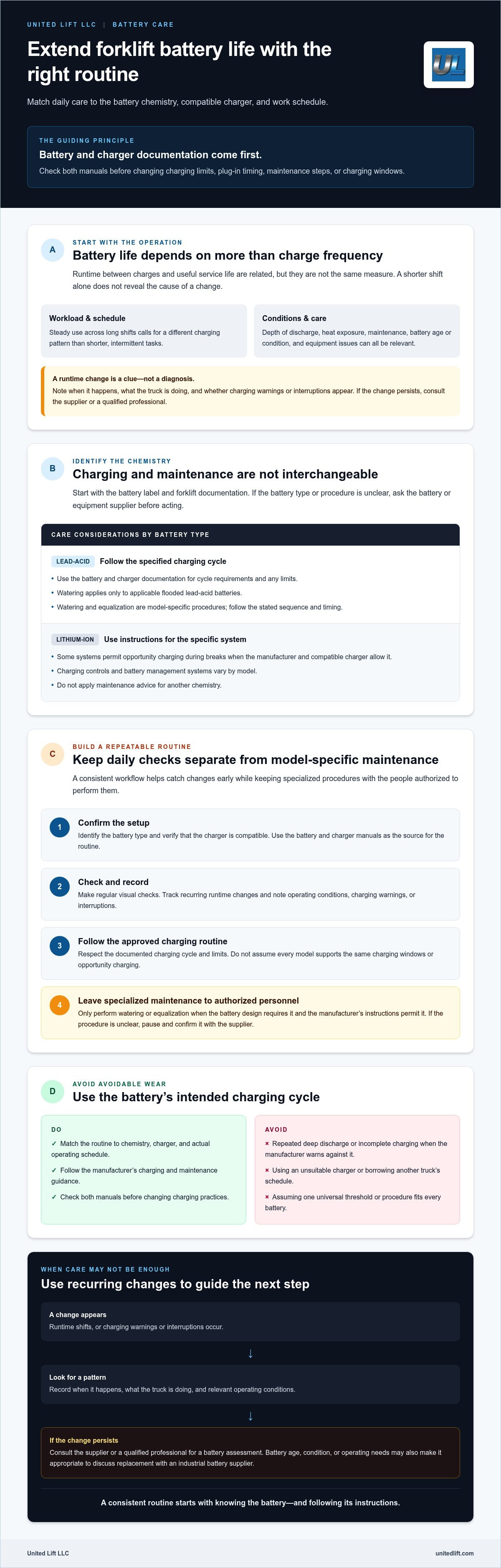
Charging instructions aren’t interchangeable. Lead-acid and lithium-ion batteries have different requirements, and the compatible charger matters too. A routine that suits one battery may be unsuitable for another. The battery and charger manuals govern the correct charging routine. Check both before setting charge limits, deciding when to plug in, or introducing opportunity charging.
| Battery type | Charging considerations | Maintenance considerations |
|---|---|---|
| Lead-acid | Follow the specified charging cycle and any limits in the battery and charger documentation. Don’t assume every model supports the same charging windows. | Watering and equalization apply only to battery designs that require them. Follow the stated procedure and timing. |
| Lithium-ion | Some systems permit opportunity charging, or charging during breaks, when the manufacturer and compatible charger allow it. | Charging controls and battery management systems vary by model. Use the instructions for the specific battery. |
Avoid repeated deep discharge or incomplete charging if the manufacturer warns against it. These practices can interfere with the intended charging cycle and contribute to avoidable wear. Don’t rely on a universal percentage threshold or a schedule borrowed from another truck. A multi-shift operation may have different charging windows from a single-shift one, but the battery and charger still set the limits.
Lead-acid charging, watering, and equalization
Some lead-acid batteries require watering or equalization; others don’t. These are model-specific procedures, not routine steps to apply to every battery. Follow the manufacturer’s sequence, including when to check or add water and when an equalization charge is permitted. If instructions are missing or unclear, pause and confirm the correct procedure with the supplier. For battery handling and charging-area safety, consult OSHA safety standards and your workplace procedures.
Lithium-ion charging and opportunity charging
Opportunity charging may fit a work schedule with short breaks, but only if the battery and charger are designed to support it. Don’t assume that a lithium-ion label alone confirms every charging practice is acceptable. Check the approved charger, charging controls, and battery management system instructions for that specific model.
For extending the life of a forklift battery, build the routine around verified instructions rather than generic tips. If you’re reviewing replacement needs or comparing battery options, explore industrial battery options from United Lift.
Which forklift battery-care practices help most, and which depend on the model?
Some habits apply across battery types: keep the area orderly, follow equipment instructions, and report anything unusual. Other tasks, including watering, equalization, and opportunity charging, depend on the battery design and compatible charger. Never transfer a maintenance procedure from one battery type without checking its manual. A familiar routine can still be the wrong one for a different model.
Cleaning, inspection, and temperature awareness
During routine checks, look for visible dirt, corrosion, damage, leaks, or signs of unusual heat. Don’t touch or attempt to repair a questionable battery or connector. Follow your workplace procedure, and report concerns to the person responsible for battery or equipment maintenance.
Keep the battery area clean and use it only as directed. Ventilation and temperature limits can vary by equipment, battery, and charging setup, so follow the relevant manuals rather than assuming one rule fits every installation. Stop using equipment if an abnormal condition raises a safety concern, and report it promptly.
Charging routines: scheduled, opportunity, and equalization
Scheduled charging can help teams follow a consistent routine, but the permitted charging window and cycle come from the battery and charger instructions. Opportunity charging during breaks may suit some systems, but only when the manufacturer allows it. Equalization is a specific procedure for applicable battery designs, not a general top-up method. Confirm whether it’s required and when it may be used.
These distinctions matter because a useful practice for one setup may be unsuitable for another. For extending the life of a forklift battery, base the routine on documented compatibility, not on a habit copied from a different truck.
Watering and equalization: when do they apply?
Watering is only for battery designs that require it, such as applicable flooded lead-acid batteries. The manual should specify the water type, when to check or add it, and the correct fill level. Don’t guess or use a schedule from another battery. Equalization also requires model-specific instructions. If the procedure or battery type is unclear, confirm it with the equipment or battery supplier before proceeding.
For help comparing battery types and care requirements, consult an industrial battery buying guide and confirm any recommendations against your specific battery documentation.
How to build a forklift battery maintenance routine operators can follow
A reliable routine makes it clear what operators should observe, what authorized personnel should maintain, and how concerns get reported. Keep battery-specific procedures tied to the correct model’s documentation. That gives the team a consistent way to support extending the life of a forklift battery without asking operators to perform tasks they aren’t authorized to do.
What should operators check during a shift?
Keep operator checks visual and observational. Don’t remove covers, handle damaged components, or attempt repairs unless workplace procedures and authorization specifically allow it. Use this simple sequence:
- 1. Check visible condition. Look for obvious damage, leaks, dirt, corrosion, or unusual heat without touching a questionable battery.
- 2. Review warnings. Note dashboard alerts, charger indicators, or interruptions shown during charging. Follow the equipment’s instructions for warnings.
- 3. Record changes. Flag unusual runtime loss, repeated charging interruptions, or any condition that differs from normal operation.
- 4. Stop and report concerns. A damaged, leaking, or unusually hot battery requires the site’s safety process. Don’t continue using questionable equipment while waiting for direction.
Managers can provide a shared log, paper or digital, with fields for the date, truck or battery identifier, charging event, warning indicator, maintenance completed, and reported abnormality. A brief, factual entry helps the next shift spot a pattern and compare similar operating conditions.
How should managers schedule battery maintenance?
Assign battery-specific work, such as watering or other required procedures, only to trained, authorized personnel. Set inspection timing from the battery and equipment documentation, then account for actual site conditions and workload. Don’t create a universal calendar that overrides the manufacturer’s directions.
Make the routine manageable:
- 1. At shift start or handoff: Have operators complete visual observations and report warning indicators or changes.
- 2. At documented intervals: Schedule authorized inspections and model-specific maintenance according to manufacturer guidance.
- 3. Periodically: Review logs for repeated interruptions, runtime changes, warning patterns, or recurring downtime. Escalate persistent concerns through workplace procedures.
A clear record helps distinguish a one-off observation from a repeat issue, but it doesn’t diagnose the cause or predict remaining battery life. If your operation is reviewing its battery needs, contact United Lift about industrial batteries.
When battery care is not enough: plan the next step for your forklift fleet
A consistent care routine can help prevent avoidable wear, but it can’t reverse every cause of declining performance. Persistent runtime loss, repeated charging interruptions, or warning indicators that keep returning are reasons to investigate. They don’t prove the battery is worn out. Confirm the cause with qualified personnel before linking a change in performance to battery age.
Signs it may be time to assess or replace a battery
Look for patterns, not just one difficult shift. Compare operating records with the forklift’s usual workload and charging history. If runtime keeps falling under similar conditions, or the same warnings or interruptions recur, arrange for a qualified assessment. Battery condition is one possibility, but the charger, equipment, and demands of the work may also need consideration.
Battery-care guidance isn’t a diagnosis, repair, or promise about remaining service life. Maintenance may help prevent certain types of avoidable wear, but it can’t be assumed to restore a worn or damaged battery. Follow site procedures for safety concerns, and ask qualified personnel to investigate persistent issues before making a replacement decision.
How to discuss an industrial battery replacement
Before comparing options, gather the details that help establish compatibility and fit with the work. Bring:
- The forklift make and model, plus battery identification from its label or documentation.
- The charger details and any relevant battery or equipment manuals.
- A clear description of the operating schedule, workload, and recurring runtime or charging concerns.
Use that information to ask which battery options are compatible with the forklift and charger, and what documentation sets out their charging and maintenance requirements. Compare the battery’s suitability with the truck’s duty cycle and the operation’s needs, such as how consistently it must be available across shifts. Don’t assume a different chemistry or battery will work with existing equipment without confirming compatibility.
Extending the life of a forklift battery starts with appropriate care, but planning the next step matters when problems persist. United Lift offers industrial batteries, so if you’re weighing replacement options, ask United Lift about industrial batteries.
Make battery care a routine your team can rely on
Extending the life of a forklift battery starts with knowing what battery you have and how your operation uses it. Match charging and maintenance to the battery, charger, and manufacturer instructions. Keep operator checks simple, assign model-specific tasks to authorized personnel, and record recurring changes in runtime or charging behavior.
If performance problems persist, treat them as a reason to investigate, not proof that the battery has reached the end of its service life. Check the forklift’s workload and charging setup, then have qualified personnel assess the cause. If replacement may be the right next step, gather your forklift, battery, charger, and operating details to help guide the discussion.
United Lift sells industrial batteries and supports customer inquiries by phone or email seven days a week. Ask United Lift about industrial battery options and take a practical next step for your fleet. A clear routine and the right information can help your team move forward with confidence.
Frequently Asked Questions
How can I extend the life of a forklift battery?
For extending the life of a forklift battery, follow care instructions for its specific chemistry, charger, and operating schedule. Use a compatible charger and avoid repeated deep discharge or incomplete charging if the manufacturer warns against it. Keep up with required inspections, and assign battery-specific maintenance to authorized personnel. Record changes in runtime or charging behavior so persistent issues can be investigated rather than mistaken for normal variation.
Is it bad to leave a forklift battery charging overnight?
It depends on the battery, charger, and their instructions. Overnight charging may fit a scheduled charging routine if the system is designed for it and workplace procedures allow it. Don’t assume every charger automatically stops safely or that a battery should remain connected after charging ends. Check the manuals for charging limits and cycle guidance, and use the designated charging area under your site’s safety procedures.
Can you opportunity charge a forklift battery?
Yes, some forklift battery systems support opportunity charging during breaks, but only when the battery manufacturer permits it and the charger is compatible. Don’t assume a charging practice is suitable based only on the battery’s chemistry or another truck’s routine. Check the specified charging windows and controls in the battery and charger documentation. If the instructions don’t address opportunity charging, confirm the practice with the equipment or battery supplier first.
How often should you add water to a forklift battery?
Add water only to battery designs that require it, such as applicable flooded lead-acid batteries. There’s no universal schedule: follow the battery manual for how often to check, what water to use, the correct fill level, and whether watering belongs before or after charging. Don’t add water to lithium-ion or sealed batteries unless their documentation explicitly directs it. Have trained, authorized personnel perform the task according to workplace procedures.
What happens if a forklift battery is over-discharged?
Over-discharging can stress a battery and may reduce its capacity or service life, but the effect depends on its design and how far it was discharged. Follow the manufacturer’s limits rather than repeatedly running the battery until the truck stops. If you suspect an over-discharge, check the battery instructions and report the event under site procedures. Don’t try an unapproved recovery or charging method; ask qualified personnel what to do next.
Why does my forklift battery lose charge so quickly?
Short runtime can reflect heavier work demands, battery age or condition, charging habits, temperature, or a charger or equipment issue. It doesn’t identify the cause by itself. Compare runtime under similar workloads and review charging records, warning indicators, and interruptions. If the change persists, have qualified personnel assess the battery and related equipment. Avoid changing charging settings or maintenance procedures until you’ve checked the relevant manuals.
Should a forklift battery cool down before it is used again?
Follow the battery and charger instructions for any required cooling period before returning the forklift to work. Requirements can differ by battery design and charging system, so don’t apply a fixed wait time from another model. If the battery is unusually hot, damaged, or showing a warning, stop using the equipment and follow your site’s safety process. Ask qualified personnel to confirm when it’s appropriate to use it again.
- Tags: battery maintenance, extending the life of a forklift battery, forklift battery care, forklift charging, forklift maintenance, lead-acid battery, lithium-ion battery, material handling, warehouse equipment
