
6000 lb Forklift for Sale: Find the Right Lift for You
Posted by United Lift LLC on
Could a 6,000 lb forklift still come up short on a load you handle every day? The rated capacity is a starting point, not the whole answer. Lift height, load dimensions, and attachments can affect how much a forklift can safely carry, so choosing a 6000 lb forklift for sale takes more than matching a number on a listing.
Look beyond capacity to find a truck that suits your worksite, whether you need nimble indoor handling, outdoor traction, or a balance of both. Comparing new and pre-owned equipment adds another decision: upfront cost versus the condition and operating history of a specific machine.
This guide explains how to assess real-world loads, mast height, power type, tires, and equipment condition before you buy. You’ll also learn what details to compare across options and how to include financing in your purchase planning. United Lift offers new and pre-owned forklifts and facilitates equipment financing, helping you move from evaluating your application to choosing a suitable lift.
Key Takeaways
- A 6,000 lb rating is only a starting point; check the data plate and how load center, lift height, and configuration affect usable capacity.
- Map your routine and maximum loads, clearances, floor surfaces, and shift pattern before comparing a 6000 lb forklift for sale.
- Compare power source and tire type against your indoor and outdoor work conditions instead of assuming one setup fits every job.
- Use a checklist to review specifications, documentation, and the condition of pre-owned equipment before making a decision.
- Weigh new and pre-owned options alongside financing as you plan a purchase that fits your material-handling needs.
What a 6,000 lb Forklift Rating Really Tells You
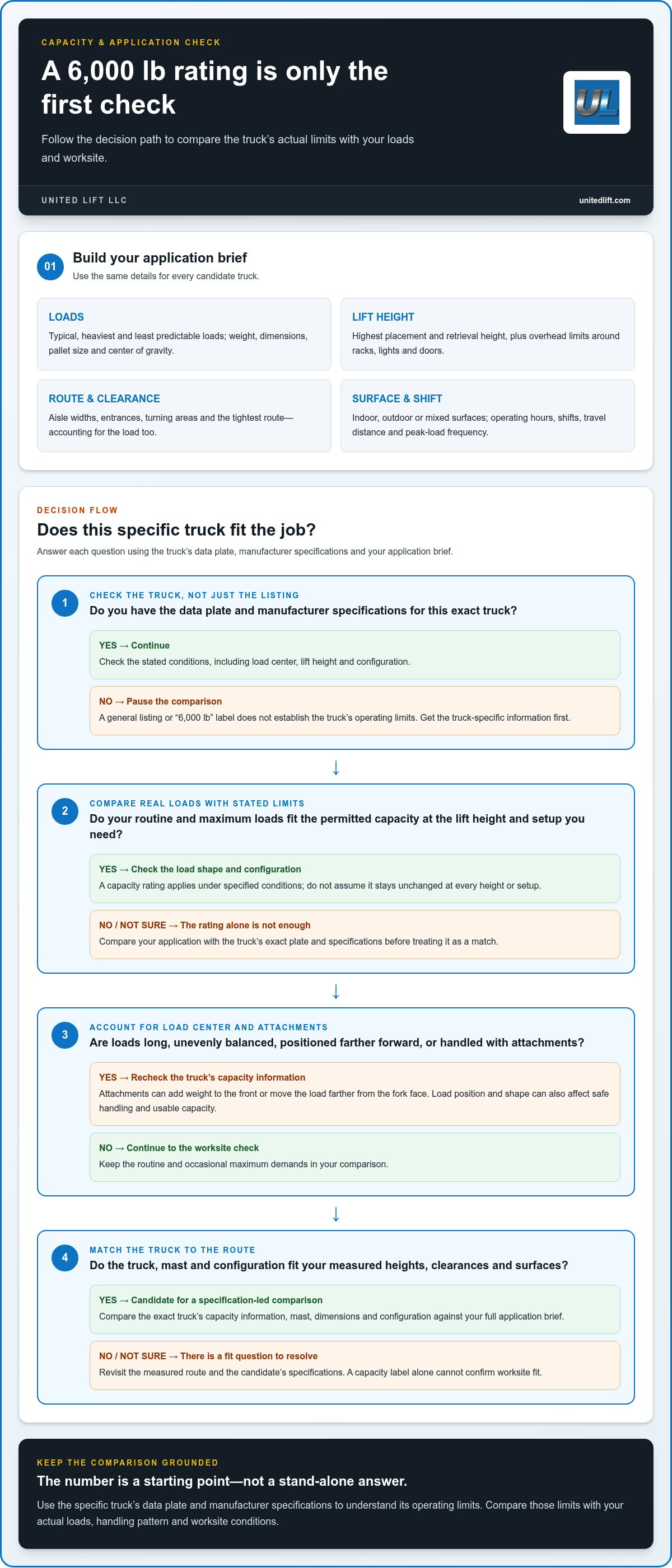
A 6,000 lb rating describes the forklift’s stated capacity under specified operating conditions. It doesn’t mean the truck can safely lift any load weighing up to 6,000 lb in every configuration or at every height. A forklift is a powered industrial truck, and its operating limits depend on the relationship between the load, forks, mast, and truck setup.
Start with the data plate on the specific truck. It gives capacity information for stated conditions, which may include load center, lift height, and configuration. Attachments can add weight to the front of the truck or move the load farther from the fork face. Either change can reduce usable capacity. Don’t rely on a general listing alone; use the truck’s data plate and manufacturer specifications to understand its operating limits.
The rating also doesn’t describe every load the forklift will encounter. The practical question is whether the truck’s permitted capacity covers your loads in the way you need to handle them.
How load center and lift height affect rated capacity
Load center is the distance from the fork face to the load’s center of gravity. A long load, an unevenly balanced load, or a load positioned farther forward can shift the center of gravity away from the truck. That changes the leverage on the forks and can affect safe handling, even when the load’s total weight stays the same.
Lift height and mast configuration matter too. Capacity can vary with the height and setup specified for a particular truck. Compare the conditions on the data plate with your actual handling task; don’t assume a capacity rating applies unchanged at every height or with every attachment.
When a 6,000 lb forklift fits the job
Before comparing a 6000 lb forklift for sale, write down the loads you handle: typical loads, the heaviest loads, and the least predictable ones. Include pallets, materials with uneven dimensions, and any attachments used during normal handling. Note where loads are picked up, carried, and placed, since the handling pattern can affect the required configuration.
Use these details to assess whether a 6,000 lb rating aligns with your application, then compare them with the exact truck’s data plate and manufacturer specifications. If your loads vary, include both routine work and occasional maximum demands in your equipment comparison. The plate and manufacturer specifications govern operating limits; a load’s weight alone doesn’t establish that it’s within capacity.
Match a 6,000 lb Forklift to Your Loads and Worksite
Capacity can narrow your search, but the right forklift also needs to fit your routes, clearances, and work rhythm. Build a short application brief before comparing a 6000 lb forklift for sale. Include routine work and occasional peak demands so you can compare equipment against the job, not just the rating.
- 1. Loads: Record typical and heaviest load weights, dimensions, pallet size, and center of gravity. Note unusual shapes, unstable materials, and how often peak loads occur.
- 2. Lift height: Measure the highest placement point and the height needed to retrieve loads. Include overhead restrictions around racks, lights, doors, and other structures.
- 3. Aisle and door clearance: Measure aisle widths, entrances, turning areas, and the tightest route the truck must travel. Account for the load as well as the forklift.
- 4. Surface: Describe the floor or ground conditions, including indoor, outdoor, or mixed use and any transitions along the route.
- 5. Shift pattern: Note operating hours, shifts, travel distance, and how frequently the truck handles demanding loads.
Measure loads, lift height, and available clearance
Measure the load itself, not just the pallet. A wide or off-center load may affect stability and visibility, while a long load can require more room to turn. Record the load’s dimensions and center of gravity alongside its weight. Then compare rack height, overhead clearance, aisle width, and access points with the exact truck and mast specifications. This helps identify a mismatch before purchase.
Account for surface, duty cycle, and handling conditions
Describe where the forklift will travel and how often. A route across smooth indoor floors differs from one that includes outdoor ground or mixed surfaces. Include distance per trip, shift pattern, peak-load frequency, and the operator’s visibility and access needs. For additional material-handling context, Material Handling Industry (MHI) provides an overview of the industry. Share your application details with United Lift to compare forklift options against the worksite, or explore forklift options.
Use the same brief for each candidate truck. Compare its specific capacity information, mast, dimensions, and configuration with your measured requirements. A specification-led comparison moves you beyond the “6,000 lb” label and toward the question that matters: does the equipment fit your application?
Compare Power, Tires, and Configuration Before You Buy
Two forklifts with the same rated capacity can have different configurations. Compare the power source, tires, mast, and attachments against your worksite instead of assuming one setup suits every 6,000 lb application. Options and specifications vary by model, so use the candidate truck’s documentation and data plate for the final comparison.
Choose a power source for the operating environment
Consider where the forklift will run, how long it operates, and how you’ll manage charging or refueling. For indoor use, ventilation and the operating environment are important factors. Your duty cycle also helps determine whether a particular power setup fits your work pattern. Plan for the charging or refueling needs of the specific equipment rather than assuming all models work the same way.
| Power source | Tire type to compare | Operating environment | Maintenance considerations |
|---|---|---|---|
| Electric | Cushion or pneumatic, depending on model | Assess indoor or mixed use, ventilation, route surfaces, and charging access. | Include battery and charging needs in ownership planning; requirements vary by equipment. |
| Internal combustion | Cushion or pneumatic, depending on model | Consider where the truck will operate and the ventilation available. | Account for the model’s fuel and maintenance requirements, plus your refueling routine. |
Use the table as a comparison framework. Power source and tire combinations depend on the specific model. Avoid choosing based on broad assumptions about emissions, noise, fuel use, or operating costs; compare verified specifications for the forklift you’re considering.
Select tires, mast, and attachments for the task
Cushion and pneumatic tires suit different surfaces and applications, so compare them against your actual route rather than treating one as universally better. Check the mast’s lift height against your highest placement point, then compare its collapsed height with doorways and overhead clearances. Include any attachment in the configuration review. Attachments can change capacity; OSHA’s forklift load handling guidance explains how load composition and positioning affect safe handling. Follow the specific truck’s data plate and manufacturer specifications.
As you evaluate a 6000 lb forklift for sale, match each configuration detail to your work pattern: surface, indoor or outdoor use, shift demands, mast clearance, and attachment needs. This gives you a practical basis for comparing new and pre-owned options without relying on the capacity label alone.
Use This 6,000 lb Forklift Buying Checklist
Use this checklist to compare each candidate against the work it needs to do. For a pre-owned forklift, review its condition and available records alongside the specifications. For a new unit, focus on whether its configuration matches your application and ownership plans.
- Application: Record routine and peak load weights, dimensions, and handling patterns. Include worksite surfaces, travel distance, clearances, and operating schedule.
- Specifications: Compare the truck’s data plate and model details with your needs. Check rated capacity under the relevant conditions, mast height, collapsed height, tires, power source, and attachments.
- Condition: For pre-owned equipment, visually review tires, forks, mast, chains, and controls. Note visible wear or damage for further evaluation.
- Documentation: Review available service records and equipment documents. Compare the recorded details with the truck’s identifying information and configuration.
- Operational review: As appropriate to the equipment and your purchasing process, evaluate its operation in a suitable setting. Record observations without assuming that a brief review establishes the full condition of the truck.
- Ownership plan: Consider expected utilization, upkeep planning, and how long you intend to use the equipment. Include financing in your purchase planning.
Review specifications and equipment condition
Start with the exact unit, not a general capacity label. Confirm that the data plate, model details, mast, and attachments align with your application. For pre-owned equipment, look over the forks for visible wear or damage, examine the mast and chains, check tire condition, and review controls. Compare your observations with available service records. A visual and operational review can inform your decision, but it isn’t a promise about future performance.
Compare new and pre-owned purchase considerations
New equipment may suit buyers who prioritize selecting a configuration for planned work. Pre-owned options may be worth comparing when the unit’s history, condition, and specifications fit the job. In either case, use unit-specific information and expected utilization to guide your choice. For more detail on evaluating used equipment, read the complete used forklift buying guide.
United Lift offers new and pre-owned forklifts and facilitates equipment financing. Bring your checklist and application details to the comparison, then explore forklift options with United Lift.
Find Your 6,000 lb Forklift and Plan the Purchase
With your application details in hand, compare equipment based on the job instead of shopping by capacity label alone. A clear request helps narrow the options and makes it easier to review each forklift’s specifications against your worksite.
Prepare a clear equipment request
Summarize the heaviest load you handle, its dimensions, and how high it needs to be lifted. Include the load’s usual shape and any attachment requirements. Describe whether the truck will work indoors, outdoors, or across both, and note aisle limits, doorway clearances, surface conditions, and operating schedule. Include how often peak loads occur and how far the forklift typically travels.
Share those details with United Lift to compare model-specific specifications against your application. Rated capacity, mast configuration, and attachment compatibility are specific to each unit, so use the exact equipment information when weighing your options.
Move from selection to purchase planning
United Lift helps buyers compare new and pre-owned forklifts against their material-handling requirements. Evaluate each suitable option using its specifications and, for pre-owned equipment, available condition and history details. The dealership offers equipment from brands including Hyster, Yale, Toyota, and Caterpillar. Compare the specifications of the specific model rather than relying on the brand name alone.
Include financing in your purchase planning. United Lift facilitates equipment financing, giving you a way to consider financing alongside the equipment choice without relying on assumptions about rates, terms, or approval.
Ready to move forward? Browse forklifts and connect with United Lift by phone or email to discuss your 6000 lb forklift for sale search. Share your load, lift height, surface, clearance, and duty-cycle details to make the conversation specific to your operation.
Browse forklifts and connect with United Lift.
Choose a Forklift That Fits the Work
The 6,000 lb rating is only the starting point. Confirm the truck’s data plate and specifications against your actual loads, lift height, mast, and attachments. Then match power, tires, and configuration to your surfaces, clearances, and operating schedule. A clear application brief makes it easier to compare equipment based on the job, not the capacity label alone.
As you evaluate a 6000 lb forklift for sale, weigh new and pre-owned options against your expected use and the specific unit’s condition. United Lift offers both, represents brands including Hyster, Yale, Toyota, and Caterpillar, and facilitates equipment financing to support purchase planning.
Ready to take the next step? Browse forklifts and connect with United Lift to discuss options for your material-handling needs. Bring your load, lift height, surface, clearance, and duty-cycle details to make the comparison specific to your operation.
Frequently Asked Questions
Is a 6,000 lb forklift enough for my operation?
A 6,000 lb forklift may fit if its rated capacity under the truck’s specified conditions covers your routine and peak loads at the lift height you need. Load center, attachments, and mast configuration can affect usable capacity. For a 6000 lb forklift for sale, compare its data plate and manufacturer specifications with your actual load dimensions, including unusually long or uneven pallets. Also consider route clearance, surface, and operating schedule before deciding.
How much can a 6,000 lb forklift lift at maximum height?
Maximum-height capacity depends on the specific forklift, mast, load center, and configuration. The nominal 6,000 lb rating alone doesn’t tell you the permitted load at full lift. Check the truck’s data plate and manufacturer specifications for capacity under the height and setup you intend to use. If the load uses an attachment or differs from the stated conditions, include those details in your model-specific capacity review before operating.
Can a 6,000 lb forklift handle loads with attachments?
Some forklift configurations use attachments, but an attachment can affect the truck’s capacity and load handling. Don’t assume a 6,000 lb rating applies unchanged after adding one. Review the data plate and manufacturer specifications for the exact truck and attachment combination. Include the attachment type and the loads it will handle when comparing equipment. The approved operating limits for that specific configuration should guide your decision.
What is the difference between a 6,000 lb electric and gas forklift?
An electric forklift uses a battery and requires a charging plan suited to the truck and work schedule. A gas or other internal-combustion forklift requires a fuel and refueling plan, and the operating environment, including ventilation, matters. Configurations and specifications vary by model. Compare the actual equipment, indoor or outdoor use, duty cycle, charging or refueling access, and maintenance considerations rather than assuming one power source suits every operation.
Should I buy a new or used 6,000 lb forklift?
Choose based on your expected use, configuration needs, and the specific equipment’s condition. A new forklift can be compared against your application requirements, while a pre-owned unit calls for a close review of its specifications, condition, and available service history. In either case, confirm capacity, mast, and attachment details for the exact truck. United Lift sells new and pre-owned forklifts, so you can consider both purchase paths.
What should I inspect before buying a used 6,000 lb forklift?
Review the data plate, model details, mast, and attachments against your intended work. Visually check the tires, forks, mast, chains, and controls for wear or damage, and review available service records. Include an operational evaluation appropriate to the equipment and your purchasing process. These steps help you gather information about the unit, but they don’t guarantee a particular inspection result or predict future performance.
Can I finance a 6,000 lb forklift?
Yes, financing can be part of planning a forklift purchase. United Lift facilitates equipment financing, allowing buyers to consider financing alongside suitable new or pre-owned forklift options. Financing terms and approval outcomes depend on the specific arrangement, so don’t assume a particular rate, term, or decision. Start by documenting your application needs and comparing the equipment specifications, then include financing in your purchase planning.
- Tags: 6000 lb forklift, 6000 lb forklift for sale, equipment financing, forklift buying tips, forklifts, material handling, used forklifts, warehouse equipment
