
Budgeting for Material Handling Equipment: 2026 Guide
Posted by United Lift LLC on
What if the purchase price is the least useful number in your equipment budget? Budgeting for material handling equipment means looking beyond the initial outlay to the work the equipment must handle and the costs of owning it over time. When equipment needs compete with other priorities, a clear plan helps you focus spending on what operations actually require.
A price tag alone won’t show the full ownership commitment. Usage, energy, maintenance, setup, and potential downtime all belong in the conversation, along with how you’ll pay for the equipment.
This 2026 guide explains how to build a practical budget before choosing equipment, compare purchase priorities with operational needs, and consider financing alongside long-term ownership costs. You’ll also learn how new and pre-owned equipment can fit a purchase plan, whether you’re budgeting for forklifts, lifts, telehandlers, or attachments. Start with the job to be done, then shape a budget around the investment your operation can support.
Key Takeaways
- Start budgeting for material handling equipment with the jobs, loads, travel paths, and work conditions the equipment must handle.
- Organize your budget into acquisition, setup, operating, maintenance, and replacement-planning categories. Research project-dependent costs instead of guessing.
- Compare outright purchase and financing based on your budget, and weigh new and pre-owned equipment against operational needs.
- Separate essential requirements from optional upgrades so you can prioritize purchases and plan later phases.
- Finalize your requirements, compare suitable equipment options, and review the full ownership budget before making a decision.
Start Your Material Handling Equipment Budget With the Work It Must Do
A purchase-price target is only a starting point. A useful equipment budget begins with the jobs your operation needs to complete, then accounts for the equipment and ownership costs that support those jobs. An equipment budget is a needs-based ownership plan that connects operational requirements with the full commitment of buying and using equipment.
Define the job before choosing equipment
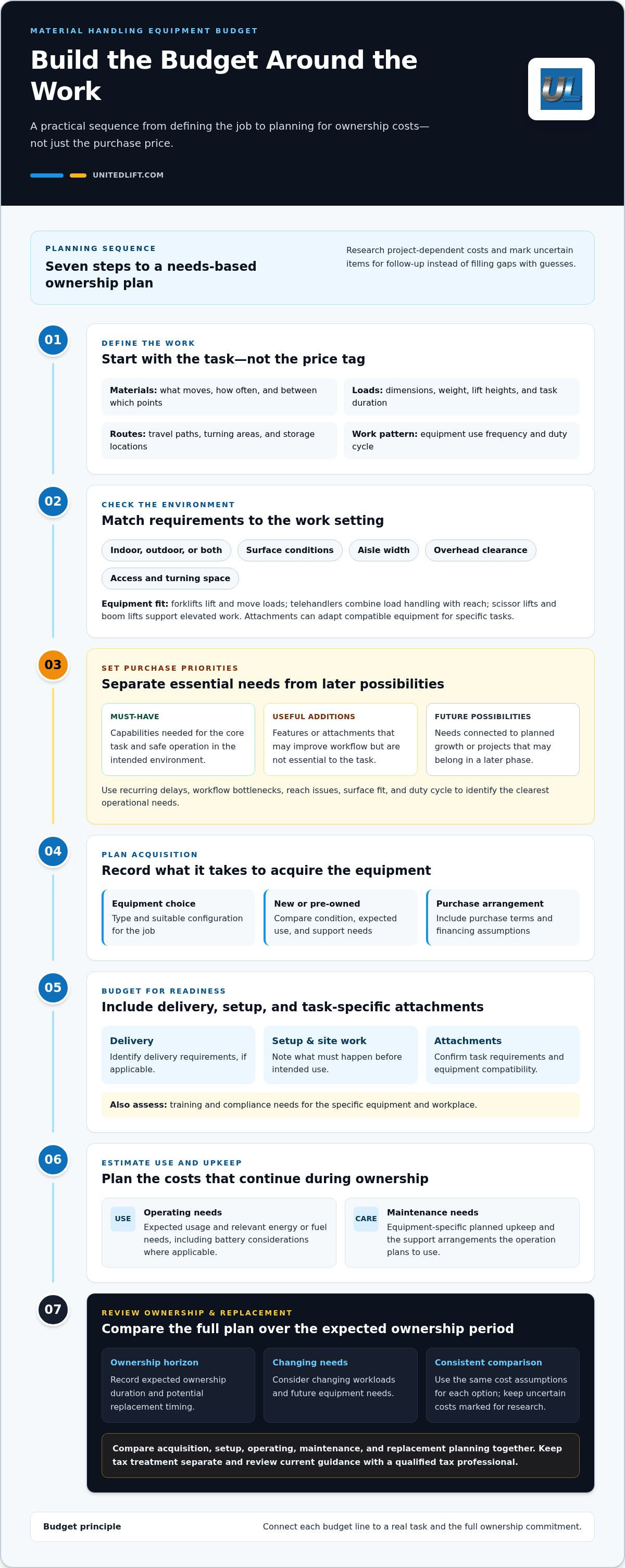
Start with the materials: what needs to move, how often, and between which points? Map travel paths, turning areas, storage locations, lift heights, and any work performed above ground. Record load dimensions and weight, how frequently equipment will be used, and how long each task typically takes. These details shape the equipment requirements. Guessing at capacity or configuration before understanding the load and application can lead to a poor fit.
Consider the work setting, too. Will equipment operate indoors, outdoors, or in both environments? What surfaces will it cross? Are there limits on aisle width, overhead clearance, access, or turning space? These details help narrow the equipment category. Forklifts are commonly used to lift and move loads, while telehandlers combine load handling with reach. Scissor lifts and boom lifts support elevated work, and attachments can adapt compatible equipment for particular material-handling tasks. For a broader overview of equipment categories, see Material-handling equipment.
Turn operational priorities into budget requirements
Once the job is clear, divide requirements into three groups:
- Must-have capabilities: Requirements the equipment needs to meet the core task and operate safely in its intended environment.
- Useful additions: Features or attachments that could improve workflow but aren’t essential to getting the job done.
- Future possibilities: Needs tied to planned growth or projects that may belong in a later purchase phase.
Use operational pain points to set priorities. Where do delays occur? Does equipment create a workflow bottleneck, struggle to reach a work area, or fail to suit the surface or duty cycle? Record how often these issues affect the work, then prioritize solutions that address the clearest need. Keep optional upgrades separate so they don’t obscure the cost of essential equipment.
This is the foundation of budgeting for material handling equipment: connect each budget requirement to a real task rather than choosing equipment by price or features alone. With the work defined, you can build a budget that reflects the full ownership plan.
Build a Material Handling Equipment Budget Beyond the Purchase Price
With the job requirements defined, build a budget that captures more than the equipment’s purchase price. Purchase price is one line item; total cost of ownership is the broader plan for acquiring, preparing, operating, maintaining, and eventually replacing equipment. The right categories depend on equipment type, site conditions, usage, and purchase arrangement. Mark uncertain items for research instead of filling gaps with guesses.
Which budget categories should buyers include?
Use this worksheet to identify what needs a figure or estimate. The Material Handling Industry (MHI) represents a broad range of equipment and systems, but your budget should stay specific to the equipment and work in your operation.
| Budget category | Planning question | Information needed |
|---|---|---|
| Acquisition | What equipment and purchase arrangement fit the job? | Equipment type, new or pre-owned option, purchase terms, and any financing assumptions. |
| Delivery and setup | What must happen before equipment is ready for its intended use? | Delivery, setup, and site work requirements, if applicable. |
| Attachments | Does the task require an attachment? | Required attachment and compatibility details for the selected equipment. |
| Operating | What resources will regular use require? | Expected usage and relevant energy or fuel needs. Include battery considerations where applicable. |
| Maintenance | What planned upkeep should be included over the ownership period? | Equipment-specific maintenance needs and the support arrangements your operation plans to use. |
| Replacement planning | How will you plan for future equipment needs? | Expected ownership duration, changing workloads, and potential replacement timing. |
Assess training, compliance, and site work for the specific project. Their relevance and requirements can depend on the equipment and workplace. Keep each as a research item until you have information that applies to your situation.
How does total cost of ownership improve the comparison?
Compare options over the period you expect to own and use them. Higher or more frequent use can change the importance of operating and maintenance assumptions. A shorter ownership horizon may change which costs matter most. For new and pre-owned equipment, consider condition, expected use, and anticipated support needs alongside acquisition terms. Record assumptions consistently so one option doesn’t appear more attractive simply because its ongoing costs were left blank.
Keep tax treatment separate from operating assumptions. Tax rules can depend on your circumstances and may change, so review current guidance with a qualified tax professional rather than treating a possible deduction as guaranteed budget savings. As a practical next step, compare material handling equipment options against your budget categories.
Compare Equipment Budget Options Without Losing Sight of Fit
Once you’ve mapped the ownership costs, compare ways to acquire equipment without letting a low initial outlay outweigh operational fit. Outright purchase and financing affect cash planning differently. New and pre-owned equipment can suit different needs depending on condition, workload, and expected ownership period. Keep the comparison focused on the purchase options that fit your operation.
| Option | Budget impact | Ownership considerations | Fit questions |
|---|---|---|---|
| Outright purchase | Plans for the acquisition as an upfront commitment. | Consider how ownership affects available capital and the full costs of use. | Can the business fund the purchase and still cover other priorities? |
| Financing | Structures acquisition spending over time according to the financing arrangement. | Review the full obligations, terms, and schedule in the actual documents. | Does the arrangement align with cash planning and expected equipment use? |
| New equipment | Compare its acquisition requirements with the operating plan. | Consider expected workload, planned ownership period, and ongoing costs. | Does the equipment’s condition and capability match the job and intended use? |
| Pre-owned equipment | May offer a different initial-investment option, depending on the equipment. | Assess condition, expected use, and anticipated support needs as part of the full budget. | Does the specific unit suit the workload and ownership horizon? |
How do new and pre-owned options affect the budget?
Don’t make the decision on purchase price alone. A lower initial investment doesn’t answer whether the equipment’s condition, capabilities, and expected support needs fit your operation. Compare each option against the same workload and planned ownership period, then include relevant operating and maintenance assumptions. Use the same checklist for both: confirm the application fit, note condition and expected use, and include anticipated support needs in the budget.
When should financing enter the budget discussion?
Include financing early enough to understand how an acquisition may fit the business’s cash plan. Review the total obligations and terms in the actual financing documents, then compare those commitments with the costs of owning and operating the equipment. United Lift facilitates equipment financing for business customers, making financing one acquisition consideration to include in your planning.
For a fuller view of operating expenses, McKinsey’s discussion of true warehousing costs describes a bottom-up approach to examining warehouse costs. Apply the same discipline here: compare options using consistent assumptions and keep budget fit tied to the work equipment must do. Explore material handling equipment options as you weigh the purchase plan.
Create a Practical Budget and Prioritize Equipment Needs
Turn your requirements into a working plan your team can review and update. A useful equipment budget records assumptions as well as amounts, so decision-makers can see where estimates came from and what still needs research. Leave monetary fields open until you have project-specific estimates and internal budget approval.
What should an equipment budget worksheet include?
Use one line per equipment request. Include fields for the equipment category, application, required capability, acquisition approach, estimate source, and expected timing. Add setup, operating, and maintenance fields where they apply. Record the person responsible for each estimate and the decision owner for each request. If an item is still uncertain, label it as an assumption or research item rather than treating it as a confirmed amount.
Set aside a contingency line for project-dependent or unresolved items. Don’t assign it an arbitrary percentage. Note what it is intended to cover and update it as you gather better information.
How can teams prioritize equipment requests?
Use this sequence to move from a list of requests to a budget that supports decisions:
- Define the job. State the operational need each purchase addresses.
- List requirements. Separate required capabilities from useful additions and future possibilities.
- Gather estimates. Document the source, date, and assumptions behind each project-specific estimate.
- Compare scenarios. Review different equipment or acquisition approaches against the same workload and timing.
- Review and assign. Confirm priorities, decision owners, dependencies, and items needing follow-up.
Rank each request by operational necessity, timing, utilization, and its effect on workflow. An item that resolves a current bottleneck may need to come before an upgrade that adds convenience. Check dependencies, too. A purchase may rely on site readiness, a compatible attachment, or power requirements being addressed first.
Mark each line as committed need, optional upgrade, or later-phase purchase. Keep immediate operational requirements in the active budget. Put expansion plans in a separate phase with their own timing and assumptions. This keeps future possibilities visible without blending them into the amount needed for current work.
Before approval, review the worksheet with operations, finance, and the people responsible for using the equipment. Confirm that estimates use consistent assumptions and that open questions have an owner. To compare equipment options against your requirements and budget plan, explore material handling equipment.
Move From Budget Plan to the Right Material Handling Equipment
You’ve defined the work, organized the costs, and ranked the requests. Now bring those pieces together. Finalize the requirements, compare equipment options that fit the application, and review the complete budget, including acquisition, setup, operating, maintenance, and future planning. This final check keeps the decision tied to operational needs and the amount your business has approved.
What information should buyers prepare before discussing equipment?
Bring a clear summary of the job. Include the materials being handled, where the work takes place, expected equipment use, and the capabilities the operation needs. Add known site conditions, timing requirements, and attachment needs. If a requirement is still being assessed, note that rather than assuming a specification.
Share your budget priorities, too. Say whether you’re considering new or pre-owned equipment and whether financing is part of the acquisition plan. This context helps keep the conversation focused on suitable options rather than features that don’t address the work.
- Application: What tasks must the equipment perform?
- Work environment: Where will it operate, and what site conditions matter?
- Usage and timing: How often is it expected to work, and when is it needed?
- Budget priorities: Which requirements are committed, and which can wait?
- Dependencies: Are there known site or attachment requirements to factor into planning?
How can United Lift help with the next step?
A material handling equipment dealer can help connect the application to relevant equipment categories and purchase options. United Lift offers new and pre-owned forklifts, boom lifts, telehandlers, scissor lifts, and attachments. For business customers evaluating equipment acquisition, United Lift also facilitates financing. Consider these options alongside the requirements and budget priorities you’ve already prepared.
Keep the discussion practical: start with the task, compare options against the same requirements, and revisit the full budget before settling on a purchase plan. That’s how budgeting for material handling equipment becomes a useful decision tool, not just a spending limit.
Discuss your material handling equipment needs with United Lift
Put Your Equipment Budget Into Action
Strong budgeting for material handling equipment starts with the work, not a price target. Define the loads, routes, environment, and usage first. Then compare acquisition options and account for setup, operating needs, maintenance, and future replacement planning.
A practical budget also makes priorities clear. Separate essential capabilities from optional upgrades, document estimates and assumptions, and review the full ownership picture before selecting equipment. This gives your team a sound basis for comparing options that fit both operations and approved spending.
United Lift offers new and pre-owned equipment across multiple material handling categories and facilitates financing for business customers. Phone and email support is available seven days a week to help you discuss your equipment needs and purchase considerations.
Discuss your material handling equipment needs with United Lift and take the next step with a clearer plan for your decision.
Frequently Asked Questions
What should be included in a material handling equipment budget?
Include more than the equipment’s acquisition cost. List the equipment category and required capabilities, then account for delivery or setup where applicable, attachments, expected energy or fuel use, battery needs, planned maintenance, and replacement planning. Add financing obligations if you’re considering that approach. Track estimate sources, assumptions, timing, and unresolved project-specific items so your team can review the full commitment before making a decision.
How do you calculate the total cost of owning material handling equipment?
Build a cost picture across the period you expect to own and use the equipment. Start with acquisition, then add applicable setup, operating, maintenance, and future replacement costs. Use project-specific estimates and realistic usage assumptions, and account for the equipment’s condition and work environment. Compare options using the same categories and time frame. Keep tax considerations separate and consult a qualified tax professional about how they apply to your business.
Is it better to buy new or used material handling equipment?
Neither option is automatically better. Compare each against your workload, budget priorities, expected ownership period, equipment condition, and support needs. New and pre-owned equipment are different acquisition choices, so assess the specific equipment against the job it must do. In either case, don’t decide on purchase price alone. Check that the capabilities fit the application and include anticipated operating and maintenance needs in your comparison.
Can financing help a business budget for equipment?
Yes. Financing can structure equipment acquisition as part of a business’s cash plan rather than treating the purchase solely as an upfront commitment. Compare the full obligations and terms in the actual financing documents with your expected ownership and operating costs. Financing doesn’t remove the need to assess equipment fit or the total budget. United Lift facilitates financing options for business customers evaluating equipment purchases.
How much should a business budget for material handling equipment?
There isn’t one budget amount that fits every operation. The required investment depends on the equipment category, application, capabilities, condition, site needs, usage, and purchase arrangement. First define the work and identify essential requirements. Then gather project-specific estimates for acquisition and related ownership costs, compare scenarios, and review them against approved spending priorities. Mark uncertain items for research instead of relying on unsupported averages.
What factors affect the cost of a forklift or lift equipment?
Equipment category and required capabilities are key factors, along with configuration, attachments, new or pre-owned condition, and the equipment’s fit for the intended application. Delivery or setup, expected use, energy or fuel requirements, battery needs, and planned maintenance can also affect the overall budget. Financing terms influence the acquisition plan as well. Gather estimates using consistent requirements so you can compare options fairly.
Should maintenance and energy use be included in an equipment budget?
Yes. Include planned maintenance and expected energy or fuel use because they contribute to the cost of owning and operating equipment beyond acquisition. For electric equipment, consider battery requirements as part of the operating plan. The details depend on equipment type, usage, and site conditions, so use relevant estimates rather than assumptions. Reviewing these categories alongside purchase and setup costs gives your team a more complete basis for comparing options.
- Tags: budgeting for material handling equipment, equipment budgeting, equipment financing, forklifts, material handling, procurement, total cost of ownership, warehouse management
