
10k Forklift Buying Guide: How to Choose the Right 10,000 lb Truck
Posted by United Lift LLC on
Could a 10k forklift rated for 10,000 pounds safely handle your heaviest load at the height you need? Not necessarily. The rating applies under specified conditions, and usable capacity can change with lift height, load position, attachments, and truck configuration.
Start with the number on the spec sheet, but don’t make it your only decision point. Match the truck’s capacity to your actual loads, then consider where and how it will work. A tire and power setup suited to a smooth warehouse floor may not fit an outdoor or mixed-surface operation.
This guide explains what a 10k forklift rating means in practice and which specifications to compare before buying. You’ll learn how to assess capacity at working height, weigh tire and power-source options, and compare new and pre-owned equipment. We’ll also cover what to review on the data plate and in manufacturer documentation. United Lift offers new and pre-owned forklift options to help you compare equipment against your needs.
Key Takeaways
- A 10k forklift’s rated capacity applies under specified conditions. The headline number alone doesn’t determine whether the truck suits your job.
- Compare your load’s weight and dimensions with the pickup and placement heights you need before narrowing your options.
- Use floor and surface conditions, travel demands, and indoor or outdoor use to guide tire and power-source choices.
- Compare candidate trucks by capacity at your required load center and lift height, not by the capacity label alone.
- Write down your operating requirements, then compare new and pre-owned options and consider financing as part of your purchase plan.
What Does 10k Forklift Capacity Mean in Real Work?
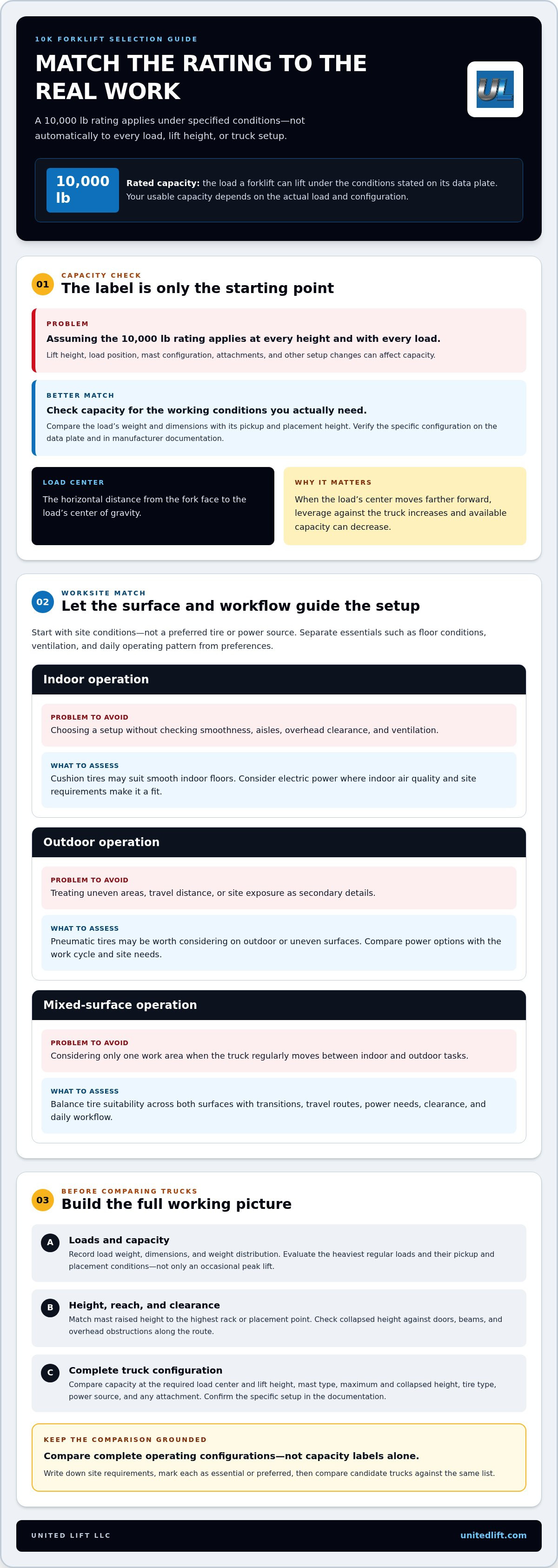
A forklift is a powered industrial truck designed to lift and move loads. A 10k forklift is rated to lift 10,000 lb under specified conditions. That figure is a reference point, not a guarantee that the truck can lift that amount at every height or with every load and setup.
Rated capacity is the load a forklift can lift under the conditions stated on its data plate. Application capacity is what it can safely lift with your actual load, lift height, mast, and equipment setup. Load center matters too. It is the horizontal distance from the fork face to the load’s center of gravity. The farther that center moves forward, the greater the leverage against the truck.
How do load center and lift height affect rated capacity?
Consider a pallet of dense material. If the weight is evenly distributed and the load sits close to the fork face, its center of gravity is closer to the truck. If the load is unusually deep or its weight sits toward the front edge, the center shifts forward. That added leverage can reduce the capacity available for the lift.
Lift height and mast configuration can also affect capacity. Don’t assume a truck’s rating at one height applies at another. Check the data plate and manufacturer documentation for the configuration and conditions that match your intended lift. Attachments and other changes to the setup can affect capacity too, so don’t treat one figure as universal.
When might a 10,000 lb forklift be worth considering?
This capacity class may suit work involving heavy pallets, dense materials, or industrial loads. Start with the weight and dimensions of the loads you handle, then consider how high and how far forward they must be lifted. A load’s shape and weight distribution can matter as much as its total weight.
Separate occasional peak lifts from routine handling. One unusually heavy lift may call for a different plan than repeated lifts near the truck’s working limit. For routine work, evaluate the heaviest regular loads and their pickup and placement conditions, not just the heaviest item you might move once. This gives you a practical basis for comparing forklifts and checking their ratings against your operation.
Match a 10k Forklift to Your Loads and Worksite
Start with the work environment, not a preferred tire or power source. A 10k forklift used on smooth warehouse floors has different requirements from one traveling over outdoor pavement or moving between both settings. Separate must-haves, such as floor conditions, ventilation, and daily operating pattern, from preferences like a particular power source. That makes equipment comparisons more useful.
| Operating environment | What to assess | Configuration considerations |
|---|---|---|
| Indoor | Floor smoothness, aisles, overhead clearance, and ventilation | Cushion tires may suit smooth indoor floors. Consider electric power where indoor air quality and site requirements make it a fit. |
| Outdoor | Surface firmness, uneven areas, travel distance, and exposure to site conditions | Pneumatic tires may be worth considering on outdoor or uneven surfaces. Compare power options with the work cycle and site needs. |
| Mixed surface | How often the truck moves between indoor and outdoor work, plus transitions and travel routes | Balance tire suitability across both surfaces with the required power source, clearance, and daily workflow. |
Which tire and power configuration fits the site?
Cushion tires are generally associated with smooth indoor surfaces, while pneumatic tires are commonly considered for outdoor or uneven operating areas. Base the choice on your actual floor or ground conditions, travel demands, and routes between work zones. For power, consider ventilation and site requirements alongside the duty cycle. Electric and internal-combustion trucks suit different operating conditions, so compare them with the work rather than assuming one option fits every site. The Material Handling Industry offers broader context on material-handling equipment and supply-chain operations.
What should you consider for mast, clearance, and attachments?
Match the mast’s raised height to your highest rack or placement point. Then check its collapsed height against doors, beams, and other overhead obstructions along the route. Include load dimensions and the room needed to approach and position the load. An attachment can change how the truck handles a load and affect its capacity. Review the data plate and manufacturer documentation for the specific setup. For broader sizing context, see our forklift capacity guide.
Before comparing trucks, write down site conditions and mark each item as essential or preferred. United Lift’s new and pre-owned forklift options give you a starting point for comparing equipment against those requirements.
Compare 10k Forklift Specifications Before You Choose
Once you know your operating conditions, compare candidate trucks by their complete working setup. A capacity label alone won’t tell you whether a forklift can handle your load at the height and reach your job requires.
Compare forklifts by their complete operating configuration, not by capacity labels alone. Use this checklist to keep the relevant details side by side:
- Capacity: Check the rated capacity at the load center and lift height your work requires.
- Mast: Record the mast type, maximum lift height, and collapsed height.
- Tires: Compare tire type with your floor or ground conditions and travel routes.
- Power source: Match the truck to site ventilation, duty cycle, and operating requirements.
- Attachments: Confirm compatibility with the tools you need and account for their effect on capacity and load handling.
- Fit and operation: Compare dimensions, controls, and visibility with the space and tasks involved.
Which data-plate details matter for a 10,000 lb forklift?
Read the data plate for rated capacity, load center, mast information, and attachment details. The plate applies to the truck’s stated configuration, so a change in mast or attachment can affect which capacity information applies. Compare the listed conditions with your actual load and lift requirements. OSHA’s guidelines on load composition explain how load size and position affect forklift stability. Use the manufacturer’s documentation for model-specific limits and operating instructions.
How do new and used 10k forklifts compare?
A new forklift may suit you if your priority is selecting a configuration around defined operating needs. A pre-owned truck may also fit, depending on its specifications, condition, and your purchase priorities. Evaluate each candidate on its own details rather than assuming all equipment in either category is the same.
For a used forklift, review available maintenance documentation and operating-hour records. Look for visible wear on the tires and mast, and check that the controls respond as expected during operation. These observations help you assess how the truck aligns with your work, but they don’t replace manufacturer documentation or establish a unit’s full history.
United Lift offers new and pre-owned forklift options to compare against your requirements. Explore forklift purchase options as you narrow down the configuration that fits your operation.
Prepare Your 10k Forklift Requirements Before Buying
A clear requirements list helps you compare forklifts and focus on configurations that fit your work. Gather details in order, starting with the loads you handle, then documenting site conditions and the purchase priorities that shape your choice.
What information should you gather about your operation?
Start with the loads. Record the heaviest routine load, any occasional maximum, and the dimensions and weight distribution of your pallets or materials. Note pickup and placement heights too. These details help distinguish the truck’s headline rating from the capacity your specific tasks require.
Next, map the route and work pattern. Include aisle width, travel distance, floor or ground conditions, overhead restrictions, and tight doors or access points. Record how frequently the forklift will operate and the shift pattern. If you use attachments, list what each one needs to handle and where you’ll use it.
Keep the information together in a simple worksheet:
- Loads: Heaviest routine and maximum load, plus dimensions and pallet or material type.
- Lifting: Pickup height, placement height, and any required load center or reach.
- Site: Aisle width, travel path, surface conditions, and overhead or access limits.
- Workflow: Travel distance, operating frequency, and shift pattern.
- Configuration: Required mast, tire type, power source, and planned attachments.
How can you prepare for a forklift purchase conversation?
Separate must-haves from preferences and future needs. A required lift height or site clearance is a must-have. A preferred tire or power option may be flexible if another configuration meets your operating requirements. Future needs, such as a different attachment or heavier loads, belong on the list, but shouldn’t distract from the jobs the truck must handle now.
Use the same worksheet to compare new and pre-owned equipment. Match each candidate against the same load, lift, site, and configuration requirements. For pre-owned options, include available operating-hour records, maintenance documentation, and observations about visible wear and controls. For any truck, compare its data plate and manufacturer documentation with your required working setup.
Include the purchase path in your planning. Financing can be one consideration alongside equipment fit and your purchasing priorities. United Lift facilitates financing options, which can be considered separately from checking whether a truck’s specifications match your work.
Bring your checklist as you compare equipment, or explore United Lift forklift options.
Find the Right 10k Forklift with United Lift
Choosing a forklift starts with the work it needs to do. Define your loads and required lift heights first. Then account for aisle access, overhead clearance, floor or ground conditions, travel routes, and the configuration those demands call for. This order keeps the focus on operating fit, not just a capacity label.
How does United Lift help buyers narrow forklift options?
Bring your load and site details into the equipment discussion. United Lift sells new and pre-owned forklifts, including equipment from Hyster, Yale, Toyota, and Caterpillar. Comparing options against your stated requirements helps clarify which configurations fit your operation. A similar capacity rating doesn’t mean every truck will perform the same way.
For each candidate, consider its capacity information for your required load center and lift height, along with mast, tire, power-source, and attachment needs. The data plate and manufacturer documentation are key references for model-specific limits and configuration details. For pre-owned equipment, available records and the unit’s condition also factor into the decision. Focus on how each option aligns with the work you’ve documented.
What is the next step toward a 10k forklift purchase?
Prepare a short summary to make the conversation productive. Include:
- Loads: Heaviest routine load, load dimensions, and any occasional maximum.
- Lift needs: Pickup and placement heights, plus the load center required for the job.
- Site fit: Aisle and overhead clearances, access points, surface conditions, and travel demands.
- Configuration: Preferred tire type and power source, mast requirements, and planned attachments.
- Purchase priorities: Whether you’re comparing new or pre-owned equipment and whether financing should be part of your planning.
United Lift facilitates financing options and provides phone and email support seven days a week. Bring your requirements to the discussion and compare forklift options against the work, site, and purchase priorities you’ve identified. The right choice is the configuration that fits your operating needs.
Talk with United Lift about forklift options.
Make Your Next Forklift Choice with Confidence
The right 10k forklift matches your loads at the lift height you need, not just a capacity label. Check the data plate and manufacturer documentation for the truck’s specific setup, then compare its mast, tires, power source, and attachments with your worksite and daily workflow.
Bring your load weights and dimensions, clearance limits, travel routes, and operating priorities into your purchase planning. United Lift offers new and pre-owned forklifts from brands including Hyster, Yale, Toyota, and Caterpillar, giving you options to compare against your requirements. Financing options can also be part of the purchase conversation, and phone and email support is available seven days a week.
Ready to explore equipment that fits your operation? Explore forklift options with United Lift. With your requirements clearly defined, you can take the next step toward a forklift choice that works for your team.
Frequently Asked Questions
What is a 10k forklift?
A 10k forklift is a truck rated to lift 10,000 lb under specified conditions. That rating applies to a particular setup and depends on factors such as load center, mast, lift height, and attachments. It doesn’t mean the truck can lift 10,000 lb in every situation. Check the data plate and manufacturer documentation to understand the capacity for the configuration and lift your work requires.
How much can a 10,000 lb forklift lift at full height?
There isn’t one full-height capacity figure that applies to every 10,000 lb forklift. Capacity can change with lift height, mast configuration, load center, and attachments. Check the data plate and manufacturer documentation for the specific truck and setup, then compare that rating with your load’s weight, dimensions, and placement height. Don’t assume the headline capacity remains available at maximum lift height.
Can a 10k forklift handle loads heavier than 10,000 lb?
Don’t assume a forklift rated at 10,000 lb can safely lift a heavier load. The permitted capacity depends on the truck’s stated configuration and operating conditions, and the load’s position and dimensions affect handling. Use the data plate and manufacturer documentation to establish the applicable limit for the task. If a load exceeds that limit, select equipment with an appropriate rating rather than exceeding the truck’s capacity.
What type of 10k forklift is best for indoor use?
The best fit depends on floor conditions, ventilation, aisle access, lift height, and operating pattern. Cushion tires are commonly associated with smooth indoor floors. An electric forklift may suit an indoor workflow where site ventilation and operating requirements make it appropriate. Compare the specific truck’s capacity, mast, and configuration with your loads and clearances instead of choosing by power source or tire type alone.
Is a 10k forklift suitable for outdoor work?
Yes, a 10k forklift can suit outdoor work if its capacity and configuration match the loads and site. Consider the surface, uneven areas, travel route, and distance. Pneumatic tires are often considered for outdoor or uneven operating surfaces. Check the manufacturer’s data plate and documentation for the truck’s configuration, then ensure its capacity suits the load at the required lift height and load center.
How do attachments affect a 10,000 lb forklift’s capacity?
Attachments can change a forklift’s effective capacity and how it handles a load. They may affect the truck’s setup and the load’s position relative to the forks, so the original capacity label shouldn’t be treated as universal for every attachment. Check the data plate and manufacturer documentation for information that applies to the attachment-equipped configuration. Confirm capacity against the load’s weight, dimensions, and working height.
Should I buy a new or used 10k forklift?
Choose based on operating fit, equipment condition, and purchase priorities. A new forklift may help you focus on a configuration that matches your requirements, while a pre-owned option may also suit the work depending on its specifications and condition. Compare both against the same checklist: load capacity for your task, lift height, mast, tires, power source, and attachments. Include purchase planning, such as financing options, in your decision.
What should I check on a used 10k forklift?
Review the data plate and manufacturer documentation first, including capacity, load center, mast, and attachment details. Examine available maintenance documentation and operating-hour records. Look for visible wear on tires and mast, and check that controls respond as expected during operation. Compare the truck’s configuration with your intended loads, lift height, and worksite. These checks help assess fit, but don’t assume every pre-owned forklift has the same condition or history.
- Tags: 10000 lb forklift, 10k forklift, forklift buying guide, forklift capacity, heavy equipment, industrial equipment, material handling, warehouse machinery
