
Used Forklift Inspection Checklist: Buyer's Guide 2026
Posted by United Lift LLC on
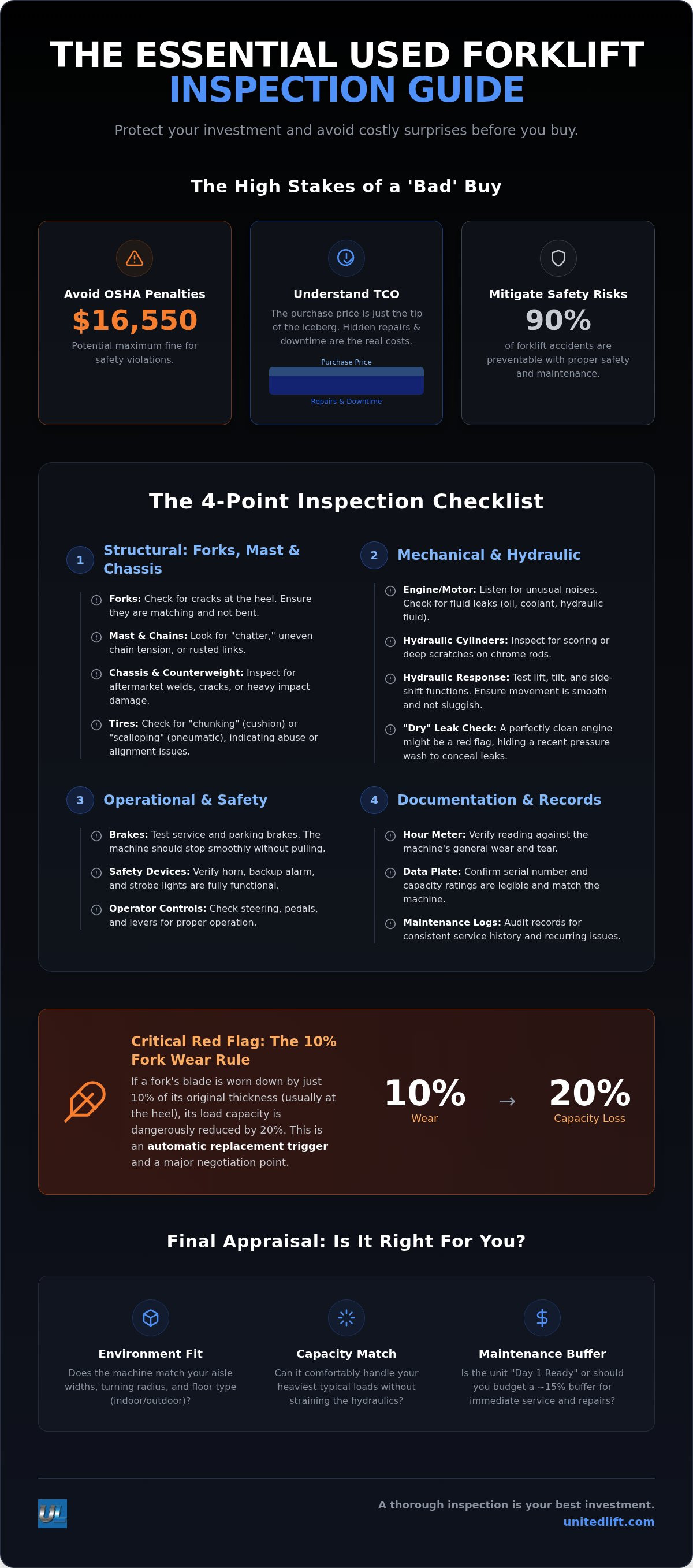
Would you pay $16,550 for a mistake you didn't even make? With OSHA penalty maximums reaching that high in 2026, buying a pre-owned forklift without a plan is a massive risk. You want to save capital, but the fear of inheriting hidden hydraulic leaks or a failing mast is real. You need more than a quick look at the hour meter to protect your business. That's why a rigorous used forklift inspection checklist is your best defense against a bad investment.
We understand that you need reliability, not a project. It's frustrating when a machine that looks clean in photos arrives with structural red flags. This guide shows you how to identify mechanical failures before you sign the check. We'll show you how to verify hour-meter readings against actual wear and check the integrity of the mast and chains. You'll gain the confidence to negotiate a fair price based on physical evidence. Let's ensure your next machine is job-site ready on day one.
Key Takeaways
- Understand why a professional mechanical appraisal is your best defense against high OSHA penalties and unexpected downtime.
- Follow a detailed used forklift inspection checklist to identify the "10% wear rule" on forks and spot dangerous mast chatter.
- Learn how to perform "dry" leak checks and test hydraulic response times to ensure the system isn't sluggish or failing.
- Verify that critical safety features like brakes, backup alarms, and strobes are fully functional before you commit to a purchase.
- Discover how to audit maintenance logs and data plates to confirm the machine's true history and serial number accuracy.
Why a Comprehensive Used Forklift Inspection is Essential
You need a machine that works. Buying used is a smart way to scale your operations, but a forklift is a complex piece of industrial capital. Before you commit, you should understand what is a forklift in terms of its mechanical components and expected lifespan. A used forklift inspection checklist is the tool that separates a reliable asset from a financial burden.
Don't confuse a daily operator check with a professional mechanical appraisal. One keeps you compliant with safety regulations; the other protects your investment. If a hydraulic pump fails or a mast develops cracks, the repair costs can quickly erase your initial savings. Focus on the Total Cost of Ownership (TCO). This calculation includes the purchase price, immediate maintenance, and the cost of potential downtime.
A used forklift inspection checklist helps you see past a fresh coat of paint. It identifies the hidden issues that cause secondary failures later. By spotting these red flags early, you mitigate risk and ensure your capital works as hard as you do.
The Cost of a 'Bad' Buy
A cheap machine becomes expensive the moment it stops moving. Unplanned downtime often costs more per hour than the machine's daily lease rate. You also face safety liability risks if you operate equipment with structural fatigue or hidden defects. These issues aren't just maintenance problems; they're significant business risks that impact your bottom line.
Financing also plays a role. Lenders are more likely to facilitate high-capital industrial purchases when the equipment is well-maintained and comes from premium brands like Hyster or Toyota. A thorough check ensures the asset holds its value. This makes it easier to secure financing or trade the unit in when it's time for an upgrade.
Setting Your Inspection Goals
Identify your specific operational needs before you visit a dealer. Every warehouse is different, and the wrong machine will slow you down. Consider these factors during your evaluation:
- Environment Fit: Does the machine match your aisle widths and floor type?
- Capacity Match: Can it handle your heaviest typical loads without straining the hydraulics?
- Maintenance Buffer: Is the unit "Day 1" ready, or should you set aside a 15% buffer for immediate service?
Your goal is to find a machine that integrates into your workflow immediately. A proactive approach saves you from the frustration of a "lemon" and keeps your crew safe. By matching the machine to the job, you ensure the equipment remains a productive asset for years to come. If your warehouse operations also involve bulk material handling, you can explore Load Cell Supply for specialized tank and silo weighing systems that ensure accurate inventory management.
The Structural Checklist: Forks, Mast, and Chassis
The structural integrity of a machine determines its remaining life and safety. While paint can be touched up, a twisted mast or a cracked chassis is often a terminal issue. When you use a used forklift inspection checklist, you're looking for signs of metal fatigue and past abuse that a quick wash can't hide. Start your evaluation at the front of the unit and work your way back to the counterweight.
Forks are the most critical point of contact. Inspect them for surface cracks, especially at the "heel" where the vertical and horizontal sections meet. You must apply the 10% wear rule: if the fork blade is 10% thinner than its original thickness, its load capacity is reduced by 20%. This is a mandatory replacement trigger. If the forks don't match or show signs of heat-treating from a torch, walk away from the deal.
Next, examine the lift chains. Look for rusted links, seized pins, or uneven tension between the left and right sides. Chains should be lubricated but not caked in old, dry grease that hides wear. Check for weld repairs on the carriage or counterweight. Aftermarket welds often signal a major past accident or structural failure. At United Lift LLC, we prioritize units with clean, original structures to ensure you get a reliable used forklift that won't fail under pressure.
Mast and Carriage Integrity
Run the mast through its full range of motion. Look for excessive play or "chatter" during vertical movement. This usually points to worn mast rollers or shims that require immediate attention. Inspect the lift cylinders for scoring on the chrome rods. Deep scratches or "scoring" indicate seal failure and impending hydraulic leaks. Finally, check the load backrest. It should be straight and securely bolted; bends suggest the machine was used to push loads it wasn't designed to handle.
Tire and Chassis Health
Tires tell the story of how a machine was driven. On cushion tire models, look for "chunking" where large pieces of rubber have broken off due to running over debris. For pneumatic tires, check for even tread wear. If you see "scalloping" or cupping on the tread, it suggests a bent axle or serious alignment issues. Finish by inspecting the undercarriage. Look for heavy impact damage or excessive corrosion, which is common in units used in chemical or brine environments. A clean chassis is a sign of a well-maintained workhorse.
Mechanical and Hydraulic System Evaluation
The structural checks covered in the previous section ensure the frame is sound. Now, you must evaluate the internal components that power your operation. A thorough used forklift inspection checklist requires a deep dive into the hydraulic and mechanical systems. These parts represent the highest potential repair costs. Don't rush this phase of the appraisal.
Start with a "dry" leak check. Park the unit on a clean patch of concrete for at least fifteen minutes. Look for fluid pools or active drips under the chassis. Inspect the hydraulic hoses for "sweating" or dampness near the fittings. If a hose feels soft or shows visible reinforcement wire, it's reaching the end of its service life. These small leaks often turn into major failures under full load.
Next, test the hydraulic response. Lift the carriage to its maximum height and tilt the mast fully. The movement should be crisp and immediate. Sluggish response times often point to a worn hydraulic pump or a leaking control valve. Listen closely while the mast is moving. A high-pitched "whining" sound usually indicates pump cavitation or internal wear. It's a sign that the pump is struggling to maintain pressure.
Check the fluid quality directly. Pull the dipsticks and open the reservoir caps. Milky hydraulic oil suggests water contamination, which can ruin internal seals. Transmission fluid that smells burnt or looks black indicates slipping clutches. These fluid conditions are red flags that suggest poor maintenance history and impending mechanical failure.
Engine and Powertrain (Internal Combustion)
For internal combustion units, the cold start is the moment of truth. Watch the exhaust carefully when the engine first turns over. Blue smoke means the engine is burning oil. Heavy black smoke suggests fuel system problems or poor combustion. Open the radiator cap when the engine is cool. If you see a "milkshake" consistency, the oil and coolant are mixing. This typically means a failed head gasket or oil cooler. Shifting between forward and reverse should be smooth. You shouldn't feel any hesitation or jarring movements when the transmission engages.
Battery and Motor (Electric Forklifts)
Electric forklifts require a specialized approach. Inspect the industrial battery cells for white powder, which indicates sulfation, or green acid corrosion on the terminals. Always ask the seller for a recent battery discharge test report. This document verifies the actual remaining capacity. A battery can look clean but still be at the end of its life cycle. Finally, check the drive motor and cables. Look for fraying or signs of overheating like melted insulation or a scorched smell near the motor housing.
Operational Testing and Safety Verification
A machine might look perfect while parked, but its true condition reveals itself under power. Visual checks are only half the battle. To complete your used forklift inspection checklist, you must perform a dynamic evaluation that mimics a real workday. This phase ensures the unit is safe for your operators and compliant with 2026 safety standards. Never skip the test drive, even if the seller provides a video of the machine running.
Start with the braking system. Accelerate the unit to its top speed and apply the brakes firmly. The machine should stop squarely without pulling to one side. If it veers, you likely have a sticking caliper or contaminated brake shoes. Next, verify every safety device. The backup alarm, strobe lights, and horn must function perfectly. These aren't just suggestions; they're mandatory for avoiding the $16,550 OSHA penalties for serious safety violations. Check the steering by turning the wheel fully in both directions. Look for "dead spots" where the wheel moves but the tires don't. Excessive play often indicates a worn steering rack or loose tie-rod ends.
Conduct a load test to verify hydraulic integrity under pressure. Lift a capacity-appropriate pallet and hold it at mid-height for several minutes. Watch the mast for "drift," which is the slow, uncommanded lowering of the forks. A machine that drifts more than an inch in ten minutes usually has internal cylinder bypass or a faulty control valve. If you want a machine that has already passed these rigorous tests, browse our pre-inspected used forklifts to find a unit ready for immediate deployment.
The Test Drive Protocol
Drive the forklift in a tight "figure-eight" pattern. This stresses the steering geometry and the drive motor simultaneously. Listen for clicking sounds from the axle or grinding from the transmission. While moving, operate the lift and tilt functions at the same time. This stresses the hydraulic pump to its limit. If the engine bogs down or the hydraulics stutter, the pump may be nearing the end of its life. If the unit has an inching pedal, test it for smooth low-speed control. It should allow you to creep forward slowly without the machine jerking or stalling.
Operator Compartment and Ergonomics
The operator's environment impacts productivity and safety. Test the seatbelt and the seat sensor, also known as the dead-man switch. The machine should not drive or lift if the operator isn't properly seated. Ensure all control levers and buttons are clearly labeled and move freely without sticking. Finally, scrutinize the hour-meter. Look for broken seals or scratches around the display that suggest tampering. Compare the hours to the wear on the foot pedals and floor mat. If the meter says 2,000 hours but the pedals are worn down to the metal, the reading is likely inaccurate.
The Paper Trail: Documentation and Final Appraisal
Physical checks confirm the current state of the machine, but documentation reveals its past. A used forklift inspection checklist must include a comprehensive audit of the maintenance history to ensure the asset was treated correctly throughout its life. Without paper evidence, you're relying solely on the seller's word, which is a significant risk in a high-capital transaction. A verified used forklift inspection checklist protects you from ownership disputes and mechanical surprises that aren't visible to the naked eye.
Request the full maintenance logs to verify that the 250 and 500-hour service intervals were met. These records should show routine oil changes, hydraulic filter replacements, and chain inspections. Next, cross-reference the VIN and serial number on the data plate with the title or bill of sale. Discrepancies here can indicate a machine built from mismatched parts or even a stolen unit. Also, look for physical OSHA safety certification stickers; they provide an extra layer of assurance that the unit met regulatory standards during its last professional review.
Finally, perform a market value appraisal. In 2026, pricing is highly sensitive to brand reputation and hour-meter accuracy. High-demand models from Toyota or Hyster with low hours command a premium, but you shouldn't pay top dollar without the logs to back it up. Comparing the asking price against current auction data helps you negotiate from a position of strength and ensures you don't overpay for an aging asset.
Verifying Machine History
While the physical wear on pedals and floors gives you a clue about usage, the paper trail should confirm those findings. If the logs stop abruptly several years ago while the meter continued to run, it's a major red flag. Investigate the machine's previous environment as well. Documentation showing the unit was used in cold storage or brine-heavy facilities suggests a higher risk of electrical failure and hidden corrosion. Before the final exchange of funds, perform a UCC search to confirm the machine is not tied up in an existing lease or lien. Ownership must be clear and transferable.
Final Steps to Purchase
Once the inspection is complete and the paperwork is verified, draft a formal bill of sale. This document should clearly state the serial number and the "as-is" condition of the sale. To keep your operational capital liquid, consider industrial lift equipment financing. This approach allows you to secure a higher-tier machine with a better maintenance history while spreading the cost over time. For a quote on inventory that has already been through this rigorous vetting process, contact United Lift LLC. We specialize in providing transparent, job-site ready equipment for your national operations.
Secure Your Fleet with Confidence
Buying a pre-owned machine shouldn't feel like a gamble. By focusing on structural integrity, testing hydraulic response times, and auditing the maintenance history, you protect your business from expensive downtime. A thorough used forklift inspection checklist is your best tool for identifying hidden issues before they impact your bottom line. It's about finding a balance between immediate savings and long-term reliability.
You don't have to navigate the used market alone. We specialize in providing high-quality equipment that has already undergone rigorous professional appraisal. Whether you need a Hyster, Yale, or Toyota, we ensure every machine is ready for the job site. We offer national shipping on our entire inventory and facilitate financing options to help you upgrade to premium brands without draining your cash flow.
Ready to find a reliable workhorse for your warehouse? Browse Our Pre-Inspected Used Forklift Inventory today. Your next productive asset is just a click away.
Frequently Asked Questions
What is the most important thing to check on a used forklift?
The synergy of the mast, forks, and hydraulic pump represents the core value of the machine. While cosmetic issues are simple to address, structural cracks or a failing pump can lead to catastrophic repair bills. By utilizing a used forklift inspection checklist, you can verify that these high-cost components are in good working order. Prioritizing these areas ensures you don't inherit a machine with terminal mechanical flaws.
How many hours is too many for a used forklift?
There is no single "too many" number, but 10,000 to 12,000 hours is typically when internal combustion engines require major overhauls. For electric units, the battery life is the primary concern rather than the motor. Most buyers look for units with under 5,000 hours to ensure several years of productive life before needing significant capital reinvestment. Proper maintenance history is always more important than the raw number on the meter.
Should I buy an electric or internal combustion used forklift?
Choose based on your environment and shift schedule. Electric forklifts are ideal for indoor warehouses where emissions and noise are concerns, though they require charging infrastructure. Internal combustion units, such as propane or diesel, excel in outdoor yards or high-intensity multi-shift operations where you can't wait for a battery to charge. Consider your total cost of ownership, including fuel and battery replacement, before making the final call.
How can I tell if a forklift mast is worn out?
A worn mast exhibits excessive horizontal "play" or movement when the forks are raised. If you see the mast sections chatter or shake during vertical travel, the rollers or shims are likely failing. Check for scoring or deep scratches on the lift cylinders, as this indicates internal seal damage. Any mast that cannot hold a load steadily or shows visible twisting during a lift is a major safety risk.
Is a battery discharge test necessary before buying an electric forklift?
Yes, a battery discharge test is the only reliable way to verify the remaining life of an industrial battery. A battery can look clean and hold a charge while sitting, yet fail within an hour under a heavy workload. Since a new battery and charger can cost several thousand dollars, confirming the current capacity is vital. Always ask for a certified test report to avoid an immediate and expensive replacement after the sale.
What does 'drifting' mean in a hydraulic system?
Drifting refers to the slow, uncommanded lowering of the forklift carriage or the tilting of the mast while under load. This happens when hydraulic fluid bypasses internal seals in the cylinders or the control valve. While a tiny amount of drift is normal over long periods, visible movement within a few minutes is a red flag. It suggests that the hydraulic system is losing pressure and requires immediate mechanical attention or seal replacement.
Can I finance a used forklift that is over 10 years old?
Yes, you can often finance older equipment through specialized lenders. United Lift LLC facilitates financing for high-capital industrial purchases to help you preserve your cash flow. While some traditional banks hesitate on machines over a decade old, industrial equipment specialists understand the long-term value of brands like Toyota or Caterpillar. This allows you to acquire the heavy machinery you need without a massive upfront cash outlay during the transaction.
What are the red flags of a tampered hour-meter?
Physical evidence often contradicts a tampered hour-meter. Scrutinize the wear on the rubber foot pedals and the condition of the operator's floor mat. If these components are worn down to the steel, but the meter shows low usage, the reading is likely inaccurate. Also, inspect the meter housing for broken seals or tool marks. Always cross-reference the digital reading with the chronological dates in the maintenance logs to ensure consistency.
- Tags: buyer's guide, checklist, equipment maintenance, forklift inspection, material handling, OSHA compliance, used forklift, used forklift inspection checklist
