
Used Genie Lift for Sale: Complete Buyer’s Guide 2026
Posted by United Lift LLC on
Buying a brand-new aerial lift in 2026 is often a poor use of capital when you can get the same legendary performance for significantly less. You're likely searching for a used Genie lift for sale because you need to bypass long lead times and avoid the massive depreciation that hits new machinery the moment it leaves the lot. It's completely natural to worry about inheriting hidden hydraulic issues or buying a lift that fails to meet current ANSI A92 safety standards.
We're here to help you skip the "lemon" and find a reliable workhorse for your fleet. This guide provides the expert framework you need to select the right model for your specific weight and height requirements. You'll learn exactly what to look for during a pre-purchase inspection and how to leverage national financing and Section 179 tax benefits to preserve your cash flow. We've simplified the process so you can acquire a high-quality, job-site ready Genie lift at a fraction of the new price.
Key Takeaways
- Learn why Genie's engineering simplicity and high resale value make it a superior long-term investment for your fleet.
- Master the differences between GS scissor lifts and Z/S boom models to find the right used Genie lift for sale for your site.
- Use our expert checklist to verify hour meters and inspect hydraulic systems for leaks or cylinder drift before you buy.
- Understand the critical difference between platform height and work height to ensure your machine meets specific project reach requirements.
- Discover how to preserve your working capital by utilizing national financing options and Section 179 tax benefits for 2026.
Why Buying a Used Genie Lift is a Smart Investment for Your Fleet
Genie equipment has earned its place on job sites worldwide through a reputation for reliability and straightforward engineering. When you look for a used Genie lift for sale, you aren't just buying a machine; you're investing in the "Genie Blue" legacy of innovation. Understanding Genie's corporate history reveals a consistent focus on safety and user-centric design that has spanned decades. This engineering simplicity means your mechanics spend less time troubleshooting complex, proprietary systems. It's built for the field, not just the showroom.
Cost Savings vs. Performance: The Used Equipment Advantage
New aerial lifts experience their steepest depreciation during the first three years of service. By choosing a pre-owned unit, you let the previous owner absorb that initial financial hit while you secure a machine with plenty of service life remaining. In the current 2026 market, used equipment asking values have shown steady growth, making these machines a stable asset for your business. Choosing used allows for rapid fleet expansion without the 12 to 18-month lead times often seen with new factory orders. You can put the machine to work immediately, generating revenue from day one. This creates a much faster path to ROI for industrial firms that need to stay agile, especially when paired with Section 179 tax benefits that allow for immediate expensing of equipment costs.
The Longevity of Genie Engineering
Genie is a global leader in the design and manufacture of world-class aerial work platforms. Their commitment to part standardization is a major win for used equipment buyers. Many components are interchangeable across different model generations, which simplifies your maintenance schedule and reduces long-term costs. You won't struggle to find a replacement sensor or hydraulic seal for a machine that's a few years old. Even older models were built to meet or exceed ANSI and OSHA safety standards, ensuring your crew stays safe at height. This focus on structural integrity is why Genie equipment consistently commands a higher resale value than generic alternatives. When you eventually decide to upgrade, you'll find that the market for a used Genie lift for sale remains incredibly liquid and competitive.
In addition to the structural safety of the lift itself, many industrial projects require specialized rigging and fall protection solutions. For professionals who need high-performance hardware, Fusion Climb offers industrial-strength equipment designed for the most demanding rigging environments.
Navigating Genie Models: Scissor Lifts vs. Boom Lifts
Which machine actually fits your job site? Choosing the wrong model wastes time and creates safety hazards. Following industry best practices starts with matching the machine's capabilities to your specific environment. You don't want to realize a boom is too wide for your aisle or a scissor lift lacks the reach for an "up and over" task after the equipment arrives. Finding the right used Genie lift for sale requires a clear understanding of how these different series operate in the field.
Genie Scissor Lifts for Indoor and Outdoor Use
The Genie GS Series is the benchmark for vertical lifting. For tight warehouse aisles, the GS-1930 is a favorite because it fits through standard doorways. If you need more height but still have narrow paths, the GS-2632 offers a 26-foot platform height with a slim profile. When the pavement ends, Genie's rough terrain (RT) models take over. These units feature 4WD and hydraulic outriggers to level the machine on uneven dirt or gravel. If you're looking at a used Genie lift for sale that's electric, check the battery plates immediately. Lead-acid batteries require consistent watering; neglected maintenance here can lead to a $2,000 replacement bill shortly after purchase.
Genie Boom Lifts: Reaching New Heights
Boom lifts offer the flexibility scissor lifts lack. Articulating Z-lifts are designed with multiple pivot points. They're perfect for reaching over pipes or machinery in a crowded factory. In contrast, straight S-booms (telescopic) are built for pure reach and speed. They extend in a straight line and are ideal for high-rise construction where horizontal outreach is just as important as vertical height. Don't forget the GTH series telehandlers for heavy material handling and site prep. Whether you need a DC electric motor for quiet indoor work or a rugged diesel engine for a muddy job site, browsing a diverse inventory helps you compare these specs side-by-side.
Power source selection is your final hurdle. DC electric units are standard for indoor maintenance where emissions and noise are concerns. Bi-Energy models offer a hybrid solution, using a small diesel generator to charge batteries during outdoor use, which is excellent for sites without reliable power. For heavy-duty construction, Tier 4 diesel engines remain the king of torque and durability. Identifying the right power source ensures your machine stays running through the entire shift without unexpected downtime. Balancing these specs with your budget is the key to a successful fleet addition.
Critical Inspection Points for Pre-Owned Genie Equipment
Buying a used Genie lift for sale requires a sharp eye for detail. You don't want to discover a major hydraulic leak two days after the machine arrives on your job site. The first thing to verify is the hour meter. In the aerial lift industry, machines with under 2,000 hours are considered low-hour units and often command a premium price. If a machine shows 5,000 hours or more, it isn't necessarily a bad buy, but it does require a much more rigorous review of its service logs. High hours without documented maintenance is a red flag you shouldn't ignore.
Structural integrity is your next priority. Walk around the entire unit and look for cracked welds, especially on the boom sections and the chassis. Inspect the platform for signs of "curb rash" or structural bowing that suggests it was used to lift more than its rated capacity. Test the controls thoroughly. Joysticks should provide proportional, smooth movement. If the machine jerks or hesitates when you move the stick, you're likely looking at failing solenoids or a worn-out controller board. Always test the emergency stop buttons on both the ground and platform consoles to ensure they kill power instantly.
Hydraulics and Mechanical Systems
Listen closely to the hydraulic pump while the machine is under load. A high-pitched whine or a grinding noise often indicates pump cavitation or internal wear that will lead to a costly failure. Check for "cylinder drift" by extending the boom and letting it sit for fifteen minutes; it shouldn't move. Inspect the swing bearing for excessive play or "slop" during rotation, as a worn gear here makes precise positioning impossible. Don't forget the tires. Foam-filled tires are excellent for preventing flats, but check for deep gouges or flat spots. If the machine has pneumatic tires, look for sidewall dry rot and ensure they're at the correct pressure for stability.
Electrical and Safety Components
Modern Genie lifts utilize the Smart Link control system. Power the machine on and check the LCD for active fault codes. These codes provide a direct window into the machine's health that a simple visual check cannot offer. You must also verify that the machine meets current OSHA safety regulations for aerial lifts. Test the tilt alarm by driving the machine onto a slight incline with the platform raised; the alarm should trigger and cut certain functions for safety. Finally, look for the annual inspection sticker. If the machine hasn't been inspected within the last twelve months, it isn't job-site ready. Insist on seeing the full maintenance logs to confirm that all safety bulletins and parts replacements were performed by a qualified technician.
Selecting the Right Capacity and Reach for Your Application
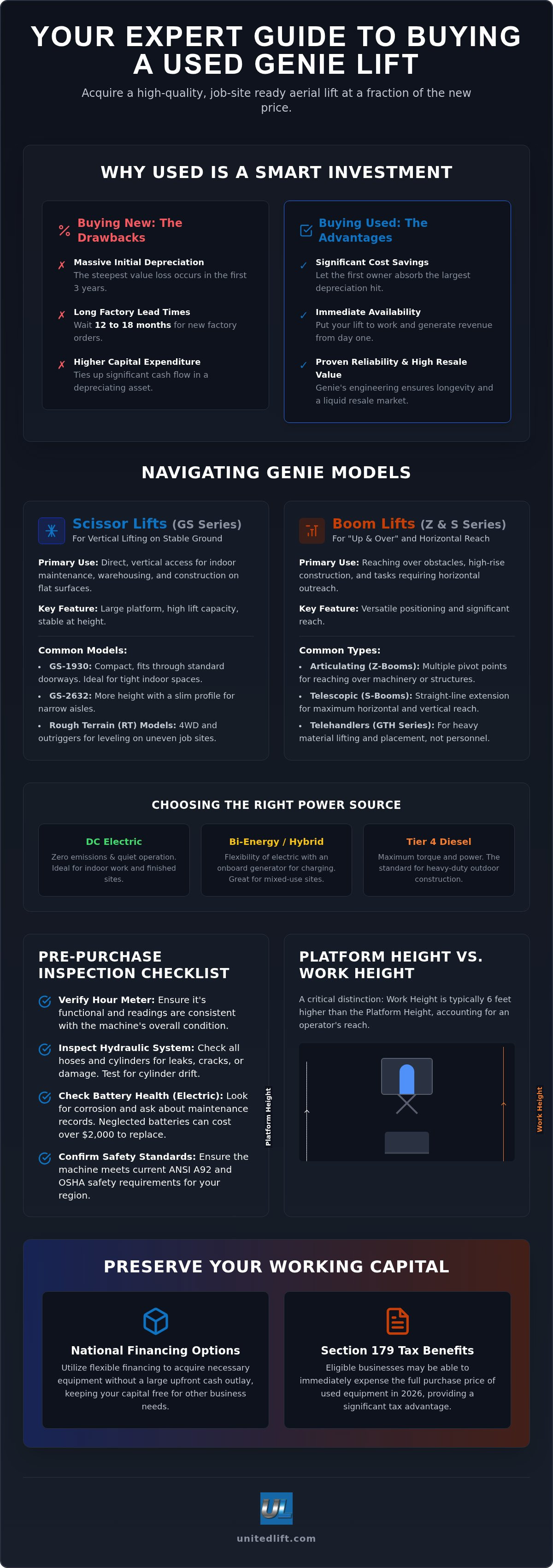
Don't make the mistake of buying a machine that leaves you six feet short of your goal. When you're looking at a used Genie lift for sale, the first distinction to master is Platform Height versus Work Height. Work height is generally calculated by adding six feet to the platform height. If your project involves reaching a 40-foot ceiling, a machine with a 34-foot platform height is usually sufficient. Buying more height than you need increases your cost and the machine's footprint, while buying too little makes the equipment useless.
Capacity is another area where buyers often get tripped up. A lift's rated capacity is not a static number. You must consult the load chart for each specific model. As a boom extends horizontally or the angle decreases, the lifting capacity often drops to maintain stability. If you're frequently lifting heavy HVAC units or multiple workers with tools, ensure the machine's capacity at full outreach meets your requirements. Selecting the right capacity isn't just about the biggest number on the spec sheet; it's about finding the balance between reach, weight, and site maneuverability.
Site constraints like turning radius and stowed dimensions are just as critical as reach. If you're working in a congested warehouse, a machine with zero tailswing is a necessity. This feature ensures the back of the turntable doesn't swing out past the chassis, preventing accidental collisions with racks or walls. For those managing indoor facilities, check out our Ultimate Forklift Buying Guide for more tips on choosing warehouse-ready machinery.
Warehouse vs. Construction Site Needs
Indoor environments require DC electric power and non-marking tires to protect flooring. If your used Genie lift for sale is destined for a muddy construction site, prioritize diesel power and oscillating axles. These axles allow the wheels to maintain contact with the ground on uneven terrain, providing better traction and stability. Always verify the stowed height and width to ensure the unit fits on your existing trailer or through the gates of your facility.
Specialized Genie Features to Look For
Genie offers unique technology like the TraX system, which uses four independent tracks instead of tires. This is perfect for job sites with sensitive turf or mud where low ground pressure is required. Another essential feature is the "Jib" boom. This short, articulated section between the main boom and the platform allows for precision positioning that a straight boom can't match. Used Genie lifts are often preferred for their intuitive control layouts that reduce operator learning curves. If you're ready to find a machine that matches these specs, browse our current national inventory today.
Securing Your Used Genie Lift with United Lift LLC
Finding a used Genie lift for sale is only the first step. You need a partner who understands that in the material handling industry, downtime isn't just an inconvenience; it's a drain on your bottom line. United Lift LLC operates as a national dealer, offering a massive inventory of pre-owned Genie machinery that bypasses the 12 to 18-month wait times often found with new orders. We don't just sell equipment; we facilitate your business growth with a no-nonsense approach that respects your time and your budget. Our reputation is built on being a reliable facilitator for contractors and industrial facility managers who need quality machinery without the corporate red tape.
Our team understands the urgency of your logistical needs. That's why we provide 7-day-a-week support via phone and email. Whether you have a technical question about a specific Z-series boom or need help coordinating shipping to a remote job site, we're ready to assist. We've positioned ourselves as a proactive partner, moving beyond the limitations of local-only dealers to provide national coverage for all equipment sales. This accessibility ensures that you're never left waiting for answers when a project deadline is looming. We act as a tireless worker in your corner, ensuring the transaction is as efficient as the machines we sell.
Financing and Tax Benefits for 2026
Preserving your working capital is essential for long-term success. For the 2026 tax year, Section 179 allows businesses to fully expense up to $2.56 million of equipment in the first year, provided the total equipment purchase stays under the $4.09 million phase-out threshold. This creates a massive immediate tax deduction that can significantly offset the purchase price of your lift. We offer specialized financing options tailored for industrial machinery, including custom leasing and direct loans. With conventional equipment loan rates currently in the 6% to 12% range for strong credit profiles, financing allows you to acquire the tools you need today while keeping your cash reserves intact for other operational expenses. Our team handles the heavy lifting of the financing process, connecting you with options that fit your specific cash flow requirements.
National Sales and Expert Support
Buying from across the country shouldn't be a headache. We handle the logistics and nationwide shipping to ensure your machine arrives ready for the job site, regardless of your location. Our experts are available to provide model-specific advice, helping you navigate the trade-offs between different reach capacities and power sources discussed earlier in this guide. We aim to remove the confusion mentioned at the start of this guide, ensuring the machine you receive meets your exact height and weight requirements. Don't let a tight equipment market slow your projects down. Browse our current inventory of used Genie lifts for sale and let us help you find the reliable workhorse your fleet requires to stay productive and safe.
Ready to Expand Your Fleet with Confidence?
Investing in a used Genie lift for sale shouldn't be a guessing game. By mastering model selection and following a rigorous inspection checklist, you've already mitigated the biggest risks of the pre-owned market. You now know how to align your work height requirements with the machine's actual platform reach. You also understand how to leverage 2026 tax benefits like Section 179 to maximize your ROI and preserve business cash flow. These strategic moves transform a simple equipment purchase into a long-term asset for your company's growth.
United Lift LLC is here to facilitate the rest of your purchase. We provide reliable national delivery and expert financing facilitation to ensure your capital stays where it belongs: in your business. Do you have specific questions about a unit's history or hydraulic performance? Our team offers 7-day phone and email support to keep your projects moving forward without delay. We take a no-nonsense approach to equipment sales so you can focus on the job at hand. We're ready to help you find a machine that meets both your safety standards and your budget.
View Our Full Inventory of Used Genie Lifts
Take the next step toward a safer, more efficient job site today. Your fleet is the backbone of your industrial success, and we're ready to help you strengthen it with a reliable workhorse that's ready to perform.
Frequently Asked Questions
What is the average lifespan of a used Genie lift?
A well-maintained Genie lift can last 15 to 20 years or approximately 10,000 to 12,000 operational hours. This longevity depends heavily on the consistency of hydraulic fluid changes and battery maintenance. While components like hoses and seals will eventually wear out, the structural chassis and boom are designed for decades of heavy industrial use if kept in a regular service rotation.
How many hours is too many for a used Genie scissor lift?
For a used Genie lift for sale, "high mileage" typically begins at the 5,000-hour mark. Units under 2,000 hours are considered premium, low-use machines that often command higher prices. If a scissor lift exceeds 5,000 hours, you must verify that major wear items like the scissor stack bushings and hydraulic pump have been recently inspected or replaced to ensure continued reliability.
Do used Genie lifts come with a warranty?
Most pre-owned equipment is sold as-is, though some refurbished units may include limited powertrain warranties. It's important to distinguish between a standard used machine and a refurbished unit that has been certified to meet specific performance standards. Always ask for a written statement regarding what components, if any, are covered during the first 30 to 90 days after your equipment delivery.
What is the difference between a Genie Z-boom and S-boom?
The main difference lies in the boom's range of motion and pivot points. A Genie Z-boom is an articulating lift with multiple joints for "up and over" reach in tight spaces with obstacles. An S-boom is a telescopic, straight lift designed for maximum horizontal outreach and faster extension speeds on open job sites where precision positioning isn't as complex.
Can I finance a used Genie lift for my small business?
Yes, you can secure specialized financing for a used Genie lift for sale through equipment experts like United Lift. We facilitate flexible options that allow small businesses to preserve their cash flow while acquiring essential assets. Current 2026 interest rates for equipment loans typically range from 6% to 12% depending on your credit profile and the length of the financing term.
How often does a Genie lift require a safety inspection?
OSHA and ANSI standards require that every aerial lift undergoes a thorough safety inspection at least once every 12 months. This is known as the Annual Inspection and must be performed by a qualified technician. Operators should also perform a visual pre-operation check before every shift to identify obvious leaks, tire damage, or control malfunctions that could compromise job site safety.
Is it better to buy a used Genie lift or rent one for a long-term project?
Purchasing used is generally better for projects lasting longer than 12 months or for businesses with recurring lifting needs. Owning the asset allows you to build equity and benefit from Section 179 tax deductions that aren't available for rentals. Rental costs can quickly exceed the monthly payment of a financed used lift, especially when you consider Genie's historically high resale value. For those with shorter-term needs or local projects, sourcing equipment from Pahrump Rentals & Hardware can be an effective way to access high-quality industrial tools without a permanent investment.
What safety certifications should I look for when buying used aerial equipment?
Look for machines that are fully compliant with the current ANSI A92 standards for Mobile Elevating Work Platforms (MEWPs). You should also verify that the unit has a current OSHA annual inspection sticker and a complete set of maintenance logs. These documents prove the equipment has been serviced by qualified technicians and meets all legal safety requirements for immediate use on a professional job site.
- Tags: Aerial Lifts, Boom Lifts, Buyer's Guide, Equipment Financing, Genie Lifts, Scissor Lifts, Section 179, Used Equipment, used Genie lift for sale
