
Used Reach Truck for Sale: 2026 Comprehensive Buyer’s Guide
Posted by United Lift LLC on
Buying a used reach truck isn't just about saving money; it's the fastest way to double your warehouse capacity without moving to a larger facility. You already know that vertical storage is the key to scaling your operations in 2026. However, finding a reliable used reach truck for sale often feels like a high-stakes gamble. You're likely worried about inherited mechanical problems, a battery that won't hold a charge, or shipping costs that eat your entire budget. We understand those concerns because we deal with them every day.
This comprehensive guide will show you how to identify high-quality units, evaluate battery health like a pro, and choose the right mast configuration for your specific racking. We'll break down the technical specs you actually need, from pantograph reaches to national shipping strategies. By the end, you'll have a clear procurement strategy to maximize your density and reduce your capital expenditure. Let's get your warehouse moving efficiently without the stress of buying new.
Key Takeaways
- Learn why purchasing pre-owned equipment allows for immediate warehouse expansion without the long wait times or high costs of new factory orders.
- Discover how to choose the right used reach truck for sale by comparing the stability of moving masts with the versatility of pantograph configurations.
- Identify the critical checkpoints for evaluating battery health and hydraulic integrity to avoid costly post-purchase repairs.
- Understand the logistics of national heavy equipment shipping, including the differences between flatbed and step-deck trailers for a smooth delivery day.
- Explore expert strategies for securing financing and selecting top-tier brands like Hyster, Yale, and Toyota to ensure long-term reliability.
Why Investing in a Used Reach Truck Makes Sense for Your Facility
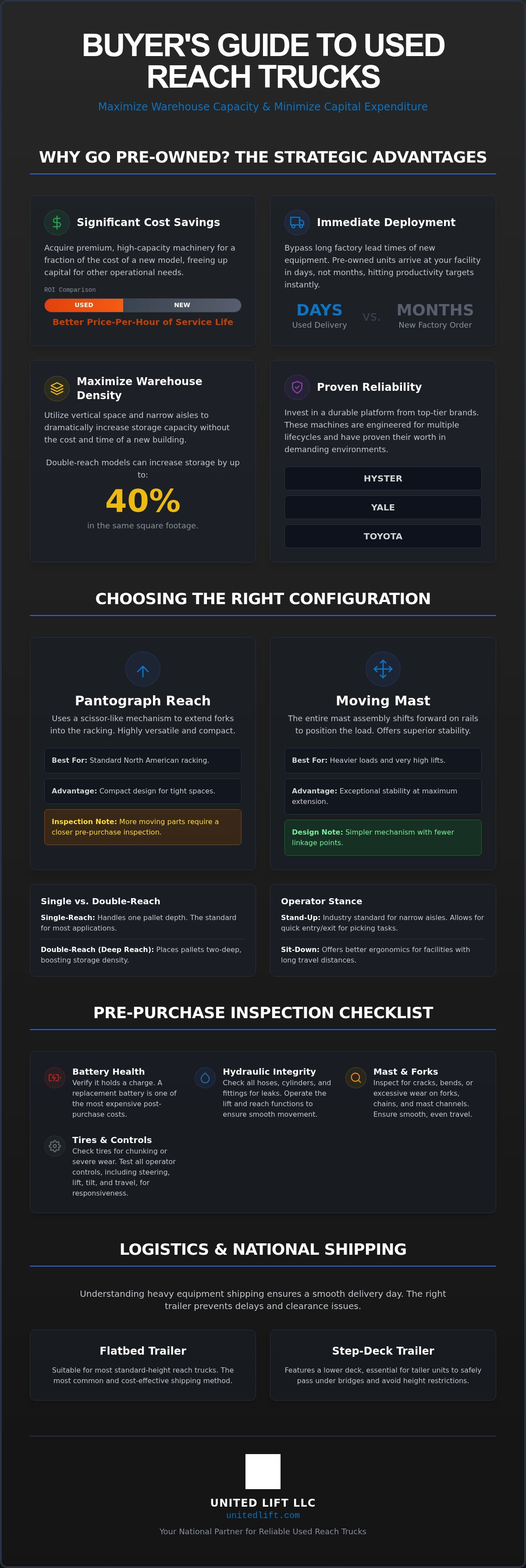
Managing a warehouse budget requires balancing high performance with smart cost control. Choosing a used reach truck for sale is often the smartest move for growing operations that need to scale quickly. You get high-spec machinery without the staggering capital outlay of a factory-fresh unit. Most new equipment orders in 2026 still face significant manufacturing lead times. Buying pre-owned means your equipment arrives at your facility in days, not months, allowing you to hit your productivity targets immediately.
Reliability is a major factor when shopping the secondary market. Brands like Hyster, Yale, and Toyota have built their reputations on rugged durability and long-term engineering. These machines are designed for multiple lifecycles. When you buy a used unit from a reputable brand, you're investing in a proven platform that has already cleared the steepest part of its depreciation curve. This shift in value allows you to acquire a premium, high-capacity truck for a fraction of the cost of a new model. It's a practical way to keep your capital liquid while still upgrading your fleet's capabilities.
Maximizing Warehouse Density Without a New Build
Expanding your physical footprint is an expensive and time-consuming process. A reach truck solves this problem by allowing you to narrow your aisles and grow vertically. While standard counterbalance forklifts need wide paths to turn, reach trucks are designed to operate in tight spaces and push pallets deep into high-density racking systems. This capability lets you store more inventory in the same square footage you already pay for. These units are essential for multi-shift logistics environments where speed and space optimization are non-negotiable for maintaining a competitive edge.
Used vs. New: Calculating Your Return on Investment
Smart procurement managers focus on the "price-per-hour" of remaining service life. A well-maintained used unit often provides a significantly better ROI because your initial investment is so much lower. If you run a low-intensity operation or simply need a reliable backup machine, our inventory of economy lifts offers a perfect solution. You can expand your fleet on a fixed budget, ensuring you always have a truck ready when demand spikes. It's about matching the specific equipment to your actual job requirements, rather than just buying the newest machine on the market.
Key Types of Reach Trucks Available in the Used Market
Selecting the right configuration for a used reach truck for sale is the difference between a smooth operation and a logistical bottleneck. Not all reach trucks are designed for the same tasks. According to the Material Handling Industry (MHI), choosing equipment that matches your specific warehouse layout is critical for both safety and throughput. You need to decide between single-reach and double-reach (deep reach) configurations early in your search. Single-reach trucks handle one pallet depth, while double-reach units use an extended mechanism to place pallets two-deep. This double-deep strategy can increase your storage density by up to 40% without changing your building's footprint.
Operator comfort also plays a role in your choice. Stand-up models are the industry standard for narrow aisles because they allow the operator to step on and off quickly. This is ideal for tasks involving frequent scanning or picking. Sit-down models are less common but offer better ergonomics for facilities with long travel distances between the dock and the racking. Balancing these aisle-width requirements with your team's workflow ensures you don't buy a machine that's technically capable but practically inefficient for your space.
Pantograph vs. Moving Mast: Which is Right for You?
The mechanical way the forks extend defines these two categories. A pantograph reach truck uses a scissor-like mechanism to push the forks into the rack. This design is compact and highly versatile for standard North American racking. Moving mast trucks literally shift the entire mast assembly forward on rails. These are often preferred for heavier loads or very high lifts because they offer superior stability. When you browse our reach truck inventory, you'll see both types from brands like Hyster and Toyota. Keep in mind that pantograph mechanisms have more moving parts, so they require a closer look during your pre-purchase inspection.
Specialized Reach Truck Features to Consider
Don't overlook environmental or load-specific needs. Cold storage conditioning is essential if you're operating in a freezer; it includes heaters and specialized seals to prevent hydraulic failure. For high-level pallet placement, look for units equipped with mast-mounted cameras or laser guidance systems. These tools significantly reduce the risk of rack damage at heights over 300 inches. If your facility handles long materials like lumber or piping, a four-way reach truck is the best solution. These units can travel sideways, allowing you to navigate narrow aisles with oversized loads that would be impossible to move with a standard truck.
Critical Inspection Points When Evaluating Pre-Owned Reach Trucks
Evaluating a used reach truck for sale requires looking past the fresh coat of paint. You need to verify the mechanical and electrical health of the unit to ensure it remains a reliable asset. Start with the hydraulic system. Operate the mast through its full range of motion while listening for unusual whining from the pump. Watch for "mast drift," where the forks slowly sink while holding a load. Any visible leaks around the cylinders or valves are immediate red flags that suggest neglected maintenance or impending seal failure.
Electronics are just as vital. Test the joystick or control levers to ensure the reach and tilt functions respond smoothly without jerking. Modern reach trucks rely on sophisticated controllers; any lag or error codes on the dashboard could indicate expensive repairs ahead. Check the wiring harnesses for signs of fraying or amateur "quick fixes" that might lead to short circuits during a busy shift. When evaluating a used reach truck for sale, identifying these electrical issues early prevents unexpected downtime later.
The 2026 Guide to Used Electric Battery Health
The battery is the most expensive component of an electric truck. Look beyond the hour meter. A low-hour machine can still have a failing battery if it wasn't watered or charged correctly. Check for acid corrosion or sulfation on the plates. A load test is the industry standard for verifying a battery's actual capacity by measuring its voltage drop under a sustained electrical draw. This test ensures you aren't buying a unit that will die halfway through a shift.
Mast and Carriage Safety Checks
Structural integrity is critical for high-reach tasks. Inspect mast channels for stress fractures or old weld repairs. Reach mechanisms shouldn't have excessive play or wobbling. Check the fork heels for wear using a caliper; a 10% reduction in thickness means the forks are unsafe. Always test the dead-man switch and travel alarms to ensure full OSHA compliance. These safety features must work perfectly to protect your team and maintain your facility's safety standards.
Logistics and Shipping: Getting Your Reach Truck to Your Facility
Shipping a heavy machine across state lines requires more than just a standard freight carrier. When you finalize the purchase of a used reach truck for sale, the logistics of moving that 8,000-pound asset safely to your dock becomes the priority. National shipping involves coordinating specialized trailers and ensuring the driver has experience with industrial machinery. Most units travel on flatbeds, but if your facility has low overhead clearance or specific height restrictions, we may coordinate a step-deck trailer. This lower deck height provides more vertical room for the mast during transit.
Always perform a "Day 1" inspection the moment the truck arrives. Check the chains, hoses, and battery cables for any movement or vibration damage that occurred during the trip. If you notice any fluid leaks on the trailer bed, document them immediately before the driver leaves. This proactive step protects your investment and ensures that any transit-related issues are handled through insurance rather than your maintenance budget. It's the best way to ensure your used reach truck for sale is ready for immediate service.
National Shipping Considerations
Calculating shipping costs depends on the weight of the unit and the total mileage. Since reach trucks are heavy and compact, they require secure blocking and bracing to prevent shifting. We ensure every unit is fully insured during transit, protecting you against unforeseen accidents on the road. Typical cross-country deliveries in 2026 take between five and eight business days, depending on the specific shipping lane. We provide tracking updates so your team is ready the moment the trailer pulls into the yard.
Preparing Your Facility for Arrival
You must have a plan for unloading before the truck arrives. A standard loading dock is the most efficient option. If you don't have a dock, you will need a specialized heavy-duty yard ramp capable of supporting the truck's concentrated weight. Once the unit is on the floor, check the battery water levels immediately. Use only distilled water to prevent mineral buildup in the cells. It's a small step that prevents long-term plate damage.
Operator familiarization is the final step. Controls for a Toyota reach truck often differ from the joystick patterns found on a Hyster or Yale. Give your team time to practice the specific reach and tilt nuances of the new unit before putting it into a high-speed production environment. Ready to find your next machine? View our current inventory and get a national shipping quote today.
United Lift: Your National Partner for Reliable Used Reach Trucks
Finding the right used reach truck for sale is only half the battle. You need a partner who understands that every hour of downtime costs your business money. United Lift operates as a no-nonsense expert, focusing on speed, reliability, and transparency. We don't hide behind corporate jargon or complex sales cycles. Instead, we offer a curated inventory of top-tier brands like Hyster, Yale, Toyota, and Caterpillar. These machines are selected for their durability and readiness to work. When you call us, you're connecting with a team that values your time as much as you do.
Our support doesn't end when the truck leaves our lot. We provide assistance seven days a week because the material handling industry never sleeps. Whether you have questions about a specific machine's history or need technical details for your facility manager, we are available to help. This direct, service-oriented approach has made us a trusted facilitator for warehouses across the country. We handle the heavy lifting of procurement so you can focus on your core operations.
Financing and Tax Benefits for Your Purchase
Investing in capital equipment requires a smart financial strategy. In 2026, many businesses are taking advantage of Section 179 to write off the full purchase price of their used equipment in a single tax year. This incentive makes it easier to upgrade your fleet without straining your cash flow. We offer expert financing solutions tailored specifically for industrial machinery investments. Whether you prefer a flexible leasing arrangement or a direct purchase, we can help you structure a deal that fits your specific budget. For more details on how to maximize your savings, check out our guide on Section 179: Forklift Tax Deductions You Need to Know.
Start Your Reach Truck Search Today
Success in a high-density warehouse starts with the right equipment. Our team doesn't just sell you a machine; we help you match a used reach truck for sale to your specific racking dimensions and aisle widths. We understand the nuances of different mast heights and carriage types. Working with a national dealer gives you access to a broad brand portfolio that local independent sellers simply cannot match. We facilitate the entire process from initial inquiry to national shipping and final delivery. Don't let a lack of equipment hold your facility back. Browse our current inventory of used reach trucks and find the perfect addition to your fleet today.
Scale Your Warehouse Operations with Confidence
You've seen how a used reach truck can transform your warehouse density without the heavy price tag of new equipment. By focusing on battery health and selecting the right mast configuration, you can secure a reliable asset that drives immediate productivity. Whether you need a single-reach unit for standard aisles or a double-reach model for high-density storage, the 2026 market offers versatile solutions for every facility. It's about making your square footage work harder for you while keeping your capital liquid.
United Lift is here to simplify your procurement process. As an authorized dealer for major industrial brands, we provide the inventory and expertise you need to scale your fleet. We manage everything from commercial financing for businesses of all sizes to nationwide delivery and logistics support. You don't have to navigate the secondary market alone when you have a partner dedicated to your operational success. We're ready to help you find a high-quality used reach truck for sale that fits your specific needs.
Ready to optimize your vertical storage? View Our Current Used Reach Truck Inventory and let us help you get your facility moving today. We're standing by to assist with your next upgrade.
Frequently Asked Questions
What is the typical lifespan of a used reach truck battery?
Lead-acid batteries typically last between 1,500 and 2,000 charge cycles, which equates to about five years in a standard single-shift operation. This lifespan depends heavily on consistent maintenance, such as proper watering and regular equalizing charges. When you evaluate a used reach truck for sale, always request a professional load test. This test is the only way to verify how much of that original cycle life remains before a replacement is needed.
How narrow can my warehouse aisles be for a standard reach truck?
Standard reach trucks typically operate in aisles between 8 and 10 feet wide. The exact requirement depends on your pallet dimensions and the specific turning radius of the truck model. Pantograph units are often more compact, while double-reach models may require slightly more room for maneuvering. You should always measure your pallet overhang and racking depth to ensure the truck can turn safely without striking your uprights or inventory.
Is it better to buy a used reach truck or lease a new one?
Buying a used unit is generally better for facilities that want to minimize long-term costs and maximize capital expenditure benefits. Purchasing allows you to own the asset outright and utilize tax deductions like Section 179. While leasing a new unit might offer lower initial monthly payments, the total cost over time is significantly higher. Used equipment also provides immediate availability, helping you avoid the long manufacturing wait times common in 2026.
What are the most reliable brands for used reach trucks?
Toyota, Hyster, Yale, and Caterpillar are the most reliable brands in the secondary market. These manufacturers build their machines for multi-shift durability and have extensive parts networks across the country. This makes it much easier to find qualified technicians and replacement components compared to off-brand models. We focus our inventory on these top-tier brands because they hold their value and provide the consistent performance required in high-volume logistics environments.
Can I use a used reach truck in a cold storage environment?
You can use a used reach truck in a freezer, but it must have a factory-installed cold storage conditioning package. Standard hydraulics and electronics will fail in freezing temperatures because the oil thickens and condensation shorts out the controllers. A proper cold storage package includes heaters for the display and specialized seals for the hydraulic cylinders. If you're looking at a used reach truck for sale for freezer use, verify these protections first.
What is the difference between a single-reach and a double-reach truck?
A single-reach truck handles one pallet depth, while a double-reach model extends its forks further to handle two pallets deep in the racking. Single-reach units are the standard for most facilities and offer faster individual pallet access. Double-reach trucks require specialized "double-deep" racking but can increase your total storage density by up to 40%. Your choice should depend entirely on your current racking layout and whether you prioritize storage volume over speed.
How do I verify the hour meter on a used reach truck is accurate?
You should compare the hour meter reading with the physical wear on the pedals, seat, and mast rails. If a machine shows low hours but has significant structural wear, the meter may have been replaced or tampered with. Always ask for service records to see if the hours progressed logically over time. A professional technician can also pull data directly from the internal controller, which often tracks operating hours independently of the dashboard display.
Does United Lift provide financing for used warehouse equipment?
We offer flexible commercial financing options for business customers of all sizes. We recognize that purchasing a reach truck is a major capital investment, so we provide structures that fit your specific cash flow needs. Our team facilitates the entire application process and coordinates with our national shipping network to get your equipment on-site quickly. We work to ensure you get the reliable machinery you need without the financial stress of a large, upfront cash payment.
- Tags: battery inspection, equipment procurement, forklift, Hyster, material handling, Toyota, used reach truck, used reach truck for sale, warehouse logistics, warehouse management
