
Common Problems with Used Forklifts: A Buyer’s Guide to Avoiding Costly Repairs
Posted by United Lift LLC on
Is that $12,000 'bargain' forklift a smart investment or a ticking time bomb for your bottom line? It's a question every warehouse manager faces when the budget is tight and the workload is heavy. You know that used equipment is the fastest way to scale your fleet, but the fear of unexpected repairs and operational downtime is real. The decision often comes down to the risks of buying a used forklift from a dealer vs private party, where the line between a cosmetic ding and a structural failure isn't always clear.
You shouldn't have to guess whether a machine is reliable. This guide helps you identify mechanical red flags before you sign the check. We'll show you how to distinguish between normal wear and deal-breaking failures so you can buy with total confidence. You'll learn what to look for in used Hyster or Yale units and how a forklift's previous application dictates its future performance. From hydraulic leaks to mast alignment, we're giving you a clear list of mechanical deal-breakers to protect your investment.
Key Takeaways
- Identify how a forklift’s previous application, such as exposure to salt or chemicals, can hide serious structural damage under a fresh coat of paint.
- Learn to spot the "Big Three" mechanical failures, including hydraulic drifting and steering gear wear, that lead to the highest repair costs.
- Follow a professional inspection checklist that includes cold start testing and cycling the mast under a rated load to ensure reliable performance.
- Evaluate the significant risks of buying a used forklift from a dealer vs private party, focusing on service history transparency and hidden liens.
- Discover the difference between minor cosmetic wear and critical safety hazards like tire chunking or mast misalignment.
Why Used Forklifts Develop Problems: The Role of Previous Applications
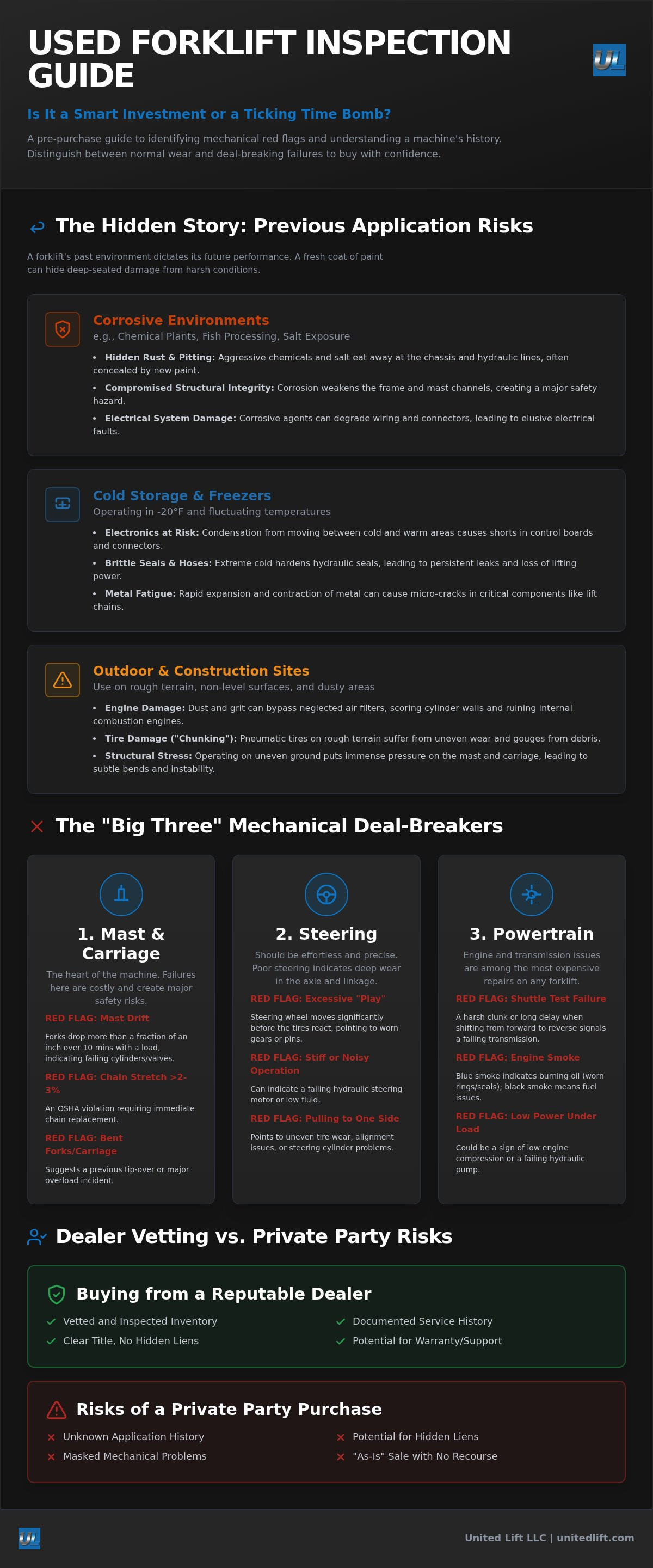
Every pre-owned forklift has a story. It isn't just about the numbers on the hour meter; it's about where those hours were spent. Understanding the application history is the first step in avoiding a lemon. A unit used in a clean pharmaceutical warehouse will have a completely different wear profile than one used in a fish processing plant or a chemical facility. When you are weighing the pros and cons of buying a used forklift from a dealer vs private party, the dealer's ability to provide a documented history becomes a massive advantage. Don't let a shiny exterior fool you.
Corrosive environments are the silent killers of material handling equipment. Salt and harsh chemicals eat away at the chassis and hydraulic lines over time. Sellers sometimes apply a fresh coat of paint to mask deep-seated rust or pitted metal. While it looks like a new machine, the structural integrity could be compromised. For a comprehensive overview of forklift components prone to this damage, look closely at the undercarriage and mast channels where paint often pools over hidden corrosion.
High-cycle warehouse environments also take a heavy toll on industrial batteries. A forklift running three shifts a day may show "low hours" on the motor, but the battery has likely been fast-charged repeatedly. This practice shortens its lifespan significantly. Similarly, "low hours" can be a trap if the unit spent its life idling in extreme temperatures. Heat cooks internal seals and wiring, leading to brittle components that fail shortly after you take delivery. Always ask how the machine was used, not just how long.
Cold Storage and Freezer Risks
Freezers are brutal on sensitive electronics. When a forklift moves from a -20°F freezer to a room-temperature loading dock, condensation forms instantly. This moisture seeps into control boards and electrical connectors, causing intermittent shorts that are a nightmare to diagnose. Hydraulic seals also become brittle in the cold, leading to slow, persistent leaks that affect lifting power. Temperature fluctuations cause micro-cracks in lift chains as the metal expands and contracts rapidly.
Outdoor and Construction Site Wear
Outdoor use introduces grit and physical stress. Pneumatic tires on rough terrain develop uneven wear patterns and "chunking" from hitting debris. Internal combustion (IC) engines are particularly vulnerable to dust. If grit bypasses a neglected air filter, it can score cylinder walls and ruin the engine. You should also check for structural stress. Operating on non-level surfaces puts immense pressure on the carriage and mast, often leading to subtle bends that affect load stability. When buying a used forklift from a dealer vs private party, verify if the unit was strictly an indoor machine or a rugged outdoor workhorse.
The Big Three: Critical Mechanical Problems to Identify
When you are buying a used forklift from a dealer vs private party, the biggest risk involves the mechanical "Big Three": the mast, the steering, and the powertrain. These systems represent the most expensive components to repair. A private seller might overlook a slow hydraulic leak or a slipping transmission, but these issues can cost thousands shortly after purchase. Identifying these red flags during your walk-around is essential for protecting your capital. If you want to avoid these mechanical headaches, browsing a vetted inventory of forklifts ensures the heavy lifting of inspection is already done for you.
Mast and Carriage Issues
The mast is the heart of the machine. To check for "mast drift," lift a rated load a few feet off the ground and shut off the engine. If the forks drop more than a fraction of an inch over ten minutes, the lift cylinders or control valves are failing. Inspect the load rollers for flat spots or "chunking," and look for a bent fork carriage that could indicate a previous tip-over. Don't forget the lift chains. You can measure "chain stretch" with a simple gauge; any elongation beyond 2% to 3% of the original pitch is an OSHA safety failure that requires immediate replacement. Remember that a triple mast is the industry standard for 189 inches of lift, while double masts are less versatile and should be priced lower.
Steering and Transmission Red Flags
Steering should be effortless and precise. Test for "play" by turning the steering wheel to full lock in both directions. If the wheel moves significantly before the tires react, the steering gears or pins are likely worn. For the transmission, perform a "shuttle test" by changing directions from forward to reverse at a low speed. A delay, a harsh "clunk," or a high-pitched whine suggests the clutch packs are burnt out. Metal shavings in transmission fluid signal imminent gear failure. These internal issues are often hidden in "as-is" private sales but are caught during professional dealer reconditioning.
Internal combustion engines provide clues through their exhaust. Blue smoke indicates the engine is burning oil, while white smoke often points to a blown head gasket or a cracked block. For electric units, battery sulfation is the hidden killer. If a battery has been left discharged, white lead sulfate crystals form on the plates, permanently reducing capacity. In 2026, replacing a battery and charger can cost between $2,500 and $5,000. This expense can instantly wipe out the perceived savings of buying a used forklift from a dealer vs private party, making a documented battery discharge test a non-negotiable requirement.
Cosmetic Wear vs. Structural Neglect: Knowing the Difference
Don't let a glossy finish distract you from the skeleton of the machine. Scratches and faded decals are part of a forklift's life in a busy facility. These are cosmetic issues that don't affect your daily throughput. However, structural neglect is a different story. When buying a used forklift from a dealer vs private party, you'll notice that reputable dealers focus on mechanical integrity, while some private sellers might use a "rattle can" paint job to hide deep-seated issues. Distinguishing between honest wear and hidden damage is the key to protecting your bottom line.
The "Fresh Paint" Trap
A brand-new coat of paint on a ten-year-old machine should trigger an immediate investigation. Look for overspray on hydraulic hoses, wiring harnesses, or grease fittings. This suggests a rushed cosmetic overhaul rather than a professional reconditioning. Check the chassis and mast for signs of "bondo" or body filler. Structural steel components should never be patched with filler; they must be solid and free of cracks. Pay close attention to the base of the mast and the tilt cylinder mounts. Rust bubbling under fresh paint in these high-stress areas often indicates metal fatigue that can lead to catastrophic failure under a heavy load.
Tires and Suspension Integrity
Tires tell the story of a forklift's alignment and suspension health. On cushion tire units, look for "chunking" where large pieces of rubber have torn away. On pneumatic tires, check for flat spots or exposed cords. Every industrial tire has a "safety line" or wear indicator; if the rubber is worn down to this mark, you'll need to budget for immediate replacement.
Uneven wear patterns are a major red flag. If one side of a tire is significantly more worn than the other, you're likely looking at a bent steer axle or a serious alignment issue. Inspect the steer axle for cracks or signs of excessive welding repairs. A compromised axle won't just ruin your tires; it makes the machine unpredictable during tight maneuvers in narrow aisles. Professional dealers typically replace these worn components before listing, but a private party might leave that cost to you.
Finally, examine the counterweight and the overhead guard. The counterweight often takes the brunt of rear-end collisions. While scrapes are normal, deep cracks in the cast iron suggest a high-impact crash that could have shifted the engine or transmission. The overhead guard must be free of any unauthorized welds, bends, or drilled holes. Under OSHA 29 CFR 1910.178, a modified or damaged guard is a serious violation. In 2026, the maximum penalty for a serious violation is $16,550, making an intact guard a non-negotiable safety requirement for any pre-owned unit.
Pre-Purchase Inspection Checklist for Used Forklifts
A systematic walk-around is your best defense against buying someone else's problem. When you're standing in front of a machine, you need a framework to evaluate its condition in minutes. One of the primary differences between buying a used forklift from a dealer vs private party is the level of transparency you'll find in the service logs. A private seller might claim the unit was well-maintained, but a dealer can usually prove it with a documented history of preventative maintenance. Use this checklist to verify the unit is floor-ready.
Always insist on a "Cold Start." If the engine is already warm when you arrive, the seller might be hiding a starting hesitation or a puff of smoke that only occurs on a cold block. Blue smoke indicates oil burning, while black smoke suggests a fuel system issue. Next, pull the engine dipstick and check the oil. If it looks "milky" or has the consistency of a chocolate milkshake, coolant is leaking into the oil. This usually signals a blown head gasket or a cracked engine block. Both are deal-breaking repairs that can cost more than the machine is worth.
Check the functionality of all safety equipment. Lights, the horn, and the backup alarm must work perfectly. Under OSHA 29 CFR 1910.178, these aren't optional features; they are mandatory for compliance. If you want to dive deeper into the selection process, read the ultimate forklift buying guide for a complete breakdown of what to look for in a reliable unit.
The Operational Test
Don't just drive in a straight line. Move the unit in a tight "figure-8" pattern to test the steering response and listen for clicking in the axle. Test the brakes and the inching pedal. The transition should be smooth; if the machine jerks or the pedal feels "spongy," the master cylinder or clutch packs may be failing. Finally, cycle the mast through its full range of motion with a rated load. Watch for "drifting" and check the side shifter for fluid leaks at the seals. If you'd rather skip the guesswork, browse our vetted used forklift inventory to find a unit that has already passed these rigorous tests.
Documentation and Serial Number Verification
Every forklift has a data plate that lists its rated capacity and attachments. Ensure this plate matches the actual equipment on the machine. If a side shifter was added later but the data plate wasn't updated, the capacity rating is technically incorrect, which is a major safety violation. Finally, verify the hour meter against the physical condition of the machine. If the meter shows low hours but the rubber on the pedals is worn down to the metal and the seat is shredded, the meter may have been replaced or tampered with. Matching the physical wear to the recorded hours is a simple way to spot potential fraud.
Dealer Vetting vs. Private Party Risks: Choosing Your Source Wisely
Choosing the right source for your equipment is just as critical as the mechanical inspection itself. While the upfront price on a marketplace listing might look tempting, the long-term return on investment (ROI) often tells a different story. When you're buying a used forklift from a dealer vs private party, you aren't just paying for the iron; you're paying for the security of a vetted machine and a clear title. A lower initial price can quickly evaporate when you're hit with a $5,000 battery replacement or an engine overhaul three weeks after delivery.
The Private Party Gamble
Private sales are almost always "as-is" transactions. Once the money changes hands, you have zero recourse if the hydraulic pump fails or the transmission starts slipping. One of the most overlooked risks is the presence of "hidden liens." If a private seller hasn't fully paid off their equipment loan, the lender can legally repossess the machine from your warehouse, even if you paid for it in full. Verifying the accuracy of an hour meter is also nearly impossible without professional diagnostic tools. In a market where dealers and distributors hold a 58.4% market share, the transparency they provide is a major safeguard against these logistical and financial traps.
The Dealer Advantage: United Lift’s Standards
We take the guesswork out of fleet expansion by vetting premium brands like Hyster, Yale, Toyota, and Caterpillar. Our national coverage ensures that whether you're in a coastal port or a Midwest distribution center, you have access to reliable, floor-ready equipment. We also understand that capital equipment is a major investment. To help preserve your business cash flow, we facilitate financing options with 2026 interest rates typically ranging from 7% to 12.5% for qualified buyers. This allows you to upgrade to a late-model used unit with better safety features and lower hours than a "bargain" private party find. Don't settle for an unreliable machine when you can leverage professional support and national shipping to get exactly what your facility needs. Browse our current inventory of vetted used forklifts to see the difference quality vetting makes.
Secure Your Fleet with Confidence
Picking the right pre-owned unit isn't about finding the lowest price; it's about minimizing future risk. You now know how to look past a fresh coat of paint to find structural integrity and mechanical reliability. By checking for mast drift and verifying the hour meter against physical wear, you can avoid the most expensive repair traps in the industry. The debate of buying a used forklift from a dealer vs private party often comes down to transparency. While private sales are "as-is" gambles, a professional dealer provides a vetted history and logistical support that protects your bottom line.
Ready to upgrade your operations without the mechanical guesswork? Our national inventory features top brands like Hyster, Yale, Toyota, and Caterpillar. We also provide flexible financing options to help you secure high-quality machinery while keeping your business cash flow steady. View Our National Inventory of Used Forklifts today to find a reliable partner for your warehouse. Your next equipment purchase should be a tool for growth, not a source of unexpected downtime.
Frequently Asked Questions
Is it worth buying a used forklift with high hours?
It depends on the maintenance history and previous environment. A well-maintained unit with 10,000 hours in a dry warehouse is often a better buy than a 3,000-hour unit used in a corrosive salt facility. When you're buying a used forklift from a dealer vs private party, you can verify these hour readings through service logs. If the price reflects the hours and the machine passes a professional inspection, it can still provide years of reliable service.
What is the most expensive part to fix on a forklift?
The battery is the most expensive component for electric units, with replacements often costing between $2,500 and $5,000. For internal combustion models, an engine overhaul or a transmission replacement represents the highest repair cost. These failures can easily total half the value of the machine. This is why a thorough shuttle test and oil inspection are non-negotiable steps before you finalize any purchase agreement for pre-owned equipment.
How can I tell if a forklift battery is bad before I buy it?
Look for white lead sulfate crystals on the plates, which indicate the battery was left discharged for too long. You should also check for milky electrolyte or bulging cells. A professional discharge test is the only way to verify if the battery still holds a full charge. If the battery is near the end of its life, you'll need to factor in a significant replacement cost when negotiating the final sale price.
What color smoke from a forklift engine is a deal-breaker?
Blue and white smoke are the primary deal-breakers. Blue smoke means the engine is burning oil, which usually requires a full rebuild. White smoke signals a blown head gasket or a cracked block, allowing coolant into the combustion chamber. While black smoke often indicates a simple air filter or fuel adjustment, blue or white smoke suggests deep mechanical failure. Walk away from any unit that produces these colors during a cold start test.
Can I finance a used forklift for my small business?
Yes, small businesses can definitely finance pre-owned equipment. United Lift facilitates capital equipment loans to help you preserve your operational cash flow while upgrading your fleet. As of August 2026, interest rates from traditional banks typically range between 7% and 12.5%. This is a major advantage of buying a used forklift from a dealer vs private party, as private sellers almost always require the full purchase price in a single cash payment.
What is the difference between "reconditioned" and "used" forklifts?
A used forklift is typically sold in its current state with only basic safety checks performed. A reconditioned unit undergoes a comprehensive overhaul where worn parts are replaced, systems are tested under load, and the machine is brought back to a specific performance standard. Reconditioned units often come with a powertrain warranty, providing a level of security that you won't find with standard as-is sales from private sellers or auctions.
How do I know if a forklift mast is safe?
Start by checking for mast drift by lifting a rated load and ensuring it doesn't drop over ten minutes. Use a chain gauge to check for chain stretch beyond 3% of the original pitch. Look for unauthorized welds or deep cracks on the carriage and mast channels. If the mast shudders or makes grinding noises during its full range of motion, the load rollers or hydraulic cylinders likely need immediate and expensive professional attention.
How many hours is too many for a used electric forklift?
For electric forklifts, 10,000 to 12,000 hours is often considered the threshold for major component life. While the electric motors can last longer, the industrial battery usually requires replacement around this mark. If you find a unit with 15,000 hours, it may still be a viable option if the battery was recently replaced. Always verify the hour meter against the physical wear on the floor pedals and the operator's seat for accuracy.
- Tags: buying a used forklift from a dealer vs private party, buying guide, equipment maintenance, forklift inspection, Hyster, material handling, used forklift, warehouse management, Yale
