
Best Construction Aerial Lifts: 2026 Buyer’s Guide
Posted by United Lift LLC on
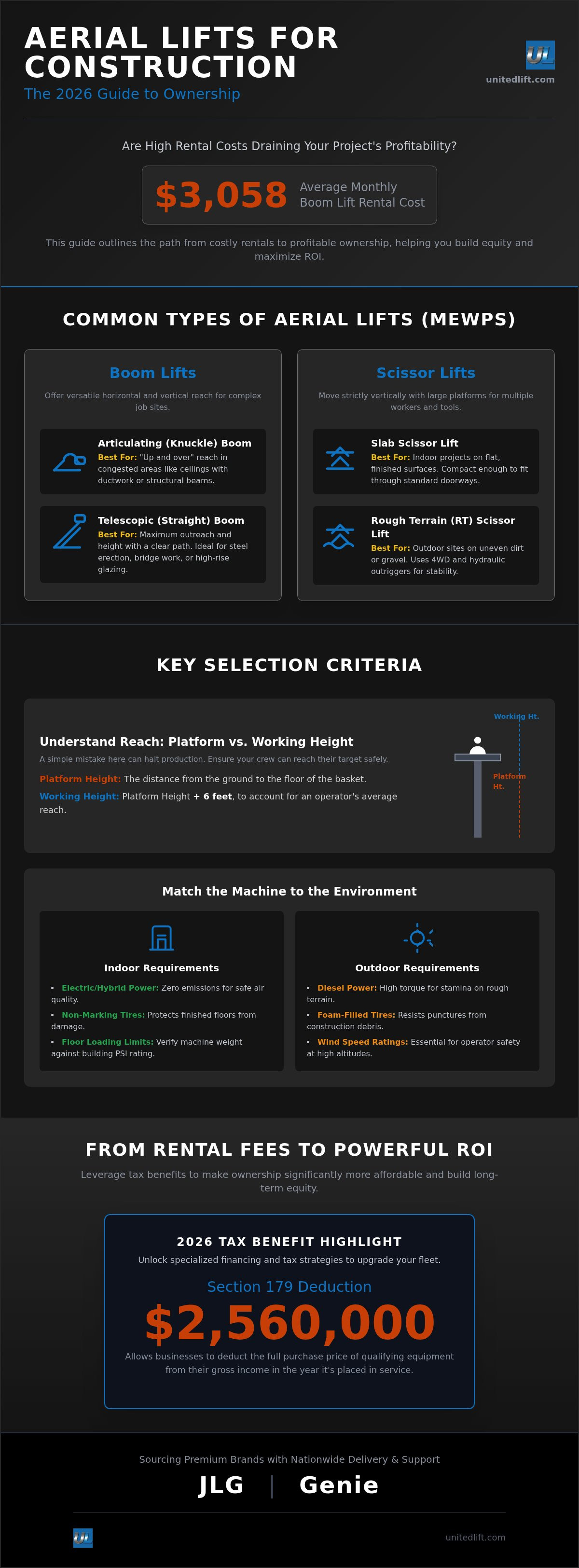
Did you know that renting a boom lift can cost your business an average of $3,058 every single month? For many contractors, those recurring invoices represent a massive leak in project profitability that never builds equity. If you're tired of watching rental fees eat your margins while searching for the right aerial lift for construction, you aren't alone. It's frustrating to pay for a machine you'll never own while struggling to decide between an articulating or telescopic boom for your specific needs.
Selecting the right equipment requires a clear understanding of your site requirements and your bottom line. This 2026 guide will show you how to choose the perfect machine, leverage current tax benefits like the $2,560,000 Section 179 deduction, and finance premium brands like JLG or Genie to maximize your long-term ROI. We will break down the best models on the market today and provide a clear roadmap for moving from high-cost rentals to profitable ownership. You'll learn how to keep your crew safe, stay OSHA compliant, and finally lower the total cost of your equipment fleet.
Key Takeaways
- Learn how to distinguish between vertical scissor lifts and high-reach boom lifts to find the most efficient aerial lift for construction projects.
- Discover how to calculate your "Rental Cross-Over Point" to stop wasting money on long-term rentals and start building equipment equity.
- Understand the critical difference between "working height" and "platform height" to ensure your crew can safely reach every point on the job site.
- Unlock specialized financing strategies and 2026 tax benefits like Section 179 to upgrade your fleet while preserving your business cash flow.
- Explore how to source construction-ready equipment from premium brands like JLG and Genie with nationwide delivery and support available seven days a week.
Common Types of Aerial Lifts for Construction
Every successful project starts with the right equipment. In the technical world of material handling, we refer to these machines as Mobile Elevating Work Platforms (MEWPs). An aerial lift for construction is designed to provide safe, stable access to heights that ladders or scaffolding simply can't reach. Understanding the different Common Types of Aerial Lifts is the first step toward improving your job site efficiency. You need to match the machine's capabilities to your specific environment to avoid costly downtime or safety risks.
While boom and scissor lifts handle the people, telehandlers act as the muscle of the construction site. These machines use a lateral telescopic boom to lift heavy pallets and materials to high floors or across muddy terrain. Beyond the mechanical structure, you must consider the power source. Diesel engines provide the high torque and "all-day" stamina required for outdoor rough terrain. Conversely, electric motors are the standard for indoor projects. They offer quiet operation and zero emissions, which are mandatory for working in enclosed spaces or finished buildings.
Boom Lifts: Articulating vs. Telescopic
Boom lifts provide the most versatile horizontal outreach on the market. Articulating booms, often called knuckle booms, feature multiple sections that bend. This design is perfect for "up and over" reach. If you're performing HVAC installation or electrical work in a congested ceiling, an articulating boom lets you navigate around ductwork and structural beams. It gives you precision in tight spots.
Telescopic booms take a different approach. They extend straight out like a telescope, offering maximum outreach and height. These are the workhorses for steel erection, bridge work, or high-rise glazing where you have a clear path to the target. They're built for speed and distance. United Lift carries premium options from JLG and Genie in both configurations to ensure you have the reach your project demands.
Scissor Lifts: Slab vs. Rough Terrain
Scissor lifts move strictly on a vertical plane. Their primary advantage is platform capacity. Unlike booms, scissor lifts feature large decks that can hold multiple workers and heavy toolsets simultaneously. If you're installing large sections of drywall or overhead lighting, the scissor lift is your best bet for productivity.
The choice between models usually comes down to the floor surface. Electric slab lifts use solid, non-marking tires designed for flat concrete or finished flooring. They're compact enough to fit through standard doorways. Rough terrain (RT) lifts are built for the early stages of a project. They feature heavy-duty foam-filled tires, four-wheel drive, and hydraulic outriggers to level the machine on uneven dirt or gravel. Picking the right tire and drive package ensures your crew stays stable regardless of the ground conditions.
Selecting the Right Lift Based on Job Site Conditions
Picking the right machine starts with a tape measure and a site walk. You can't just look at the maximum reach and call it a day. You have to distinguish between platform height and working height. Platform height measures from the ground to the floor of the basket. Working height adds an extra six feet to account for the operator's reach. If you buy a machine based on the wrong number, your crew won't reach their target. It's a simple mistake that halts production immediately.
Next, look down. Ground conditions dictate your drive system. Is the surface mud, loose gravel, or finished flooring? Indoor projects often have strict floor loading limits. You must check the machine's weight against the building's PSI rating to avoid structural damage. For outdoor sites, rough terrain models with outriggers are essential for stability on uneven grades. Always consult OSHA safety regulations to ensure your site setup meets federal standards, such as maintaining the required 10-foot clearance from energized power lines. This level of planning is what makes an aerial lift for construction a tool rather than a liability.
Indoor vs. Outdoor Requirements
Enclosed job sites have zero tolerance for exhaust. This makes electric or hybrid lifts mandatory for indoor construction. You don't want to compromise air quality or trigger fire alarms with diesel fumes. Tire choice is equally important. Indoor lifts use non-marking rubber to protect finished surfaces. Outdoor lifts require foam-filled lug tires to handle debris and punctures. If you're working at high altitudes outside, pay attention to wind speed ratings. Safety considerations for high-altitude work are non-negotiable when the weather turns.
Navigating Job Site Obstacles
Tight alleys and crowded floor plans require specialized maneuverability. Zero tailswing models are the solution here. They allow the machine to rotate within its own footprint without the counterweight swinging into walls or buildings. This is critical for urban construction where space is a premium. For even more precision, look for models equipped with a jib boom. A jib boom is a secondary arm that provides an extra 4-6 feet of maneuverability. It allows the operator to position the basket exactly where it's needed without moving the entire chassis. If you need to see these features in action, browse our construction-ready inventory to find the right fit for your next project.
Buying vs. Renting: Maximizing Your Construction Equipment ROI
Renting often feels like the easy path, but it's frequently the most expensive one for growing contractors. You have to identify your "Rental Cross-Over Point." This is the specific moment when the total cost of monthly rental payments exceeds the cost of ownership. Industry data suggests that if you utilize an aerial lift for construction for more than 90 days a year, buying is almost always the more profitable move. Ownership transforms a recurring expense into a business asset that builds equity on your balance sheet.
Beyond the numbers, owning your fleet provides 24/7 availability. You don't have to wait for a rental yard to process your paperwork or schedule a delivery truck. Your crew can start work at 6:00 AM because the equipment is already on-site. This eliminates the downtime that often occurs when projects shift or deadlines tighten. When the job is done, premium brands like JLG and Genie retain significant value. A well-maintained, five-year-old lift from a major brand can retain 40 percent to 60 percent of its original value, allowing you to recoup capital when it's time to upgrade.
The Value of Pre-Owned Aerial Lifts
You don't always need a brand-new machine to get the job done. Buying used from a reputable dealer like United Lift allows you to acquire high-quality machinery at a much lower price point. It's the most effective way to reduce your initial investment while still getting a reliable workhorse. You should focus on three key inspection points: recorded hours of use, a documented service history, and structural integrity. Learn how to buy a used lift like a professional to ensure your pre-owned investment is project-ready from day one.
Long-Term Fleet Strategy
Building a fleet is about more than just having machines; it's about controlling your logistics and safety. Every time you rent, you pay delivery and pickup fees that can range from $75 to $200 each way. Over a year, those fees add up to thousands of dollars in lost profit. Owning your equipment also ensures a consistent safety standard. You know exactly who has operated the machine and when it was last inspected. This makes it much easier to stay compliant with OSHA aerial lift safety standards. You aren't at the mercy of a rental company's maintenance schedule. You're in the driver's seat of your own productivity.
Financing Your Aerial Lift and Tax Benefits
Cash flow is the lifeblood of any job site. Using specialized equipment loans lets you keep your working capital for payroll, materials, and unexpected expenses. It's often a smarter long-term strategy to finance an aerial lift for construction than to deplete your cash reserves on a single asset. This financial leverage allows you to acquire a higher-spec machine with better reach or capacity than a strict cash budget might allow. Instead of settling for a basic model, you can invest in a JLG or Genie that offers the specific features your projects demand. Our dealer partnerships make the application process quick and direct for business customers. You get the equipment you need without the typical bank runaround.
Leveraging Section 179 for 2026
The tax code for 2026 offers a massive competitive advantage for equipment buyers. Under Section 179, businesses can deduct the full purchase price of qualifying equipment up to a maximum of $2,560,000. This deduction begins to phase out only after you exceed $4,090,000 in total equipment purchases. It applies to both new and used machinery. For a hypothetical $50,000 equipment purchase, you could potentially write off the entire amount in year one if the machine is put into service by the end of 2026. This significantly lowers your taxable income. When you combine this with the 100 percent bonus depreciation that was restored for property acquired after January 2025, the financial incentive to own your fleet is undeniable.
Custom Financing Solutions
Every construction firm has unique needs. We offer flexible leasing and purchasing options to fit your specific balance sheet. Some firms prefer the lower monthly payments of a lease to keep overhead down, while others want the full equity of an outright purchase. We also provide seasonal payment structures that match your construction cycles. If your revenue dips during certain months, your payments can be scaled to match your actual income. Low-down-payment options are a great fit for growing contractors who need to add an aerial lift for construction to their fleet without a huge upfront hit. While credit scores impact your final rate, strong borrowers typically see APRs between 7 percent and 14 percent for used equipment.
Explore our financing options to find a plan that preserves your capital while growing your fleet.
Premium Brands and Inventory at United Lift
Finding the right aerial lift for construction is about more than just checking a spec sheet. It's about finding a partner who understands the urgency of your project. At United Lift, we position ourselves as a no-nonsense expert in material handling and aerial access. We don't just sell machines; we provide the tools that drive your project's ROI. Our inventory is built on a foundation of premium brands like Hyster, Yale, Genie, and JLG. These aren't just names; they're the industry standards for safety and performance on the toughest job sites.
Distance shouldn't limit your access to quality equipment. We offer national delivery and sales scope, shipping construction-ready lifts across the entire United States. Whether your project is in the heart of a city or a remote rural site, we ensure your machine arrives ready to work. Our team is available for support seven days a week to handle sales and financing inquiries. We know that construction doesn't stop on the weekends, so we don't either. You get direct access to experts who can help you navigate inventory options or finalize a deal when you're ready to move.
Why We Carry JLG and Genie
We curate our inventory based on field performance. JLG is the leader in innovative reach technology. Their high-capacity platforms are essential for heavy-duty construction tasks where reach and weight capacity are both critical. Genie represents the industry standard for reliability. Their controls are intuitive, making them a favorite for operators who need to get to work quickly without a steep learning curve. For those focused on vertical tasks, we offer Skyjack. They're the go-to for durable, easy-to-service scissor lifts that can handle the daily grind of a busy site. We focus on these brands because they hold their value and keep your downtime to a minimum.
Ready to Upgrade Your Fleet?
The right equipment is waiting for you. You can browse our current inventory of new and used aerial lifts online right now. Every machine is inspected to ensure it meets our high standards for reliability. If you're ready to move from expensive rentals to equity-building ownership, contact our team for a fast, direct quote on sales and financing. We make the transition seamless. Don't let your project wait on a rental yard's schedule. Take control of your fleet today with an aerial lift for construction that you actually own.
View our Aerial Lift Inventory
Build Your Future with a Stronger Fleet
Success on the job site depends on having the right tools at the right time. Choosing the perfect aerial lift for construction means looking beyond the immediate project and focusing on long-term ROI. By matching machine specs to your site conditions and moving away from the high costs of repetitive rentals, you're building real equity in your business. Remember that 2026 tax benefits and specialized financing make it easier than ever to own premium equipment while keeping your cash flow healthy.
United Lift is ready to help you make that transition. We provide national sales and support seven days a week, ensuring you always have an expert to call. Our inventory features industry-leading brands like JLG and Genie, and we offer financing solutions for business sizes of all types. It's time to stop paying for machines you'll never own and start investing in your own productivity. Browse our inventory of construction-ready aerial lifts to find the right fit for your team. We're here to help you reach new heights with confidence.
Frequently Asked Questions
How do I choose between a scissor lift and a boom lift for construction?
Choose based on whether you need vertical capacity or horizontal reach. Scissor lifts are best for lifting multiple people and heavy tools straight up. Boom lifts are necessary when you need to reach over obstacles or access high points from a distance. If you're working on a flat slab with heavy materials, pick a scissor. If you need to navigate around a building's structure, a boom lift is the right aerial lift for construction.
Is a telehandler considered an aerial lift?
No, a telehandler is technically a reach forklift rather than an aerial lift. While both use a telescopic boom, telehandlers are designed to move materials using forks or attachments. Aerial lifts are specifically engineered as mobile elevating work platforms to carry personnel. Some telehandlers can be equipped with work platforms, but they fall under different safety standards. An aerial lift for construction is the better choice for personnel access.
What are the OSHA requirements for operating an aerial lift on a job site?
OSHA requires employers to provide competency-based training and ensure operators are authorized to use specific equipment. Key standards include 29 CFR 1926.453 for construction. Operators must perform daily pre-start inspections and maintain a 10-foot clearance from energized power lines. Fall protection is mandatory for boom lifts; workers must wear a full-body harness connected to an anchor point. Scissor lifts typically rely on the guardrail system for primary fall protection.
Can I finance a used aerial lift?
Yes, you can secure specialized financing for both new and pre-owned equipment to preserve your capital. Many lenders offer competitive rates for used machinery depending on your credit score. Financing used equipment allows your business to acquire premium brands like JLG or Genie at a lower entry cost. You can also take advantage of Section 179 tax deductions to write off the full purchase price in the first year. This strategy builds equity.
What is the maximum height for a standard construction boom lift?
Standard construction boom lifts typically offer platform heights ranging from 30 feet to 185 feet. Most common job site models fall in the 45-foot to 80-foot range. If your project requires extreme reach, specialized ultra booms can extend even further. Always remember to distinguish between platform height and working height. Working height adds an extra six feet to the platform measurement. Choosing the right height ensures your crew can safely access the highest points.
How much does it cost to buy a used scissor lift in 2026?
The cost of a used scissor lift depends on the platform height, power source, and total hours of operation. Newer models with low hours and rough terrain capabilities command higher market values than older electric slab units. Factors like the inclusion of non-marking tires or hydraulic outriggers also influence the final price. Contractors should evaluate the total cost of ownership and potential tax savings rather than just the initial sticker price.
Do I need a special license to operate an aerial lift for my business?
There is no government-issued license for aerial lifts, but OSHA requires documented operator certification. Employers are responsible for training their staff and verifying their competency on the specific type of lift being used. This training must be both classroom-based and hands-on. While OSHA doesn't set a hard expiration date, the industry standard is to renew training every three years. Keeping these records updated is essential for maintaining site safety and compliance.
What is the difference between an articulating and a telescopic boom?
The primary difference is how the boom extends and its ability to navigate around obstacles. Articulating booms have multiple sections that knuckle, allowing you to reach up and over structures in confined spaces. They provide maximum versatility for complex sites. Telescopic booms extend straight out like a telescope, offering superior horizontal reach and height. They are faster to position and ideal for open job sites where you need to cover ground from one spot.
- Tags: aerial lift for construction, Aerial Lifts, Boom Lifts, Buyer's Guide, Construction Equipment, Equipment Financing, Genie, JLG, Scissor Lifts, Section 179
