
2026 Strategic Guide: Forklifts for Small Warehouses
Posted by United Lift LLC on
Have you ever watched a forklift operator struggle through a multi-point turn only to clip a rack upright? In a tight warehouse, a few inches of turning radius can be the difference between a productive shift and expensive rack damage. Choosing the right forklift for a small warehouse is about more than just raw lifting capacity. You're likely balancing the need for faster pick speeds with the reality of narrow aisles and the rising costs of capital equipment. It's frustrating when standard machines feel like they're designed for a massive distribution center rather than your actual floor plan.
We understand that square footage is your most valuable asset. This guide will show you how to maximize every inch of your facility by selecting the ideal forklift type and power source. We'll help you navigate the latest 2026 OSHA standards and evaluate the maneuverability specs required for tight industrial spaces. You'll learn how to improve pick speeds, protect your indoor air quality, and secure the financing needed to grow your business without sacrificing your margins. Whether you need a nimble 3-wheel electric or a specialized economy lift, we'll help you find the perfect fit.
Key Takeaways
- Discover why 3-wheel electric forklifts and reach trucks are the gold standard for navigating narrow aisles and maximizing tight-radius turns.
- Master the math behind Right Angle Stack (RAS) calculations to ensure you're choosing the right forklift for a small warehouse without risking rack damage.
- Learn how to evaluate the ROI of used equipment by inspecting critical components like mast play, battery health, and hydraulic systems.
- Access a national inventory of leading brands like Hyster, Yale, and Toyota to find specialized economy lifts that fit your specific budget and floor plan.
- Improve your pick speeds and vertical storage efficiency by matching machine maneuverability specs to your facility's unique layout requirements.
The Unique Challenges of Small Warehouse Material Handling
Operating a 5,000 square foot shop is a completely different game than managing a massive regional distribution center. In a smaller footprint, every square inch must generate revenue. You don't have the luxury of 14 foot wide aisles or 40 foot ceilings. Instead, you're likely dealing with narrow passageways, low-hanging light fixtures, and limited airflow. These physical boundaries define your operational capacity. If your equipment is too bulky, your pick speeds drop and your risk of rack damage skyrockets.
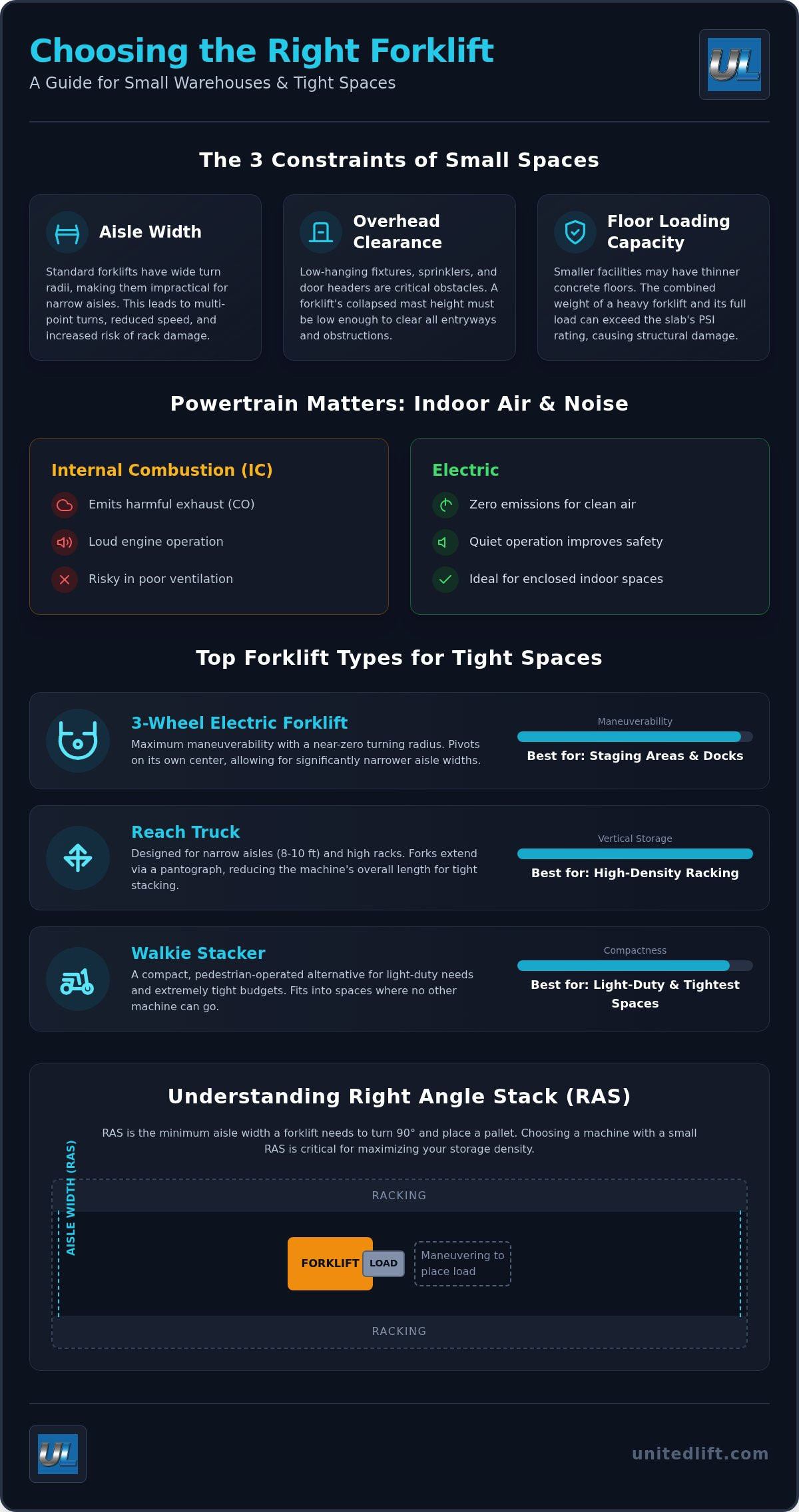
Standard counterbalance forklifts often fail in these environments. While they are workhorses in open yards, their wide turn radius makes them nearly impossible to use in tight rows. You'll find yourself performing five-point turns just to enter an aisle. Choosing the right forklift for a small warehouse requires a shift in perspective. You aren't just looking for lifting power; you're looking for a machine that can dance in a phone booth. You have to account for the "Three Constraints" before you sign any paperwork: aisle width, door clearance, and floor loading capacity.
Indoor Air Quality and Ventilation
Small, enclosed spaces trap exhaust quickly. Internal combustion (IC) engines that run on liquid propane or diesel pose a significant risk in warehouses with limited ventilation. Carbon monoxide buildup happens faster than most operators realize. Because of this, we've seen a massive shift toward zero-emission electric fleets. Electric motors don't just keep the air clean; they also run much quieter. In a tight acoustic environment, reducing engine roar helps operators stay alert and improves overall site safety. It's a cleaner, smarter way to work indoors.
Physical Infrastructure Limitations
Before you bring a heavy-duty lift onto your floor, check your slab's PSI rating. Small warehouses often have thinner concrete floors that can't support the concentrated weight of a heavy forklift plus a full load. You also need to look up. Measure your door headers and any overhead obstructions like sprinklers or heaters. This is where collapsed mast height becomes critical. If your mast is too tall when lowered, you'll be restricted to a single room. Choosing the right forklift for a small warehouse means finding a machine that clears every doorway while still reaching your highest rack level. We recommend walking your floor with a tape measure before browsing our inventory to ensure a perfect fit.
Top Forklift Types Engineered for Tight Spaces
Selecting equipment for a cramped facility requires prioritizing agility over raw speed. When space is at a premium, the physical dimensions of the machine dictate your entire warehouse layout. Choosing the right forklift for a small warehouse usually narrows your options to four specialized categories: 3-wheel electrics, reach trucks, order pickers, and walkie stackers. Each offers a specific mechanical advantage for navigating tight corners or reaching high-density racking.
The 3-Wheel Electric Advantage
These machines are designed for maximum maneuverability. By using a single steer wheel at the rear, a 3-wheel electric forklift can pivot on its own center. This configuration creates a near-zero turning radius. Compared to a standard 4-wheel model, the total footprint is significantly shorter. This allows you to shrink your aisle widths by several feet without losing the ability to load and unload trailers at the dock. If your staging area feels like a bottleneck, a 3-wheel model is often the best solution for maintaining flow.
Maximizing Vertical Cubes with Reach Trucks
If your strategy involves narrow aisles and high racks, a reach truck is essential. These machines don't rely on a heavy counterweight at the rear. Instead, they distribute the load weight over two stabilizing outriggers. A pantograph mechanism allows the forks to extend forward into the racking and retract back over the outriggers. This design drastically reduces the overall length of the machine. You can stack pallets in aisles as narrow as 8 to 10 feet. It's the most efficient way to increase your storage capacity without expanding your building's footprint. Stability is maintained through a low center of gravity, which is vital when lifting loads to high rack levels in small footprints.
For businesses focused on small-item fulfillment, order pickers allow operators to rise with the load. This provides direct access to individual cartons on high shelves. If you have light-duty needs or a very tight budget, electric walkie stackers offer a compact, pedestrian-operated alternative. They lack the speed of a sit-down lift but fit into spaces where no other machine can go. Choosing the right forklift for a small warehouse depends on your specific pick frequency and rack height. You can browse our current inventory to compare specs on these different models and see which fits your facility best.
Critical Specs: Calculating Aisle Width and Turn Radius
Precision matters when square footage is tight. You can't rely on generic estimates of 8 to 10 feet for narrow aisles. Choosing the right forklift for a small warehouse requires calculating the Right Angle Stack (RAS) for your specific machine and load. If you get this number wrong, your operators will spend their shifts backing up and repositioning. This kills productivity and eventually leads to rack damage. We recommend performing these measurements on your actual floor rather than relying solely on blueprints.
We differentiate between "Clear Aisle" and "Operating Aisle" widths. The Clear Aisle is the distance between rack uprights. The Operating Aisle is the actual space available once you factor in pallet overhang and rack protectors. You must also account for the length of the load itself. A standard 48-inch pallet creates a much larger turning arc than a smaller custom crate. Always add a 12-inch safety buffer to your final calculation. This isn't a suggestion; it's a non-negotiable requirement to prevent collisions and maintain a safe workspace.
The Aisle Math Formula
RAS is the minimum distance required for a forklift to turn 90 degrees and deposit a load. To calculate this, you need three numbers: the machine's basic turn radius, the load moment, and your safety clearance. The load moment is the distance from the center of the front axle to the face of the forks plus the length of the pallet. If you're using specialized attachments like side-shifters, you must add that thickness to the calculation as well. Common mistakes include ignoring the few inches a pallet hangs over the rack edge or the width of the rack uprights themselves. If your math is too tight, your fleet simply won't function efficiently.
Cushion vs. Pneumatic Tires for Small Floors
Tire choice directly impacts your machine's total footprint. Cushion tires are the superior choice for smooth warehouse concrete. They are made of solid rubber molded to a steel band. Because they have a smaller diameter than pneumatic tires, the forklift sits lower to the ground and typically has a tighter turning radius. This lower profile allows the machine to be more compact overall. Pneumatic tires are excellent for gravel or uneven yards, but they add unnecessary bulk and height in a tight indoor environment. Stick with cushion tires to keep your machine as compact and agile as possible for your narrowest aisles.
Strategic Buying: Used vs. New and Financing for Small Fleets
Choosing the right forklift for a small warehouse often feels like a trade-off between your current cash flow and future productivity. If your operation only requires a lift for three or four hours a day, a brand-new machine might not be the most efficient use of your capital. Pre-owned equipment from trusted brands like Hyster or Yale provides a high-value entry point for growing shops. You get the reliability of a premium brand at a significant discount compared to factory-fresh models.
Don't buy blindly. When you're inspecting a used machine, start with the mast. Look for excessive side-to-side play, which suggests worn carriage bearings. Check the floor beneath the machine for hydraulic fluid leaks. Most importantly, ask for a battery discharge test on electric models. A battery that can't hold a charge is an expensive surprise you want to avoid. We specialize in providing "Economy Lifts" that have been thoroughly vetted for these exact issues, ensuring you get a reliable workhorse for your tight spaces.
Maximizing the Section 179 Deduction
The tax code offers a massive advantage for small businesses investing in their infrastructure. Under Section 179, you can often deduct the full purchase price of qualifying equipment in the very year you put it into service. This incentive applies to both new and pre-owned industrial machinery. Instead of depreciating the asset over several years, you get an immediate tax break that can significantly offset the cost of your investment. We recommend consulting with a tax professional to align your equipment needs with your fiscal year end. It's one of the most effective ways to lower the total cost of ownership when choosing the right forklift for a small warehouse.
Lease vs. Buy for Small Warehouses
Preserving cash flow is vital for small operations. Leasing is an excellent option if you want lower monthly payments and the ability to upgrade to newer technology every few years. It keeps your fleet modern without a large upfront down payment. On the other hand, buying allows you to build equity in a long-term asset. You won't have to worry about hour-usage restrictions or "overage" fees that some leases include. For a deeper dive into these strategies, read The Ultimate Forklift Buying Guide for Industrial Success in 2026. Whether you choose to lease or buy, we offer national financing programs to help you secure the equipment you need. View our current used inventory to find a machine that fits your budget and your aisle widths.
Finding Your Perfect Fit with United Lift
You've done the math and measured your aisles. Now you need a machine that actually exists in the real world. Choosing the right forklift for a small warehouse shouldn't feel like a guessing game or a gamble on a marketplace. At United Lift, we take the guesswork out of the transaction. We don't just point you to a catalog; we match machine specs to your specific warehouse CAD drawings. This ensures that the 3-wheel electric or reach truck you buy will actually clear your door headers and turn in your narrowest aisles before it ever leaves our lot.
We specialize in providing "Economy Lifts" that serve as a perfect entry point for growing businesses. If you don't need a machine running three shifts a day, an economy model provides the same lifting power and maneuverability as a premium unit at a fraction of the cost. We facilitate national financing to make these capital investments even more accessible. You get the equipment you need today without draining your operating reserves. It's a no-nonsense approach to fleet management that respects your budget and your time.
Broad Inventory of Tier-1 Brands
Our national inventory features the industry's most reliable names. For high-cycle small warehouses that need constant uptime, Hyster and Yale are our top recommendations for their durability. If maneuverability is your primary concern, Toyota's 3-wheel electric models are the industry standard for tight-radius turning. We also stock Caterpillar and Mitsubishi options for heavy-duty indoor needs that require a more robust chassis. Having this variety in one place makes choosing the right forklift for a small warehouse much simpler. You can compare specs across brands to find the exact footprint your facility requires.
Streamlined National Acquisition
We serve a national audience with professional equipment logistics that get your lift to your dock quickly. Managing a warehouse is a round-the-clock job, so we provide 7-day-a-week support to answer your questions when you actually have them. You aren't stuck waiting for a local office to open on Monday morning. From the initial inquiry to the final delivery, we act as a tireless worker for your business. Ready to see what's available? Browse our current inventory of new and used forklifts today and find the machine that fits your floor plan.
Optimize Your Floor Plan Today
You now have the tools to transform your facility from a cramped bottleneck into a high-speed fulfillment hub. Choosing the right forklift for a small warehouse comes down to matching precise maneuverability specs with your specific aisle dimensions. By prioritizing zero-emission electric motors and tight turning radii, you protect both your team and your inventory. Whether you're leveraging Section 179 tax breaks or exploring our used inventory, the goal is clear: maximize your square footage without overextending your budget.
We're here to help you navigate every step of the acquisition process. Our national inventory includes top-tier brands like Hyster, Yale, and Toyota, and we offer dedicated financing programs tailored for small businesses. With expert support available 7 days a week, we ensure you never have to wait to get your questions answered. We can even match machine specs to your specific warehouse drawings to guarantee a perfect fit.
Find the Right Forklift for Your Small Warehouse at United Lift. Your warehouse has untapped potential. Let's find the machine that helps you reach it.
Frequently Asked Questions
What is the best forklift for a very narrow aisle (VNA) warehouse?
Reach trucks or swing-reach machines are the top choices for VNA environments. A reach truck can operate in aisles as narrow as 8 to 10 feet. For even tighter spaces, specialized VNA machines allow you to stack higher without increasing aisle width. These machines are designed for high-density storage where every inch of floor space must be utilized for racking rather than maneuvering. They offer the highest storage density possible today.
Can I use a propane forklift in a small, enclosed warehouse?
We generally advise against using internal combustion engines like propane in small, enclosed spaces due to carbon monoxide risks. While propane burns cleaner than diesel, it still requires heavy ventilation to meet OSHA safety standards. For small warehouses, zero-emission electric models are the safer and more efficient choice. They eliminate the need for complex ventilation systems and protect your indoor air quality while reducing noise levels.
How much aisle space does a standard 3-wheel electric forklift need?
A standard 3-wheel electric forklift typically requires an operating aisle of approximately 10 to 11 feet for a standard 48-inch pallet. However, this depends on the specific turn radius of the machine and the load length. Choosing the right forklift for a small warehouse involves calculating the Right Angle Stack (RAS) plus a 12-inch safety buffer. Always check the manufacturer's spec sheet for the exact dimensions before you finalize your warehouse layout.
Is it better for a small business to buy a new or used forklift?
Used forklifts often provide the best return on investment for small businesses with low-hour applications. If you only use a lift for a few hours daily, a pre-owned Hyster or Toyota can save you thousands in upfront costs. New forklifts are better suited for high-cycle operations where maximum uptime is the priority. We offer national financing for both options to help you preserve your cash flow while acquiring reliable equipment.
What are the floor loading requirements for a 5,000 lb capacity forklift?
A 5,000 lb capacity forklift can have a total weight of 9,000 lbs or more when you factor in the machine's counterweight. This creates significant point pressure on your concrete slab. You should verify that your floor's PSI rating can support the combined weight of the machine and its maximum load. Small warehouses with older or thinner slabs may require lighter, specialized economy lifts to avoid structural cracking or slab failure over time.
How does Section 179 affect my forklift purchase in 2026?
Section 179 allows you to deduct the full purchase price of new or used equipment in 2026, provided it is put into service by the end of the year. This creates an immediate tax benefit rather than depreciating the asset over several years. It is a powerful tool for small businesses looking to upgrade their fleet. Always consult with a tax professional to ensure your equipment purchase aligns with current federal limits and eligibility rules.
What is the difference between a reach truck and a standard forklift?
The primary difference lies in how they handle loads. A standard counterbalance forklift uses a heavy rear weight, making it longer and wider. A reach truck uses stabilizing outriggers and a pantograph mechanism to reach into racks. This design makes reach trucks much more compact. Choosing the right forklift for a small warehouse usually means opting for a reach truck if you need to navigate aisles under 10 feet wide.
Can I get financing for a used forklift if I am a new small business?
Yes, we facilitate national financing programs that accommodate new small businesses and startups. While interest rates may vary based on your credit profile, having a solid business plan and revenue projections can help you secure capital. We work with a variety of lenders to find affordable solutions for pre-owned equipment. This allows you to acquire a reliable machine from a top brand without a massive upfront cash outlay.
- Tags: choosing the right forklift for a small warehouse, Electric Forklifts, Forklifts, Material Handling, Narrow Aisle Forklifts, OSHA, Small Warehouse, Used Equipment, Warehouse Management
