
Used Caterpillar Forklift for Sale: The 2026 Buyer’s Guide
Posted by United Lift LLC on
The most expensive mistake in your warehouse isn't buying a used machine; it's buying a brand-new "economy" brand that can't survive a double shift. Many savvy fleet managers now realize that a used Caterpillar forklift for sale often provides better long-term ROI than a cheaper new alternative. Cat's over-built engineering is designed for multiple lifecycles, yet the fear of buying a "lemon" with hidden mechanical issues keeps many buyers on the sidelines. You need a high-durability lift that won't drain your maintenance budget or stop your production line.
We're here to help you cut through the confusion of GP, DP, and GC series designations to find the exact match for your floor. This 2026 guide promises to simplify your search by providing expert inspection tips and clear breakdowns of model specifications. You'll learn how to verify parts availability for older units and explore financing options that make capital equipment more accessible. We'll show you exactly what to look for so you can acquire premium equipment at a fraction of the original cost and keep your operation moving without interruption.
Key Takeaways
- Discover why Caterpillar's heavy-duty engineering often provides better long-term value than purchasing a brand-new economy model.
- Learn the key differences between the GP and DP series to ensure your lift matches your specific indoor or outdoor environment.
- Identify exactly what to look for when browsing a used Caterpillar forklift for sale, from mast scoring to hour meter accuracy.
- Choose the right tire configuration for your operation to avoid unnecessary wear on your equipment and floors.
- Understand how to leverage Section 179 tax benefits and professional financing to secure premium equipment while protecting your cash flow.
Why Choose a Used Caterpillar Forklift for Your Fleet?
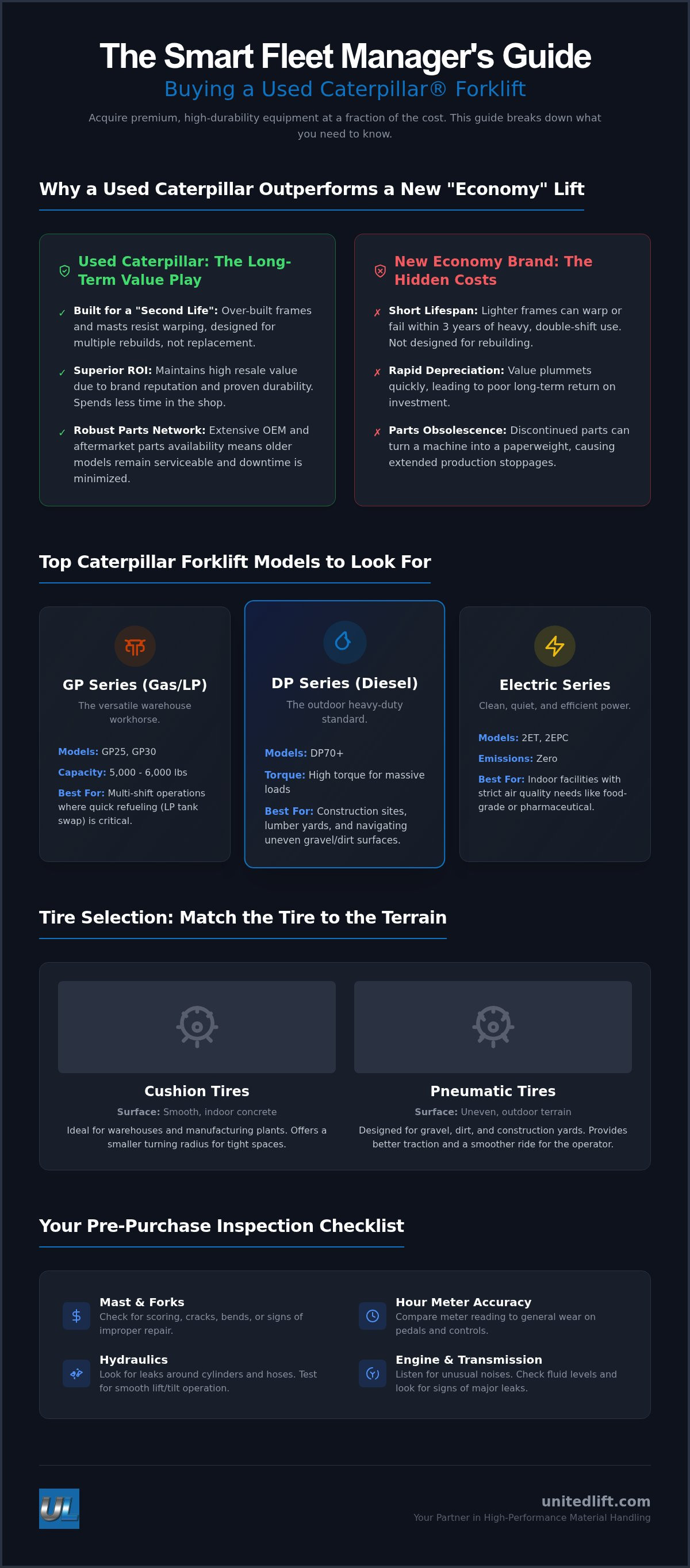
Caterpillar's reputation isn't just marketing; it's physics. When you search for a used Caterpillar forklift for sale, you're looking for a machine that can handle high-intensity work cycles without buckling under pressure. Many operations make the mistake of buying a shiny new "economy" brand, only to find the frame warps or the hydraulics fail within three years of heavy use. Cat builds for the long haul. Their rugged engineering ensures these units maintain high resale value even after years of service. This makes them a safer financial bet than unproven budget models that lose value the moment they leave the lot.
The ROI of Caterpillar Engineering
Structural rigidity is the backbone of Cat's engineering. Their heavy-duty masts and frames are famous for resisting the warping and twisting that plagues lighter machines. This design choice is part of Caterpillar's "second life" philosophy. They build core components specifically so they can be rebuilt rather than scrapped. This means a used unit often has thousands of productive hours left in its second or even third life. Caterpillar’s "Total Cost of Ownership" advantage means you spend less on major structural repairs over the years compared to budget brands that require frequent, expensive component swaps.
Parts and Serviceability Advantage
Reliability depends on how fast you can get a part when something breaks. Caterpillar boasts one of the most robust networks of both OEM and aftermarket parts in the world. Whether you're running a five-year-old model or a ten-year-old workhorse, finding a replacement starter or hydraulic seal is rarely an issue. Standardized components across different model years simplify maintenance for your mechanics. This universal availability keeps your fleet running even when older models from other manufacturers would be sidelined by discontinued parts. You won't have to worry about a machine becoming a paperweight because a single sensor is out of production.
United Lift takes this advantage a step further by sourcing units that have maintained their structural integrity. We ensure they're ready for immediate deployment in demanding environments. If you have questions about a specific model's maintenance history or part needs, our team provides expertise seven days a week via phone or email. We function as a reliable facilitator, making sure your capital equipment purchase minimizes downtime from day one. You aren't just buying a machine; you're securing a partner that understands the urgency of your material handling needs and the importance of a quick, transparent transaction.
Top Caterpillar Forklift Models to Look For
Finding the right used Caterpillar forklift for sale starts with decoding the model names. Caterpillar uses a clear system to help you match a machine to your specific environment. Whether you're moving pallets in a climate-controlled warehouse or loading lumber in a muddy yard, there's a specific series designed for that stress. Understanding these designations ensures you don't overpay for capacity you don't need or under-equip your team for heavy cycles.
Caterpillar GP Series (Gas/LP)
The GP series represents the versatile Gas/Propane line. Models like the GP25 and GP30 are widely considered the workhorses of the material handling world. These units shine in the 5,000 to 6,000 lb capacity range. They offer a perfect balance of travel speed and lifting power. One of the biggest advantages for multi-shift operations is the ease of refueling. You don't have to wait hours for a charge; you simply swap the LP tank and keep moving immediately. This keeps your momentum high and your downtime low.
Caterpillar DP Series (Diesel)
For heavy-duty outdoor construction or industrial yards, the DP series is the standard. These diesel-powered units, specifically the DP70 and larger models, provide the high torque required for massive loads. Cat diesel engines are engineered for maximum fuel efficiency during high-cycle work. When you pair these engines with pneumatic tires, you get a machine capable of navigating gravel and uneven surfaces without losing stability. They're built to withstand the elements while maintaining the precision needed for expensive cargo.
Electric Models for Indoor Efficiency
Indoor operations with strict air quality requirements, such as food-grade or pharmaceutical facilities, should look toward electric models. The 2ET and 2EPC series provide clean, quiet power without compromising on Cat's rugged build quality. Choosing a used electric unit can lead to significant long-term savings on both fuel and engine maintenance. If you're debating between internal combustion and battery power, our United Lift electric vs IC guide breaks down the operational costs for 2026. These units are perfect for companies looking to minimize their carbon footprint while maintaining high throughput.
If your primary concern is space, the 2C series offers compact cushion tire lifts. These are designed for tight warehouse aisles where every inch of turning radius matters. They provide the same structural integrity as the larger models but in a footprint optimized for high-density storage. Not sure which model fits your floor plan? You can view our current inventory to see which specs are available for immediate nationwide shipping.
Comparing Cushion vs. Pneumatic Tire Cat Forklifts
Choosing the right tires is just as critical as selecting the right engine capacity. The tire type dictates your machine's physical footprint, ground clearance, and turning radius. If you pick the wrong set, you'll either damage your warehouse floors or find your machine spinning its wheels in the yard. When browsing a used Caterpillar forklift for sale, you'll usually see two distinct categories: cushion and pneumatic. Understanding where each one thrives will save you from expensive operational mistakes and unnecessary tire wear.
Indoor Precision with Cushion Tires
Cushion tires are made of solid rubber molded to a steel band. They're designed specifically for smooth concrete surfaces and indoor warehouse applications. Because these tires are smaller than their pneumatic counterparts, the entire forklift chassis can be built lower and more compact. This creates a significantly tighter turning radius, allowing operators to navigate narrow aisles with ease. The Cat 2C5000 is a premier choice for high-density storage facilities because of this agility. These units also feature lower ground clearance, which provides superior stability during high-lift maneuvers on loading docks. They don't require air, so you'll never deal with a flat tire in the middle of a busy shift.
Outdoor Power with Pneumatic Tires
Pneumatic tires are the standard for any operation that moves outside the warehouse. These tires are larger and wider, providing the traction and stability needed for gravel, asphalt, or uneven dirt. Standard air-filled pneumatics function like shock absorbers. They protect both the operator and the load from jarring bumps on rough terrain. A used Caterpillar forklift for sale equipped with pneumatic tires, such as the GP series, is a versatile tool for lumber yards, brickyards, and shipping terminals. The larger tire size increases the machine's overall footprint, so you'll need more room to turn, but the trade-off is a machine that won't get stuck when the pavement ends.
If your job site is littered with nails, metal shavings, or sharp debris, you should look for solid pneumatic tires. These are the "no-flat" solution for scrapyards and construction sites. They're made of solid rubber but shaped like a pneumatic tire to fit the same rims. They provide the durability of a cushion tire with the high ground clearance of a pneumatic. While they don't absorb shock as well as air-filled tires, they eliminate the risk of downtime caused by punctures. At United Lift, we help you identify which tire configuration matches your specific floor conditions to ensure your investment stays productive 7 days a week.
How to Inspect a Used Cat Forklift Before Buying
Buying a used Caterpillar forklift for sale requires more than a quick look at the paint job. You need to verify that the machine's internal health matches its external appearance. Start with the hour meter. It's easy to assume high hours mean a bad machine, but you must distinguish between "key-on" hours and actual "work-hours". Key-on hours simply reflect how long the ignition was engaged, while work-hours track the actual strain on the engine and hydraulics. A machine with 5,000 work-hours is often in better shape than one with 3,000 key-on hours that sat idling in a humid loading dock.
The 5-Point Mast Inspection
A faulty mast is a safety hazard and an expensive repair. Follow this checklist to ensure the lifting mechanism is sound:
- Smooth Operation: Fully extend the mast to its maximum height. Listen for grinding and look for any hesitation or "jumping" in the rails.
- Fork Integrity: Inspect forks for surface cracks. Use a caliper to ensure they retain more than 90% of their original thickness. Anything less is an automatic OSHA failure.
- Chain Tension: Check lift chains for even tension and signs of rust or "plate cracking". Chains should be lubricated but not caked in old, gritty grease.
- Hydraulic Weeping: Look for fluid "weeping" at the tilt and lift cylinders. A small damp spot today often leads to a blown seal under a full load tomorrow.
- Mast Scoring: Run your hand (carefully) along the mast channels. Deep scoring suggests the load rollers are seized and need immediate replacement.
Evaluating the Powertrain
Don't ignore the fluids. Pull the dipsticks and check the oil and coolant. If the oil looks like chocolate milk, you have coolant cross-contamination, which usually points to a blown head gasket or a cracked block. You should also perform a "stall test". Drive the lift against a solid barrier or apply the service brakes while giving it gas in gear. If the engine doesn't bog down or if you hear the transmission slipping, the powertrain is likely at the end of its life. For a comprehensive walkthrough of these technical checks, read our United Lift 'How to Buy a Used Forklift' guide.
Finally, verify the overhead guard and seatbelt integrity. Look for welds or bends in the guard that suggest a previous tip-over or a major falling-object impact. Ensure the seatbelt retracts and locks properly. These aren't just suggestions; they're essential for keeping your operators safe and your facility compliant. If you're unsure about a specific unit's condition, contact United Lift to discuss our rigorous inspection standards. We're available seven days a week to help you secure a reliable machine that won't let you down.
Financing and Section 179 for Your Cat Forklift
Securing a used Caterpillar forklift for sale is a significant capital investment, but it shouldn't drain your operational cash reserves. Many fleet managers view high-value equipment as a burden on their balance sheet. However, with the right financing and tax strategy, these machines become engines for growth rather than simple expenses. United Lift acts as a reliable facilitator for these transactions. We help you navigate the entire process from the initial quote to nationwide delivery, ensuring your business stays liquid while upgrading its capabilities.
Maximizing Tax Savings in 2026
Section 179 remains one of the most powerful tools for businesses investing in equipment for 2026. A common misconception is that this tax deduction only applies to brand-new machinery. In reality, used equipment qualifies for the same benefits as long as it is "new to you." This allows you to deduct the full purchase price of the forklift in the year you put it into service rather than depreciating it over several years.
Consider a hypothetical example. If you purchase a used Cat forklift for $30,000, you may be able to write off the entire amount from your 2026 taxable income. For a business in a 21% corporate tax bracket, this could lead to a tax savings of $6,300. These savings effectively lower the net cost of your equipment immediately. You should always consult with a qualified tax professional to confirm the current-year limits and how they apply to your specific business structure.
Flexible Financing with United Lift
Financing turns a large upfront outlay into a manageable, predictable monthly expense. This strategy preserves your cash flow for other critical needs like payroll, inventory, or facility upgrades. We offer facilitated financing options tailored to business customers. For established operations, the approval process is streamlined to minimize downtime. We understand the urgency of the material handling industry. You shouldn't have to wait weeks for a bank to approve a loan when your production line is waiting for a lift.
Deciding between a lease and a direct purchase depends on your long-term goals. Buying builds equity and allows for the maximum Section 179 deduction. Leasing typically offers lower monthly payments and provides more flexibility for businesses that prefer to rotate their fleet every few years. We provide the expertise to help you weigh these options based on your fleet's duty cycles and your company's financial health. Browse our current Caterpillar inventory and get a quote today!
Our national support network ensures that high-value transactions are handled with speed and transparency. We don't just sell equipment; we provide a path to ownership that respects your budget and your timeline. Our team is available seven days a week to answer questions about shipping, attachments, or financing terms. Whether you are adding a single unit or overhauling an entire fleet, we prioritize your immediate requirements and long-term success.
Upgrade Your Fleet with Confidence
Finding a reliable used Caterpillar forklift for sale doesn't have to be a gamble. By focusing on Cat's rugged engineering and performing a disciplined 5-point mast inspection, you secure a machine that outlasts any budget-brand alternative. Remember that your choice of cushion or pneumatic tires will define your efficiency on the shop floor or in the yard. Leveraging Section 179 tax deductions in 2026 makes this the ideal time to invest in high-durability equipment without overextending your capital.
United Lift is ready to help you move forward. We provide nationwide shipping and facilitated financing to keep your operations running at peak capacity. Every pre-owned unit in our inventory undergoes a rigorous inspection process to ensure it's work-ready on day one. Do you have specific questions about model specs or attachments? Our expert support team is available seven days a week via phone or email to assist you. View Our Used Caterpillar Inventory & Get a Quote and start scaling your material handling capabilities today.
Frequently Asked Questions
What is the typical lifespan of a Caterpillar forklift?
A Caterpillar forklift typically lasts between 10,000 and 15,000 hours before needing a major powertrain overhaul. Because they're engineered for multiple lifecycles, many units remain productive well beyond this range if they've received consistent preventative maintenance. The structural integrity of the frame and mast often outlasts the engine components. This durability is exactly why finding a used Caterpillar forklift for sale is a top priority for high-volume warehouses that need equipment to survive double shifts.
How many hours is considered 'high' for a used Cat forklift?
Most industry professionals consider anything over 10,000 work-hours to be high for a typical lift, but Cat units are different. These machines are designed with a rebuild-friendly philosophy, meaning core components can be restored to factory specs. You should prioritize maintenance history over the raw hour count. A well-maintained unit with 8,000 hours is often a safer investment than a neglected machine with only 4,000 hours on the meter.
Are parts for older Caterpillar forklifts still available?
Yes, parts for older Caterpillar units are widely available through a massive global network of OEM and aftermarket suppliers. Caterpillar uses standardized components across many of its model lines, which simplifies the sourcing process for items like hydraulic seals, starters, and lift chains. You don't have to worry about a ten-year-old machine becoming obsolete. This universal availability ensures your used equipment remains serviceable for years after your initial purchase.
Can I use a cushion tire Cat forklift outside on gravel?
You shouldn't use a cushion tire forklift on gravel or uneven outdoor surfaces. These tires are designed for smooth concrete and have very low ground clearance, which causes them to bottom out on stones or debris. They also lack the tread pattern necessary for traction on loose soil. If your operation involves moving between a warehouse and a gravel yard, you'll need a pneumatic tire model to ensure operator safety and prevent mechanical damage.
Does United Lift provide financing for used equipment?
United Lift facilitates capital equipment financing and leasing options specifically for our business customers. We turn a large capital outlay into a manageable monthly expense that preserves your company's cash flow for other operational needs. Our approval process is fast and straightforward for established businesses. We work as a reliable facilitator to help you secure the equipment you need without the long wait times often associated with traditional bank loans.
What is the difference between a Cat GP and DP series forklift?
The primary difference is the fuel source and intended environment. The GP series runs on Gas or Liquid Propane (LP) and is versatile enough for both indoor and outdoor warehouse work. The DP series uses Diesel fuel and provides the high torque necessary for heavy industrial or construction applications. DP models are almost always equipped with pneumatic tires, while GP models are available in both cushion and pneumatic configurations depending on your floor type.
Is a used Caterpillar better than a new economy forklift?
A used Caterpillar often provides a better long-term return on investment than a brand-new economy brand. Budget lifts frequently use thinner steel and unproven components that fail under heavy work cycles. In contrast, a used Cat maintains its structural integrity and enjoys a much higher resale value. You're buying a machine engineered for a second life, which means it's built to be rebuilt and returned to the field multiple times.
How do I verify the year of a used Caterpillar forklift?
You can verify the manufacture year by checking the data plate located near the operator's seat or on the mast. This plate contains the serial number, which is the key to identifying the machine's history. If the plate is missing or unreadable, you can often find the serial number stamped directly into the frame. You can then use a serial number lookup tool or contact our team to confirm the exact age of the unit.
- Tags: Buyer's Guide, Caterpillar Forklift, Equipment Financing, Forklift Inspection, Material Handling, used Caterpillar forklift for sale, Used Forklift, Warehouse Equipment
