
2026 Warehouse Forklift Selection & Efficiency Guide
Posted by United Lift LLC on
Is your warehouse footprint actually too small, or are you just using the wrong equipment? Many operators believe they've hit a storage ceiling when they've actually just reached the limit of their current fleet. Finding the right forklift for warehouse operations is a geometry problem that, when solved, unlocks vertical space you didn't know you had. It's a constant struggle to balance narrow aisle constraints with the need for high throughput, especially when inefficient power choices drive up your monthly overhead.
We know you need equipment that stays on the floor and off the sidelines. You're looking for a clear path to reliable machinery that fits your budget, whether that's a new premium model or a high-value used unit. This guide will show you how to master your logistics by matching the right lift to your specific layout and power needs. We'll explore the 2026 shift toward electrification, compare financing paths for fleet expansion, and provide a blueprint for lowering your total cost of ownership. It's time to stop fighting your floor plan and start optimizing it.
Key Takeaways
- Learn the "aisle-first" strategy to maximize your vertical storage capacity without the need for a larger facility footprint.
- Identify the ideal forklift for warehouse operations by matching specific equipment types to your inventory's unique movement patterns.
- Evaluate the 2026 shift toward electric power and lithium-ion technology to significantly lower your fleet's long-term operational costs.
- Use minimum turn radius (MTR) calculations to eliminate floor bottlenecks and improve operator throughput in high-velocity zones.
- Discover how strategic financing and high-quality used inventory can help you scale your fleet quickly while maintaining a healthy budget.
Why Selecting the Right Forklift for Warehouse Operations is Critical
Your fleet is the heartbeat of your logistics chain. In high-velocity environments, choosing the right forklift for warehouse operations determines whether you hit your daily shipping targets or fall behind schedule. These machines are no longer just simple lifting tools; they are precision instruments that dictate your entire workflow. For a deeper look at their evolution and design, a comprehensive overview of forklifts shows how specialized these units have become for modern industry needs. If your equipment doesn't match your specific floor plan, you're essentially forcing a square peg into a round hole.
Mismatched equipment creates immediate risks and long-term costs. A truck with a turning radius that's too wide for your aisles leads to frequent rack strikes and expensive floor gouging. Beyond physical damage, using the wrong machine compromises team safety. Overloading a light-duty lift or using an indoor unit on uneven surfaces can lead to tip-overs or mechanical failure. You need a fleet built for your specific environment to protect your inventory and your people.
Maximizing Storage Space with Vertical Stacking
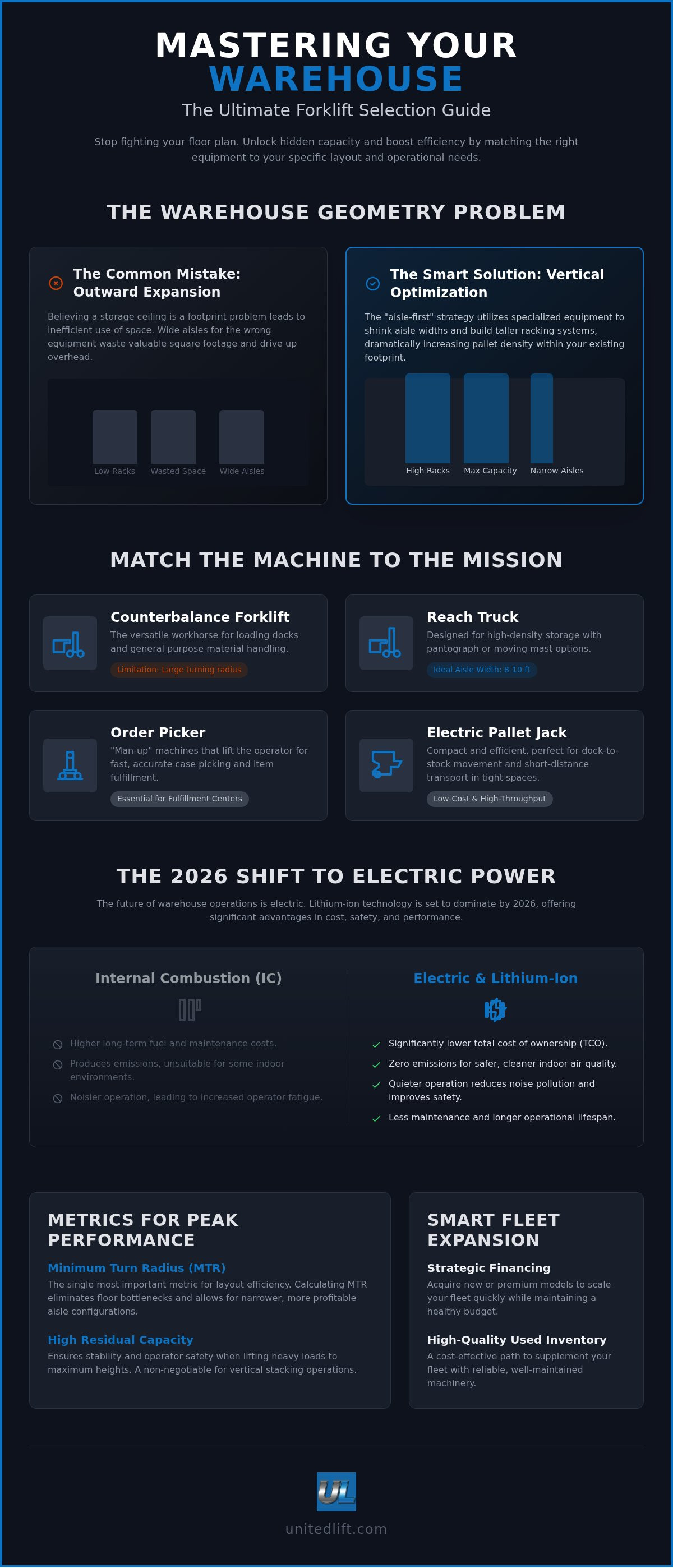
Real estate costs are climbing. In 2026, the trend for warehouse design is moving upward rather than outward. High-reach forklifts are the solution to this "geometry problem" because they allow for much narrower aisles and taller racking systems. By utilizing your facility's full height, you increase pallet density without paying for more square footage. This shift toward verticality is the primary driver for warehouse ROI this year. Every extra foot of vertical storage you can reach represents a direct reduction in your footprint costs.
Reducing Operational Friction and Improving Safety
Operator fatigue is a silent killer of productivity. Modern units now feature ergonomic controls that allow your team to work faster with less physical strain. When operators are comfortable, they make fewer mistakes and maintain a higher pace throughout the shift. Safety technology has also advanced; many new models include sensors that prevent rack damage in tight spaces. Warehouse throughput is the total number of pallet moves completed within a specific forklift cycle time. Reducing friction in these cycles is the fastest way to improve your bottom line. Reliable equipment ensures your operators spend their time moving product, not waiting for a technician.
Specialized Warehouse Forklift Types and Their Applications
Selecting the right forklift for warehouse operations requires more than just checking a lift capacity. You must match the machine to the specific layout and inventory flow of your facility. While a standard counterbalance forklift is the versatile workhorse of the shipping dock, its large turning radius makes it inefficient for dense storage areas. To maintain compliance and protect your team, always consult the OSHA forklift safety regulations regarding the specific training requirements for each equipment class. Using the wrong machine for the job doesn't just slow down your throughput; it creates unnecessary safety hazards.
Electric walkies and pallet jacks serve as the backbone for small to medium setups. These compact machines are ideal for dock to stock movement where space is at a premium. They offer a low cost entry point for startups while providing the reliability needed for constant daily use. Versatility is the goal in multi-use industrial facilities; having a mix of specialized lifts ensures you aren't using a heavy duty machine for a lightweight task.
Reach Trucks for High-Density Racking
Reach trucks are designed specifically for narrow aisle environments, typically operating in spaces as tight as 8 to 10 feet. There are two primary designs: pantograph and moving mast. Pantograph trucks use a scissor-like mechanism to reach into racking, making them perfect for double-deep storage. Moving mast trucks shift the entire mast assembly forward to secure the load. While these machines allow you to stack higher, stability becomes a major factor at maximum lift heights. You need a machine with high residual capacity to ensure safe operation when your forks are 30 feet in the air.
Order Pickers and Electric Pallet Jacks
If your business focuses on case picking rather than full pallet moves, order pickers are essential. These "man-up" machines lift the operator to the rack level, allowing for fast and accurate selection of individual items. For high-volume fulfillment centers, brands like Hyster and Yale offer specialized electric pallet jacks that prioritize speed and battery longevity. These units are built for the grueling pace of 2026 e-commerce logistics. If you're ready to expand your fleet, you can browse our warehouse equipment inventory to find the right fit for your specific application.
Comparing Power Sources and Tire Types for Indoor Environments
Choosing the right power source for your forklift for warehouse operations is no longer just about fuel cost; it's about facility health and long-term ROI. By 2026, electric models have become the global standard, with the market projected to grow at a 13.7% CAGR through 2033. While internal combustion (IC) units still have a place in some heavy-duty applications, their role is shrinking in enclosed spaces. Understanding forklift fundamentals helps you see why the interaction between the engine and the floor surface is critical for daily efficiency. If you choose the wrong power or tire combination, you'll see it immediately in your utility bills and floor maintenance costs.
Electric Forklifts: Efficiency and Air Quality
Electric units are now mandatory for food and pharmaceutical warehouses due to their zero-emission design. Beyond air quality, the total cost of ownership (TCO) is the biggest draw for modern fleet managers. Research indicates that electric forklifts can save between $10,000 and $15,000 over a five-year period compared to IC models. This is driven by lower fuel costs and reduced maintenance requirements since electric motors have far fewer moving parts. Lithium-ion batteries now offer a payback period of 18 to 36 months for multi-shift operations. They effectively eliminate the downtime once associated with lead-acid charging. While some 24/7 facilities still use LPG (Propane) for instant refueling, the maintenance overhead of oil changes and tune-ups makes them a secondary choice for most indoor setups.
Cushion Tires: The Standard for Smooth Concrete Floors
As you transition to a modern electric fleet, disposing of old lead-acid batteries and retired machinery parts becomes an important logistical step. To find environmentally responsible solutions for your facility's industrial scrap, you can visit OC Recycling and explore their commercial recycling services.
Tire choice is often overlooked, but it's as vital as the engine type. Most indoor forklifts use cushion tires made of solid rubber molded to a steel band. These tires are the gold standard for smooth concrete because they allow for a smaller forklift frame. A smaller frame means a tighter turning radius, which is essential when you're navigating narrow aisles. You'll get more maneuverability in tight spots than you ever could with a pneumatic tire setup.
Don't confuse these with the air-filled pneumatic tires used on gravel or uneven yards. Cushion tires sit lower to the ground, providing better stability for high-lifting tasks. While they aren't suitable for outdoor use, their longevity on polished warehouse floors is unmatched. Maintaining these specialized compounds involves regular inspections for "chunking" or flat spots, but they generally require less frequent replacement than air-filled alternatives. Picking the right combination of electric power and cushion tires ensures your forklift for warehouse operations runs at peak efficiency without damaging your facility.
Sizing Your Fleet for Your Warehouse Layout
Your floor plan should dictate your equipment purchases, not the other way around. Selecting a forklift for warehouse operations requires a geometry-first mindset where you measure your tightest pinch points before browsing inventory. Many managers make the mistake of buying a machine based on lift capacity alone, only to find it can't navigate their existing racking. Calculating the Minimum Turn Radius (MTR) is the first step in avoiding operational bottlenecks. To find your required aisle width, add the MTR to the length of your load and include at least 12 inches of clearance for safe maneuvering. If your math is off by even a few inches, you risk constant rack strikes and slowed throughput.
Future-proofing your fleet means looking at where your warehouse will be in three years. If you plan to add more racking or move to a high-density configuration, your current choice must be able to adapt. This ensures every forklift for warehouse operations in your fleet is earning its keep as you scale. Balancing machine size with maneuverability is a fine art that separates profitable logistics centers from those struggling with floor congestion.
Navigating Narrow Aisles (NA) and Very Narrow Aisles (VNA)
Standard warehouse aisles usually measure around 12 feet, providing plenty of room for counterbalance trucks. However, narrow aisles (9 feet) and very narrow aisles (6 feet) require specialized equipment like turret trucks or swing-reach mast options. Right-sizing a forklift for a specific rack configuration means selecting a machine that meets the maximum weight and height requirements of your inventory while maintaining the tightest possible turning clearance within your existing aisle widths. In VNA environments, you're often looking at wire-guided or rail-guided systems to keep the machine perfectly centered and prevent rack damage.
Calculating Necessary Lift Capacity for Your Inventory
Capacity isn't just a single number; it's a calculation based on the load center. Most standard pallets have a 24-inch load center, meaning the center of gravity is two feet from the fork face. If you handle oversized crates or long materials, your effective capacity drops significantly as the load center moves forward. Over-speccing your capacity can be a costly error. An 8,000 lb unit is physically larger than a 5,000 lb unit, meaning it requires more aisle space to turn. If you only move 3,000 lb pallets, the larger machine is actually wasting your storage potential. We help you match the right tonnage to your specific inventory needs to maximize your floor space. Browse our national inventory of new and used forklifts to find a unit that fits your specific layout requirements.
Sourcing Reliable Warehouse Equipment with United Lift
You've mapped your aisles and identified your power needs. Now you need a partner who can deliver the iron. United Lift LLC simplifies the procurement of a forklift for warehouse operations by offering a curated national inventory of premium brands like Hyster, Yale, Toyota, and Caterpillar. We don't just sell machines; we provide the logistical muscle that keeps American warehouses moving. Our team understands that every minute of downtime is lost revenue. We focus on providing reliable equipment with clear, direct paths to ownership for businesses across the United States.
Customization often makes the difference between a standard fleet and a high-performance one. We offer a variety of equipment attachments, such as side-shifters, which allow operators to move loads laterally without repositioning the entire truck. This small adjustment saves seconds on every pallet move. Those seconds compound into significant labor savings over a full shift. Whether you're outfitting a new distribution center or expanding a startup, we have the inventory and expertise to help you scale your capacity quickly.
New vs. Pre-Owned: Building a Cost-Effective Fleet
Deciding between new and used equipment is a strategic choice for your bottom line. Investing in new Hyster or Yale technology is ideal for your primary, high-velocity lines where the latest battery efficiency is critical. These machines are built for the grueling duty cycles of 2026 fulfillment centers. For secondary tasks or backup support, evaluating used Toyota or Caterpillar units is a smart way to stretch your budget. We maintain a diverse inventory of pre-owned lifts that have undergone rigorous quality checks. They're ready to work the moment they arrive at your dock, providing a reliable alternative to the high cost of new machinery.
Financing and Tax Incentives for Material Handling
Preserving operational cash flow is essential when building or expanding a fleet. We offer flexible industrial financing, including leasing and loan options that fit your specific business cycle. One of the most powerful tools for fleet expansion in 2026 remains the Section 179 tax deduction. This incentive allows businesses to deduct the purchase price of qualifying equipment from their gross income, which significantly lowers the total cost of ownership. It's a proactive way to upgrade your technology while keeping your balance sheet healthy. For more insights on navigating the procurement process, read The Ultimate Forklift Buying Guide for Industrial Success in 2026. We're ready to help you find the right forklift for warehouse operations today.
Optimize Your Warehouse for 2026 and Beyond
Optimizing your facility starts with the right iron on the floor. You've seen how matching your aisle width to specific machine specs prevents bottlenecks and protects your racking. Moving to electric power isn't just about emissions; it's a strategic move to lower your total cost of ownership through reduced fuel and maintenance. Whether you're expanding a startup or upgrading a national distribution center, selecting the perfect forklift for warehouse operations is the foundation of a high-velocity logistics strategy.
United Lift is here to facilitate your next move. As an authorized dealer for Hyster, Yale, and Toyota, we offer premium equipment backed by national shipping on all forklift sales. We provide flexible financing options for both new and used units, helping you preserve cash flow while you scale. Don't let a cramped floor plan or an outdated fleet limit your throughput. Take control of your logistics and build a fleet that works as hard as you do. Browse our full inventory of warehouse forklifts today.
Frequently Asked Questions
What is the best forklift for a warehouse with narrow aisles?
Reach trucks and turret trucks are the top choices for tight spaces. Reach trucks handle aisles as narrow as 8 to 10 feet, while turret trucks can work in 6 foot spaces. These specialized units allow for higher rack density compared to a standard counterbalance model. Choosing the right forklift for warehouse operations in tight spaces maximizes your vertical storage without requiring a larger building footprint.
Are electric forklifts better than propane for indoor warehouse operations?
Electric models are generally superior for indoor use due to zero emissions and lower noise levels. Propane units require ventilation to manage carbon monoxide, which is difficult in enclosed spaces. While propane offers faster refueling, electric units now use lithium ion batteries that allow for opportunity charging during breaks. This shift makes electric the more cost effective and healthy choice for modern indoor facilities.
How much weight can a standard warehouse forklift lift?
A standard warehouse forklift typically has a lift capacity between 3,000 and 8,000 pounds. The most common workhorse units found in distribution centers are rated for 5,000 pounds. It's vital to remember that capacity decreases as the load center moves forward or as you lift higher. Always check the data plate on your specific machine to ensure you aren't exceeding the safe residual capacity for your inventory.
What is the difference between a reach truck and a standard forklift?
The primary difference is how they handle loads and navigate space. A standard counterbalance forklift uses its weight at the rear to balance the load in the front and requires wide aisles to turn. A reach truck features outriggers for stability and a mast that reaches out to grab pallets. This design allows reach trucks to operate in much narrower aisles and lift loads significantly higher than a standard model.
Can I use cushion tire forklifts outdoors on gravel?
No, you should never use cushion tire forklifts on gravel or uneven terrain. These tires are made of solid rubber molded to a steel band and are designed exclusively for smooth, dry concrete floors. They have very low ground clearance and no traction for loose surfaces. Attempting to drive them on gravel can cause the machine to get stuck, damage the tires, or lead to a dangerous tip over.
How do I calculate the aisle width needed for my forklift?
You calculate the required aisle width by adding the forklift's Minimum Turn Radius to the load length and adding a 12 inch safety buffer. For example, if your forklift has an 80 inch radius and you're carrying a 48 inch pallet, you need at least 140 inches of aisle space. Accurate measurements ensure your forklift for warehouse operations can turn safely without striking racks or slowing down your daily throughput.
What brands of warehouse forklifts does United Lift sell?
United Lift sells a wide range of premium material handling brands to meet any operational need. Our national inventory includes top tier names like Hyster, Yale, and Toyota. We also carry reliable units from Caterpillar and Caterpillar affiliated brands. Whether you need a brand new high tech model or a reliable pre owned unit, we provide the variety and financing options necessary to help you scale your warehouse fleet quickly and affordably.
Are there tax benefits for buying warehouse equipment in 2026?
Yes, the Section 179 tax deduction remains a powerful incentive for businesses purchasing industrial equipment in 2026. This provision allows you to deduct the full purchase price of qualifying new or used forklifts from your gross income in the year they are put into service. It's a proactive way to lower your total cost of ownership while upgrading your fleet. You should always consult with a tax professional to verify current limits.
- Tags: Electric Forklifts, Fleet Management, Forklift, forklift for warehouse operations, Logistics, Material Handling, Warehouse Efficiency, Warehouse Management
