
Business Equipment Loan Requirements: The 2026 Checklist for Industrial Financing
Posted by United Lift LLC on
Did you know that over 82% of U.S. businesses finance their heavy machinery rather than paying cash? Even with such high numbers, many owners still feel overwhelmed by the specific business equipment loan requirements needed to get a new forklift or boom lift onto the job site. It's frustrating to feel stuck between your personal credit history and your company's revenue targets while staring at a mountain of paperwork. You need to grow your fleet, but the fear of a rejection often keeps the best equipment out of reach.
We understand that your time is better spent on the floor or in the field than decoding lender jargon. This 2026 checklist simplifies the path to approval by laying out the exact financial benchmarks and documentation standards for industrial financing. You'll learn about the latest SBA underwriting shifts, the specific Debt Service Coverage Ratios lenders demand, and how to organize your files for a fast response. We've built this guide to give you the confidence to master the application process and secure the telehandlers or scissor lifts your business needs to stay competitive.
Key Takeaways
- Understand the three core pillars lenders use to evaluate your credit capacity, cash flow, and the resale value of your machinery.
- Identify the updated 2026 business equipment loan requirements for credit scores and annual revenue to see exactly where your company stands.
- Prepare a complete documentation package, including specific bank statements and tax records, to fast-track your approval for new or pre-owned lifts.
- Learn how recent SBA policy shifts and Debt Service Coverage Ratio (DSCR) benchmarks impact your ability to secure low-interest industrial financing.
- Master the equipment-specific details and insurance needs that ensure your forklift or boom lift funding is finalized without unnecessary delays.
The 3 Pillars of Business Equipment Loan Requirements
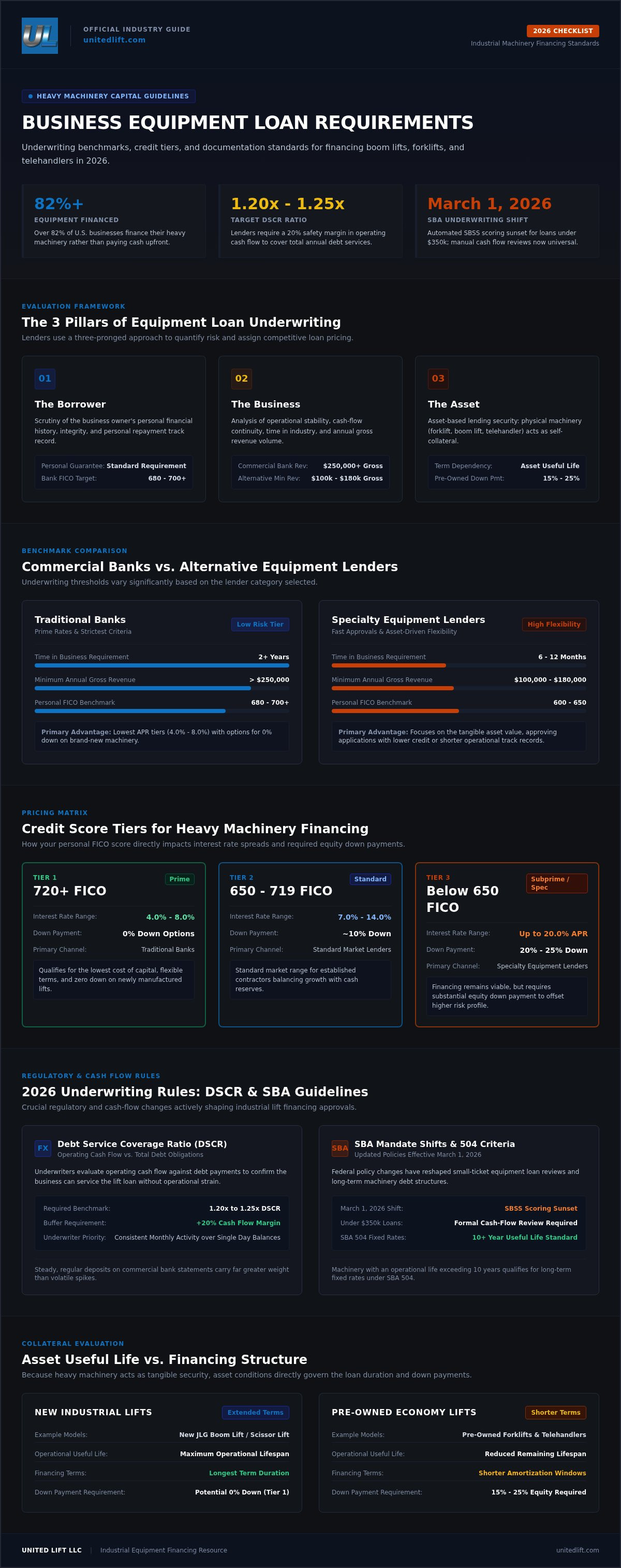
Lenders don't just look at a single number when reviewing your application. They use a three-pronged approach to minimize their risk. These three pillars define the modern business equipment loan requirements for anyone looking to add a boom lift or telehandler to their fleet. By understanding these categories, you can present a stronger case and potentially secure better interest rates. Unlike unsecured loans that rely entirely on your reputation, these loans focus on the tangible value you're bringing to the table.
The three pillars include:
- The Borrower: This is you and your personal financial track record.
- The Business: This covers your company's revenue, cash flow, and time in the industry.
- The Asset: This is the specific machine, its age, condition, and resale value.
Borrower vs. Business Credentials
Most small to mid-sized business owners find that lenders scrutinize both personal and business credit. Even if your company is a separate legal entity like an LLC or S-Corp, you'll likely provide a personal guarantee. Traditional banks usually look for a personal FICO score between 680 and 700. If you're working with specialty equipment lenders, they might accept scores as low as 600 to 650. They want to see that you manage your personal obligations as carefully as your professional ones.
Lenders also check your business's operational history. Commercial banks typically require at least two years in business and annual gross revenue exceeding $250,000. Alternative lenders are often more flexible. They might fund your scissor lift or forklift with only six to twelve months of history if you show at least $100,000 to $180,000 in annual revenue. This flexibility is why equipment loans are often the first choice for growing operations.
The Role of Collateral in 2026 Financing
The biggest advantage of equipment financing is that the machine itself acts as security. This structure is a form of asset-based lending where the loan is backed by physical machinery. Because the lender has a way to recover their funds, the barriers to entry are often lower than they are for unsecured business loans. In the context of industrial lifts, collateral is the physical machinery, such as a forklift or telehandler, that the lender can repossess and sell if the loan isn't repaid.
Lenders look at the "useful life" of the asset to determine your loan term. A new JLG boom lift might qualify for a longer term because it has years of operational life left. Conversely, a pre-owned economy lift might require a shorter term or a higher down payment of 15% to 25%. This focus on the asset's condition allows many businesses to qualify for financing even if their credit isn't perfect. It's about the machine's ability to do the work and hold its value over time.
Financial Checklist: Credit Scores and Revenue Benchmarks
Lenders use your financial history to predict your future behavior. Meeting the business equipment loan requirements means proving your company generates enough cash to cover new debt without straining daily operations. Most underwriters look for a Debt Service Coverage Ratio (DSCR) between 1.20x and 1.25x. This provides a 20% safety margin for your operating cash flow. If you're applying for a loan under $350,000, keep in mind that as of March 1, 2026, the SBA sunset the automated SBSS scoring system. Lenders now conduct formal cash-flow evaluations for every application, regardless of the loan size.
Credit Score Tiers for Heavy Machinery
Your personal FICO score remains a primary factor in determining your interest rate and down payment size. While some big banks demand a 700+ score for any approval, the broader market offers more flexibility for industrial borrowers.
- Tier 1 (720+): You'll qualify for the lowest rates, often 4.0% to 8.0% at traditional banks, and potential 0% down options on new machinery.
- Tier 2 (650-719): This is the standard market range. Expect rates between 7% and 14% with a 10% down payment.
- Tier 3 (Below 650): Financing is still possible through specialty lenders, but expect APRs up to 20% and down payments of 20% to 25%.
Cash Flow and Revenue Requirements
Lenders care more about consistent monthly deposits than a high balance on a single day. They want to see that your bank statements show regular activity and healthy liquidity. Most alternative equipment lenders require a minimum of $15,000 in monthly revenue, or roughly $180,000 annually. If your business is seasonal, provide 12 months of statements. This helps underwriters see your ability to pay across the entire year rather than judging you solely on your off-peak months.
Time in business is the final hurdle. Traditional institutions prefer two years of history and $250,000 in annual revenue. However, you can find funding with just six months of operation if your cash flow is strong. If you're unsure where your financials land, you can browse our inventory to see which lift options fit your current budget. Matching the right machine to your revenue tier is the fastest way to move from application to the job site.
Documentation Checklist: The Paperwork Trail
Organizing your paperwork is the fastest way to get your boom lift or telehandler on-site. While mega-banks might demand complex corporate audits, most business equipment loan requirements are far more streamlined for industrial operators. You don't need a team of accountants to get approved. You just need to be organized and transparent. Having these files ready before you call a lender shows that you're a serious, low-risk borrower who values professional efficiency.
Lenders typically request the last three to six months of business bank statements. They aren't just looking at the final balance. They want to see consistent daily or weekly deposits that prove your cash flow can handle a new monthly payment. You'll also need your previous two years of federal business tax returns. These documents confirm your long-term stability and help lenders verify the revenue you've reported on your application. If you've claimed significant Section 179 deductions in the past, these returns prove you understand the tax advantages of owning machinery.
Proof of Business Identity
Underwriters need to know exactly who they're doing business with. Prepare a valid government-issued ID for every owner with a 20% stake or higher. You'll also need your EIN confirmation letter from the IRS and your articles of incorporation or operating agreement. These documents prove your business is a legal entity in good standing and clarify who has the authority to sign the financing contract. If you're looking for larger projects, these same documents are central to meeting SBA 504 loan eligibility requirements for long-term machinery.
Financial Statements for MOFU Buyers
A current Year-to-Date (YTD) Profit and Loss (P&L) statement is mandatory for mid-year purchases. Lenders want to see how you're performing right now, not just how you did last December. When preparing your balance sheet, ensure your existing debt is clearly labeled. A clean balance sheet should show a healthy ratio of current assets to current liabilities. If your current equipment is already paid off, list those assets clearly to show your company's equity.
Common mistakes often involve submitting tax returns with missing schedules or blurry scans. This causes immediate delays in the approval process. Make sure every page of your return is included, even the ones that seem blank. If you're buying in the second half of the year, an "interim" statement that covers the most recent quarter is often the difference between a 24-hour approval and a week-long back-and-forth. Clear documentation is the bridge between your application and your new equipment arriving at the yard.
Equipment Checklist: Quotes, Invoices, and Condition
Many business owners focus so much on their credit scores that they forget the machine is the star of the show. In equipment financing, the lender treats the asset as a safety net. If the machine doesn't hold its value, the lender's risk goes up. This is why your equipment documentation must be as precise as your financial records. Providing a clear, professional quote from the start prevents delays and shows the lender exactly what they're securing. It's the difference between a fast approval and a long list of follow-up questions.
Financing New vs. Used Industrial Lifts
Lenders have different business equipment loan requirements depending on the age of the machinery. For new forklifts or scissor lifts, the process is straightforward. However, if you're buying used boom lifts or telehandlers, lenders usually cap the age at 10 to 15 years. They also look closely at the hour meter. High usage hours suggest a shorter remaining economic life, which can lower your loan-to-value (LTV) ratio. If the machine is highly specialized or carries a high price tag, expect the lender to require an independent appraisal or detailed maintenance logs to verify its condition.
The Equipment Quote: Must-Have Details
Your pro-forma invoice or quote needs to be itemized and transparent. Lenders won't accept a vague "one forklift" description. The document must list the make, model, and year of the machine. It also needs to include the hour meter reading and the serial number or VIN. Make sure the pricing clearly breaks down the base cost, any equipment attachments, and freight charges. Lenders also need to see the sales tax or a copy of your tax-exempt certificate if you aren't paying it. If you're still deciding which machine fits your job site, check out The Ultimate Forklift Buying Guide for help selecting the right asset.
For used equipment, you'll also need to provide high-resolution photos of the machine from all angles. Include a clear shot of the manufacturer's nameplate and the serial number. This helps the lender verify that the machine exists and matches the condition described in the quote. Being proactive with these details builds trust with the underwriting team. Ready to get started? You can contact our team to request a professional quote that meets all lender standards and helps you move forward with confidence.
Approval Checklist: Final Steps to Funding
Once you've selected your machinery and submitted your paperwork, you enter the final funding phase. This is where the deal is secured and the money moves. Many owners expect this stage to take weeks, but modern digital processes have shortened the timeline significantly. Meeting the final business equipment loan requirements ensures that your forklift or scissor lift is delivered to your site without a last-minute hitch. You've done the hard work of organizing your financials; now it's time to cross the finish line.
Standard down payment expectations vary based on your credit tier and the asset's age. For new equipment and prime borrowers, you might see 0% to 10% down. If you're purchasing used machinery or have a credit score below 650, lenders typically require 15% to 25% down. Some financing structures use a "first and last" payment model instead of a traditional percentage. This can be a great way to preserve your upfront cash for other operating expenses while still securing the capital you need.
Insurance and Risk Mitigation
Lenders require specific insurance riders before they release funds. You'll need a certificate of insurance that includes both general liability and physical damage coverage. Lenders require 'physical damage' insurance to ensure the loan can be repaid even if the machine is destroyed, stolen, or damaged on a job site. Your policy must name the lender as the "loss payee" and "additional insured." This protects the lender's interest in the collateral throughout the life of the loan. Most industrial operators find it easiest to add a new machine to their existing inland marine or equipment floater policy.
For larger transactions, usually those exceeding $100,000, a lender might perform a brief site inspection. They aren't there to audit your books. They simply want to verify that your facility is appropriate for the equipment being financed. In 2026, most of the signing process happens through secure digital platforms. Unless you're dealing with specific SBA documents that require "wet" ink, you can sign your contract on a tablet or computer. This shift to digital signatures allows many loans to fund within 24 to 48 hours of final approval.
Facilitating Your Loan with United Lift
We believe that getting the right equipment shouldn't be a bureaucratic nightmare. Our team acts as a reliable facilitator between you and our network of specialized lenders. We understand the urgency of your material handling needs and value your time. By offering "one-stop" shopping, we move your equipment quote and financing application through the same channel. This eliminates the communication gaps that often happen when you deal with a separate bank. We're here to help you navigate the checklist and get your crew back to work.
Our expertise covers everything from premium JLG boom lifts to economy solutions for smaller warehouses. We don't just provide the iron; we provide the path to ownership. If you're ready to grow your fleet, we have the resources to make it happen quickly and professionally. Contact United Lift LLC for a custom financing quote and let our experts handle the heavy lifting for your next equipment acquisition.
Secure Your Fleet for 2026 and Beyond
Navigating the modern landscape of business equipment loan requirements doesn't have to be a source of stress. You now have a clear roadmap for organizing your financial documentation and selecting the right machinery to act as collateral. By focusing on consistent cash flow and accurate equipment specs, you're already ahead of most applicants. Remember that the machine's value is your greatest asset during the underwriting process.
We're ready to help you turn this checklist into a funded contract. Our team provides access to a wide network of national lending partners and offers expert financing for top brands like Hyster, Yale, and Toyota. We're here to assist you seven days a week to ensure your application moves at the speed of your business. Whether you need a new boom lift or a pre-owned forklift, we'll help you navigate the benchmarks with professional ease.
Get Pre-Approved for Your Next Lift with United Lift LLC today. Your next project is waiting, and we have the tools to help you reach it.
Frequently Asked Questions
What is the minimum credit score for a business equipment loan in 2026?
The minimum credit score for a business equipment loan in 2026 varies based on the lender you choose. Traditional banks typically require a FICO score of 680 to 700 or higher for the best rates. However, alternative and specialty equipment lenders often accept scores between 600 and 650 for qualified businesses. While a lower score might lead to a higher interest rate or larger down payment, it won't automatically disqualify you from securing machinery.
Can I get equipment financing if my business is less than two years old?
Yes, you can secure financing even if your business is less than two years old. While traditional commercial banks prefer a two-year track record, many alternative lenders only require six to twelve months of operational history. These lenders focus more on your recent bank statements and monthly revenue than long-term history. New ventures with strong cash flow can often qualify for competitive rates on essential equipment like forklifts or scissor lifts to help them grow.
Do I need a down payment for a forklift or telehandler loan?
Most lenders require a down payment, though the amount depends on your credit profile and the asset type. Prime borrowers purchasing new equipment may see options for 0% to 10% down. For used machinery or highly specialized assets like telehandlers, a down payment of 10% to 25% is standard. Some lenders also offer "first and last" payment structures, which can be an effective way to manage your initial cash outlay while still securing the capital you need.
What documents are required for used equipment financing specifically?
Used equipment financing requires specific business equipment loan requirements to verify the asset's condition and value. You must provide a detailed dealer quote including the make, model, year, and hour meter reading. Lenders also require the serial number and high-resolution photos of the machine and its nameplate. If the purchase price exceeds $100,000, some lenders may also ask for an independent appraisal or maintenance logs to confirm the machine's remaining economic life and resale potential.
How long does the equipment loan approval process typically take?
The approval process for a dedicated equipment loan is typically much faster than a standard bank loan. Most applications are reviewed and approved within one to four weeks. Digital signing platforms and automated valuation tools have streamlined the process for 2026. If your documentation is complete and your equipment quote is itemized, you can often move from initial application to final funding in just a few business days, getting your equipment on-site much sooner.
Does an equipment loan require a personal guarantee?
Most equipment loans for small to mid-sized businesses do require a personal guarantee. Even if your company is an LLC or S-Corp, lenders want to see that the owners are personally committed to the debt. This adds a layer of security for the lender, especially when financing high-value assets like boom lifts or telehandlers. Providing a guarantee can sometimes help you secure better interest rates or more favorable loan terms because it reduces the lender's overall risk.
Can I finance attachments and batteries along with the main lift?
Yes, you can typically bundle equipment attachments and industrial batteries into your main equipment loan. Lenders understand that items like specialized forks, rotators, or high-capacity batteries are essential for the machine's operation. Including these in your initial financing allows you to spread the cost over the life of the loan rather than paying for them upfront. Ensure these items are clearly itemized on your dealer quote to avoid delays during the final approval and funding phase.
What is the difference between an equipment loan and an equipment lease?
The main difference lies in ownership and tax treatment. An equipment loan allows you to own the asset immediately, making you eligible for the $2,560,000 Section 179 deduction and 100% bonus depreciation. An equipment lease, specifically a Fair Market Value lease, often results in lower monthly payments but treats the machine as an operating expense. Most industrial buyers choose loans to maximize their long-term equity while leveraging significant tax benefits for their heavy machinery and fleet growth.
- Tags: business equipment loan requirements, business loans, commercial lending, credit requirements, equipment financing, heavy equipment, industrial machinery, loan approval checklist, SBA loans
