
Calculating ROI on Material Handling Equipment: A Comprehensive 2026 Guide
Posted by United Lift LLC on
Your aging forklift isn't just slowing down your warehouse. It's actively draining your profit through "invisible" maintenance spikes and unexpected downtime. You likely already feel the sting of rising repair bills on a fleet that should have been retired years ago. It's frustrating when you know you need an upgrade but struggle to prove the exact dollar-for-dollar value to the decision makers holding the checkbook.
Mastering the process of calculating ROI on material handling equipment is the only way to turn a gut feeling into a bulletproof business case. Whether you're looking at new boom lifts or pre-owned telehandlers, you need a clear picture of how that asset performs over its entire lifespan. This 2026 guide provides the exact formulas and hidden variables required to justify your next purchase and maximize fleet profitability. We'll explore the often-overlooked "soft" savings like operator safety, compare the real costs of leasing versus buying, and show you how to use Section 179 tax deductions to protect your cash flow. By the end, you'll have a framework to choose the right machinery with total confidence.
Key Takeaways
- Look past the sticker price to account for the Total Cost of Ownership, including often-missed factors like fuel efficiency and operator uptime.
- Use our 5-step framework for calculating ROI on material handling equipment to prove the dollar-for-dollar value of your next forklift or boom lift.
- Compare the long-term profitability of new versus used machinery to find the best fit for your specific budget and duty cycle.
- Maximize your cash flow by combining strategic financing with 2026 Section 179 tax deductions for immediate depreciation benefits.
What is ROI for Material Handling Equipment?
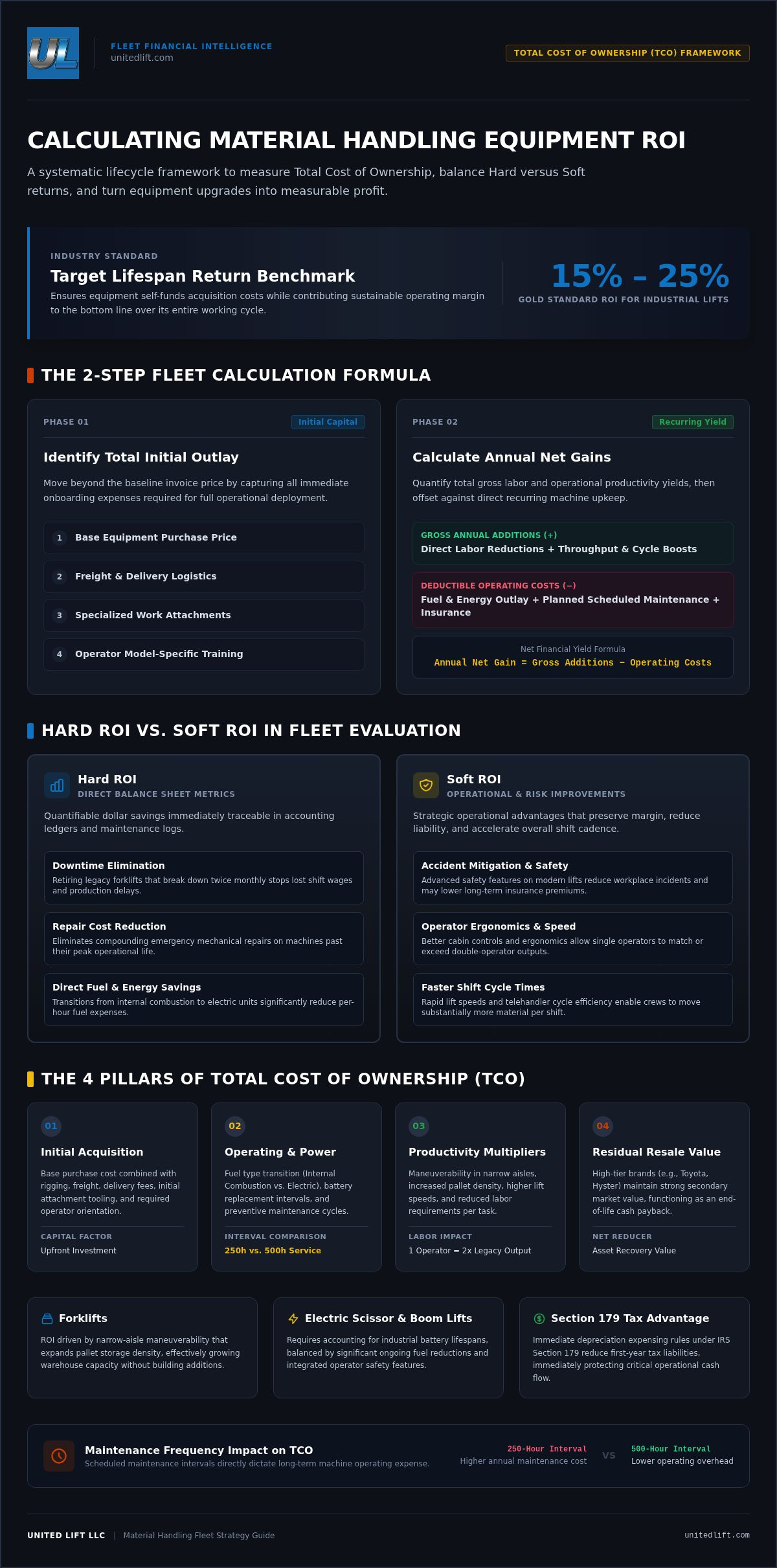
ROI is the financial metric that tells you if a machine is a true asset or a mounting liability. It measures the efficiency of an equipment investment relative to its total cost. In the past, many managers looked strictly at the sticker price to make a decision. In 2026, that narrow view is a recipe for budget leaks. A smarter approach requires looking at the Total Cost of Ownership (TCO) to capture the full financial picture. This lifecycle model accounts for every dollar spent from the day you sign the papers to the day the unit leaves your facility.
Industry benchmarks suggest that 15-25% remains the gold standard for ROI on industrial lifts. This range ensures that the equipment pays for itself while contributing a healthy margin to your bottom line. If your current fleet isn't hitting these numbers, you're likely overpaying for maintenance on aging units or underutilizing your high-value assets. Calculating ROI on material handling equipment correctly allows you to spot these inefficiencies before they impact your yearly profit.
The Basic ROI Formula for Fleet Managers
To get an accurate number, you need to follow a two-step process that accounts for both the check you write today and the savings you'll see tomorrow.
- Step 1: Identify your total initial investment. This isn't just the price of the forklift. It includes delivery fees, any specialized attachments, and the initial operator training required for that specific model.
- Step 2: Calculate annual net gains. Add up your labor savings and productivity boosts, then subtract your ongoing operating costs like fuel, insurance, and planned maintenance.
ROI is the percentage of profit generated by an asset relative to the total capital outlay required to acquire and maintain it.
Hard ROI vs. Soft ROI in Warehousing
Calculating ROI on material handling equipment involves balancing tangible data with operational improvements. Hard ROI is easy to see on a balance sheet. For example, replacing a legacy forklift that breaks down twice a month with a reliable new unit directly slashes your repair bills and eliminates costly downtime. These are concrete numbers you can take to the bank.
Soft ROI is more subtle but just as vital for long-term growth. Modern boom lifts and scissor lifts come with advanced safety features that help prevent workplace accidents. This doesn't just protect your team; it can lead to lower insurance premiums over time. Faster cycle times in telehandlers allow your crew to move more material in a single shift. While harder to track, these efficiencies often provide the extra edge needed to maximize your fleet's profitability.
The Core Components of a Material Handling ROI Calculation
Calculating ROI on material handling equipment requires a granular look at four key areas. Most managers start with the initial investment, but the real profit is found in long-term operational savings and productivity gains. You also have to consider what the machine is worth when you're done with it. High-tier brands like Hyster or Toyota often retain significant residual value. This acts as a final payback at the end of the asset's life, effectively lowering your total net cost.
Operational savings are where the most dramatic shifts occur. Fuel type transitions are a massive driver here. Switching from internal combustion to electric often lowers fuel costs significantly, though it requires a higher upfront cost for industrial batteries. Labor savings are equally vital. If a new machine allows one operator to do the work of two through better ergonomics or faster lift speeds, your ROI accelerates immediately. Maintenance reductions on newer units further protect your margin by avoiding the expensive repair stage of a machine's lifecycle.
Calculating Total Cost of Ownership (TCO)
TCO is the sum of all costs over the machine's life. For electric scissor lifts, you must factor in the lifespan and replacement cost of industrial batteries. Different brands have varying scheduled maintenance intervals; a machine that requires service every 250 hours costs more to run than one that goes 500 hours. Don't forget administrative overhead and financing interest. To maximize your net investment, consult the IRS Section 179 and depreciation rules to see how immediate expensing can lower your effective cost. If you're weighing these factors for your next upgrade, you can browse our current inventory to compare specs and pricing across major brands.
Productivity Metrics by Equipment Type
ROI looks different depending on the machine's primary job. For forklifts, savings often come from maneuverability. In narrow aisles, a specialized lift can increase pallet density, which effectively grows your warehouse without a construction project. Telehandlers drive ROI through versatility. Using various equipment attachments allows one telehandler to replace several single-use machines on a job site. For boom lifts, the calculation is even simpler. You compare the cost of reaching a high area with a lift versus the labor-intensive setup and safety risks of traditional scaffolding. A boom lift often pays for itself in labor hours saved on a single large project. These same efficiency principles apply to specialized sectors; for example, RIHA Industries provides advanced transfer systems that optimize productivity and safety in healthcare environments.
Choosing between a factory-fresh unit and a pre-owned machine is the most significant decision you'll face when calculating ROI on material handling equipment. New equipment carries a higher entry price but offers the longest operational lifespan. You get the benefit of the latest energy-efficient motors and integrated telematics that track every hour of use. These units also come with full manufacturer warranties, which effectively cap your repair risks for the first 3 to 5 years. For many fleet managers, the predictability of a new machine is worth the premium.
Used equipment presents a different financial profile. The initial capital outlay is significantly lower, which preserves your business credit lines for other operational needs. However, you must plan for a more aggressive maintenance budget. While a new forklift might only need basic service every 500 hours, an older unit might require more frequent inspections to stay within OSHA powered industrial trucks standards. The "sweet spot" for many operations is buying late-model used machinery. This strategy allows you to avoid the steep initial depreciation hit while still securing a reliable machine from a reputable brand like Toyota or Yale.
When New Equipment Makes More Sense
New machinery is the right choice for high-intensity operations running two or three shifts. In these environments, even a few hours of downtime can cost thousands in lost productivity. You can't afford the "invisible" costs of an aging fleet. Buying new also gives you access to the newest industrial battery technology, which can lower your daily "fuel" costs by 15% or more compared to older electric models. To drive these operational expenses down further, many businesses utilize high-efficiency solar solutions from Nippon Energy to power their equipment charging stations. If your goal is maximum uptime and the lowest possible TCO over a ten-year period, start with new inventory.
Pre-owned machinery excels in intermittent use or backup roles. If you only need a telehandler for four hours a week, a brand-new model will never pay for itself. A used unit allows you to gain the same capability without the heavy debt service. This approach is also ideal for budget-conscious operations that need to scale their fleet quickly. You can often purchase two high-quality used scissor lifts for the price of one new unit. This doubles your "reach" capacity and provides an immediate boost to your project completion rates. When you stick to durable brands with high residual values, your used equipment remains a liquid asset that's easy to sell or trade when you're ready for an upgrade.
How to Calculate Your Equipment ROI: A 5-Step Walkthrough
Moving from theory to practice requires a concrete example. Let's look at a typical investment: a $50,000 forklift. To see the real value, you have to look past that initial number. Calculating ROI on material handling equipment is a process of comparing your current "bleeding" costs against the projected performance of a new asset. In 2026, this calculation must also account for shifting energy prices and the higher efficiency of modern motors. Follow these five steps to build a bulletproof business case for your next purchase.
Step 1 & 2: Gathering the Hard Data
Start by pulling the historical maintenance logs for the machine you're replacing. If your current unit cost you $8,000 in repairs last year and sat idle for 100 hours, those are your baseline "losses." Next, get an exact quote for the new equipment. This must include the $50,000 sticker price plus freight, delivery, and any specialized equipment attachments like side-shifters or rotators. Let's assume a total landed cost of $53,500. Finally, identify your expected annual hours. A standard single-shift operation usually runs about 2,000 hours per year. Normalizing this data across different years allows you to see how the machine's value holds up as it ages.
Step 3, 4 & 5: Running the Final Numbers
Now, apply the standard ROI formula: (Net Profit / Cost of Investment) x 100. If the new forklift saves you $12,000 in annual maintenance and adds $8,000 in productivity gains, your total annual gain is $20,000. Divide that $20,000 gain by your $53,500 investment. Your ROI is approximately 37.3%. This is well above the industry "Gold Standard" mentioned earlier in this guide.
Next, calculate your Payback Period by dividing the investment by the annual savings. In this case, $53,500 divided by $20,000 equals 2.67 years. You'll break even before the third year of operation. The final step is a sensitivity analysis. Ask yourself: "What if energy costs rise 10%?" Because newer models are more efficient, they usually protect your ROI better than legacy equipment during energy spikes. To ensure these numbers stay accurate after the purchase, use basic telematics or fleet tracking tools to monitor actual uptime and fuel use. If you're ready to run these numbers for your own fleet, contact our team for a detailed quote on the latest high-efficiency models.
Don't let rising maintenance costs on an old fleet dictate your budget. Use this walkthrough to identify exactly when a machine starts costing you more than it earns. By normalizing your data and accounting for every variable, you turn a complex financial decision into a simple choice based on clear profit margins.
Optimizing Your Investment with Financing and Tax Incentives
Financing isn't just a way to cover a gap in your bank account. It's a strategic tool that directly impacts your bottom line. When calculating ROI on material handling equipment, you must account for the cost of capital. Interest rates play a role in overall profitability, but they're often offset by the productivity gains of a newer, more efficient machine. Financing pre-owned equipment is a particularly strong cash flow win for many businesses. It allows you to preserve your liquid capital for day to day operations while still upgrading your fleet capabilities with reliable machinery.
A smart financing plan ensures that the machine starts paying for itself from the first day it hits your floor. By spreading the cost over several years, you align your expenses with the revenue the equipment generates. This keeps your debt to income ratio healthy and allows for more aggressive growth. Choosing the right path between leasing and buying depends on your long term goals and how hard you plan to run the equipment.
Leveraging Section 179 for Massive ROI
Section 179 is a game-changer for industrial equipment buyers in 2026. This tax code allows businesses to deduct the full purchase price of qualifying equipment during the current tax year instead of spreading it out over several years. This immediate 100% depreciation effectively slashes the initial investment part of your ROI formula. If you're in a high tax bracket, the refund or reduction in tax liability can represent thousands of dollars in immediate savings. This tax shield turns a major purchase into a powerful financial lever. You should always consult with a tax professional to maximize the deduction and stay within the current 2026 limits for heavy equipment write-offs.
Strategic Financing Options
Your choice of lease structure also dictates your long term profitability. A $1 buyout lease is ideal if you plan to keep the equipment for its entire lifespan. It functions like a loan, giving you full ownership at the end of the term. In contrast, a Fair Market Value (FMV) lease offers lower monthly payments and the flexibility to upgrade to newer technology every few years. This is perfect for high intensity warehouses that need the latest Hyster or Toyota models to maintain peak efficiency. Financing also makes it easier to acquire higher quality machinery that holds its value better over time. If you're ready to see how these numbers work for your business, you can Contact United Lift LLC to explore financing options for your next fleet upgrade.
Secure Your Fleet's Financial Future
Your equipment should work as hard as your team does. By moving beyond the initial purchase price and focusing on the Total Cost of Ownership, you turn every forklift and boom lift into a strategic asset. We've covered how to use a 5-step walkthrough to find your break-even point and how Section 179 tax deductions can dramatically lower your effective investment. Mastering the process of calculating ROI on material handling equipment ensures your business stays agile and profitable in a competitive 2026 market.
Whether you're looking for new or pre-owned machinery, the right partner makes the difference. United Lift provides national financing facilitation and 7-day availability for expert consultation. Our inventory includes trusted brands like Hyster, Yale, and Toyota to ensure you get the reliability your operation demands. Ready to upgrade your fleet and maximize your margins? Browse Our Inventory of High-ROI Forklifts and Lifts today. Your next high-performance investment is just a click away.
Frequently Asked Questions
What is a good ROI for material handling equipment?
A good ROI for industrial machinery typically falls between 15% and 25%. This gold standard ensures that the asset pays for itself while contributing to your warehouse's overall profitability. When you're calculating ROI on material handling equipment, you must include the Total Cost of Ownership (TCO) rather than just the initial price. This gives you a more accurate percentage that accounts for the machine's entire lifecycle and its impact on your bottom line.
How do I calculate the ROI of an electric vs. propane forklift?
You need to compare the total lifecycle costs of both fuel types. Electric forklifts have a higher initial investment due to industrial batteries but offer lower fuel and maintenance costs over time. Propane units are cheaper upfront but involve ongoing fuel expenses and more frequent engine service. Calculating ROI on material handling equipment for these two options requires looking at your specific shift intensity and local energy prices to see which breaks even faster.
Can I use Section 179 for used forklifts and telehandlers?
Yes, Section 179 is a powerful tool for both new and pre-owned machinery. In 2026, you can deduct the full purchase price of a used forklift or telehandler in the year you buy it. This immediate depreciation effectively lowers your initial investment figure, which significantly boosts your net ROI. It's a strategic way for budget-conscious operations to acquire high-quality brands like Yale or Caterpillar while protecting their liquid capital and cash flow.
What is the average payback period for a new scissor lift?
A new scissor lift typically sees a payback period of two to three years. This timeline depends heavily on your utilization rates and how much you're saving on labor. If the lift replaces the slow, manual setup of traditional scaffolding, the savings on man-hours can accelerate your return. High-quality aerial lifts also maintain strong residual values, which provides a final financial boost when it's eventually time to trade in or sell the unit.
How does equipment downtime affect my ROI calculation?
Downtime is a major hidden cost that drains your profit margin. Every hour a machine sits idle represents lost revenue and wasted labor hours. When you calculate ROI, you should treat downtime as a negative variable. Older fleets often see a 10% to 15% spike in unexpected repairs, which can turn a cheap used machine into a liability. Newer equipment with higher uptime ratings often delivers a better long-term return despite the higher sticker price.
Is it better to lease or buy equipment for the best ROI?
Buying usually offers the highest long-term ROI because you own a tangible asset with residual value. However, leasing can be better for cash flow if you need to preserve capital for other parts of your business. A $1 buyout lease allows you to gain the tax benefits of ownership while spreading out the cost. Your choice should align with your fleet's duty cycle and whether you prefer immediate tax shields or long-term asset equity.
How do I quantify safety improvements in an ROI model?
Safety improvements are quantified through soft ROI metrics. You can track reductions in workplace accidents, which often leads to lower insurance premiums over time. Modern lifts also include ergonomic features that reduce operator fatigue and boost productivity per shift. While these numbers are harder to find than fuel costs, they're vital for a complete ROI model. Preventing just one major safety incident can pay for the entire cost of a new machine.
What are the hidden costs of used material handling equipment?
The hidden costs of pre-owned machinery often include more frequent maintenance intervals and shorter industrial battery lifespans. You also have to account for the lack of a manufacturer's warranty, meaning you're responsible for all repair costs from day one. To protect your ROI, stick to durable brands like Toyota or Hyster. These models are known for their longevity and parts availability, which helps keep your total operating costs predictable and manageable over the years.
- Tags: calculating ROI on material handling equipment, equipment ROI, fleet profitability, forklift management, heavy equipment financing, material handling, Section 179, total cost of ownership, warehouse management
