
Choosing the Right Forklift Attachment: The 2026 Industrial Buyer’s Guide
Posted by United Lift LLC on
What if your standard forklift could do the work of three specialized machines without the overhead of three separate equipment payments? Most warehouse managers realize that the right tool can transform a fleet, yet the technical hurdles often cause more stress than they're worth. You've likely felt the frustration of trying to calculate how a new clamp or rotator affects your net lifting capacity. It's a high-stakes game where a small math error leads to dropped loads or compromised safety.
Choosing the right forklift attachment shouldn't feel like a guessing game. We'll help you master the technical and operational factors needed to maximize your fleet's versatility and ROI. This 2026 guide breaks down everything from ITA carriage classes to hydraulic requirements. You'll learn how to protect your specialized loads with precise clamping pressure and ensure your equipment stays compliant with the latest safety standards. Let's turn your existing machinery into a multi-purpose powerhouse that handles any material with ease.
Key Takeaways
- Learn how attachments transform a single forklift into a versatile fleet, boosting your ROI without the cost of a new specialized lift.
- Avoid safety risks by mastering "Net Capacity" calculations and ensuring your ITA Carriage Class matches the attachment's specs.
- Follow our five-step framework for choosing the right forklift attachment based on your specific load dimensions and hydraulic needs.
- Explore common industrial tools like side shifters and fork positioners that improve lateral positioning and operator speed.
- Compare the benefits of new versus used attachments and see how specialized financing helps you upgrade your fleet's capabilities today.
Maximizing Fleet Utility: Why Forklift Attachments Matter
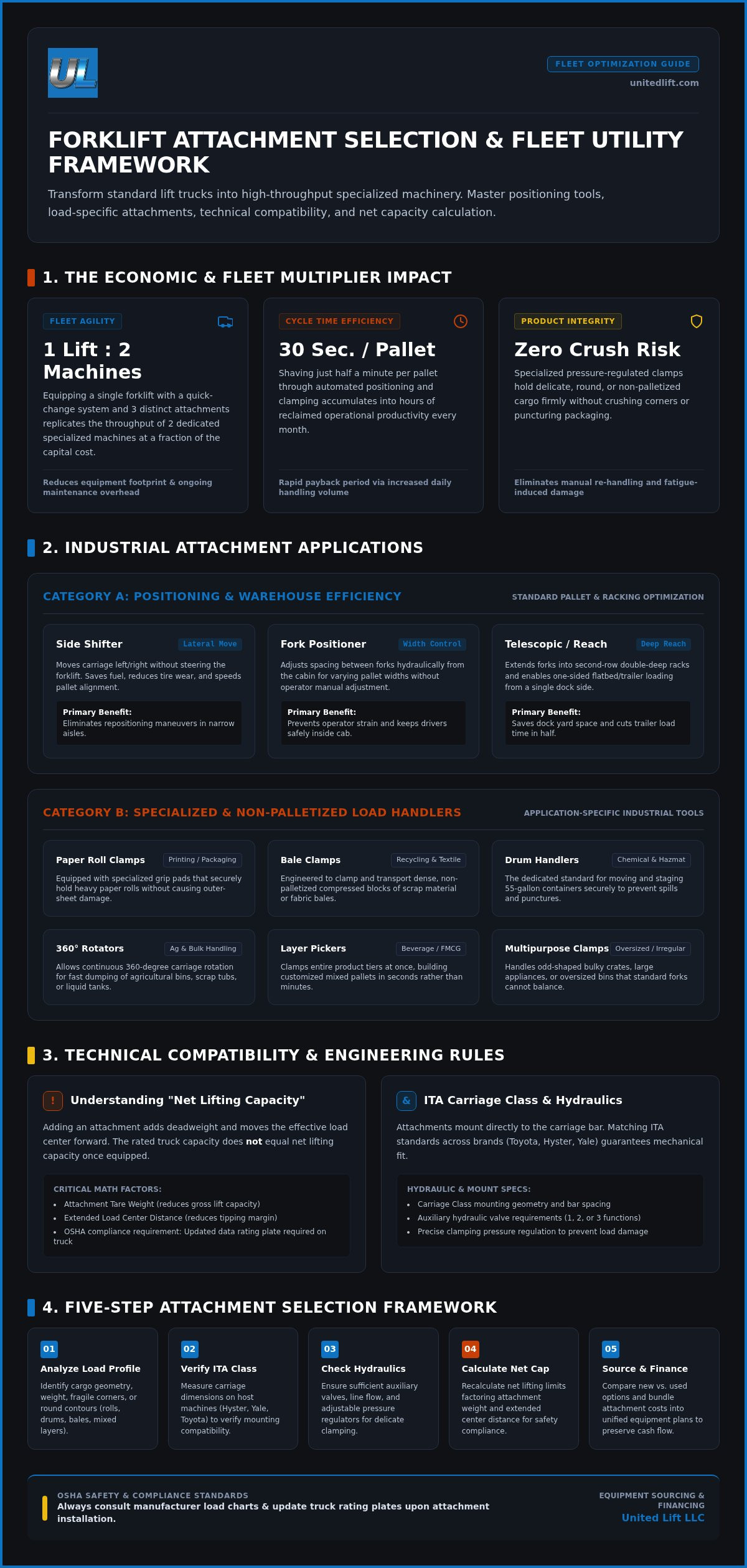
Modern material handling requires more than just moving pallets from point A to point B. It requires agility. A standard forklift is a generalist; it's built to be a workhorse. However, adding the right tool turns it into a specialist. When choosing the right forklift attachment, you're investing in your warehouse's future throughput and operational flexibility.
The economic case is clear for any growing business. A new specialized lift requires significant capital, more floor space, and additional maintenance. An attachment costs a fraction of that investment while delivering similar results. By exploring the variety of forklift truck attachments and applications, you can handle paper rolls, heavy drums, or multiple pallets without buying a dedicated truck for each specialized task.
Labor efficiency also improves when you match the tool to the specific job. Rotators allow for quick dumping of bins without manual intervention. Layer pickers let operators build mixed pallets in seconds rather than minutes. These tools reduce manual handling and prevent operator fatigue. The right tool also stops product damage. Specialized clamps apply precise pressure to hold a load without crushing it; this protects your inventory and your bottom line.
The ROI of a Multi-Purpose Forklift
Payback periods for attachments are often shorter than you'd expect. It's not just about the purchase price; it's about the reduction in cycle times. If an attachment saves just 30 seconds per pallet, those gains add up to hours of reclaimed productivity every month. Financing these upgrades makes sense as a capital investment. National dealers like United Lift facilitate financing that lets you bundle attachment costs into your equipment plan to preserve cash flow. By equipping a single forklift with a quick-change system and three distinct attachments, you can effectively perform the duties of two specialized machines while maintaining a smaller, more efficient footprint.
Beyond the Standard Fork: Identifying Your Needs
Knowing when to upgrade starts with looking at your load variety. Are your operators struggling to position forks manually for different pallet sizes? Are you seeing damaged corners on fragile goods or frequent spills? These are clear signs that choosing the right forklift attachment is overdue. Don't settle for standard forks if your inventory says otherwise. Future-proofing your fleet means selecting versatile tools that handle both your current inventory and potential new product lines. Check your ITA Carriage Class dimensions now to ensure any new additions fit your existing Hyster, Yale, or Toyota machines perfectly.
Common Attachment Types and Their Industrial Applications
Selecting the correct tool depends entirely on what you move and how your facility is laid out. While standard forks handle pallets, they aren't always the most efficient choice for high-volume operations. When choosing the right forklift attachment, you should start with the basics of positioning before moving into specialized clamping needs.
Positioning and Efficiency Tools
Side shifters are the most common upgrade. They allow the operator to move the carriage left or right without repositioning the entire truck. It saves time and fuel. Fork positioners take this a step further. They let the operator adjust the distance between forks from the cabin. This is essential if you handle pallets of varying widths throughout the day. It prevents the operator from repeatedly stepping off the machine, which reduces the risk of injury and increases throughput.
If your warehouse uses double-deep racking, reach extenders are necessary. They allow a standard lift to reach into the second row of a rack. Similarly, telescopic forks allow for one-sided truck loading. You can load or unload an entire trailer from one side of the dock. This saves space and keeps your yard traffic moving smoothly. Always ensure these additions comply with OSHA powered industrial truck safety standards to maintain a safe work environment.
Specialized Handling for Unique Loads
Some loads don't use pallets at all. Paper roll clamps are designed for the printing and packaging industries. They use specialized pads to grip heavy rolls without causing surface damage. Bale clamps are the standard for recycling and textile facilities. They handle compressed blocks of scrap or fabric with ease. For hazardous materials, drum handlers are the only safe way to transport 55-gallon containers without spills.
Rotators are indispensable in agricultural and chemical sectors. They allow the operator to rotate the carriage 360 degrees to dump bins or pour liquids. Multipurpose clamps handle oversized bins or odd-shaped items that standard forks can't secure. If you're unsure which tool fits your specific workflow, you can browse our inventory of equipment attachments to see the latest options from Hyster, Yale, and Toyota. We offer both new and used solutions to fit your budget and operational needs.
Technical Compatibility: Capacity, ITA Classes, and Hydraulics
Choosing the right forklift attachment requires more than just checking the mounting plate. You must understand the technical marriage between the truck and the tool. If these don't align, you risk mechanical failure or a major safety violation. Compatibility spans mechanical mounting, hydraulic power, and brand-specific specs for Hyster, Yale, and Toyota machines.
Determining Your Forklift’s Carriage Class
Most industrial forklifts follow the Industrial Truck Association (ITA) standards. To find yours, measure the vertical distance between the top and bottom carriage bars. This simple measurement tells you exactly what size mounting you need.
- Class II: 16 inches high. Usually found on trucks with capacities up to 5,500 lbs.
- Class III: 20 inches high. Common on 6,000 to 10,000 lb capacity lifts.
- Class IV: 25 inches high. Found on heavy-duty machinery.
Matching the class is non-negotiable. Using an adapter to force a fit is dangerous and often violates safety protocols. Beyond the carriage, check your hydraulic setup. Powered tools like rotators or clamps require auxiliary valves to function. If your Hyster or Toyota lift doesn't have a third or fourth function lever, you'll need to install hosing and a valve kit. This hosing must be rated for the specific pressure settings of your machine to prevent leaks or sluggish performance.
Calculating De-rated Lift Capacity
This is where many buyers fall into the "Net Capacity" trap. Every attachment adds weight and moves the load center forward. This reduces the maximum weight your forklift can safely lift. Net capacity is the remaining lifting ability after accounting for attachment weight and load center shifts.
To calculate this, you must look at "Effective Thickness." This is the distance the attachment adds between the carriage and the forks. Even a thin side shifter moves the center of gravity. You can't just subtract the attachment's weight from the truck's capacity. The math is more complex because of the leverage involved. A heavy paper roll clamp can reduce a 5,000 lb truck's capacity to 3,500 lbs or less depending on the load center.
Always check the revised load capacity plate. OSHA requires a new data plate for any forklift using an attachment. This plate shows the "de-rated" capacity specific to that machine and tool combination. We help our national clients navigate these calculations to ensure their Hyster, Yale, or Toyota fleets stay compliant. Whether you're buying new or used, getting the math right is the only way to protect your operators and your inventory.
The Selection Framework: Five Steps to the Right Choice
Success in material handling isn't about buying the most expensive tool. It's about finding the perfect match for your specific workflow. Choosing the right forklift attachment requires a disciplined approach to ensure you don't compromise safety or machine longevity. Follow this five-step framework to make an informed decision.
- Analyze the Load: Start with the material itself. Beyond simple weight, consider the dimensions, center of gravity, and fragility. Does the load require a gentle grip or a high-pressure clamp?
- Check the Machine: Verify your forklift’s power source and carriage class. Ensure you have the necessary hydraulic valves and hosing to power the new tool.
- Evaluate the Environment: Measure your narrowest aisles and lowest ceiling heights. An attachment that adds significant length to your truck can turn a standard aisle into a bottleneck.
- Choose the Brand: Stick with industry leaders like Cascade or Bolzoni. These brands offer the best reliability and parts availability for long-term maintenance.
- Plan for Installation: Never skip professional mounting. Secure hosing and proper pressure settings are critical for preventing hydraulic failure.
Environmental and Operational Constraints
Attachments change how your forklift interacts with your facility. Adding a heavy clamp increases the "lost load" distance, which naturally expands your turning radius. You might find that a truck that once fit perfectly in your racking now struggles to clear the corners. If you operate electric forklifts, remember that high-draw hydraulic attachments like rotators drain batteries faster than standard forks. You may need to upgrade to higher-capacity industrial batteries to maintain full-shift productivity. For outdoor operations, look for weather-resistant finishes to protect hydraulic cylinders from grit and moisture, and prioritize structural components made from high-grade iron castings like those from bowmanvillefoundry.com.
Compliance is your biggest priority once the tool is mounted. OSHA requires written approval from the forklift manufacturer before you can use any attachment that affects capacity or safety. Once approved, you must install a revised data plate that reflects the new net capacity of the machine. Operator training is also mandatory. A driver who is an expert with standard forks still needs to learn the specific nuances of a paper roll clamp or a rotator. Implement a daily inspection checklist to monitor hydraulic fittings for leaks and mounting pins for signs of stress. If you're ready to refine your fleet's capabilities, contact United Lift for expert guidance on selecting and financing the right attachment for your application.
Sourcing and Financing Your Forklift Attachments
Acquiring the right tools for your fleet requires a balance of operational needs and financial strategy. When choosing the right forklift attachment, you have to decide between new and used inventory. New attachments provide the latest technology and full manufacturer warranties. They're ideal for high-cycle environments where downtime is costly. Used attachments offer a lower entry price, which is perfect for backup machines or seasonal workflows. We provide both options across our national inventory to ensure you find a fit for your specific budget.
Don't forget the tax benefits of these upgrades. Section 179 tax deductions allow many businesses to write off the full cost of equipment in the year of purchase. This applies to both the forklift and its attachments. It turns a necessary purchase into a powerful tool for managing your year-end tax liability. Financing specialized tools like paper roll clamps or rotators separately can sometimes be difficult through traditional banks. We specialize in material handling, so we understand the value these tools add to your business. Always consult with your tax professional to see how these rules apply to your specific situation.
Financing Your Industrial Equipment
Should you lease or buy? Leasing keeps your fleet fresh and preserves capital for other operational needs. Buying gives you full ownership and long-term asset value. One of the best ways to secure a competitive rate is to bundle your attachments with a forklift purchase. This simplifies your monthly payments and often lowers your overall interest costs. For a deeper look at fleet planning, check out The Ultimate Forklift Buying Guide for Industrial Success in 2026. We help facilitate financing that covers the entire package, from the base truck to the specialized clamps.
The United Lift Advantage
Why work with a national dealer? We offer a massive inventory of attachments compatible with Hyster, Yale, and Toyota machines. You aren't limited to what's on a local lot. We provide support seven days a week to answer technical questions about carriage classes or hydraulic fittings. Our team understands that material handling doesn't stop on the weekend. Our national reach means we can source specific, hard-to-find attachments that local shops simply don't carry. We verify brand compatibility before shipping to ensure your Hyster or Toyota lift is ready to work the moment the attachment arrives. Whether you need expert guidance on choosing the right forklift attachment for a used lift or want to finance a brand-new rotator, we're your proactive partner in the field. We prioritize your immediate requirements to keep your operations moving at full speed.
Optimize Your Fleet for 2026 and Beyond
Your warehouse efficiency depends on more than just the number of trucks in your bay. It relies on the versatility of every machine in your fleet. By mastering the technical requirements of ITA carriage classes and net capacity calculations, you ensure your team stays safe and compliant while handling specialized loads. Choosing the right forklift attachment is a strategic investment that transforms a single lift into a multi-purpose tool, significantly boosting your throughput without the massive capital expense of a brand new specialized machine.
Ready to upgrade your operational capabilities? As a national dealer specializing in Hyster, Yale, and Toyota, United Lift LLC is here to help you navigate complex hydraulic specs and flexible financing options for all your industrial equipment. We bridge the gap between technical confusion and long term operational success. Whether you need a side shifter for precision or a paper roll clamp for heavy manufacturing, we have the inventory to keep you moving at full speed.
Browse our inventory of forklift attachments and equipment today to find the perfect match for your fleet. Let's build a more productive and efficient warehouse together.
Frequently Asked Questions
Do forklift attachments reduce the lifting capacity of the machine?
Yes, attachments always reduce the net lifting capacity. Adding weight and thickness to the carriage moves the load center forward. This creates a leverage effect that lowers the maximum safe weight. When choosing the right forklift attachment, you must calculate this de-rated capacity to avoid tipping. We help our national clients determine these new limits for their Hyster or Toyota machines to ensure full compliance with safety standards.
What is the difference between an ITA Class II and Class III carriage?
The main difference is the physical height of the mounting carriage. An ITA Class II carriage measures 16 inches vertically and typically supports lifts up to 5,500 lbs. A Class III carriage is 20 inches high and is standard for trucks rated between 6,000 and 10,000 lbs. You can't swap attachments between classes without an adapter, which is often discouraged for safety and performance reasons in industrial environments.
Can I install a hydraulic attachment on a forklift that only has two valves?
You can, but it requires a hydraulic upgrade. A standard forklift with only two valves handles lifting and tilting. To power a rotator or clamp, you'll need to install an auxiliary valve kit and hosing. This allows the operator to control the attachment's movement from the cabin. It's a common modification for warehouse managers looking to improve fleet utility without purchasing a brand new specialized lift.
Does OSHA require a new data plate when I add a forklift attachment?
Yes, OSHA mandates a revised data plate for any forklift using an attachment that alters capacity. This plate must show the new net capacity and the specific attachment model. You also need written approval from the manufacturer before making the modification. Operating without an accurate capacity plate is a significant safety violation that can lead to heavy fines and increased risk of accidents during daily material handling tasks.
Are forklift attachments universal across different brands like Toyota and Hyster?
Most attachments are universal because they follow ITA carriage standards. Whether you're choosing the right forklift attachment for a Toyota, Hyster, or Yale machine, the mounting system is usually identical if the carriage classes match. However, you must still verify hydraulic pressure settings and hosing connections. We source attachments that are compatible with all major premium brands to ensure a seamless fit for your existing material handling equipment.
How much maintenance do hydraulic forklift attachments require?
Hydraulic attachments need consistent attention to prevent leaks and sluggish performance. You should inspect the hosing, seals, and fittings every day as part of your pre-shift check. Moving parts like slides or pivots require weekly lubrication to reduce friction and wear. Proper maintenance prevents costly downtime and ensures that specialized tools like bale clamps or rotators operate with the precision needed to handle fragile loads safely.
Can I finance a forklift attachment separately from the forklift?
Yes, financing for individual attachments is available. While many buyers bundle attachments with a new forklift purchase, you can also finance them separately to upgrade your current fleet. United Lift facilitates flexible financing options for both new and used attachments across the country. This allows you to leverage Section 179 tax deductions and improve your warehouse throughput without a massive, immediate capital outlay from your budget.
- Tags: choosing the right forklift attachment, equipment ROI, fleet management, fork positioners, forklift attachments, forklift safety, industrial buyer's guide, lifting capacity, material handling, side shifters, warehouse equipment
