
Buying Guide: Choosing the Right Drum Handling Forklift Attachments in 2026
Posted by United Lift LLC on
Did you know that powered industrial truck violations remain one of OSHA's top ten most cited infractions, with 1,826 federal violations logged in 2025 alone? A significant portion of these penalties comes from unapproved equipment modifications or missing data plates when using specialized drum handling forklift attachments. Getting the hardware right isn't just about moving inventory; it's about staying compliant and keeping your team safe.
Moving 1,000-pound chemical drums or slippery polyethylene containers is a high-stakes task where a single spill can halt production and compromise your team's safety. You're likely looking for a way to eliminate manual strain and prevent costly accidents without slowing down your operations. It's about finding the right balance between equipment durability and daily speed to keep your warehouse running smoothly.
This guide will show you how to select the safest, most efficient attachments to maximize your fleet's utility while maintaining strict industrial safety standards. We'll break down the latest 2026 engineering trends, from hydraulic rotators to universal rim grippers, and explain the critical OSHA compliance steps you must follow before putting any new equipment into service. You'll learn how to match the right attachment to your specific drum materials for a zero-incident workplace.
Key Takeaways
- Stop risking spills or punctures by understanding why specialized tools are an industrial necessity compared to standard forks.
- Compare different drum handling forklift attachments based on whether you need to grip, lift, or pour materials safely.
- Match your hardware to specific drum materials and weight capacities to prevent equipment failure and load instability.
- Navigate OSHA 1910.178 compliance requirements, including the mandatory step of obtaining written approval from your forklift manufacturer.
- Learn how to optimize your fleet's utility by balancing long-term durability with flexible equipment financing options.
Why specialized drum handling attachments are an industrial necessity
Are you still balancing 55-gallon drums on standard pallet forks? This practice is one of the fastest ways to cause a workplace accident. Drum handling forklift attachments are specialized mechanical or hydraulic tools designed to safely secure 30 to 55-gallon containers. These attachments lock onto the drum rim or belly, ensuring the load stays centered and stable throughout the trip. Without them, you're relying on friction and luck to keep your inventory off the floor.
When you rely on bare forks, you're inviting slippage and punctures. A standard drum’s center of gravity shifts easily, especially if it's partially full. If a drum falls, it doesn't just spill; it can roll, crush equipment, or injure bystanders. Utilizing the correct forklift-mounted drum handling categories gives your operators the confidence to move heavy resins, chemicals, or oils across uneven warehouse floors without the risk of the load sliding forward during a sudden stop.
Productivity is the other side of the safety coin. High-performance attachments allow for the simultaneous transport of multiple drums, which slashes loading and unloading times. You can also find rotators that handle the heavy lifting of pouring liquids into vats or mixers. This level of automation keeps your team out of the "danger zone" and keeps your floor moving. It transforms a standard lift truck into a specialized tool tailored for high-volume liquid logistics.
Reducing workplace injuries and environmental spills
Workplace safety isn't just a metric; it's about protecting your people. Manual drum handling is a leading cause of back and shoulder injuries in industrial settings. These attachments take the physical burden off your team. Beyond injury prevention, they act as a safeguard against environmental disasters. A single chemical spill can lead to massive cleanup costs and forced shutdowns. Secure mechanical jaws and cinch belts provide a fail-safe that manual handling simply can't match, especially during high-lift maneuvers where stability is critical.
Maximizing existing forklift fleet utility
Why buy a separate machine when an attachment can do the job? Most drum grippers and rotators are designed for quick installation, allowing your operators to transition from moving pallets to handling drums in under five minutes. This flexibility is vital for businesses that only handle drums occasionally or during peak seasons. By choosing high-utility drum handling forklift attachments, you enhance your fleet's versatility without the capital expense of a new vehicle. It’s a cost-effective way to scale your operations while ensuring every forklift in your bay is a high-performance tool ready for any task.
A breakdown of forklift-mounted drum handling categories
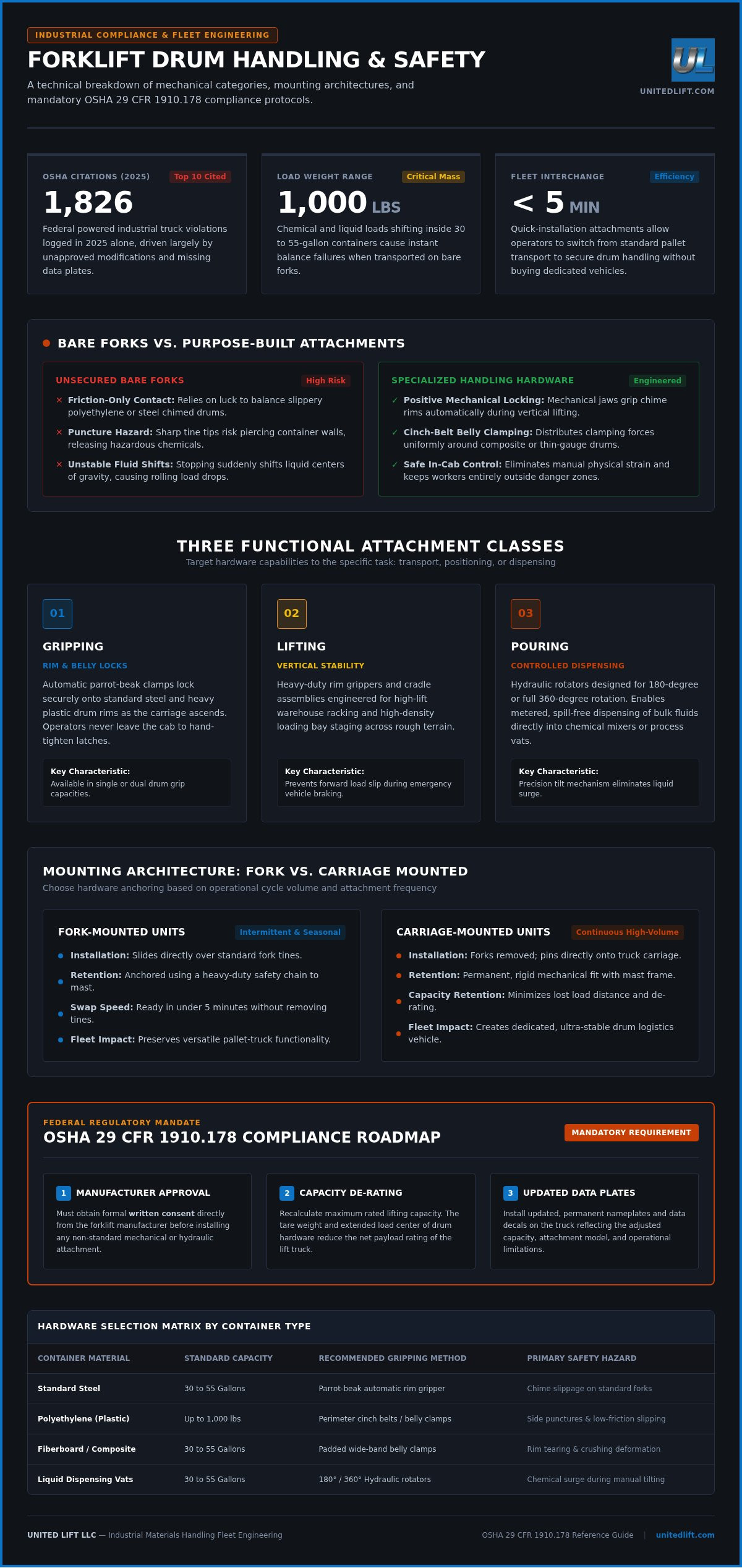
Not all drum handling forklift attachments are built for the same task. You need to identify if you're simply moving drums, stacking them, or dispensing their contents. Most attachments fall into three functional buckets: gripping, lifting, or pouring. You also have to choose between fork-mounted and carriage-mounted styles. Fork-mounted units slide directly onto your existing tines and secure with a safety chain. Carriage-mounted versions require removing the forks entirely. This offers a more permanent, stable connection for high-volume operations. If you're unsure which mounting style fits your current fleet, browse our attachment inventory to see the options in action.
Fork-mounted drum grippers and clamps
Automatic "parrot-beak" grippers are the industry standard for efficiency. They use a mechanical jaw that grabs the drum rim as you lift, meaning the operator never has to leave the cab. This is a massive upgrade over manual latching systems that require hand-tightening. These grippers work well for both steel and plastic drums, provided the chime is strong enough. Heavy-duty rim-grip systems are better for high-volume transport where you might need to move two drums at once. Choosing between single and double grippers depends on your forklift’s rated capacity. Remember that any modification must adhere to OSHA 29 CFR 1910.178 compliance, specifically regarding capacity de-rating and data plate updates.
Drum pourers and rotators for controlled dispensing
Pouring requires precision that a standard gripper can't provide. Rotators allow for 180-degree or full 360-degree movement to empty contents safely. Mechanical rotators usually use a pull-chain, while hydraulic versions connect to the forklift's auxiliary valves for total control from the seat. Gear-driven rotation is essential when you're pouring hazardous liquids, as it prevents the drum from "free-falling" or splashing. If you're mixing batches or filling smaller containers, look for scale-integrated pourers. They allow you to weigh the drum as you dispense, which reduces waste and improves your batch accuracy. To streamline your liquid management further, you can learn more about PVC Slangen Expert for high-quality industrial hoses that ensure safe and efficient material transfer.
Vertical lifters are a lifter's best friend in tight warehouse aisles. These units often use a top-lifting "eagle-claw" mechanism. It grabs the top chime of the drum, allowing you to stack containers closely together in high-density racking. Side-clamping is an alternative, but it requires more lateral space between drums. Top-lifters are generally the go-to for maximizing every inch of your warehouse floor. They're particularly useful for loading and unloading trailers where space is at a premium and side access is limited.
Match attachments to specific drum types and weights
Selecting the right drum handling forklift attachments depends entirely on what you're lifting. A tool that works perfectly for a reinforced steel drum might crush a fiber or plastic container. You also have to account for the weight. Standard 800-pound capacity grippers are fine for light oils, but heavy resins or metal powders require heavy-duty units rated for 1,500 pounds or more. Don't forget to look at the drum head style. Open-head drums with removable lids have different structural limits than closed-head versions. Matching the attachment to the container prevents equipment failure and expensive product loss. For facilities that need to maintain clear identification on these containers, check out OptiMediaLabs Canada for professional color label printers that ensure compliance and safety.
Steel drums are the easiest to handle because their rigid chimes can withstand high-pressure mechanical jaws. Plastic (poly) and fiber drums are much more delicate. Standard grippers can easily shear through thin-walled plastic or collapse the rim of a fiber drum. If your inventory includes these materials, you need belt-style or padded clamps that distribute pressure across the drum's belly. Drum rim integrity is the primary factor in gripper selection. If the rim is compromised, the attachment cannot maintain a secure hold during transport. For mixed inventory, look for "universal" grippers designed with contoured jaws to handle different materials safely.
Calculating combined load capacity and stability
Stability is a matter of physics. When you add an attachment to your forklift, you're extending the load center further away from the mast. This shift moves the center of gravity and shrinks the forklift’s stability triangle. You must follow NIOSH forklift safety recommendations to prevent tip-over accidents. To find your safe operating limit, add the weight of the attachment to the weight of the full drum. Then, consult your forklift manufacturer’s data plate to see the derated capacity at that specific load center. Never assume your forklift can still lift its maximum rated capacity once an attachment is installed.
Single vs. double drum handling requirements
Are you focused on speed or precision? Double-drum handlers are a great way to increase throughput in high-volume logistics. They allow an operator to move twice the inventory in a single trip, which is ideal for loading trailers quickly. However, these units are wider than single-drum attachments. You need to verify that your trailer widths and aisle clearances can accommodate the extra bulk. Moving two full 1,000-pound drums requires a power unit with significant base capacity. You can browse United Lift LLC’s inventory of high-capacity forklifts to find a machine capable of supporting these heavy, multi-drum loads.
Operational safety and OSHA compliance for drum handling
Safety isn't just about the hardware; it's about the rules that govern the use of drum handling forklift attachments. OSHA 1910.178 sets strict standards for any front-end attachments. You must get written approval from your forklift manufacturer before putting a drum handler into service. This ensures the truck's structure can handle the specific stresses of the attachment. Always verify that your fork-mounted tools are secured with heavy-duty chains or locking pins. These prevent the attachment from sliding off the tines during a sudden stop or high-lift maneuver.
Compliance with OSHA forklift attachment regulations
Adding drum handling forklift attachments changes your truck's lifting capacity. You are legally required to update your forklift's data plate to reflect the new derated capacity and altered center of gravity. Using uncertified or homemade attachments is a major liability. It leads to heavy fines and failed inspections. Only authorized operators who have received specific training on the attachment should be allowed to use it. If you need help sourcing compliant hardware for your fleet, contact our equipment experts for professional guidance.
Daily inspection checklist for drum attachments
A quick pre-shift check prevents catastrophic failures. Your operators should inspect every attachment before the first lift of the day. Focus on these critical areas:
- Weld integrity: Look for hairline cracks in the frame or mounting sleeves.
- Hydraulic systems: Check for leaks or frayed hoses on powered rotators.
- Gripper tension: Ensure springs and parrot-beak jaws snap back into place firmly.
- Contact pads: Replace worn rubber or textured pads to maintain a non-slip grip.
Perform a test lift with an empty drum to confirm the mechanism engages correctly before moving full loads. This simple step ensures the equipment is ready for the day's tasks.
Operator training for liquid load stability
Transporting liquids is different than moving solid pallets. Full drums are subject to the slosh effect. This happens when liquid shifts inside the container during movement. It causes a sudden weight transfer that can destabilize your forklift’s center of gravity, especially during sharp turns or quick stops. Operators must maintain slow, steady speeds and avoid aggressive cornering. When releasing a drum into a rack or onto a pallet, ensure the container is fully settled before disengaging the gripper. Clear visibility is also a factor; if a bulky drum blocks the forward view, operators must travel in reverse to maintain a safe line of sight.
Optimizing your fleet with high-performance attachments
Choosing between new and used drum handling forklift attachments is a strategic decision that impacts your long-term return on investment. If your facility operates multiple shifts or handles corrosive materials, new attachments offer the latest in corrosion-resistant coatings and ergonomic safety features. For businesses with lower throughput or seasonal spikes, a certified pre-owned unit provides a high-utility solution at a lower entry price. The goal is to match the equipment's duty cycle to your specific operational demands, ensuring you don't overspend on capacity you don't use or underspec a tool that will fail under constant pressure.
Maintenance plays a vital role in extending the functional lifespan of these tools. Beyond the basic pre-shift checks, you should implement a deep-clean and lubrication schedule for all moving parts. Pivot pins and mechanical springs are high-wear items that require periodic replacement to maintain peak gripping force. In environments handling food or pharmaceuticals, using the correct specialized lubricants is essential for compliance. A well-maintained attachment can easily outlast several cycles of forklift fleet rotations, making it one of the most durable assets in your material handling arsenal.
Investing in new vs. pre-owned attachments
Mechanical grippers are inherently robust, making them ideal candidates for the pre-owned market. If the frame is straight and the parrot-beak mechanism is snappy, a used unit can perform just as well as a brand-new one. However, for hydraulic rotators or scale-integrated transporters, United Lift LLC often suggests buying new. These complex systems benefit from the latest software updates and leak-proof hydraulic seals that come with a factory warranty. Our team stress-tests every piece of inventory to ensure it meets professional-grade reliability standards before it ever reaches your facility.
Financing your equipment fleet upgrades
Upgrading your material handling capabilities is more accessible when you leverage flexible financing. You can bundle your forklift, industrial batteries, and specialized drum handling forklift attachments into a single capital equipment loan. This approach preserves your cash flow and may offer significant tax advantages under current industrial equipment depreciation rules. Industrial businesses often use these upgrades to improve their safety ratings and lower insurance premiums by eliminating manual handling risks. It’s a proactive way to scale your business while maintaining a modern, compliant fleet.
Our experts are available seven days a week to help you navigate these choices and find the right balance of performance and price. Contact United Lift LLC today to discuss your fleet requirements or to explore our current inventory of major brands like Hyster and Yale. We provide national support to ensure your operation stays productive no matter where you are located.
Upgrade your warehouse safety and fleet efficiency
Selecting the right drum handling forklift attachments is a critical step in protecting your crew and your inventory. Remember that matching your hardware to specific drum materials is non-negotiable for long-term durability. You also need to stay ahead of OSHA compliance by ensuring all modifications are approved and your data plates are up to date. These operational details prevent expensive fines and workplace accidents while keeping your production lines moving at full speed.
Ready to optimize your facility? We offer direct equipment financing to help you upgrade your entire fleet without a heavy upfront cost. Our expert team is available 7 days a week to provide the support you need, and we provide national delivery on all major brands like Hyster, Yale, and Toyota. Don't let outdated equipment slow you down or compromise your industrial safety standards.
Browse our inventory of forklifts and industrial attachments to find the perfect fit for your operation today. We're here to help you get the job done right.
Frequently Asked Questions
Do I need OSHA approval to use a drum handler attachment on my forklift?
Yes, you must obtain prior written approval from the forklift's Original Equipment Manufacturer (OEM) before putting any front-end attachment into service. This is a mandatory requirement under OSHA 1910.178. The manufacturer needs to verify that the modification won't compromise the truck's structural integrity or safety. If the OEM is no longer in business, you can alternatively seek approval from a Qualified Registered Professional Engineer who performs a documented safety analysis.
Can a standard drum gripper handle both steel and plastic drums?
Not always. While many "parrot-beak" mechanical grippers work for both, standard narrow jaws can crush or shear thin-walled plastic (HDPE) drums. Steel drums are rigid enough for most mechanical jaws, but plastic and fiber containers often require specialized wide belts or padded clamps to distribute pressure safely. Always check the attachment specifications to ensure compatibility with your specific drum materials to prevent punctures or dropped loads.
How does a drum attachment affect my forklift’s lifting capacity?
Adding drum handling forklift attachments moves the load's center of gravity forward, which significantly reduces your forklift's effective lifting capacity. You must calculate the "net capacity" by adding the weight of the attachment to the weight of the full drum. Then, compare this total to the derated capacity listed on your updated data plate. Never exceed the manufacturer’s specified limits at the extended load center to avoid tip-over hazards and structural failure.
What is the difference between a fork-mounted and a carriage-mounted drum handler?
Fork-mounted handlers slide directly onto your existing tines and are secured with safety chains or locking pins. They are ideal for facilities that switch between pallets and drums frequently. Carriage-mounted attachments require you to remove the forks and mount the tool directly to the forklift carriage. This creates a more stable, permanent connection for high-volume operations where the forklift is dedicated primarily to drum transport and dispensing tasks.
Are there specific attachments for 30-gallon drums vs. 55-gallon drums?
Yes, while many modern attachments feature adjustable jaws or cradles to handle various sizes, some are specifically engineered for either 30-gallon or 55-gallon containers. Using a 55-gallon gripper on a smaller 30-gallon drum can lead to an insecure fit and potential slippage. Before purchasing, verify the diameter range of the attachment's gripping mechanism. Most heavy-duty industrial units are designed to accommodate the standard dimensions of a 55-gallon steel or poly drum.
How often should I inspect my drum handling forklift attachments?
You should perform a visual inspection of your drum handling forklift attachments before every shift. Operators need to check for signs of metal fatigue, hairline cracks in welds, and hydraulic fluid leaks on powered units. Pay close attention to the gripping "beaks" or contact pads for excessive wear that could reduce friction. A daily pre-shift test lift with an empty drum is a best practice to ensure all mechanical springs and locking pins are functioning correctly.
Can I use a forklift drum attachment to pour liquids into a hopper?
Yes, but you must use a specialized drum rotator or pourer attachment rather than a standard gripper. These units offer 180-degree or 360-degree rotation, allowing for controlled dispensing of liquids or powders into hoppers and vats. For hazardous materials, gear-driven rotators are recommended because they provide smoother, more precise movement. This prevents the "free-fall" effect that can occur when a heavy drum reaches its tipping point, protecting your team from dangerous splashes.
Do I need to retrain my operators to use drum handling attachments?
Yes, OSHA 1910.178(l) requires that operators receive formal training and a performance evaluation specific to any new attachment. Handling drums introduces unique challenges, such as the "slosh effect" of liquids and altered vehicle stability. Your team must understand how the attachment changes the truck's center of gravity and visibility. Proper training ensures operators can safely navigate corners and release loads into racking without risking tip-overs or dropped inventory.
- Tags: drum handling forklift attachments, drum lifters, drum rotators, forklift attachments, material handling, OSHA compliance, warehouse safety
