
Best Used Boom Lifts: Professional Dealer’s Guide 2026
Posted by United Lift LLC on
The most expensive mistake you can make in 2026 isn't buying the wrong boom lift; it's buying the right one with the wrong history. You already know that adding a machine to your fleet should solve logistical problems, not create new ones in the repair shop. With new equipment prices remaining high, identifying the best used boom lift to buy is the most effective way to protect your margins while maintaining high performance. It's frustrating to look at a listing and wonder if those low hours are genuine or if they hide a neglected hydraulic system. You need a machine that is ready to work on day one.
We're here to take the guesswork out of your next purchase. This guide reveals which specific models from brands like JLG and Genie are holding their value best in the current market. You'll learn how to inspect a unit like a professional dealer and how to choose between articulating and telescopic booms for your specific job sites. We'll also cover the 2026 ANSI standards and financing options to ensure your investment is both compliant and cost-effective. Let's find a machine that keeps your crew safe and your projects on schedule.
Key Takeaways
- Save significant capital by bypassing 2026 new-equipment lead times and securing a reliable pre-owned unit for immediate deployment.
- Identify the best used boom lift to buy by focusing on brands like JLG and Genie that offer superior parts availability and long-term durability.
- Master the professional 5-point inspection to spot hidden hydraulic issues and engine wear before you commit to a purchase.
- Compare articulating and telescopic models to ensure your machine handles your specific "up and over" or straight reach requirements.
- Leverage Section 179 tax deductions and specialized financing to preserve your business's cash flow while expanding your fleet.
Why Buying a Used Boom Lift Makes Strategic Sense in 2026
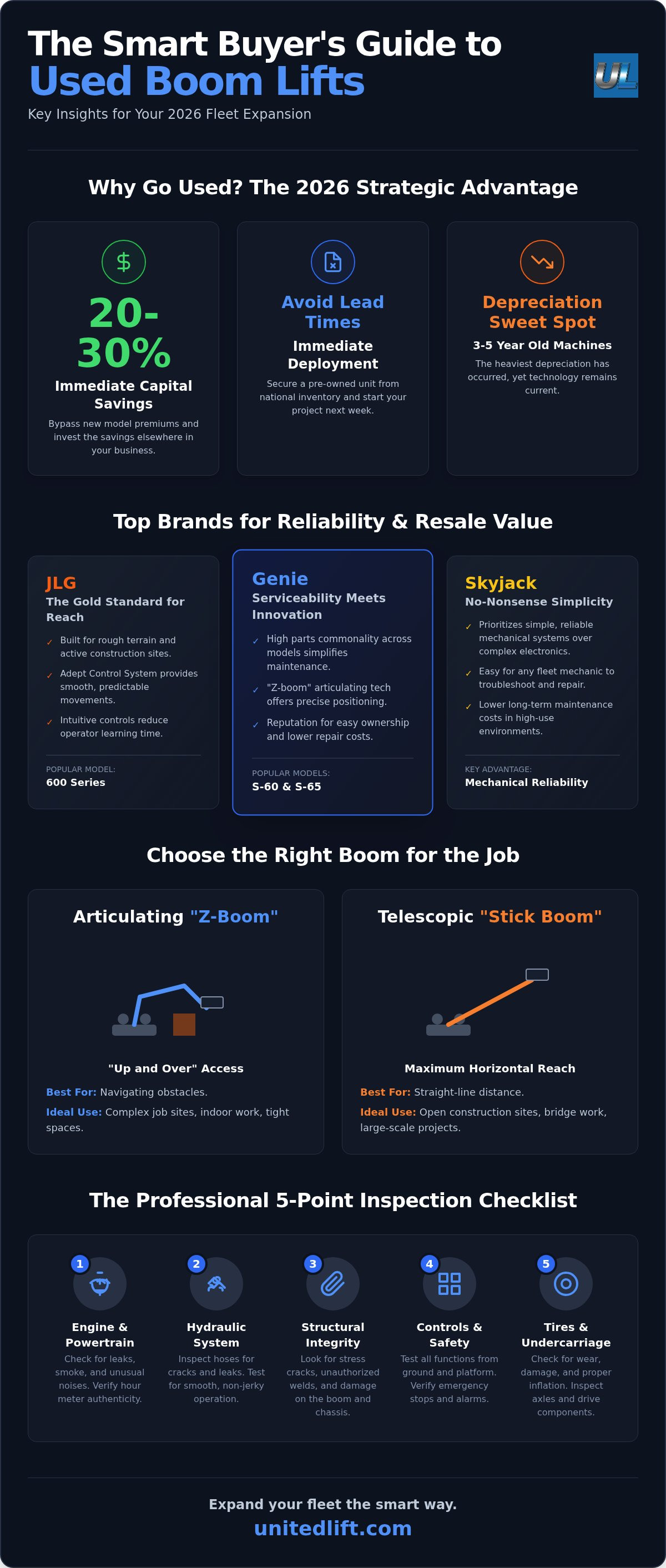
Buying a new machine in 2026 often feels like paying a premium for the smell of fresh paint. For most businesses, the strategic move is looking at the secondary market where you can see immediate 20-30% savings compared to brand-new models. This capital stays in your bank account or goes toward other equipment needs. Finding the best used boom lift to buy isn't just about the lower sticker price; it's about avoiding the factory lead times that still slow down the industry. When you need to start a project next week, a machine sitting in a manufacturing queue doesn't help your bottom line.
Modern units equipped with Tier 4 engines have changed the game for longevity. These engines are designed for cleaner operation and extended service lives, meaning a pre-owned Aerial Work Platform (AWP) often has thousands of productive hours left. Working with a dealer that maintains a national inventory ensures you aren't limited by what's available locally. You get access to a deeper pool of high-quality machines that have been vetted for performance and safety compliance.
Understanding the Depreciation Sweet Spot
Machines that are three to five years old represent the ideal balance of modern technology and reduced cost. Most of the heavy initial depreciation has already occurred, yet the technology remains current with 2026 safety standards. Brands like JLG and Genie often hold about 60% of their original value after five years, making them excellent assets for your balance sheet. When you calculate the total cost of ownership, the combination of lower insurance premiums and slower future depreciation makes these units highly profitable for growing companies.
Availability and Immediate Deployment
Used equipment is the fastest way to scale your fleet when a new contract lands. You don't have to wait months for a factory build. Dealer-certified pre-owned lifts are ready to work the moment they arrive at your job site. This immediate deployment reduces project downtime and allows you to bid on jobs with confidence. By skipping the manufacturing line, you turn your capital into a working asset immediately, ensuring your crew stays productive and your deadlines are met.
The Top 3 Boom Lift Brands for the Used Market
Picking a brand isn't just a matter of color preference; it's a calculation of future resale value and maintenance ease. When you're searching for the best used boom lift to buy, three names consistently rise to the top: JLG, Genie, and Skyjack. These manufacturers dominate the secondary market because they prioritize parts availability and long-term durability. A brand-name machine might cost more upfront than a generic alternative, but it pays for itself through lower downtime and a higher price tag when you're finally ready to sell.
JLG: The Gold Standard for Reach and Reliability
JLG is often the first choice for crews working on rough terrain. The JLG 600 series is a staple of used inventory because these machines are built to take a beating on active construction sites. One major advantage of buying a pre-owned JLG is the Adept Control System found in many older models. This technology provides smooth, predictable movements, which is vital for operator confidence at full extension. Their intuitive control layouts mean your team spends less time learning the machine and more time getting the job done.
Genie: Serviceability Meets Innovation
Genie has built its reputation on making machines that are easy to own. The Genie S-60 and S-65 telescopic models are incredibly popular in the secondary market because of their parts commonality. Genie uses many of the same components across different models, which simplifies your maintenance schedule and lowers your overall repair costs. If your job requires reaching over obstacles, Genie's "Z-boom" articulating technology offers precise positioning that's hard to beat. Regardless of the model you choose, ensure it meets all OSHA aerial lift regulations before putting it into service.
Skyjack offers a no-nonsense alternative for businesses that value mechanical simplicity. They skip over-engineered electronics in favor of reliable, straightforward systems that are easy for any fleet mechanic to troubleshoot. This simplicity makes them a favorite for high-use environments where quick fixes are essential. You can find a wide selection of these brands in our current pre-owned boom lift inventory, each vetted for quality and performance. Choosing a Skyjack often means lower long-term maintenance costs because you aren't paying for proprietary software diagnostics just to clear a simple code.
Articulating vs. Telescopic: Which Used Lift Fits Your Job?
Choosing the right configuration is the most important step in finding the best used boom lift to buy. It isn't just about how high you can go; it's about how you get there. If you buy a machine that can't navigate your specific job site constraints, you've wasted your capital. You need to analyze whether your work involves clearing obstacles or reaching maximum heights in open spaces.
Articulating Booms for Complex Access
These machines, often called knuckle booms, are the masters of up and over reach. They're the best used boom lift to buy if you're working in tight industrial environments, like navigating around warehouse rafters or complex piping. The multiple pivot points allow the platform to reach over obstacles that would stop a straight boom. Because they have more moving parts and hydraulic cylinders, they often carry a slight price premium in the used market. This complexity also means your maintenance team needs to be more diligent with pivot point lubrication and hose inspections to stay compliant with OSHA aerial lift safety standards.
Telescopic Booms for Maximum Height and Speed
If your projects involve high-rise construction or open-field work, a telescopic or stick boom is usually the better choice. These units offer superior horizontal reach and faster extension speeds compared to their articulating counterparts. The design is much simpler, featuring a single boom that extends straight out. This simplicity often translates to fewer hydraulic failures and lower long-term maintenance costs. When evaluating used units, remember that more reach isn't always better for your budget. A 60-foot boom that spends its life working at 40 feet is an inefficient use of your investment. Stick to the reach capacity that matches your most frequent project needs to maximize your ROI.
Weight and footprint also play a role. Telescopic lifts often have a larger footprint to maintain stability at full extension. If you're working on finished indoor flooring, you might need the more compact, articulating models with non-marking tires. Always check the machine's weight against the load-bearing capacity of your work surface before you sign the paperwork.
The 5-Point Used Boom Lift Inspection Checklist
Finding the best used boom lift to buy requires looking past the fresh coat of paint. You need to dig into the mechanical health of the unit to ensure it's a working asset rather than a liability. A professional inspection prevents you from inheriting someone else's maintenance nightmare and keeps your operators safe. Don't skip these steps; your bottom line depends on it.
Interpreting the Hour Meter and Service Logs
In 2026, don't let the hour meter scare you off without context. You'll often see two different readings: key hours and engine hours. Key hours represent any time the ignition was on, while engine hours track actual run time. A machine with 4,000 engine hours that has seen regular service at 1,000, 3,000, and 5,000-hour milestones is a safer bet than a low-hour machine with a missing logbook. High-hour units that have passed their 3,000-hour hydraulic flush and major engine service are often the most reliable assets you can add to your fleet.
Examine the boom weld points and the turntable for any signs of hairline cracks or stress. If you see fresh paint over a specific weld, ask why. You also need to verify that the annual ANSI inspection is current. A machine without these records is a liability on any job site. Check the hydraulic cylinders for scoring; any vertical scratches on the chrome can lead to seal failure and expensive leaks. If you're ready to see machines that have already passed our rigorous standards, browse our inspected boom lift inventory today.
Function Testing the Controls
Always test the ground controls before stepping into the basket. Ensure every toggle switch and joystick responds immediately without "chatter" or jerky movements. Once you're in the platform, verify the deadman foot switch and the emergency lowering system. These safety features are non-negotiable for compliance and operator protection. The turret should rotate smoothly through its entire range without hesitation.
Perform a cold start test on the engine. Listen for unusual knocking and watch the exhaust color carefully. Blue smoke indicates the engine is burning oil, while thick white smoke suggests a coolant leak. A healthy Tier 4 engine should settle into a steady idle quickly. If you hear grinding or feel hesitation during boom extension, it could indicate worn wear pads or internal cable issues. These are signs of a machine that hasn't been properly greased and may require a teardown soon.
Financing and ROI: Making the Purchase Work for Your Business
Once you've identified a machine that passes your mechanical inspection, the final step is ensuring the numbers support your growth. The best used boom lift to buy is one that pays for itself quickly through billable hours and tax incentives. Buying pre-owned isn't just about saving on the initial sticker price. It's a strategic move to lower your monthly overhead and keep your business agile in a competitive market. When you aren't tied to the massive monthly payments of a brand-new 2026 model, your break-even point on every project drops significantly.
Calculating your return on investment starts with a simple billable hour analysis. If you're currently renting equipment, you're likely paying for the machine's availability even on days it sits idle. Owning a used lift allows you to capture that rental margin for yourself. Most of our clients find that a well-maintained pre-owned unit pays for its own cost in less than 12 months of consistent project work. This accelerated path to ownership frees up capital for other equipment or personnel needs sooner than you might expect.
Section 179 and Accelerated Depreciation
Section 179 allows businesses to deduct the full purchase price of qualifying equipment from their taxable income in the year it is placed in service. This is a powerful tool for businesses looking to reduce their 2026 tax liability. Unlike standard depreciation schedules that spread the deduction over several years, this incentive provides an immediate boost to your bottom line. Used equipment qualifies for these significant tax breaks just as new equipment does, provided the machine is new to your business. We recommend consulting with your CPA to maximize these benefits before the end of the tax year, as the savings can often cover a significant portion of your down payment.
Flexible Financing for Heavy Machinery
Preserving your cash flow is essential for day-to-day operations. We facilitate national equipment loans designed to get you the machinery you need without draining your operating capital. The down payment requirements for used equipment are often determined by the machine's appraised value and your business's credit history. You can choose between capital loans that lead to full ownership or flexible leasing options that might offer lower monthly payments. Our team understands the urgency of the construction industry and works quickly to provide answers on your application. If you're ready to expand your fleet, you can browse our current boom lift inventory and inquire about financing today. We're here seven days a week to help you find the right financial structure for your next purchase.
Scale Your Operations with Vetted Equipment
Building a reliable fleet doesn't require the massive overhead of new machinery. By focusing on durable brands and rigorous inspections, you secure assets that maintain their value and remain easy to service. The best used boom lift to buy is one that balances a clean maintenance record with the specific reach capabilities your job site demands. Leveraging tax incentives like Section 179 turns a smart mechanical choice into a significant financial advantage for your current tax year.
United Lift LLC is your partner in finding high-quality machinery that's ready for immediate deployment. We offer expert inventory from JLG, Genie, and Hyster, all backed by our national shipping and support network. Whether you're a small contractor or a large firm, we facilitate financing options for all credit profiles to ensure you get the right tool for the job. Don't let manufacturing delays hold your projects back. View Our National Inventory of Used Boom Lifts today and find a machine that delivers safety, compliance, and a strong return on your investment. Your crew is ready to work; make sure your equipment is too.
Frequently Asked Questions
What is considered high hours for a used boom lift?
High hours typically start at the 5,000-hour mark for the engine. While many modern Tier 4 engines can reach 10,000 hours with proper care, the hydraulic systems and wear pads often require major attention much sooner. A machine with 3,000 hours that has been professionally serviced is often the best used boom lift to buy for long-term value. Focus on the service records rather than just the number on the clock.
Can I finance a used boom lift that is over 10 years old?
You can often finance machines over 10 years old, though the down payment and interest rates may differ from newer models. United Lift LLC facilitates capital equipment loans for a wide range of ages and credit profiles. We look at the overall condition and brand reputation of the unit. Reliable brands like JLG and Genie tend to secure better financing terms because their resale value remains high as they age.
Is JLG better than Genie for used equipment?
Neither brand is objectively "better," but they serve different needs. JLG is frequently praised for its rugged durability and smooth control systems on rough terrain. Genie is often preferred for its parts commonality and ease of service across different models. Both brands represent excellent choices in the secondary market because their parts are easy to source nationally. Your choice should depend on your specific job site requirements and your mechanic's familiarity with the systems.
What is the difference between an articulating and a telescopic boom lift?
The main difference is how the boom reaches its target. Articulating lifts use multiple sections that hinge, allowing "up and over" access to reach over obstacles like warehouse rafters. Telescopic lifts extend straight out like a telescope, providing greater horizontal reach and faster extension speeds. Telescopic models are simpler and often have lower maintenance costs, while articulating models are essential for tight, complex spaces where straight reach isn't possible.
Does United Lift LLC offer national shipping for used boom lifts?
Yes, United Lift LLC provides national shipping and support for our entire inventory. We coordinate the logistics to get your equipment to your job site regardless of your location in the United States. Our team handles the details of the transaction and transportation so you can focus on your projects. We're available seven days a week to provide updates and answer any questions during the delivery process.
What safety inspections are required for a used boom lift?
Annual ANSI inspections and daily pre-use checks are mandatory for all aerial lifts. You must verify that the machine has a current annual inspection sticker and that all safety systems, including the emergency lowering and tilt sensors, are fully functional. OSHA standards require that only trained operators use these machines. Buying from a reputable dealer ensures that the unit has been vetted for compliance with these strict safety regulations before it reaches your site.
How do I check the maintenance history of a used machine?
You can check the maintenance history by reviewing the physical logbooks stored on the machine and requesting dealer service records. Look specifically for stamps or entries at major milestones like 1,000 and 3,000 hours. These entries should show hydraulic fluid changes, filter replacements, and structural inspections. If a machine lacks a clear paper trail, it's a significant red flag. Professional dealers keep detailed records to prove the machine's reliability and history.
Are used electric boom lifts a good investment for indoor work?
Used electric boom lifts are an excellent investment for indoor warehouse and industrial work. They offer zero emissions and quiet operation, which are essential for enclosed spaces. Most electric models come with non-marking tires to protect finished flooring. While you need to check the health of the industrial batteries before purchasing, these units often have fewer mechanical issues than diesel models. They provide a high ROI for facilities requiring frequent overhead maintenance.
- Tags: articulating boom lift, best used boom lift to buy, construction equipment, equipment financing, Genie, heavy machinery, JLG, telescopic boom lift, used boom lift
