
Forklift Lease vs. Buy: The Ultimate Acquisition Guide for 2026
Posted by United Lift LLC on
Does a massive upfront capital expenditure make sense for your business right now, or is that cash better spent on scaling your inventory? Deciding between a forklift lease vs buy isn't just about the monthly payment. It's an operational gamble on how long you can keep a machine running before it becomes a liability. If you're currently managing an aging fleet, you're likely already feeling the sting of unpredictable maintenance costs and the fear of falling behind as electric technology evolves.
We know that running a high-volume warehouse requires balancing immediate cash flow with long-term reliability. You need equipment that stays in the aisle, not sitting in a repair bay. This guide will help you master the financial and operational trade-offs of forklift acquisition to maximize your fleet ROI and keep your uptime at a peak.
We'll examine the 2026 Section 179 tax deduction limits, which allow businesses to deduct up to $2,560,000 in qualifying equipment. You'll also learn how to calculate the true total cost of ownership and why your specific usage hours should dictate your final choice. Let's find the smartest path to keep your operation moving.
Key Takeaways
- Learn how the 1,500-hour annual usage rule acts as the critical tipping point in the forklift lease vs buy debate to protect your operational uptime.
- Master the financial differences between Fair Market Value (FMV) leases for technology flexibility and $1 Buyout leases for building long-term equipment equity.
- Discover how to leverage the 2026 Section 179 tax deduction to significantly lower the total cost of ownership for purchased material handling assets.
- Assess your internal maintenance capabilities to determine if the lower monthly cost of an owned unit outweighs the potential for unpredictable repair expenses.
- Explore how customized financing packages for major brands like Hyster, Yale, and Toyota can streamline your fleet acquisition and preserve vital business capital.
Forklift Lease vs. Buy: The 2026 Acquisition Strategy
The industrial landscape in 2026 demands a smarter approach to fleet management. With the global forklift market projected to hit over $26 billion this year, the pressure to maintain a modern, efficient fleet is high. You aren't just choosing a piece of machinery; you're choosing how to deploy your business capital. The decision between a forklift lease vs buy has never been more critical for your bottom line. New electric sit-down models can represent a significant investment, making it vital to weigh immediate cash flow against long-term asset equity.
A "one-size-fits-all" answer usually leads to wasted budget. Every warehouse has different shift patterns and throughput requirements. A single-shift operation with low annual hours might find that buying a used Hyster or Yale provides the best long-term value. Conversely, a high-volume logistics hub often needs the reliability of new equipment from brands like Caterpillar to avoid the maintenance trap. We offer a wide variety of both new and used options to ensure your strategy matches your specific workload.
Defining Your Operational Goals
Success starts with assessing whether you need short-term flexibility or long-term stability. Ownership builds equity and allows you to use the machine for its entire functional life, which is often a decade or more for premium brands. However, an aging owned fleet carries hidden costs. As units cross the five-year mark, unpredictable repair bills can spike, often at the worst possible time for your production schedule. Fleet size also plays a major role. Large operations frequently use leasing to keep their equipment cycles predictable and their balance sheets lean.
The Role of Technology in Your Choice
Technology is moving faster than ever in the material handling world. Leasing a Forklift allows you to cycle out equipment every three to five years, ensuring you always have access to the latest efficiency features. This is especially vital today, as 61% of large manufacturing companies have already upgraded to electric or hybrid fleets. Rapid advancements in lithium-ion batteries offer faster charging and longer lifespans, but they also represent a higher initial cost.
By choosing to forklift lease vs buy, you can avoid the risk of owning obsolete technology. While internal combustion units remain durable workhorses for outdoor applications, the shift toward warehouse automation and digital fleet monitoring favors those who stay current. Balancing these modern features with the proven durability of brands like Toyota or Caterpillar requires a nuanced look at your five-year growth plan. We're here to help you navigate these choices with expert advice and a massive inventory of ready-to-work machinery.
Leasing a Forklift: Preserving Capital and Flexibility
Leasing is the primary choice for businesses that value agility and cash flow. When you're weighing the forklift lease vs buy equation, the Fair Market Value (FMV) lease stands out for its maximum flexibility. With an FMV lease, you pay for the use of the machine rather than the asset itself. Once the term ends, you simply return the unit and upgrade to a newer model. If you prefer a path toward ownership but want to spread out the cost, the $1 Buyout Lease is an excellent middle ground. It functions much like a loan, allowing you to take full ownership of the equipment for a single dollar at the end of the contract.
This approach keeps your credit lines open for other vital investments. Instead of tying up large amounts of capital in heavy machinery, you preserve that cash for inventory, marketing, or facility expansions. You'll enjoy predictable monthly payments that make warehouse budgeting straightforward. There are also distinct Tax Advantages to this route, as lease payments are often fully deductible as an operational expense. If you're ready to see how these payments fit your budget, you can view our current forklift inventory and request a quote today.
Operational Benefits of the Lease Path
Standardizing your fleet every three to five years is a massive operational win. It prevents the "Frankenstein fleet" problem where every machine has different controls, parts, and battery requirements. Leasing also simplifies the process of adding specialized attachments. Whether you need side shifters, rotators, or specialized clamps, these can be bundled into your monthly payment. Perhaps the biggest perk is the disposal process. You don't have to worry about the used equipment market or finding a buyer for an aging unit; you just swap it for a fresh machine and keep moving.
Potential Drawbacks to Consider
Leasing isn't the right fit for every scenario. While it saves cash today, the total cost of interest and lease fees over several years can exceed the cost of an outright cash purchase. You also have to monitor your usage closely. Most lease agreements include strict annual hour limits. If your warehouse runs 24/7 and you exceed these limits, overage charges can be quite expensive. Finally, you must adhere to strict maintenance schedules. Because you don't own the machine, you're responsible for returning it in a specific condition. Neglecting service intervals can lead to costly reconditioning fees when the lease expires.
Buying a Forklift: Long-Term Equity and Tax Advantages
Buying a forklift turns a recurring operational expense into a tangible business asset. While leasing offers low entry costs, ownership is often the most cost-effective path for companies with stable, long-term needs. When you own your equipment, you build equity in a tool that can serve your warehouse for a decade or more. Premium brands like Toyota and Caterpillar are known for their exceptional durability and high resale value. This means that even after years of hard work, your machine remains a valuable asset on your balance sheet rather than a liability you must return to a dealer.
Ownership also grants you total control over your machinery. There are no strict hour limits or overage penalties to worry about during peak seasons. You can modify the equipment with specialized attachments or implement a custom maintenance schedule that fits your specific workflow. This freedom is a major factor in the forklift lease vs buy decision for high-intensity operations. For more foundational advice on these financial structures, the SBA guide to equipment financing provides excellent neutral insights for growing businesses.
Section 179 and 2026 Tax Deductions
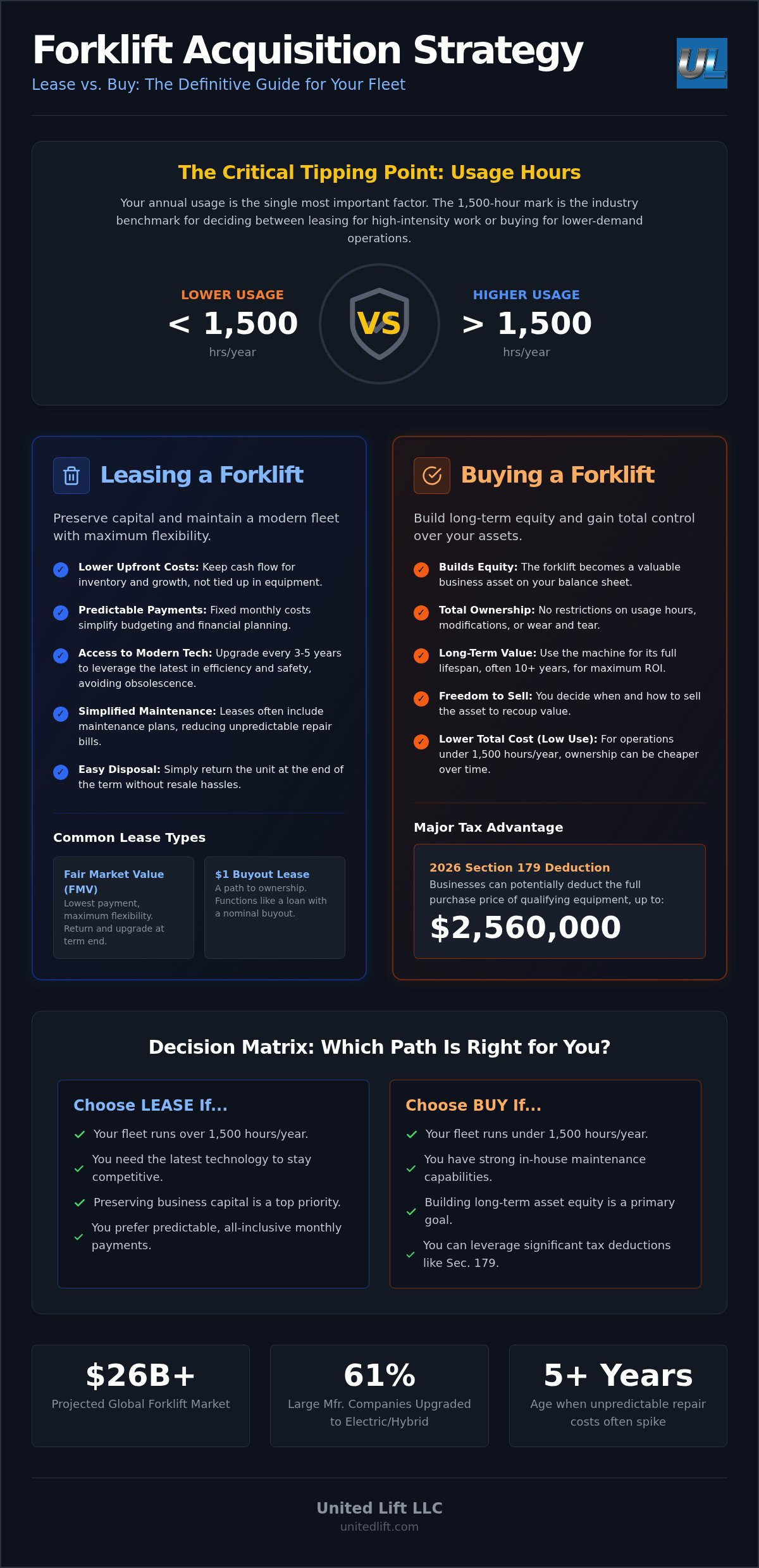
The tax landscape for 2026 provides a massive incentive for outright purchases. Under Section 179, businesses can deduct up to $2,560,000 in qualifying equipment purchases this year. This deduction begins to phase out only after you spend more than $4,090,000 on equipment. This allows many small and medium-sized businesses to write off the entire purchase price of a new or used forklift in the first year. This immediate tax relief is often more beneficial than the staggered deductions offered by a lease. We always recommend consulting with a tax professional to ensure you're maximizing these heavy equipment write-offs for your specific situation.
Calculating Total Cost of Ownership (TCO)
To find the true break-even point, you must look beyond the sticker price. Buying used forklifts can often offer the best ROI because the previous owner has already absorbed the steepest part of the depreciation curve. You'll need to factor in insurance, storage, and long-term maintenance costs to see the full picture. Typically, if you plan to keep a machine for more than five or six years, buying becomes significantly cheaper than leasing. You can use The Ultimate Forklift Buying Guide to assess these long-term costs and determine if ownership aligns with your fleet goals.
Decision Matrix: When to Lease vs. When to Buy
Choosing between a forklift lease vs buy strategy often comes down to a single metric: annual usage hours. In the material handling industry, the 1,500-hour rule is the gold standard for decision making. If your equipment runs more than 1,500 hours per year, you're likely operating a multi-shift or high-intensity warehouse. For these operations, leasing is usually the superior choice. High usage leads to faster wear and tear. An owned unit would require expensive repairs just as its financial value drops, whereas a lease allows you to cycle the machine out before it becomes a liability.
If your forklift sits idle 50% of the time, buying is the smarter play. A machine that only runs 500 to 700 hours a year will last for decades with basic care. In this scenario, paying lease interest on an asset that isn't being fully utilized is a waste of capital. You also need to look at your internal maintenance capabilities. Do you have a dedicated shop and technicians? If you lack the staff to handle hydraulic leaks or battery service, the predictable maintenance included in many lease packages provides essential peace of mind.
Usage Intensity: High-Hour vs. Low-Hour Applications
Matching the acquisition path to the equipment’s expected lifespan is vital for your ROI. High-hour, three-shift operations put immense stress on internal combustion engines and industrial batteries. Leasing allows you to rotate these "tired" units out before they become a drain on your uptime. Conversely, for specialized equipment like telehandlers or boom lifts that may only be used for specific projects, ownership or a long-term loan often makes more sense. These machines have different duty cycles than a standard warehouse forklift and often retain their value longer because they aren't running 24/7.
Financial Health and Cash Flow Analysis
Your current business growth stage should dictate your strategy. Startups and rapidly expanding companies often face a high opportunity cost when tying up capital in depreciating assets. If that cash could be used to hire new sales reps or buy more inventory, leasing is the better move. You should also evaluate your debt-to-equity ratio. Large amounts of equipment debt can affect your ability to secure other business loans. For a balanced approach, many of our clients use a hybrid fleet. They buy their core, low-hour units and lease the high-intensity machines that require frequent updates. If you're ready to crunch the numbers for your fleet, contact our team for a custom quote on your next acquisition.
Navigating Forklift Financing with United Lift
Getting the right equipment shouldn't be a hurdle for your operation. We provide direct access to financing for both new and used industrial machinery, ensuring you have the tools to stay productive. Whether you have decided on a forklift lease vs buy strategy or you're still weighing the options, our team simplifies the capital acquisition process. We work with a wide range of business profiles to find a solution that fits your specific cash flow requirements. Our national reach means we can facilitate these transactions regardless of where your facility is located.
We believe in readiness and accessibility. Are you tired of waiting days for a callback from a bank? We offer a single point of contact for major brands like Hyster, Yale, Toyota, and Caterpillar. This streamlined approach saves you time and reduces the paperwork involved in fleet expansion. Our support team is available seven days a week to assist with your application and ensure your approval moves forward at the speed of your business.
The United Lift Financing Process
We know your time is valuable. Our process focuses on quick application and rapid approval for industrial lift equipment. We facilitate capital equipment loans and leases that allow growing businesses to scale without draining their operating accounts. You don't have to navigate the complexities of heavy equipment lending alone. We provide expert guidance to match the right brand to your chosen financing path. If a used Toyota offers the best ROI for your low-hour application, we'll help you secure the loan to make it happen. If a new electric Hyster is better for your high-intensity shifts, we can structure a lease that keeps your monthly payments predictable.
Why Choose a Multi-Brand Dealer for Acquisition?
Most manufacturer-owned finance arms only want to sell you their specific brand. We take a different approach. As a multi-brand dealer, we help you avoid manufacturer bias so you can choose the best tool for the job. You can compare financing rates across different equipment categories, from standard forklifts to specialized telehandlers or boom lifts. This ensures you get a competitive package that reflects the actual market value and durability of the machine. We are a proactive partner deeply integrated into the logistical needs of our clients. Are you ready to optimize your fleet and maximize your cash flow? Contact United Lift for a custom financing quote today and let’s get your team moving.
Future-Proof Your Fleet Strategy
Mastering the forklift lease vs buy decision is the first step toward a leaner, more efficient warehouse. Your choice should align with your annual usage hours and tax goals to ensure maximum ROI. Remember that the 1,500-hour rule is your guide. High-intensity shifts often favor the flexibility of new leases, while low-hour applications make owning used equipment a high-value move. Leveraging the 2026 Section 179 deduction can also provide the immediate tax relief your balance sheet needs to stay competitive.
United Lift is here to facilitate your next move with national financing for all major brands. We offer a massive variety of new and used equipment options to fit any operational budget. Our expert support is available seven days a week to help you navigate the approval process quickly. Ready to upgrade? Browse our inventory and get a financing quote today. We're prepared to help you keep your inventory moving with the right tools and a plan that protects your cash flow.
Frequently Asked Questions
Is it better to lease or buy a forklift for a small business?
It depends on your current cash flow and how often you'll use the machine. Leasing is often better for businesses that need to keep their credit lines open for other investments. If you plan to use the unit for over five years in a low-intensity environment, buying usually costs less over time. We offer both new and pre-owned options to help small operations find the right balance between monthly payments and long-term asset ownership.
Can I deduct the full cost of a purchased forklift on my taxes?
Yes, under Section 179 for the 2026 tax year, qualifying businesses can deduct up to $2,560,000 in equipment purchases. This allows you to write off the full price of a new or used forklift in the year you buy it, provided your total equipment spending stays below $4,090,000. This is a major advantage for companies choosing to buy rather than lease. Always consult your tax professional to confirm how these limits apply to your specific filing.
What is the average length of a forklift lease in 2026?
Most industrial leases in 2026 run for 36 to 60 months. A 36-month term is common for high-intensity operations that want to swap out machinery before maintenance costs spike. 60-month terms are popular for businesses looking for the lowest possible monthly payment. Your choice should depend on the equipment's expected duty cycle and how quickly you want to upgrade to newer technology, such as the latest lithium-ion battery systems.
Does a forklift lease include maintenance and repairs?
It depends on the specific terms of your agreement. A Full Maintenance lease bundles the cost of routine service into your monthly payment, while a Net Lease leaves maintenance responsibilities to you. While we are a dealer and don't provide on-site repair services directly, we can help you structure a lease that includes third-party maintenance plans. This ensures your uptime remains high without the stress of managing unpredictable repair bills on older, owned units.
What happens at the end of a forklift lease?
You generally have three choices when a lease concludes. You can return the equipment and upgrade to a newer model, purchase the forklift at its Fair Market Value, or extend the lease for a set period. If you chose a $1 Buyout lease, you simply pay one dollar to take full ownership of the asset. Most warehouse managers prefer returning the unit to avoid the higher maintenance costs associated with older material handling machinery.
Can I finance a used forklift from United Lift?
Yes, we facilitate financing for both new and pre-owned industrial machinery. Financing a used unit is a popular strategy for businesses that want the equity of ownership without the higher price tag of brand-new equipment. We offer customized loan and lease packages for major brands like Hyster, Yale, and Toyota. Our national team is available seven days a week to help you find a financing path that matches your operational needs and budget.
How many hours a year should a forklift run to justify a lease?
Generally, if a forklift runs more than 1,500 hours per year, a lease is easier to justify. High-hour applications lead to faster wear, making it beneficial to rotate the machine out every few years before it requires a major overhaul. If your usage is below 1,000 hours annually, the forklift lease vs buy math usually favors purchasing. Low-hour machines can often stay in service for a decade or more with basic preventative care.
Which forklift brands have the highest resale value?
Premium brands like Toyota, Hyster, Yale, and Caterpillar consistently hold the highest resale value in the secondary market. These manufacturers are known for their durable engineering and the widespread availability of replacement parts. When you choose to buy one of these brands, you're investing in an asset that retains significant equity. This makes them a safer long-term investment compared to economy brands, especially if you plan to sell or trade in the unit after several years.
- Tags: business finance, equipment financing, equipment leasing, fleet management, forklift, forklift lease vs buy, material handling, Section 179, warehouse operations
