
Forklift Impact on Warehouse Productivity: A Practical 2026 Guide
Posted by United Lift LLC on
What if the forklift slowing your warehouse isn’t the wrong machine, but a symptom of a bottleneck elsewhere? The forklift impact on warehouse productivity depends on how well equipment fits the work, from unloading incoming inventory to replenishing pick locations and staging orders for shipment. When loads wait, routes cross, or operators make unnecessary trips, throughput can suffer.
Before considering an equipment change, identify where time is being lost. Track completed moves, travel time, waiting time, and delays at key handoffs. For example, note whether pallets wait at receiving, whether operators detour around blocked aisles, or whether staged orders queue for a trip to shipping. These observations can help distinguish equipment limitations from congestion, layout, or workflow issues.
This guide explains how forklifts influence warehouse throughput, which measures can reveal productivity gaps, and how to match capabilities to day-to-day material-handling tasks. You’ll learn how to locate the bottleneck that limits output, compare equipment needs across different jobs, and assess whether a change improves operations. Once your requirements are clear, United Lift’s range of new and pre-owned forklifts offers options to consider for your workflow.
Key Takeaways
- Separate throughput from accuracy, equipment utilization, and labor productivity to understand what your warehouse measures are telling you.
- Follow inventory from receiving through shipping to spot handoffs where forklift travel or waiting may slow the flow.
- Match lift height, load needs, travel paths, and operating conditions to the tasks forklifts handle most often.
- Assess the forklift impact on warehouse productivity by mapping work, setting a baseline, and reviewing results across shifts and task types.
- Use documented workflow needs to compare new and pre-owned forklifts, economy and premium options, and major brands.
How forklifts affect warehouse productivity: start with measurable outcomes
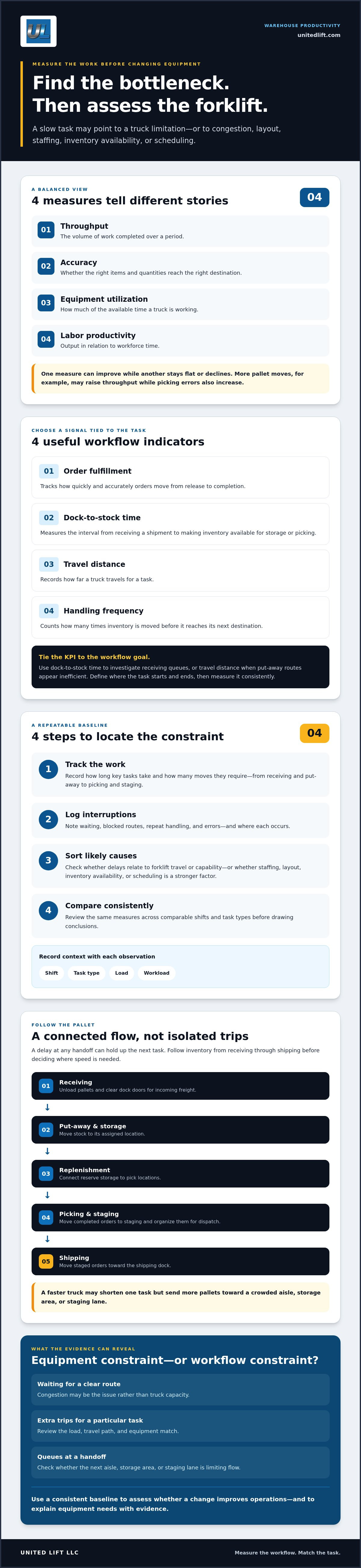
Warehouse productivity is the useful work completed with the people, equipment, space, and time available. A forklift can influence how quickly inventory moves, but no single metric captures the full picture. Throughput measures the volume completed over a period. Accuracy tracks whether the right items and quantities reach the right destination. Equipment utilization shows how much of the available time a truck is working, while labor productivity measures output in relation to workforce time. These measures are connected, but one can improve while another stays flat or declines.
For example, more pallet moves per shift may raise throughput, but if picking errors also increase, the operation hasn’t improved in every important way. A forklift’s role depends on its task and the workflow around it. For background on truck types and uses, see The Role of Forklifts in Modern Warehousing.
Which warehouse productivity KPIs reveal forklift-related delays?
Choose measures that point to a specific stage, rather than relying on a general sense that work is slow. Order fulfillment tracks how quickly and accurately orders move from release to completion. Dock-to-stock time measures the interval from receiving a shipment to making inventory available for storage or picking. Travel distance records how far a truck travels for a task, while handling frequency counts how many times inventory is moved before it reaches its next destination.
A KPI is useful only when it’s tied to a specific workflow goal. Track dock-to-stock time if receiving queues are the concern, or travel distance if put-away routes appear inefficient. Define where each task starts and ends, then measure it consistently. Compare similar shifts, task types, and workloads. Targets should reflect the operation’s requirements, not a universal benchmark.
How to set a useful productivity baseline
Before changing equipment, record current process times, movement counts, and recurring errors or delays. A baseline gives you a reference point for evaluating a change. Capture context with every observation, including shift, task type, load, and workload. A busy receiving period and a quieter replenishment run shouldn’t be treated as identical conditions.
- Track the work. Record how long key tasks take and how many moves they require, from receiving and put-away to picking and staging.
- Log interruptions. Note waiting, blocked routes, repeat handling, and errors, and record where they occur.
- Sort likely causes. Ask whether a delay relates to forklift travel or capability, or whether staffing, layout, inventory availability, or scheduling is a stronger factor.
- Compare consistently. Review the same measures across comparable shifts and task types before drawing conclusions.
This process helps separate a forklift constraint from a broader workflow problem. If equipment repeatedly waits for a clear route, for example, congestion may be the issue rather than truck capacity. If a particular task takes extra trips, the movement record can help clarify whether the load, travel path, or equipment match deserves closer review. That evidence makes the forklift impact on warehouse productivity easier to assess and equipment decisions easier to explain.
Where forklifts change warehouse flow from receiving to shipping
A pallet’s warehouse journey is a chain of connected moves: it arrives at the dock, goes into storage, may be moved to a pick location, joins an order, waits in staging, and then heads to shipping. A delay at any handoff can hold up the next task. The forklift impact on warehouse productivity depends not just on how quickly a truck travels, but on whether it can handle each move without adding unnecessary transfers, waiting, or congestion.
A bottleneck is a process constraint that limits the flow of the entire operation. Faster equipment may shorten one task while sending more pallets toward a crowded aisle, storage area, or staging lane. In facilities where delays stem from end-of-line stacking or packaging bottlenecks rather than vehicle speed, automation specialists like phoenixhandling.co.uk can help streamline pallet building before transport even begins. Follow the pallet from receiving to shipping before deciding where speed is needed.
Receiving, put-away, and replenishment
At receiving, forklifts unload pallets and move them away from dock doors so incoming freight can continue through the process. If stock waits for a truck, a clear route, or a suitable storage location, dock congestion can grow and inventory may not be ready for use. Put-away then moves stock to its assigned location. The best equipment fit depends on the warehouse layout, the loads being handled, and the order in which tasks occur.
Replenishment connects reserve storage to pick locations. Timely moves help keep those locations supplied, while poorly timed transfers can create extra handling or interrupt other work. Consider whether the equipment’s lifting and travel capabilities suit the storage and travel paths involved. A task performed often may deserve more attention than an occasional move, especially if delays there affect picking or order completion.
Picking, staging, and shipping
Once an order is picked, forklifts may move completed pallets or loads to staging, where orders are organized for dispatch. From there, they move toward the shipping dock. Clear handoffs matter: if staging space is full or several movements compete for the same route, operators may wait or encounter traffic conflicts. OSHA’s forklift safety guidance provides useful context for planning workplace forklift movement alongside productivity goals.
Separate equipment travel time from the rest of the task. A forklift may reach a location quickly, but the full process can still take longer if a worker needs to locate inventory, verify an item, prepare a load, or wait for an order to be ready. Track these steps separately to see whether the constraint is movement, coordination, or another part of the workflow.
Walk the route and note where pallets pause, change equipment, or cross paths with other work. Compare those observations with the movement pattern required by the task. If the workflow points to a forklift fit question, reviewing forklift options for warehouse tasks can be a practical next step.
Compare forklift capabilities against the warehouse task
A forklift should fit the work it needs to do across a full shift, not just one headline figure. Maximum lift height and rated capacity matter, but so do load dimensions, routes, surfaces, operating conditions, and how often each task occurs. A capability that suits occasional reserve-storage moves may not be the best match for frequent replenishment through narrow travel paths. Define the work first, then compare equipment capabilities, brands, and new or pre-owned options against it.
Match equipment capabilities to common warehouse tasks
Start with actual loads and movement patterns. Note where pallets travel, how high they need to go, how much room routes provide, and what surfaces the truck crosses. Two facilities with similar storage heights can have different needs if one handles occasional bulky loads and the other makes frequent moves through tight aisles. The forklift impact on warehouse productivity depends on this task-to-capability fit.
| Warehouse task | Capabilities and conditions to evaluate |
|---|---|
| Receiving and dock movement | Typical load dimensions and weight, dock-to-storage routes, surface transitions, and frequency of unloading moves. |
| Put-away and retrieval | Required lift height, load characteristics, aisle space, turning room, and how often stock moves to or from storage. |
| Replenishment | Travel paths between reserve and pick locations, handling frequency, load size, and whether other traffic shares the route. |
| Picking, staging, and shipping | How loads are collected and staged, route length, floor conditions, and coordination with people and other equipment. |
Use the table to frame the questions, not to prescribe a truck from one feature alone. A warehouse with tall storage and straightforward travel paths may prioritize different capabilities from a facility with lower storage, frequent cross-traffic, and varied loads. Industry resources such as Material Handling Industry Insights on Warehouse Efficiency can provide broader context, but the decision should reflect your own workflow and operating conditions.
When technology and attachments may affect workflow
Visibility or tracking tools may help managers understand equipment use and movement patterns, but their value depends on what information they provide and how the operation uses it. Assess them against a specific workflow question, such as where equipment spends time waiting, rather than assuming they will improve productivity on their own.
An attachment may suit a particular load-handling task, but it changes the equipment setup and should be evaluated against the load, movement, and work area. Define the handling need before selecting one. Once requirements are clear, forklift options for warehouse work can be considered alongside task fit. Keep that assessment separate from the later choice of brand, purchase condition, or budget.
A practical process for finding and improving forklift bottlenecks
Don’t assume a slow move means the forklift is the problem. Trace the work, identify where flow breaks down, and compare possible causes before changing equipment or process. This keeps the forklift impact on warehouse productivity tied to evidence and gives your team a clear way to evaluate whether a change helped.
- Map the work. Follow representative loads through the relevant steps, from the task’s starting point to its handoff. Note routes, waits, detours, repeated handling, and where equipment or inventory queues build up.
- Establish a baseline. Record task times, movements, and delay patterns before making a change. Include the shift, task type, and workload so you can compare similar work later.
- Locate the constraint. Compare observations with your existing KPI data. Ask operators which tasks routinely interrupt flow, then check whether the same delay appears across shifts or only under particular conditions.
- Define requirements. Describe the job the equipment needs to perform, including loads, lift demands, travel paths, operating conditions, and task frequency. Separate these requirements from preferences about brand or purchase condition.
- Review results. Compare follow-up measures with the baseline under similar operating conditions. Review task completion, delays, safe operation, and operator feedback before deciding whether the change addressed the constraint.
Map the work and locate the constraint
Observe more than one task type and shift before attributing delays to equipment. A route that flows during replenishment may become congested during receiving. Record where loads wait, take detours, or need repeated handling, then ask operators what disrupts their work. Compare their feedback with the process data, and check whether layout, inventory placement, or scheduling contributes to the same hold-up.
Test changes and evaluate results
Before adjusting equipment or workflow, write down the expected change. For example, you may expect a task to involve fewer transfers or less waiting at a specific handoff. Compare the same measures before and after the change under comparable workloads and conditions. Include safe operation, equipment serviceability, and operator feedback in the review. A faster task alone doesn’t prove the full workflow improved.
Use the findings to guide equipment discussions, not to assume that a particular truck will solve every delay. A forklift buying guide can help organize the next stage of that evaluation. Once you’ve documented the operational requirements, explore forklift options for your warehouse that align with the work.
Choose a forklift solution that supports warehouse productivity
Equipment discussions are more productive when they start with documented work, not a general request for a faster forklift. Bring together the tasks the truck will handle, the operating conditions, and the delays your assessment identified. This gives you a practical way to compare options against warehouse needs and evaluate the forklift impact on warehouse productivity without assuming one machine or feature will solve every constraint.
Prepare a clear equipment brief
Capture routine moves and occasional ones. Include the loads, lift demands, travel paths, surfaces, and operating environment. Note where delays occur and what capability might address them. Separate requirements that must be met from preferences, such as a particular brand or purchase condition. Add operator feedback and the productivity measures you plan to monitor, so everyone is working from the same priorities.
- Tasks and loads: Describe what the forklift will move, where the load begins and ends, and how often the move occurs.
- Operating conditions: Record storage and aisle constraints, travel routes, surfaces, and other conditions that affect daily work.
- Measured needs: Identify the workflow constraint and the measures you’ll use to evaluate a change, such as task time, movement count, or waiting.
- People and priorities: Include operator input, must-have capabilities, and preferences that can guide a focused comparison.
This brief keeps the conversation anchored to the job. It also helps distinguish a genuine equipment requirement from a broader layout, scheduling, or inventory issue that may need a different response.
Explore new and pre-owned forklift options
With requirements in hand, a dealer can help compare forklift categories and brands against the work you’ve documented. United Lift offers new and pre-owned forklifts across economy and premium options, including equipment from brands such as Hyster, Yale, Toyota, and Caterpillar. Compare each option against the capabilities and operating conditions the job requires, rather than choosing by brand name alone.
Consider purchase condition and budget after identifying the operational fit. New and pre-owned equipment can both be part of that discussion, alongside economy and premium options. United Lift also facilitates financing for business customers who want to explore purchasing options. Financing arrangements vary, so focus first on defining the equipment needs the purchase must address.
Ready to put your task list and priorities to work? Explore forklift options with United Lift and discuss which choices align with your warehouse workflow.
Turn your workflow findings into your next equipment decision
Turn operational observations into a clear decision. Keep the measures that matter visible after any equipment or workflow change, and use them to guide future adjustments. That way, the forklift impact on warehouse productivity stays connected to the work your team needs to complete, not just a general sense of speed.
United Lift’s team is available by phone and email seven days a week to discuss forklift options for your operation. Bring your priorities and questions to the conversation, then explore equipment choices that fit your warehouse tasks and conditions.
Explore forklift options with United Lift and take the next step toward a better-informed equipment decision. With a clear picture of your needs, you can compare options against the work your team performs.
Frequently Asked Questions
How do you measure forklift productivity in a warehouse?
Measure a defined forklift task using a consistent starting point and end point. For example, time a pallet move from a receiving dock to its assigned storage location, and note any stops or rerouting along the way. The forklift impact on warehouse productivity is clearer when you compare similar moves under similar workloads. Record details such as shift, load type, and route conditions so changes in the results have useful context.
What warehouse productivity KPIs should forklift operators influence?
Choose KPIs that reflect the operator’s part in a specific process, rather than expecting one measure to capture every contribution. For put-away, track completed moves and delays between unloading and storage. For shipping, consider how long staged loads wait for transfer to the dock. Pair those figures with observations about route conflicts or unavailable inventory. This helps managers distinguish movement delays from problems outside the operator’s control.
Can warehouse layout reduce forklift productivity?
Yes. A layout can add avoidable travel or make routine movements harder to coordinate. For example, placing fast-moving stock far from picking areas may increase repeated trips, while a shared aisle can create waiting during busy periods. Sketch the actual routes used for common tasks and mark points where traffic backs up. Compare alternate inventory placement or routing plans before deciding that a different forklift is the only answer.
How does forklift operator fatigue affect warehouse productivity?
Fatigue may affect attention, consistency, and work pace, so it’s useful to consider alongside equipment and workflow factors. Look for patterns by task duration, shift timing, traffic conditions, visibility, and operator feedback rather than assuming a truck is responsible for a change in output. If operators report that a task is tiring or difficult to sustain, include that input in the operational review and consider applicable safety requirements.
Does buying a faster forklift always increase warehouse throughput?
No. Faster travel may help if movement speed is the constraint, but it won’t resolve delays caused by order preparation, unavailable stock, or a crowded destination area. For example, a quicker transfer to staging can simply create a larger queue if shipping cannot process loads at the same pace. Identify where work accumulates, then decide whether travel time is the cause or just the most visible part of the delay.
How often should a warehouse review forklift productivity?
Review it whenever a meaningful change could affect the work, such as a new product mix, revised storage arrangement, or different task schedule. A regular review can also reveal gradual changes, such as routes becoming busier as inventory patterns shift. Keep the review focused on a manageable set of indicators and ask operators what has changed. That combination can flag a developing issue before it becomes a persistent disruption.
Can forklift attachments improve warehouse productivity?
An attachment can support a specific handling method when it matches the load and the forklift’s intended task. For example, a load that is awkward to handle with standard equipment may call for a different approach. Consider how an attachment affects the load, movement, visibility, and work area before selecting it. Then evaluate the task in practice, since a change that helps one move may not improve the warehouse’s overall output.
- Tags: fleet management, forklift impact on warehouse productivity, forklifts, material handling, warehouse logistics, warehouse productivity, warehouse throughput, workflow optimization
