
Fork Truck Dealer: How to Find the Right Equipment Partner
Posted by United Lift LLC on
The right fork truck dealer is not necessarily the one with the most equipment. It is the one whose options fit your operation and buying plan. Choosing a lift or forklift can feel complicated when you are comparing equipment categories, new and pre-owned options, and the cost of a major purchase. Start with the work the equipment must do, then compare categories and purchase routes against that need.
United Lift brings multiple equipment categories and brands together in one place. Its inventory includes new and pre-owned forklifts, boom lifts, telehandlers, scissor lifts, attachments, and industrial batteries, with economy and premium options from brands such as Hyster, Yale, Toyota, JLG, Genie, and Caterpillar. Financing is available as a purchase option.
This guide explains what a fork truck dealer can provide and what to consider before choosing equipment. You will learn how to match an equipment category to your operation, compare new and pre-owned options using practical criteria, and weigh financing against an outright purchase. You will also get a clear picture of what working with United Lift can involve, so you can move forward with a more focused plan.
Key Takeaways
- Understand how a fork truck dealer differs from a manufacturer or dealer-locator page, so you know what kind of buying support to expect.
- Compare equipment range, brand choice, and purchase options against your operation’s needs.
- Match the equipment category to the task and setting before narrowing down specific models.
- Prepare for a purchase by defining the job, weighing equipment condition and budget, then considering an outright purchase or financing.
- See how United Lift’s range of lift equipment and economy and premium options can help you shape a purchase plan.
What a Fork Truck Dealer Can Do Beyond Listing Forklifts
A fork truck dealer sells material handling equipment to businesses. Rather than comparing a single listing in isolation, buyers can consider equipment across categories and brands, as well as new and pre-owned options. A broad inventory is useful when a job could call for more than one type of machine or when you want to compare brands through one buying channel.
It helps to distinguish three terms. A manufacturer builds equipment. A dealer offers equipment for purchase, often from multiple manufacturers. A dealer-locator page is a search tool that helps users find a seller; it is not itself the equipment seller. United Lift offers equipment from Hyster, Yale, Toyota, JLG, Genie, and Caterpillar, giving buyers different brands and categories to consider.
Equipment sales help a business buy machinery. Rentals and repair are separate service categories, not substitutes for a purchase. Knowing what you need from the buying process helps keep your search focused on equipment and purchase options that fit your operation.
Fork truck dealer, forklift dealer, and manufacturer: what is the difference?
“Fork truck” and “forklift” are commonly used terms for lift trucks. A forklift is designed to lift and move loads, including palletized goods. For a general overview of forklift types and their development, see Forklift.
A manufacturer builds its own equipment. A dealer brings equipment from manufacturers together for purchase, which can make brand comparisons more straightforward. For example, if you are considering a lift truck, a dealer’s inventory can help you compare options from different manufacturers. A locator helps identify sellers, while a dealer presents equipment for sale.
What kinds of equipment may a dealer sell?
Forklifts are a common choice for lifting and moving palletized loads. Other equipment categories suit different tasks, so identify the work before assuming a forklift is the right fit.
- Boom lifts provide an elevated work platform for reaching work areas above the ground.
- Scissor lifts raise a platform vertically, making them suited to tasks that need a stable elevated work position.
- Telehandlers handle and lift materials, often where reach and placement are part of the job.
Attachments and industrial batteries round out the equipment choices. An attachment may suit a particular material-handling task, while batteries are an important consideration for applicable electric equipment. United Lift offers forklifts, boom lifts, telehandlers, scissor lifts, attachments, and industrial batteries, alongside economy and premium options. Use the range as a starting point: define the task, identify the equipment category, then compare purchase options.
How to Evaluate a Fork Truck Dealer Before You Buy
A useful dealer comparison starts with your operation, not a brand name or a single listing. Identify the tasks the equipment must handle, where it will work, and what matters most in the purchase. Then use this checklist to compare a dealer’s inventory and buying options with your needs.
- Match equipment categories to the work. Compare forklifts, boom lifts, scissor lifts, telehandlers, attachments, and industrial batteries according to the tasks your operation needs to complete.
- Consider the work setting. Note where the equipment will be used and what material or work area it needs to serve. This can help narrow the equipment category before you focus on a model.
- Review brand choice. A multi-brand inventory gives you options to compare rather than limiting your search to one manufacturer. Check which brands and equipment categories are represented.
- Compare new and pre-owned options. Consider equipment condition alongside intended use and purchase priorities. Neither option is automatically the better fit for every buyer.
- Compare purchase routes. Decide whether an outright purchase or financing better aligns with your buying plan, then compare the options for the equipment you are considering.
- Look for clear communication. Straightforward conversations can help you understand the choices and keep the buying process focused on your requirements.
Use the checklist to guide your search, then explore United Lift equipment options across categories and brands.
Check inventory range, equipment categories, and brand choice
Start broad, then narrow down. If your operation moves palletized loads, a forklift may be the starting point. If the work involves elevated access or material handling that calls for reach, compare the relevant lift categories too. Looking at the task first can prevent you from choosing a model before you have defined what it needs to do.
United Lift’s inventory includes Hyster, Yale, Toyota, JLG, Genie, and Caterpillar equipment, along with economy and premium options. Compare categories and brands against the job and your purchase priorities. For example, start by deciding whether the task is primarily moving materials or reaching an elevated work area, then narrow your choices within the appropriate category.
Assess the buying options and support available
New and pre-owned equipment can each fit a purchase plan. Consider how the equipment will be used and whether its condition suits your operating needs. Then compare an outright purchase with financing as different ways to structure the buying decision. Keep the assessment focused on the whole plan, not just an initial preference for new or pre-owned.
United Lift offers financing options and supports customers by phone and email seven days a week. You can use that support to discuss equipment choices and purchase routes as you work through your decision. A good comparison keeps the focus on relevant equipment and a buying plan that fits your operation.
Forklifts, Telehandlers, and Lift Equipment: Match the Category to the Job
Start with the task, not the machine name. A forklift, telehandler, and aerial lift address different material-handling or work-positioning needs. Let the work environment guide your equipment category before you compare individual machines. Consider what needs to move or be reached, where the equipment will operate, and what the job requires day to day.
| Equipment category | General task | Buyer consideration |
|---|---|---|
| Forklift | Lifting and moving palletized loads | Consider the load-handling task and workplace layout. |
| Telehandler | Handling materials in applications that call for reach | Consider where materials need to be placed and the setting. |
| Boom lift | Positioning workers at elevated work areas | Consider the work area and the access needed to reach it. |
| Scissor lift | Raising a platform vertically for elevated work | Consider whether the task calls for vertical access. |
| Attachments | Supporting particular material handling tasks | Match the attachment to the work and equipment involved. |
| Industrial batteries | Powering applicable material handling equipment | Include the power source in the overall equipment decision. |
When a forklift is the right starting point
Forklifts are a core option for moving materials in industrial operations, especially when the task involves palletized loads. Before comparing machines, identify what materials need to be handled and how they move through the workplace. Note the routes, work areas, and typical tasks the equipment must support. These details help keep the search relevant. For more selection guidance, read the ultimate forklift buying guide.
When to consider telehandlers, boom lifts, or scissor lifts
Consider a telehandler when an application involves placing materials at a distance or in a position that calls for reach. Boom lifts and scissor lifts serve elevated-work needs. Both provide access to work areas above the ground, but their general movement patterns differ. Start with a simple distinction: is the priority moving materials, positioning them, or raising a worker to an elevated task?
Once you have identified the category, focus on guidance for that equipment type rather than comparing unlike machines on a single basis. A fork truck dealer with several equipment categories can help you consider options, but the job should determine where to start. This overview is a starting point, not a substitute for assessing the requirements of a particular application.
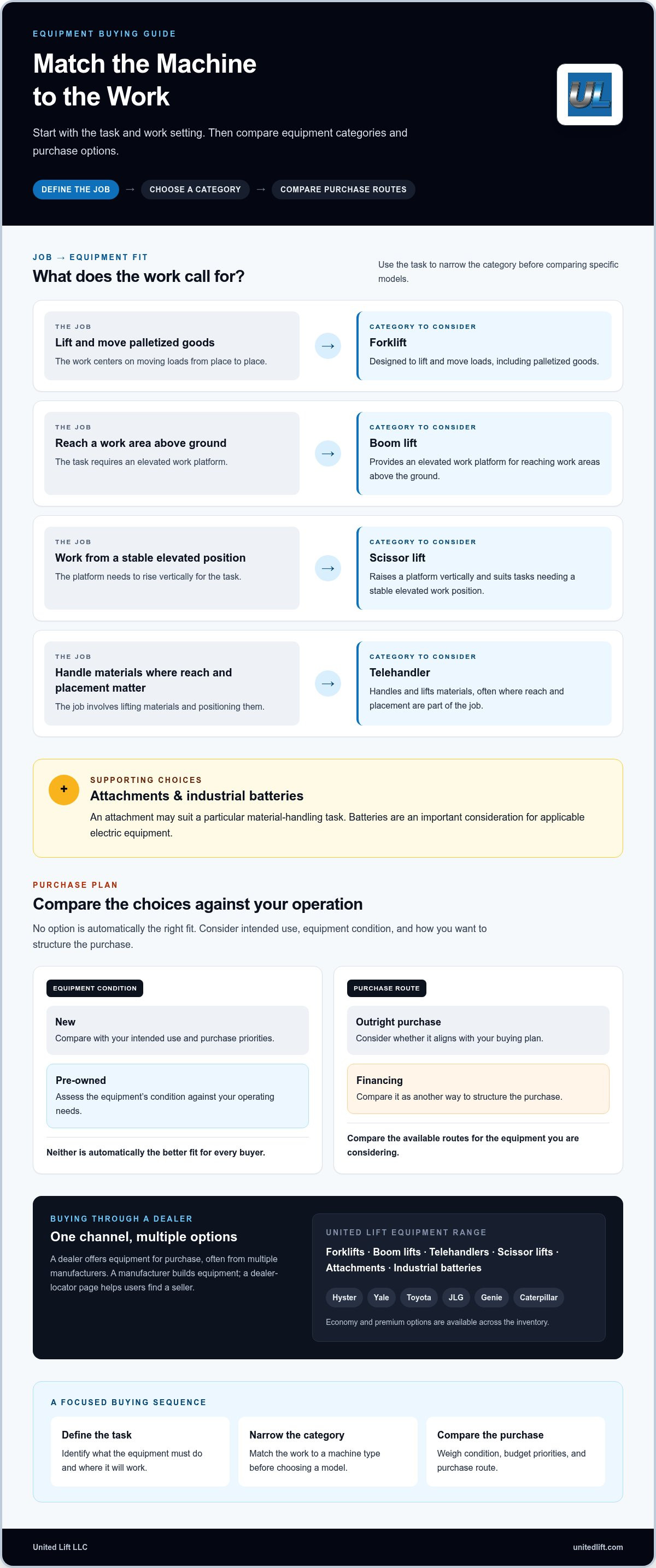
Plan the Fork Truck Purchase: Condition, Budget, and Financing
A clear purchase plan starts before you compare listings. Define what the equipment needs to do and where it will work, then weigh equipment condition and purchase routes against your business priorities. This sequence helps you focus on a suitable category and makes budget planning more practical.
- Define the task. Write down what materials or work the equipment must support. Consider how it will be used and whether the priority is lifting, moving, or positioning materials.
- Describe the workplace. Note where the equipment will operate and the conditions that could affect its use. Include the work area and how the equipment needs to move through it.
- Choose the equipment category. Use the task and setting to decide whether to focus on a forklift, telehandler, or another lift category. Choosing a category first keeps comparisons relevant.
- Set purchase priorities. Decide what matters most, such as equipment condition, budget planning, or the buying route. Apply the same priorities when comparing options.
- Compare new and pre-owned choices. Consider condition and intended use together. A pre-owned option may fit one operating plan, while a new option may suit another. Neither is automatically right for every business.
- Choose how to fund the purchase. Compare an outright purchase with financing as distinct ways to acquire equipment. Consider how each route fits your business plan before deciding.
Prepare the equipment and operating requirements
Make your notes specific to the job. If the equipment will move loads between work areas, describe the route and material-handling task. If the need involves elevated work, state that before comparing products. Specific requirements help you avoid choosing a machine based on a general label alone.
Next, compare new and pre-owned options against those requirements. Consider the equipment’s condition and how it aligns with your intended use. Review the information available for each option, and base the comparison on the specific equipment rather than assumptions about a category or brand. A fork truck dealer can help you consider purchase options that match the task you have defined.
Compare an outright purchase with financing
An outright purchase and financing are different ways to fund equipment. With a direct purchase, you buy the equipment outright. Financing gives you another route to consider as part of your business’s equipment plan. Compare these options in light of your budget priorities and purchasing approach, without relying on assumed payment amounts or outcomes.
United Lift sells equipment outright and facilitates equipment financing. Explore equipment options and plan your purchase with your operating needs and preferred purchase route in mind.
Work With United Lift to Source Your Fork Truck
You have defined the work, compared equipment categories, and considered how you want to purchase. Now bring those decisions together. United Lift is a material handling equipment dealer with new and pre-owned options across forklifts and related lift equipment. Its multi-category inventory and financing options give buyers a place to compare equipment and shape a purchase plan around their operation.
What United Lift brings to a material handling purchase
United Lift sells forklifts, boom lifts, telehandlers, scissor lifts, equipment attachments, and industrial batteries. Its inventory includes equipment from Hyster, Yale, Toyota, JLG, Genie, and Caterpillar, with economy and premium options. That range can help you compare relevant categories and brands while keeping the job and your purchasing priorities in view. New and pre-owned equipment are both available.
Financing is another purchase route to consider alongside buying outright. United Lift facilitates equipment financing and provides phone and email support seven days a week. Keep your requirements close as you explore. A clear description of the task helps focus the discussion on the equipment category and purchase approach that suit your plan.
Make the next step straightforward
Prepare a short outline before exploring equipment. Include the job, where the equipment will be used, the category you are considering, and whether you are weighing new or pre-owned options. Add your purchase priorities, such as comparing economy and premium choices or considering financing. You do not need to select a model before getting started. A practical description of the work gives the conversation a useful direction.
Then move through three simple steps:
- Outline the job. Describe what the equipment needs to do and the setting where it will work.
- Review relevant options. Explore categories that fit the task, then compare brands and new or pre-owned choices.
- Discuss the purchase route. Consider an outright purchase or financing in light of your business plan and priorities.
This keeps the process focused without forcing a decision before you have reviewed suitable choices. As a fork truck dealer, United Lift brings equipment options and purchase routes into one conversation, with phone and email support seven days a week.
Ready to discuss your equipment needs? Connect with United Lift about equipment and share the job you are planning for.
Turn Your Equipment Decision Into a Clear Plan
Turn your equipment choice into a shared plan before moving forward. Make sure the people involved in the purchase agree on what the equipment must accomplish and which priorities are flexible. Separating essential requirements from preferences can make comparisons more focused and help prevent a quick decision from creating confusion later.
Keep the plan practical. Record the reason for the purchase, the tasks it needs to support, and the buying approach your business is considering. This gives your conversation with a fork truck dealer a clear starting point, even if you are still weighing options. You do not need every detail settled before taking the next step.
United Lift can help you continue the equipment conversation with a range of categories and buying options to consider. Connect with United Lift about equipment and put your plan into motion. A clear starting point makes it easier to move ahead with confidence.
Frequently Asked Questions
Is a fork truck the same as a forklift?
Yes. “Fork truck” and “forklift” are commonly used names for the same general type of lift truck. Both terms usually refer to equipment that lifts and moves materials using forks. Listings may use either phrase, so try both when browsing. Once you find relevant options, compare the equipment’s intended task and workplace fit rather than relying on the wording alone.
Does a fork truck dealer sell both new and used forklifts?
Some dealers offer both new and pre-owned forklifts, including United Lift. Having both choices lets buyers consider equipment condition alongside planned use and purchasing priorities. For a pre-owned option, review the details for that specific machine and consider how its condition aligns with your operation. A new forklift may suit a different purchase plan, but neither choice is automatically right for every buyer.
Can a fork truck dealer help with equipment financing?
Yes. A fork truck dealer may facilitate equipment financing as one way to fund a purchase. United Lift facilitates financing options, giving buyers another route to consider alongside buying equipment outright. Financing can be part of planning how an equipment purchase fits the business’s broader purchasing approach. Approval, payment amounts, and financing details depend on the arrangement, so review the specific option before treating it as a confirmed outcome.
Can one dealer sell forklifts and aerial lifts?
Yes. A dealer can sell equipment across both categories. United Lift sells forklifts as well as boom lifts and scissor lifts, which are aerial lift categories used for elevated work. A business moving palletized goods and maintaining elevated work areas may need to compare more than one type of equipment. Start by separating material movement from elevated-work tasks, then focus on the category suited to each job.
Do fork truck dealers sell attachments as well as equipment?
Some do. United Lift sells equipment attachments alongside its lift equipment. An attachment may be relevant when a task calls for a particular way to handle materials, but the right choice depends on the work and the equipment it will be used with. Before comparing attachments, describe the material-handling task and identify the equipment involved. This gives the purchase discussion a clear, practical starting point.
What should I have ready before contacting a fork truck dealer?
Prepare a short description of the job, workplace, and equipment category you are considering. Note what materials need handling, where the equipment will be used, and whether you are open to new or pre-owned options. It also helps to know whether you are considering a direct purchase or financing. You do not need to select a model in advance. Clear operating details help focus the conversation.
Do all fork truck dealers carry the same brands?
No. Brand selection differs between dealers. Some focus on a single manufacturer, while others offer equipment from multiple brands. That distinction matters if you want to compare manufacturers or shop across equipment categories. United Lift’s inventory includes several major manufacturers, so buyers can explore multi-brand options. Compare the brands and equipment types relevant to your task rather than assuming every dealer carries the same selection.
- Tags: equipment purchasing, fork truck dealer, forklift financing, forklifts, material handling, used forklifts, warehouse equipment
