
Forklift Aisle Width Requirements: How to Measure for a Safe, Efficient Layout
Posted by United Lift LLC on
A forklift’s stated aisle requirement isn’t automatically a workable aisle width. The right forklift aisle width requirements depend on more than the truck: the load, pallet overhang, racking and operating conditions all affect how much room you need. A layout based on a turning figure alone can leave too little space to approach and retrieve a load.
It’s easy to confuse a truck’s turning dimensions with the aisle width needed to work in your facility. This guide explains the difference and shows you how to calculate a practical starting point using the right-angle stacking dimension, load length and clearance. You’ll also learn what to measure around racks and traffic routes before settling on a layout.
Use those details to build an equipment brief that reflects the job, not just a specification sheet. With a clearer picture of your aisle and load needs, you can compare new and pre-owned forklifts against the demands of your operation.
Key Takeaways
- Forklift aisle width requirements depend on the truck, load, storage layout and operating task, not a single universal measurement.
- Separate the truck’s width and turning dimensions from its right-angle stacking specification when planning for rack access.
- Start with the largest load and how it enters or leaves storage, then account for pallet orientation and overhang.
- Measure clear aisle space at multiple points and record columns, doors, obstructions and turning areas before finalizing a layout.
- Build an equipment brief with your measured aisle, load, rack, floor and task details to compare forklift options against the actual application.
Forklift Aisle Width Requirements: What the Measurement Actually Means
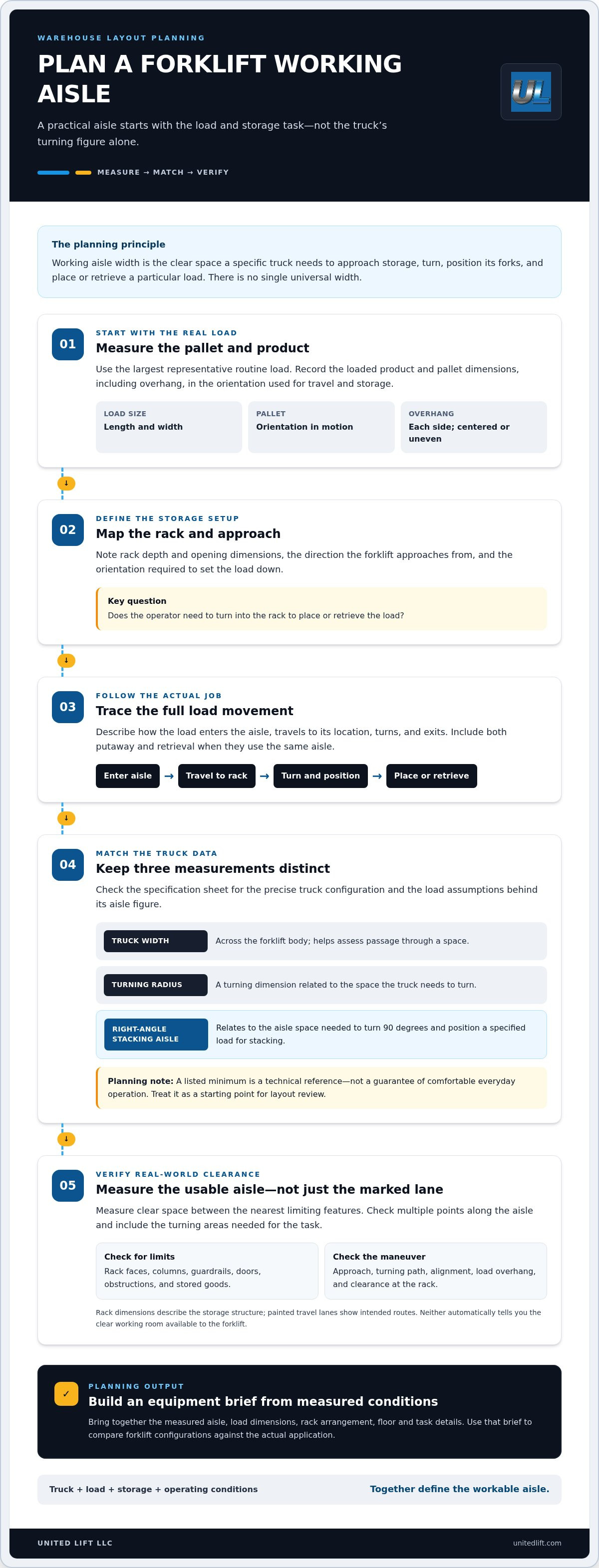
A forklift aisle isn’t sized by the truck’s body width alone. The working aisle is the clear space a specific truck needs to approach storage, turn, position its forks and place or retrieve a particular load. The right forklift aisle width requirements depend on both the equipment and the work it must do in your facility.
There is no single universal forklift aisle width: the workable measurement depends on the truck, load, storage arrangement and maneuver. A figure in a specification can be a useful planning starting point, but it doesn’t automatically provide enough room for everyday operation. Actual loads, clearance, traffic flow and nearby obstructions all matter.
What is a forklift working aisle?
The working aisle is the usable, unobstructed width available for equipment and load movement. Measure the clear space between the nearest limiting features, such as rack faces, columns, guardrails or stored goods. Rack dimensions describe the storage structure, while painted travel lanes show intended routes. Neither automatically tells you how much clear working room the forklift has.
Consider the task as well as the direction of travel. Driving straight through an aisle takes different space than turning toward a rack to deposit a pallet. A load may also extend beyond the pallet or rack position, reducing effective clearance. For a general overview of forklift types and operation, consider how equipment design and handling tasks vary.
Which forklift measurements matter?
Truck width is the dimension across the forklift body. It helps show whether the truck can travel through a passage, but it doesn’t account for turning and positioning at a rack. Turning radius describes the space the truck needs to turn, typically considered in relation to the truck itself. Neither measurement alone defines the working aisle.
Right-angle stacking aisle width, often listed as an aisle dimension in a forklift specification, relates more directly to storage work. It describes the aisle space required for a truck to turn 90 degrees and position a specified load for stacking. The figure depends on the truck and load configuration used for the specification. Check the exact specification sheet for the truck being considered, including the stated load dimensions and assumptions behind its aisle figure.
A manufacturer’s listed minimum is a technical reference, not a guarantee that the same width will be comfortable for every operator, load or warehouse condition. Treat it as a starting point for layout review. Compare it with actual load dimensions, pallet orientation, rack openings and available clearance. A setup that works on paper may leave little room for routine variation if loads overhang or approach the rack from a different angle.
Keep these measurements distinct as you plan: truck width helps assess passage, turning radius describes a turning dimension, and right-angle stacking aisle width relates to placing or retrieving a load at a rack. Together, they give you a more useful basis for evaluating the layout than any one number alone.
How to Calculate Forklift Aisle Width Requirements Step by Step
A reliable aisle calculation starts with the work your warehouse actually handles, not a generic width chart. Gather load and rack dimensions first, then compare them with the specifications for the truck configuration under consideration. Use the actual load and truck configuration, because changing either can change the space needed to reach and place a rack position.
Measure the load, pallet, and rack arrangement
Start with the largest representative load, including any product that extends beyond the pallet. Record its length and width in the orientation it will travel and enter storage. Then note rack depth, the direction of approach and how the load must face when placed. If loads vary, use the largest routine load rather than assuming every pallet matches a standard size.
- Document the load. Measure the pallet and loaded product, including overhang on each side. Note whether the load is centered or unevenly positioned, since its shape and placement affect the turning path.
- Map the storage task. Record rack depth and opening dimensions, plus the direction the forklift approaches from. Identify whether the operator must turn into the rack and the orientation required to set the load down.
- Describe the full movement. Trace how the load enters the aisle, travels to its location, turns and exits. Include retrieval as well as putaway if both happen in the same aisle. The closer this sequence is to actual work, the more useful the resulting layout will be.
Apply truck specifications and operating clearance
With the load and storage task documented, compare them with the manufacturer’s data for the precise forklift configuration being considered. Keep the listed right-angle stacking aisle dimension distinct from turning measurements. Use both as inputs to layout planning, then check the load path and usable clearance at the rack.
- Match the specification sheet. Use data for the specific truck setup, including the relevant load configuration and attachment, if applicable. Don’t transfer an aisle figure from a different truck or configuration simply because the equipment appears similar.
- Review the complete maneuver. Account separately for the load’s dimensions, the truck’s turning path and planned operating clearance. Check how the forklift approaches and aligns with the rack, not just whether it can travel straight down the aisle.
- Record assumptions and review the layout. Mark the load size, pallet orientation, truck specification and clearance assumptions on the draft plan. Compare the proposed movement with the facility’s actual rack arrangement before final equipment selection. If the load mix or task changes, revisit the calculation.
This process turns forklift aisle width requirements into a practical equipment brief rather than a single unsupported number. Once the measurements are organized, compare them with forklift options for your application, using the specifications of each truck under consideration.
Why Load Size and Forklift Stability Change the Aisle Decision
The forklift may stay the same, but the load can change the maneuver. A wide or uneven load may need a different approach angle than a compact pallet. Overhang can also reduce the usable gap between the load and rack. That’s why forklift aisle width requirements should reflect the loads and handling tasks in your operation, not just a typical pallet.
Stability limits govern how a forklift can safely carry a load; they don’t tell you how much physical clearance the truck needs to maneuver. Keep those questions separate. Aisle geometry is about space for the truck and load to travel, turn and reach the rack. Stability is about keeping the loaded forklift within its operating limits.
How the forklift stability triangle relates to aisle operation
On a counterbalanced forklift, the stability triangle is the support area formed by the two front wheels and the pivot point of the rear axle. Load weight and position affect the combined center of gravity. Turning, braking or traveling over uneven surfaces can also shift it. The triangle helps explain stability, but it isn’t an aisle-width formula or a way to set a minimum aisle dimension.
When real loads require more room than the pallet suggests
A pallet’s footprint may not show the full load envelope. Measure the widest and longest points of the product, including overhang, and consider whether its shape changes as it moves or turns. A long item may need more room to align with a rack than a compact pallet, even if both use the same forklift.
Attachments matter, too. They can change the truck’s overall configuration and the way a load is held. Use the specification for the truck setup being considered, and assess the attachment and load together rather than relying on a bare-truck dimension.
| Factor | May increase space needs | May simplify the maneuver |
|---|---|---|
| Load shape | Long, wide, uneven or overhanging loads | Compact, centered loads |
| Load orientation | Different orientations at travel and placement | Consistent orientation through the task |
| Approach path | Angled approach or tight turn to reach storage | Direct approach with room to align |
| Truck setup | Configuration or attachment that changes handling dimensions | Configuration matched to the task and load |
Use the comparison as a planning prompt, not a substitute for measuring. A centered load or direct approach may make handling more straightforward, but it doesn’t establish a safe aisle width by itself. Compare the actual load shape and travel task with the truck’s specifications, then assess available space through the full turn and placement sequence.
For example, a forklift that handles standard pallets on a straight approach may need a different layout when the same aisle serves longer products or loads placed crosswise. Capture those variations before choosing equipment. The more your plan reflects real loads, attachments and rack access, the more useful it will be for matching a forklift to the job.
A Warehouse Checklist for Verifying Forklift Aisle Width
A draft layout needs a real-world check before you commit to equipment. Aisles can narrow at rack ends, columns, doorways or stored items, and a measurement taken at one convenient point may miss the tightest spot. Use this walkthrough to compare the plan with the facility and capture details that affect forklift aisle width requirements.
What to measure and record on site
Walk each route the forklift will use, from its entry point to every storage position and back out. Measure clear space at several points along each aisle, including the narrowest sections, intersections and turning areas. Record fixed features and anything that reduces usable width at floor level.
- Aisles and rack ends: Note the clear distance between limiting edges, plus the space available to turn at each end.
- Obstructions: Mark columns, door frames, guards, equipment and other fixed features. Record doors that open into travel paths and any low or floor-level constraints that affect movement.
- Traffic and staging: Map one-way or two-way travel, cross aisles, intersections, pedestrian routes, loading areas and places where loads wait temporarily. For operations integrating mobile equipment with systems from Quintec Conveyors, clearly outline clearance at pallet pick-up stations and conveyor transfer points.
- Storage access: Trace the route to each rack position and note where the truck must turn, align or reverse. Include the actual load envelope in the sketch.
Take photos or make a simple annotated sketch of unusual loads and tight locations. A long load approaching a rack end, for example, may need a different positioning path than a compact pallet. Mark where each measurement was taken so the layout reviewer can compare site conditions with the plan.
How to check safety and compliance assumptions
Keep two questions separate: does the layout provide practical room for the truck and load to operate, and does the facility meet applicable workplace safety requirements? A working-width estimate answers the first question, but it doesn’t establish regulatory compliance. Requirements can depend on the specific use and setting.
Before quoting a standard or treating a dimension as mandatory, verify the current applicable OSHA and ANSI/ITSDF references. Don’t rely on an old rule of thumb or a number copied from a different facility as a legal requirement. Record the source and date of any guidance used, and identify which parts of the plan are operational assumptions rather than regulatory statements.
Close out the review with a clear record. Include measured clear widths, obstruction locations, traffic paths, load dimensions and the truck specifications used for comparison. Note who reviewed the layout and any conditions that still need resolution. If the rack arrangement, load mix or truck configuration changes, update the review before treating the old measurements as current.
Once your site measurements and load details are organized, compare forklift options for your layout against the specifications used in the review.
Turn Aisle Measurements Into the Right Forklift Requirement
Once the layout has been measured, turn the findings into a concise equipment brief. This gives each forklift under consideration the same real-world test: can its specifications support your loads, storage positions and travel tasks in the space available? A clear brief keeps equipment selection focused on the work, rather than a single aisle number viewed in isolation.
Build an equipment brief from measured aisle data
Summarize the conditions that will shape the forklift’s day-to-day use. Include the narrowest clear aisle and where it occurs, plus the routes and turns needed to reach storage. Record the maximum load dimensions, including overhang, and note how the load is oriented during travel and placement.
- Truck and configuration: List each forklift setup being considered, including any attachment that changes the handling arrangement.
- Load and task: State the maximum load size and weight, the required lift or stacking task, and how often loads are placed or retrieved at height.
- Facility: Include rack layout and access direction, measured aisle widths, turning areas, floor conditions, and relevant doors, columns or other constraints.
- Traffic pattern: Describe travel direction, intersections, pedestrian routes, staging points and whether the truck must pass or turn near other activity.
- Specification comparison: Record the manufacturer’s required aisle specification for each exact truck configuration being evaluated. Keep the source details with the brief so the figures can be compared on the same basis.
Use the details together. Consider a truck specification against the facility’s narrowest points and actual load task, not just a typical aisle measurement. For a broader framework for comparing equipment needs, the forklift buying guide can help organize the other factors involved in a purchase decision.
Discuss forklift options with United Lift LLC
With the brief in hand, compare new and pre-owned forklifts against the same application requirements. The condition category doesn’t change the aisle, load, rack or task the equipment must handle. Evaluate each option using its own specifications and the configuration intended for your operation. United Lift LLC offers forklifts from brands including Hyster, Yale, Toyota and Caterpillar, as well as boom lifts, telehandlers, scissor lifts and attachments.
Keep the measured brief close during selection. If a proposed truck configuration changes, compare its specifications against the same site and load information again. That makes differences easier to spot and keeps the decision tied to actual operating conditions. It also gives your team a practical record of the assumptions behind the equipment choice.
Ready to put your measurements to work? Discuss your measured application and forklift requirements with United Lift LLC.
Put Your Aisle Plan to Work
Your measurements can do more than guide a purchase. Keep them as a working reference for future changes to storage, loads or traffic patterns. If the operation shifts, revisit the forklift aisle width requirements against the updated tasks before those changes become part of daily movement.
A useful next step is to bring your site notes and equipment priorities into one conversation. Share the tightest aisle points, the loads you handle and the movements the forklift needs to make. United Lift offers new and pre-owned forklifts to meet a range of material handling needs. Financing options are available for business customers, and customer support is available seven days a week by phone and email.
Discuss your forklift application with United Lift and take the next step with a clearer equipment brief. Your measured plan is a practical foundation for making a confident decision.
Frequently Asked Questions
What is the minimum aisle width for a forklift?
There’s no single OSHA minimum aisle width for every forklift setup. OSHA’s general industry rule, 29 CFR 1910.176(a), requires sufficient safe clearances for mechanical handling equipment, so the layout and equipment matter. A withdrawn 1972 OSHA interpretation suggested a rule of thumb, but it isn’t an enforceable standard. Use the exact truck and load data, then assess the facility’s clearances and applicable current requirements.
How do you calculate forklift aisle width?
Use the selected truck’s right-angle stacking dimension, the actual load configuration and a clearance allowance as a planning basis. A commonly used estimate is right-angle stack plus load length plus 12 inches, but don’t treat it as a universal formula or a substitute for manufacturer specifications. The forklift aisle width requirements for your facility also depend on the turn, rack access, overhang and how the load is handled.
What is right-angle stacking aisle width?
Right-angle stacking aisle width is the aisle dimension a forklift needs to turn 90 degrees and position a specified load for stacking. It’s different from the truck’s overall width or turning radius. The figure applies to the configuration described in the manufacturer’s data, including the assumed load dimensions. If the load is longer or carried in another orientation, the listed value may not represent your actual maneuver.
Can a forklift operate in an aisle narrower than its stated aisle requirement?
Don’t assume it can. A manufacturer’s aisle figure is tied to a specified truck and load configuration, and less space may prevent the required turn or positioning maneuver. A different approach or handling setup could alter the space calculation, but that doesn’t by itself establish safe operation. Compare the exact specifications with the real task and layout before selecting equipment or changing aisle dimensions.
How much clearance should be added to a forklift aisle?
A commonly used planning estimate adds 12 inches of clearance to the right-angle stacking dimension and load length. Treat that as a starting allowance, not a guarantee that every aisle will work with that margin. Aisle width can be affected by overhang, uneven loads, obstructions, turning space and operating patterns. Review the actual load path and available clear width before relying on a calculated figure.
Does a forklift’s stability triangle determine the required aisle width?
No. The stability triangle is a way to understand how a counterbalanced forklift’s support points relate to its load and balance. It doesn’t measure the space needed to turn or reach a rack. For example, a load may remain within the truck’s operating limits but still need extra room to clear a rack end during a turn. Assess stability and aisle clearance as separate planning questions.
Do forklift aisle-width requirements include the pallet or load?
They should account for the load configuration used in the maneuver, not just the forklift body. A specification may assume a particular load size, so compare that assumption with your pallet and product. If cartons, pipes or other goods extend beyond the pallet, include the overhang in the load envelope. A load carried lengthwise can require different positioning space than one carried crosswise.
- Tags: forklift aisle width, forklift aisle width requirements, forklift operations, forklift safety, material handling, pallet racking, right-angle stacking, warehouse layout, warehouse planning
