
Forklift Maintenance Cost Analysis: Track Spending, Downtime, and Replacement Decisions
Posted by United Lift LLC on
What does a forklift repair bill leave out? The operating hours lost while a truck is down can disrupt work without appearing on the invoice. A useful forklift maintenance cost analysis looks beyond individual repairs to show what each truck costs to keep working.
Invoices can be hard to compare when forklifts have different operating hours, workloads, and service histories. When repair bills keep climbing, it can also be difficult to tell whether another repair makes sense or whether replacement deserves a closer look. Consistent records give you a clearer basis for both decisions.
This guide explains how to build a maintenance-cost baseline for each truck, calculate spending per operating hour, and track downtime separately from repair costs. You’ll also see how age, use, work environment, and maintenance history can help explain rising expenses, and how to compare recurring repairs with replacement needs. With reliable records, you can budget more confidently and plan for a new or pre-owned forklift when the pattern points that way.
Key Takeaways
- Separate documented service and repair spending from downtime impacts to keep cost records clear.
- Use a forklift maintenance cost analysis to compare trucks on a consistent cost-per-operating-hour basis.
- Track age, operating hours, workload, and work conditions to identify factors behind rising maintenance needs.
- Record service dates, hours, parts, labor, repairs, and downtime consistently to support better planning.
- Weigh recurring costs and downtime alongside equipment suitability before deciding whether to keep repairing or review replacement options.
What Does Forklift Maintenance Cost Include?
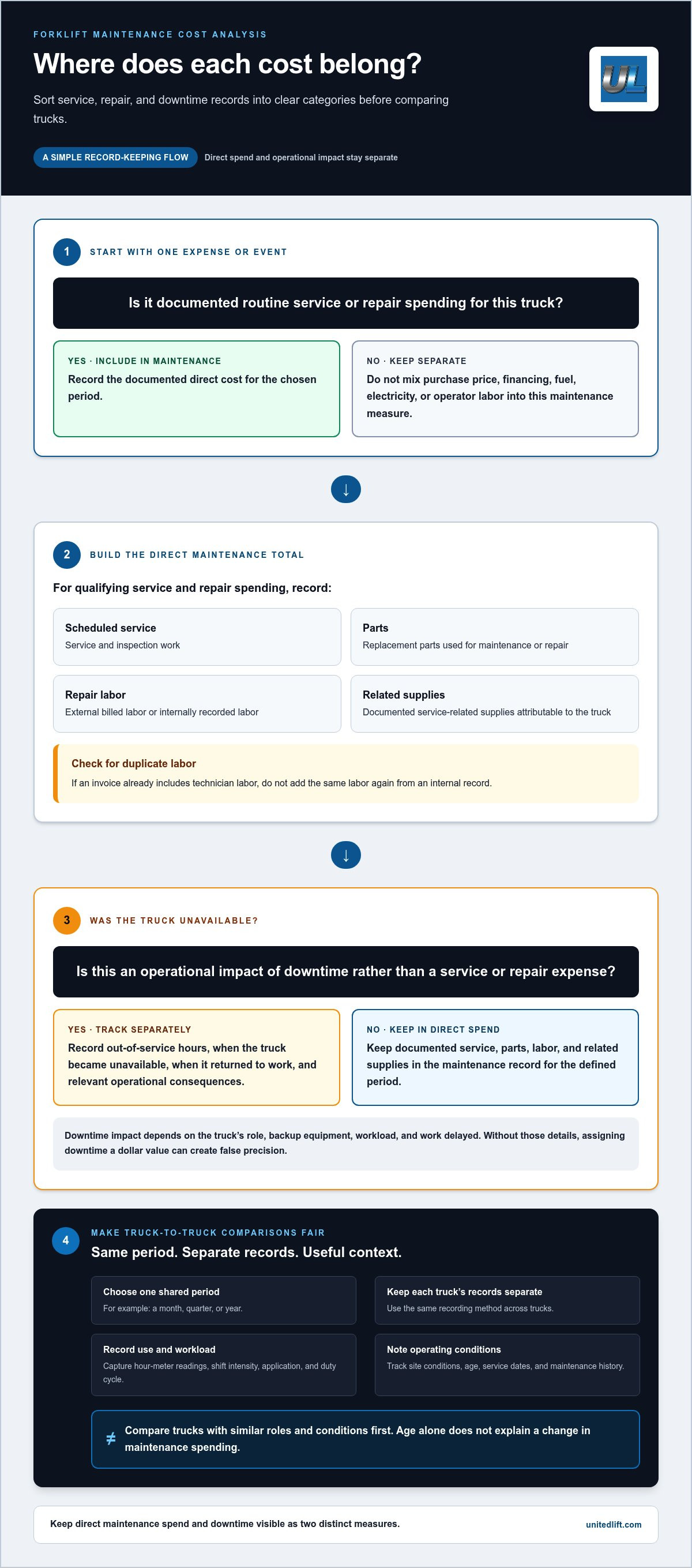
For a useful forklift maintenance cost analysis, define the figure first: maintenance cost is the documented routine service and repair spending for one truck over a chosen period. Set the same period for every forklift you compare, such as a month, quarter, or year, and keep each truck’s records separate. This creates a consistent baseline without mixing maintenance with the full cost of owning or operating the equipment.
Costs vary by truck, workload, work environment, and maintenance history. A forklift used intensively in dusty or demanding conditions may need a different service pattern from one used more lightly. Equipment design and power source can also affect maintenance needs. A general overview of forklift types and components can help explain why different trucks may require different parts and service.
Which expenses belong in a forklift maintenance total?
Include documented costs directly tied to routine service or repairs. Use supplier invoices and internal labor records where available. If an invoice already includes technician labor, don’t add the same labor again from an internal record. Apply the same recording method to each truck so the comparison reflects real differences, not inconsistent bookkeeping.
- Scheduled service and inspection work.
- Replacement parts used for maintenance or repair.
- Repair labor, whether billed externally or recorded internally.
- Documented service-related supplies attributable to the truck.
Keep purchase price and financing, fuel, and electricity in separate budget categories. They matter to the broader cost of owning and operating a forklift, but including them in maintenance spending makes this measure harder to interpret. Keep operator labor and other operating expenses separate, too, unless you’re preparing a broader cost analysis with clearly defined categories.
Why downtime should be reported separately
Direct maintenance spend is the recorded cost of service, parts, labor, and related supplies for a defined period. Downtime impact is the operational effect of the truck being unavailable, tracked separately through out-of-service hours, delayed work, or disruption. An invoice shows what a repair cost, but not what work was postponed or how the operation was affected.
Track downtime alongside maintenance expenses, not inside the same total. Record when the forklift became unavailable, when it returned to work, and any relevant operational consequences. The impact depends on the truck’s role, available backup equipment, workload, and the work delayed. Without those details, assigning downtime a dollar value can create false precision.
Keep the two measures visible in your records. This lets you compare direct spending consistently while still seeing where downtime affects operations. Together, they provide a clearer picture of maintenance performance without treating unlike costs as if they were the same.
Which Factors Drive Forklift Maintenance Costs Up?
Rising maintenance spend can point to heavier use, tougher conditions, an aging truck, or a combination of factors. Don’t assume age alone explains the change. Compare each truck’s service history with its operating hours, workload, and work environment. This helps distinguish a genuine change in equipment needs from differences in how trucks are used.
How operating hours, age, and workload shape service needs
Age and operating hours are related, but they measure different things. A newer truck may have accumulated many hours through intensive shifts, while an older one may have seen lighter use. Review hour-meter readings alongside service dates to see how quickly each truck accumulates use and whether service frequency or repair patterns change as hours build.
Compare forklifts doing similar work before attributing higher spending to age. Consider shift patterns, load demands, and application. A truck working frequent, demanding shifts may experience different wear from one used intermittently, even if both are the same age. Note these conditions with each service record so comparisons remain consistent. Warehouse Fieldbook also explains calculating forklift maintenance cost per hour as a way to assess spending against use.
How the work environment changes maintenance patterns
Site conditions matter. Dust and debris, moisture, outdoor exposure, uneven surfaces, cold storage, and other demanding conditions can affect maintenance needs. Two similar forklifts may develop different service patterns if one works in a clean indoor space and the other regularly faces rough surfaces or environmental exposure.
Use a consistent set of context variables when comparing trucks: age, accumulated hours, workload, duty cycle, environment, and maintenance history. This record helps show whether rising spend aligns with heavier use, harsher conditions, or a change in service history.
Manufacturer guidance should anchor service planning, while each truck’s records show how its actual use may shape maintenance needs. Generic assumptions can mislead. For example, comparing a truck in cold storage with one operating outdoors may suggest an age-related cost difference when their environments and applications differ. Group trucks with similar roles and conditions first to make the comparison fair.
For each review period, record hour-meter readings, shift intensity, application, site conditions, and service events alongside maintenance spend. Note changes, too. A truck moved to a more demanding job or a new work area may develop a different maintenance pattern. This creates a practical view of cost and context, rather than a list of invoices without an explanation.
If the pattern points to a persistent mismatch between a truck and its work, assess what equipment the application requires. Explore new and pre-owned forklifts as possible replacement paths when your records support that review.
How to Calculate and Compare Forklift Maintenance Cost per Hour
Cost per operating hour puts maintenance spend in context. It lets you compare trucks that have logged different amounts of use, provided you use matching records and interpret the result alongside each truck’s operating conditions. Consistent records matter more than chasing a single benchmark.
Build a reliable maintenance cost-per-hour calculation
Use this formula: maintenance cost per operating hour = recorded maintenance spend ÷ hours operated. First, choose a review period, such as a quarter or year. Gather scheduled-service and repair invoices, plus documented internal labor entries, for that exact period. Match the total to hour-meter readings from the same start and end dates. Don’t divide a year of spending by only a few months of operating hours.
Include the same types of maintenance expenses for every truck. Keep purchase financing and energy costs separate, and don’t add downtime impacts to the maintenance-spend figure. If a record is missing, don’t silently estimate it into the verified total. Label the gap or estimate separately so it’s clear which figures are confirmed and which need follow-up.
Set up a comparison that keeps context visible
A simple tracker can put the calculation and its context in one place. Give each forklift a row and record:
- Truck identifier and review period
- Operating hours during that period
- Verified maintenance spend and calculated cost per hour
- Unavailable hours, tracked separately from direct spend
- Context notes, such as age, application, workload, environment, and record gaps
Use the same measurement period and accounting rules across the fleet. This makes it easier to see whether a change reflects more maintenance spending, fewer operating hours, or incomplete records. The ratio can shift when the denominator changes, so review the hourly figure alongside the underlying spend and hours.
Compare forklifts fairly instead of chasing a single benchmark
Group trucks by similar duty cycle, environment, age, and utilization where practical. A forklift working intensive shifts in a demanding application isn’t directly comparable to one used intermittently in a cleaner setting. Compare similar trucks first, then use differences in workload and conditions to explain why their figures may diverge.
Review results over multiple periods. A single high reading may reflect a one-time repair or unusually low operating hours, so check the records before drawing conclusions. Look for a persistent upward trend, rising downtime, or a growing gap between comparable trucks. Those patterns provide a stronger basis for a replacement review than one isolated figure.
Maintenance comparisons can also inform equipment planning. If the analysis points to a mismatch between a forklift and its application, the forklift buying guide offers broader context for evaluating equipment needs.
How Can You Control Forklift Maintenance Costs?
Cost control starts with a repeatable process, not a promise that maintenance spending will fall by a set amount. Follow the manufacturer’s maintenance instructions and account for how each forklift is actually used. A truck working intensive shifts or in a demanding environment may need a different review approach from one with lighter use. Results depend on the equipment, its condition, and operating practices.
Create a practical preventive maintenance tracking routine
Use one consistent recordkeeping process across the fleet. Assign responsibility for entering inspection findings, scheduled service, and completed repairs, then reconcile those records with hour-meter readings at regular review points. Use the manufacturer’s schedule for service intervals rather than applying a universal timetable. This ties maintenance planning to the truck’s instructions while giving managers a dependable view of completed and upcoming work.
Make each entry useful on its own. Capture the service date, meter reading, work performed, parts used, labor, and any issue found. Record downtime separately, including when the truck was unavailable and when it returned to operation. These details connect repair patterns to actual use and show whether a record is incomplete. Don’t treat a blank field as proof that no work occurred.
A simple routine can keep records current:
- Enter service and repair details when the work is completed.
- Check hour-meter readings against service records at scheduled review points.
- Mark missing invoices or uncertain entries for follow-up instead of blending estimates into verified totals.
- Review the fleet on a consistent cadence and keep the same categories from period to period.
Use maintenance trends to plan fleet decisions
Look for patterns, not just one expensive repair. Flag repeated repairs to the same system, longer periods out of service, or a rising cost per operating hour. Then compare the truck with others doing similar work. Differences in workload, age, environment, and utilization may explain why one unit’s record looks worse than another’s.
Before escalating a case, check whether the pattern continues across review periods and whether the records are complete. A single spike may be an isolated event; repeated issues alongside growing downtime deserve a closer equipment review. This gives your team a grounded basis for deciding whether to keep monitoring, adjust the truck’s assignment, or begin replacement planning. A forklift maintenance cost analysis is most useful when it leads to a clear next step.
If the records point toward replacement planning, compare equipment options that fit the operation. Explore United Lift’s forklift options, including new and pre-owned forklifts, as possible purchasing paths.
When Should Maintenance Analysis Lead to a Forklift Replacement Review?
One major repair doesn’t automatically mean a forklift should be replaced. The better signal is a pattern: repeated failures, increasing maintenance needs, more time out of service, or a truck that no longer suits the work. A forklift maintenance cost analysis brings those records together, but the decision should also reflect operating hours and the demands of the application.
Signals that justify a repair-versus-replacement review
Start a review when repair events recur or downtime interferes with planned work. Check whether multiple maintenance concerns are developing over time instead of treating one unusual event as proof. Then assess the truck’s fit: does it still meet the operation’s capacity and working demands? There’s no universal repair count or cost threshold. Use documented patterns and business needs to decide when to compare options.
A quick comparison can help organize the evidence before deciding what to do next:
| Review area | What to look for | Planning question |
|---|---|---|
| Repair pattern | Repeated failures, recurring work, or multiple concerns over time | Is the pattern continuing, or was this an isolated event? |
| Downtime pattern | Frequency and duration of unavailable periods | How does lost operating time affect the work this truck supports? |
| Application fit | Current capacity and working demands compared with the truck’s role | Does the equipment still suit the operation? |
| Replacement planning | Maintenance trends, operating hours, and expected equipment needs | What changes if the operation continues with this truck versus planning a replacement? |
Turn the analysis into a practical equipment decision
Compare continued operation with replacement using the same planning period. For the current forklift, consider its documented maintenance trend, operating hours, downtime, and ongoing suitability. For a replacement, account for the equipment purchase and how it fits the work ahead. Keep assumptions visible, and avoid treating an uncertain estimate as a confirmed cost.
Include both new and pre-owned forklifts in the options under review. Financing can also be part of purchase planning, but terms and approval depend on the specific transaction. The goal isn’t to force a replacement decision. It’s to assess whether continued repairs or a planned purchase better supports the operation, based on the records and requirements in front of you.
If the evidence points toward a purchase review, Review forklift options with United Lift, including new and pre-owned equipment and financing options for business purchases.
Make Your Next Fleet Decision With Confidence
Your maintenance records can do more than explain past spending. Use them to set a regular review point, identify which trucks need closer attention, and plan equipment changes before a decision becomes urgent. A consistent forklift maintenance cost analysis turns scattered service details into a practical planning tool for your next budget cycle.
If the evidence points toward replacement, compare options against the work your operation needs to handle next. United Lift sells new and pre-owned forklifts nationally and offers financing options for business equipment purchases. Phone and email support is available seven days a week.
Review new and pre-owned forklifts with United Lift and take the next step with a clearer view of your fleet needs.
Frequently Asked Questions
How often should forklift maintenance be scheduled?
Follow the manufacturer’s maintenance schedule, adjusting your planning to the truck’s operating hours, application, and working conditions. Don’t assume two forklifts need service at the same interval just because they’re similar models. For example, a truck moved from occasional indoor use to intensive shifts may need its plan reassessed against its new usage and applicable OEM guidance. Keep service records current, and review them when conditions change or recurring issues appear.
Can I compare maintenance costs between electric and internal combustion forklifts?
Yes, as long as you compare equivalent periods and keep maintenance separate from energy costs. A forklift maintenance cost analysis should also account for operating hours, age, workload, and environment. For example, comparing an electric truck used for one shift with an internal combustion truck used across heavier shifts may produce a misleading ranking. State which expenses are included, then consider differences in power type and application before drawing conclusions.
What should I do if a forklift has incomplete maintenance records?
Start with what you can verify, such as invoices, service notes, and hour-meter readings, and mark missing periods clearly. Don’t treat undocumented work as zero spending. For example, if an invoice is available but the service date or truck identifier is unclear, keep it separate until it can be matched reliably. Set up consistent records going forward and build a baseline from verified data. Use equipment documentation and qualified inspection practices to guide decisions if history or condition is uncertain.
Does low forklift usage mean maintenance is unnecessary?
No, low operating hours don’t automatically eliminate maintenance needs. Time in storage, storage conditions, and the work environment can still matter, along with manufacturer instructions. Track calendar time as well as meter readings so periods of inactivity don’t disappear from the record. Before returning a lightly used truck to regular work, review its documented history and applicable equipment guidance. Don’t extend service intervals based only on low hours.
Should downtime be included in forklift maintenance cost per hour?
Track downtime, but report its operational impact separately from direct maintenance spending. Invoices and labor records document repair expenditure; unavailable hours and disrupted work show what the interruption meant to the operation. For example, note whether another truck covered the task or whether work was delayed. Keep both measures aligned to the same review period, explain any assumptions, and use them together when assessing performance or considering a replacement.
Can maintenance records help with forklift replacement planning?
Yes. Consistent records can reveal whether repairs, downtime, or maintenance spending are becoming a recurring pattern. Review that trend alongside operating hours, the truck’s age, and whether it still fits the work. One major repair alone doesn’t settle the decision. For example, repeated issues combined with longer interruptions may justify comparing continued operation with replacement options. Use the records to begin that review, then weigh each path against current business needs.
- Tags: cost analysis, equipment downtime, fleet management, forklift maintenance, forklift maintenance cost analysis, forklift repair, material handling, operating costs, repair vs replacement
