
Forklift Paper Roll Clamp Attachment: 2026 Buyer’s Guide
Posted by United Lift LLC on
The clamp with the highest rated capacity may still be the wrong choice for your paper rolls. A forklift paper roll clamp attachment needs to suit the rolls’ size, weight, surface, and handling pattern, as well as the forklift it’s paired with. Poorly matched contact or clamp pressure can damage rolls, and adding an attachment changes the forklift’s capacity. It’s understandable to want clear answers before choosing.
This guide will help you compare clamp configurations, identify the key forklift compatibility checks, and understand how to assess remaining capacity. You’ll also see how roll requirements and day-to-day workflow shape the right setup, so the decision isn’t based on one rating alone. United Lift LLC offers forklifts and equipment attachments, making it practical to consider the truck and clamp as a coordinated equipment purchase. Start with the loads you handle, then match the attachment and forklift to the job.
Key Takeaways
- Start with your rolls’ weight, dimensions, and handling pattern to narrow down the clamp configuration that fits the work.
- Compare capacity, attachment weight, clamp range, pad dimensions, mounting class, and condition against your actual operating needs.
- A forklift paper roll clamp attachment affects truck capacity, so assess the complete forklift-and-attachment setup, not the clamp rating alone.
- Use manufacturer documentation to check mounting, hydraulic requirements, compatibility, and updated capacity information before purchase.
- Plan the roll, clamp, and forklift together to build a paper-handling setup that suits your workflow.
What a Forklift Paper Roll Clamp Attachment Does, and When It Fits
A forklift paper roll clamp attachment is a forklift tool that grips and moves paper rolls with clamp arms and contact pads instead of relying on conventional forks alone. It’s designed around the shape of a roll, giving the operator a way to lift, carry, and position it as part of a material-handling workflow. The right setup can make roll movement more controlled and reduce reliance on improvised methods that may not suit the load.
Paper rolls move through paper mills, converting operations, print facilities, and distribution workflows. They may need to travel from storage to production, between processing stages, or into a staging area. Where mobile transport interfaces with plant processing equipment, industrial suppliers such as Jealco International, Inc. provide the power transmission components and material handling systems needed to keep production lines running smoothly. The attachment’s value depends on what those moves look like in practice: the rolls being handled, the forklift available, and the conditions along the route.
How does a paper roll clamp work?
A paper roll clamp grips a roll between closing arms fitted with contact pads, then maintains that contact as the forklift lifts and moves the load. Unlike standard forks, which support a load from beneath, the clamp arms hold the roll from its sides. For example, a roll can be gripped around its curved surface rather than carried on fork blades. The forklift attachments overview also describes roll and barrel clamps as a distinct attachment type.
Contact matters. Poorly placed arms or unsuitable pressure can mark, crush, or destabilize a roll. The clamp must suit the roll’s surface and dimensions, and operators need to handle it in line with the attachment’s instructions.
Which operations benefit from a roll clamp?
Purpose-built roll handling may be especially useful where rolls move regularly and need to be placed accurately at a machine, storage position, or dispatch area. Repeated production or warehouse moves can make a dedicated handling method more practical than relying on a workaround. For occasional moves, the purchase decision may look different: compare the expected handling frequency and placement needs with the cost and operational impact of adding an attachment, without assuming frequency alone determines suitability.
Map the work before comparing equipment. Note where rolls are picked up, how they travel, and where they must be placed. Consider:
- Roll size and weight: Dimensions affect how the arms meet the roll; weight matters to the complete forklift-and-attachment setup.
- Paper condition: Surface condition and vulnerability to marking influence the contact approach.
- Destination: A production line, rack, or staging area can call for different positioning and maneuvering.
- Work conditions: Aisle space, travel distance, and handling frequency shape how the attachment fits the workflow.
There isn’t one clamp choice for every paper operation. Start with the rolls and the tasks, then match those needs to the forklift and attachment specifications. That application-first view helps distinguish a clamp that merely appears suitable from a setup designed around the actual work.
How Clamp Design Protects Paper Rolls During Handling
Roll protection starts where the attachment meets the load. Arm shape determines how the clamp approaches a roll, while pad size and placement affect the area making contact. The aim is to hold the roll steadily without concentrating force in a way that damages its outer layers. A design that suits one roll may not suit another, so compare the clamp’s geometry with the roll’s dimensions and material.
What role do clamp arms and contact pads play?
Arms need to close around the roll in a way that supports stable handling. Their reach and shape affect where they meet rolls of different diameters. Pad dimensions and surfaces influence how contact is distributed across the roll. A smaller contact area may concentrate pressure, while a broader pad may not fit every application. Neither is automatically better: suitability depends on the paper, roll size, and manufacturer’s specifications.
Inspect the contact surfaces as well as the listed dimensions. Worn, damaged, or contaminated pads can change how the attachment meets the load. A roll with a delicate or easily marked outer layer may call for a different contact approach from one with a more robust surface. Don’t assume a particular pad material or shape is right for every paper product. Use the attachment documentation to match the design to the intended load.
How can operators reduce the risk of roll damage?
Use controlled engagement. Position the arms as directed, bring them into contact without abrupt movement, and keep the roll balanced during lifting and travel. Avoid sudden starts, stops, or turns that could shift the load. Follow the attachment manufacturer’s operating instructions and workplace procedures, including guidance on clamping force. There is no universal pressure setting; use the specifications for the specific attachment and application.
Before a move, check that the roll is stable and that the pads meet it in the intended position. Watch for signs of slipping, uneven contact, or visible damage, and stop if the load doesn’t remain secure. The attachment’s condition matters too: damaged components can affect how it grips, so follow the manufacturer’s inspection and maintenance guidance.
- Match the design: Compare arm geometry and pad dimensions with the roll’s diameter and surface.
- Use controlled handling: Engage, lift, and travel smoothly, following the attachment’s instructions.
- Account for the load: Consider paper type, roll dimensions, and any surface vulnerability.
- Keep equipment in condition: Check the attachment according to manufacturer guidance and workplace procedures.
Suitable attachment fit and controlled handling help limit damaging contact, but neither replaces the manufacturer’s operating instructions or safe workplace procedures. Paper mills should also account for applicable workplace requirements; OSHA standards for paper mills provide industry-specific safety context.
When planning a forklift paper roll clamp attachment, treat pad contact, roll dimensions, and operating practice as connected decisions. United Lift offers forklifts and equipment attachments, so you can explore a coordinated equipment purchase through forklift and attachment options.
How to Compare Forklift Paper Roll Clamp Attachments
Compare a forklift paper roll clamp attachment against the rolls you handle and the forklift that will carry it. A high capacity figure by itself doesn’t show whether the clamp opens wide enough, contacts the roll appropriately, or leaves the truck with suitable capacity for the job. Use the same set of specifications for each option, then verify the details against manufacturer documentation.
| Specification | What it tells you | What to compare |
|---|---|---|
| Rated capacity | The attachment’s stated load rating under specified conditions. | Whether it suits your roll loads and the forklift’s capacity with the attachment installed. |
| Attachment weight | How much the clamp itself weighs. | Its effect on the forklift’s remaining capacity and load center. |
| Clamp range | The opening and closing range of the arms. | Whether the clamp can engage the smallest and largest rolls you handle as specified. |
| Pad dimensions | The size of the contact surfaces. | Whether pad contact suits the roll’s dimensions and surface. |
| Mounting class | The attachment’s mounting interface category. | Whether it matches the forklift carriage and manufacturer requirements. |
| Condition | The attachment’s physical and documented state. | Wear, damage, available records, and completeness of specifications. |
Which attachment specifications matter most?
Rated capacity is not the same as the forklift’s usable capacity after an attachment is fitted. Attachment weight and load position matter, so review the truck’s applicable capacity information as well. Clamp range describes the opening span, while pad dimensions help you assess contact. Mounting class identifies the attachment interface. Confirm each item using the attachment’s specification plate and applicable manufacturer documentation.
Use fields from listings as comparison prompts, not as recommendations. For example, a Cleveland Forklift listing for one refurbished unit reports attachment weight, pad dimensions, and an open-to-closed range. Those details show what to record; they are not benchmarks for your operation or proof of fit.
Should you consider a new or pre-owned clamp?
For either option, compare intended application, specification completeness, and documentation. With pre-owned equipment, inspect visible condition and review available service history alongside the specification plate. A clean appearance alone can’t establish compatibility, capacity, or safe operation. New equipment also needs to match the roll and truck, and its documentation should support that assessment.
Before choosing, make a side-by-side record of each candidate’s specifications and note any missing information. Then compare every option with the roll dimensions and weights, forklift model, mounting requirements, and work conditions. Don’t treat similar-looking clamps as interchangeable. A complete, verifiable match is more useful than a single attractive rating.
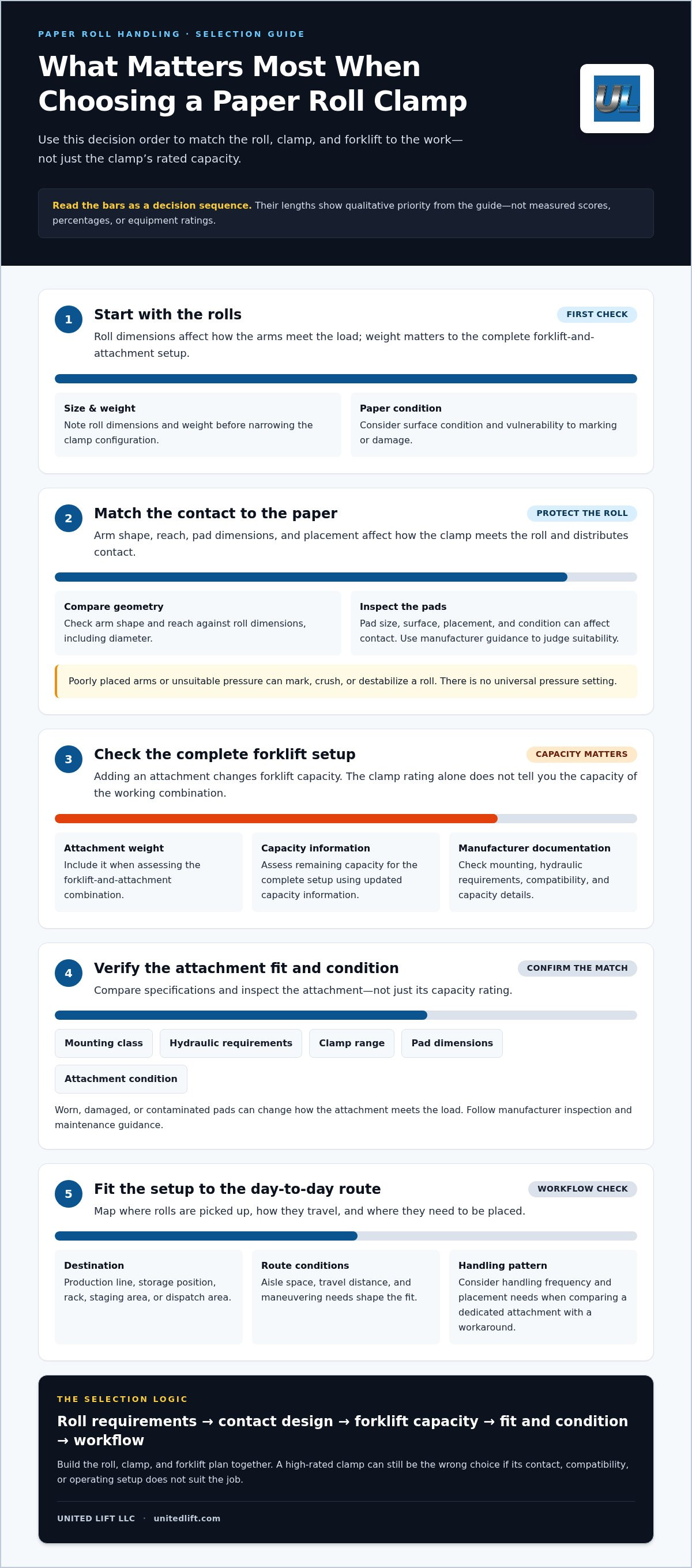
Check Forklift Fit, Capacity, and Safety Before Buying
A clamp can match the roll and still be a poor fit for the truck. Check the whole configuration before purchase: the load, forklift, attachment, and work cycle. A mounting match alone doesn’t establish safe capacity, and the attachment’s weight and position can change how much the forklift can lift.
- Document the load. Record the heaviest roll’s weight and dimensions, plus the range of sizes handled and how often rolls move.
- Identify the forklift. Note its make, model, serial or identification details, capacity plate information, and current configuration.
- Record the load center and work cycle. Use the truck documentation to establish the relevant load center, and describe travel, lift height, placement, and operating conditions.
- Compare the attachment. Match mounting class, weight, hydraulic requirements, and other specifications with the forklift and roll requirements using manufacturer documentation.
How do you verify forklift and clamp compatibility?
Collect the forklift identification and capacity data, carriage or mounting details, and available hydraulic functions. Then compare them with the clamp identification plate and the attachment manufacturer’s specifications. Confirm that the mounting interface and hydraulic setup match. Treat these as separate checks: an attachment that physically mounts to a carriage isn’t automatically suitable for the truck’s capacity or the intended load.
What safety checks belong in the purchase decision?
Review the attachment’s weight and load position against the forklift’s capacity in the proposed configuration. Check the clamp’s identification and specification information, and inspect its condition, hoses, connections, pads, and visible structural components. A visual inspection can flag concerns, but it doesn’t verify capacity or replace manufacturer documentation. Have technical capacity decisions assessed by qualified equipment professionals.
OSHA’s powered industrial truck standard, 29 CFR 1910.178, requires the truck manufacturer’s prior written approval for modifications or additions that affect capacity or safe operation. It also requires capacity, operation, and maintenance information to be updated as applicable. Confirm the specific requirements against the current standard and manufacturer guidance before installation; don’t rely on an old plate or an attachment’s standalone rating. If the attachment changes, make sure the configuration’s capacity information is clear to operators.
Keep the records together: forklift identification, current capacity information, attachment specifications, manufacturer guidance, and the load details used for the decision. This gives equipment professionals the information needed to assess the complete setup, not just one component. For a coordinated equipment purchase, explore United Lift’s forklift and attachment options.
Build a Forklift-and-Clamp Purchase Plan That Fits the Operation
A sound purchase plan connects the paper rolls, clamp, forklift, and daily workflow before you choose equipment. Start with the load and its handling demands. Then identify the attachment requirements, verify the forklift configuration, and review the relevant manufacturer documentation. This sequence helps keep the decision focused on fit, capacity, and the work the equipment needs to do.
What information should buyers prepare?
Bring practical details about the rolls and the equipment. Include typical and maximum roll weights, diameters, widths, surface characteristics, and how frequently rolls are handled. Note any variation in the load, since a setup intended for one roll size may not suit the full range of work.
For the forklift, record the make and model, capacity information, mounting configuration, and available hydraulic functions. Add details about the operating area, travel route, stacking needs, and where rolls must be placed. These facts help frame the requirements for a forklift paper roll clamp attachment and make it easier to compare a complete setup rather than a single attachment specification.
- Roll details: Typical and maximum weight, diameter, width, and surface condition.
- Handling pattern: Frequency of moves, travel distance, stacking, and placement needs.
- Forklift information: Model, capacity data, mounting setup, and hydraulic functions.
- Operating environment: Work area, aisle constraints, route, and destination points.
How does the attachment fit into a broader forklift purchase?
Selecting the truck and attachment together helps align mounting, hydraulic needs, and capacity with the actual application. An existing forklift may be part of the plan, or the operation may be considering a different truck. In either case, assess the proposed configuration using current manufacturer documentation. The attachment’s weight and the load position can affect the forklift’s rated capacity, so don’t base the decision on the truck’s original rating alone.
United Lift offers forklifts and equipment attachments, allowing buyers to approach equipment selection as a coordinated purchase. If a forklift is also under consideration, the forklift buying guide can help organize broader truck-selection priorities alongside this attachment decision.
Keep the specifications, roll details, and operating needs together as you evaluate options. Financing may also be part of purchase planning, alongside selecting equipment that suits the application. For a practical next step, talk with United Lift about your equipment needs and discuss forklift, attachment, and financing options.
Make Your Next Equipment Decision With Confidence
Use this purchase as a chance to look beyond today’s load. Consider whether your paper-handling needs may change as production, storage, or distribution demands shift. A setup that supports the operation over time should be grounded in the work you actually expect it to do, not just the most convenient specification on a listing.
Before you move forward, bring together the details that shape your decision and use them to guide a practical equipment discussion. United Lift offers forklifts and equipment attachments, with financing options available through the dealership to support purchase planning. A clear picture of your operation can help focus that conversation on suitable equipment choices.
Ready to take the next step? Talk with United Lift about matching equipment to your operation. With a focused plan, you can move toward a forklift paper roll clamp attachment setup that fits the job and supports confident handling.
Frequently Asked Questions
What is a forklift paper roll clamp attachment?
A forklift paper roll clamp attachment is a carriage-mounted tool that holds a roll between clamping arms so it can be lifted and moved without supporting it on conventional forks alone. It’s intended for paper-roll handling, but the right configuration depends on the load and work. For example, a roll moved from a staging area to a production machine may need different positioning than one handled only for storage.
How do I choose the right paper roll clamp for my forklift?
Start with the range of rolls you handle, then check that the clamp’s opening, contact surfaces, mounting interface, and hydraulic requirements suit the job and truck. Include the heaviest load and the most demanding placement in your assessment. For instance, if rolls vary in diameter, compare the clamp’s specified range with both the smallest and largest rolls. Use current forklift and attachment manufacturer documentation to evaluate the complete setup.
Can a paper roll clamp damage paper rolls?
Yes. Incorrect positioning, unsuitable pad contact, excessive clamping force, or abrupt movement can mark, crush, or destabilize a roll. Paper type and condition matter too: a vulnerable outer layer may show damage more readily than a robust one. Follow the attachment manufacturer’s instructions for engagement and clamping force, and use workplace handling procedures. If contact is uneven or a roll shifts during a move, stop and reassess the setup.
How do I calculate forklift capacity with a paper roll clamp attached?
Don’t rely on a simple subtraction of the clamp’s weight from the forklift’s original capacity. The attachment’s weight and the load’s position affect the truck’s capacity as configured. Use the forklift manufacturer’s capacity information for the specific truck and attachment combination, including the relevant load center. If the configuration’s capacity information is unavailable or unclear, have qualified equipment professionals assess it before operation rather than estimating a safe limit.
What specifications should I compare when buying a paper roll clamp?
Compare rated capacity, attachment weight, clamp opening range, pad dimensions, mounting class, hydraulic needs, and condition. Check that each specification relates to your actual rolls and forklift. For example, a clamp’s maximum opening alone doesn’t show whether its pads contact a smaller roll appropriately. Review the identification plate and applicable manufacturer documentation, and note any missing details. A specification list is useful only when you can connect it to the truck and job.
Can a paper roll clamp be installed on any forklift?
No. The forklift must suit the attachment’s mounting interface and hydraulic requirements, and the configured truck must have adequate capacity for the intended load. A clamp that physically fits the carriage is not necessarily safe or suitable. Under OSHA’s powered industrial truck standard, modifications or additions affecting capacity or safe operation require the manufacturer’s prior written approval. Follow the applicable manufacturer guidance and ensure the truck’s capacity information reflects the attachment configuration.
Should I buy a new or refurbished paper roll clamp?
Choose based on application fit and the quality of the available information, not condition alone. For a new or refurbished clamp, review its identification, specifications, and manufacturer documentation. For refurbished equipment, also consider visible wear, damage, and any available service history. A clean appearance doesn’t prove compatibility or remaining capacity. Compare each option against the rolls and forklift you’ll use, and make sure the documentation supports an informed assessment.
- Tags: forklift attachments, forklift buyer guide, forklift capacity, forklift paper roll clamp attachment, material handling, paper handling, paper roll clamps, warehouse equipment
