
Hyster vs Yale Forklift Comparison: Which Brand Wins in 2026?
Posted by United Lift LLC on
Are you actually choosing between two different machines, or just picking a different color of paint? It's the first question most fleet managers ask when starting a Hyster vs Yale forklift comparison. Since both brands share a parent company and many internal components, it's easy to think the differences are only skin deep. You've likely dealt with the headache of high maintenance costs on aging units or seen operator fatigue slow down your throughput. You want a machine that works as hard as you do, but you don't want to pay for features your warehouse won't use.
This guide helps you decide which brand fits your industrial application and fleet budget for 2026. We promise to provide a clear framework for choosing based on your specific job site needs, whether you're moving heavy loads outdoors or navigating tight aisles. We'll preview the critical performance gaps between these sister brands, compare the resale value of each, and look at the latest 2026 technology like the Hyster XTLG lithium-ion series. By the end, you'll know exactly which truck belongs on your floor and how to connect with a reliable national dealer to get it there.
Key Takeaways
- Understand how the Hyster-Yale Group uses a shared platform strategy to simplify maintenance and parts sourcing for your entire fleet.
- Identify why Hyster remains the industry standard for rugged outdoor power and heavy-duty lifting exceeding 10,000 pounds.
- Evaluate Yale’s warehouse-centric features like ergonomic controls and advanced precision for high-density storage applications.
- Apply our Hyster vs Yale forklift comparison framework to determine which brand offers the best long-term resale value for your specific job site.
- Learn how to leverage national financing and shipping to streamline the procurement of new or pre-owned equipment.
Hyster vs. Yale: Understanding the Hyster-Yale Group Legacy
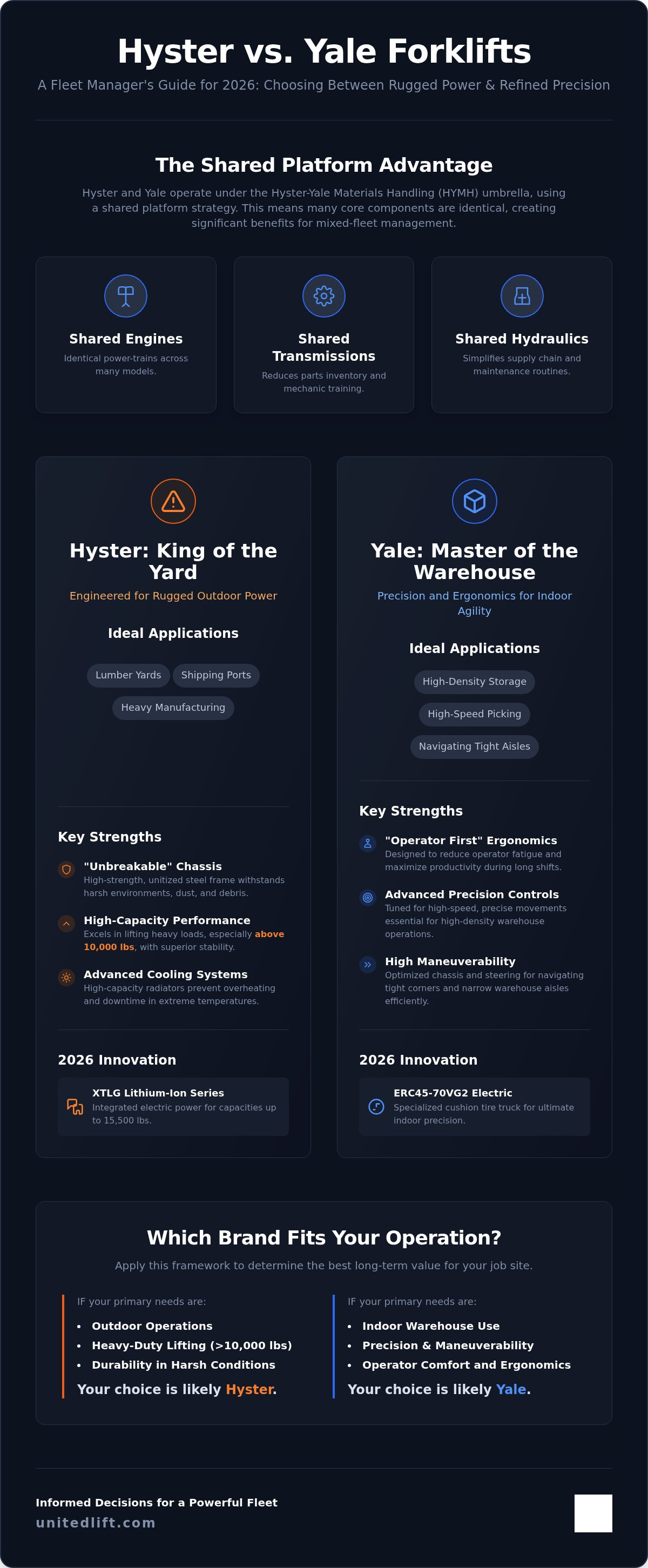
Understanding the relationship between these two giants is the first step in any Hyster vs Yale forklift comparison. They aren't separate competitors fighting for market share from different corners of the world. Instead, they operate under the Hyster-Yale Materials Handling (HYMH) umbrella. This Hyster-Yale Group legacy allows both brands to benefit from massive research and development budgets while maintaining their own specialized market niches. By sharing a corporate parent, they produce high-quality equipment that uses many of the same core parts, which is a win for your maintenance team.
HYMH uses a "shared platform" strategy. This means a Hyster truck and a Yale truck in the same weight class often share the same engines, transmissions, and hydraulic systems. Why does this matter to you? It simplifies your supply chain. If you run a mixed fleet, your mechanics don't need to learn two entirely different systems. Parts are interchangeable across a large percentage of the models, which reduces the amount of inventory you need to keep on your shelves. It's about efficiency and keeping your uptime as high as possible.
Shared Engineering vs. Brand Identity
If the internals are the same, why choose one over the other? It comes down to the "Rugged vs. Refined" philosophy. Hyster is built for the yard. It features an "unbreakable" chassis design meant to handle the vibration and debris of outdoor work. Yale focuses on the "Operator First" experience. You'll find different seat configurations and control layouts designed for high-speed warehouse picking. Even with the same engine, the way the machine responds to operator input is tuned differently to match these specific environments. One is a powerhouse; the other is a precision tool.
The Evolution of Hyster and Yale in 2026
The 2026 product lines show a clear shift toward green energy and automation. Hyster launched the XTLG integrated lithium-ion series on May 19, 2026, targeting capacities up to 15,500 pounds. Yale followed on April 14, 2026, with the ERC45-70VG2, a specialized electric cushion tire truck for indoor precision. Both brands are aggressively integrating telematics and automated guidance to help businesses manage the national labor shortage. These updates ensure that whether you're moving lumber or pallets of electronics, you have access to the latest efficiency tech that keeps your fleet moving.
Hyster Forklifts: Engineered for Rugged Outdoor Power
If your operations involve lumber yards, shipping ports, or heavy manufacturing, Hyster is likely the name at the top of your list. While a Hyster vs Yale forklift comparison shows many similarities under the hood, Hyster separates itself through sheer physical resilience. The 2026 internal combustion (IC) lineup continues this tradition of durability. These machines are built to thrive where dust, mud, and extreme temperatures would sideline lesser equipment. They don't just survive in these conditions; they maintain high productivity levels through every shift.
Durability in Harsh Environments
Hyster's reputation rests on its "unbreakable" chassis design. Every unit is built to Hyster’s Durant chassis durability standards, which utilize a high-strength, unitized steel frame to protect internal components from external impacts. The heavy-duty mast construction is specifically engineered for high-cycle applications. This ensures that the mast doesn't flex or fatigue under constant stress. To combat outdoor heat, Hyster uses advanced cooling systems with high-capacity radiators and optimized airflow. This prevents downtime during the hottest summer months, even in high-dust environments like recycling centers or concrete plants.
High-Capacity Performance and Attachments
When you move into the 10,000-pound and above weight classes, Hyster truly shines. The brand is the preferred choice for ports and heavy manufacturing because of its superior stability during high-lift maneuvers. These trucks handle heavy lumber, steel coils, and concrete pre-casts with a level of poise that gives operators confidence. Modern units also integrate intelligent forklift technology to monitor load stability in real-time. This tech helps prevent tip-overs and ensures that heavy-duty attachments, like paper clamps, rotators, or multi-pallet handlers, operate within safe parameters.
This outdoor focus makes Hyster the "King of the Yard" for 2026. If your site plan involves rough terrain or inclement weather, investing in a rugged chassis is a smart move for your long-term budget. You can browse our current Hyster inventory to see which high-capacity models are ready for national shipping today. While Yale handles the indoor precision, Hyster is the clear winner for anyone needing raw power and weather-resistant reliability. It's the go-to brand for the most demanding physical environments in the material handling world.
Yale Forklifts: Precision and Ergonomics for the Warehouse
If your business revolves around high-density storage and rapid pallet movement, Yale is engineered for your floor. While Hyster tackles the gravel and rain, Yale focuses on the rack. In any Hyster vs Yale forklift comparison, you'll see that Yale prioritizes the "Operator First" design philosophy. This isn't just about a comfortable seat. It's about reducing the micro-stresses that lead to errors and downtime. With the April 14, 2026, launch of the ERC45-70VG2 electric cushion tire truck, Yale solidified its lead in indoor precision. This model is built specifically for the tight turns and high-cycle demands of a busy distribution center.
Operator Comfort and Productivity
Long shifts in a warehouse can be brutal on a driver's body. Yale addresses this with ergonomic cab designs that feature low step-heights and adjustable armrests. Visibility is another major focus. Yale’s mast designs offer clear sightlines for high-rack picking, which is essential for safety in narrow aisles. The "Smart Operator" tech suite helps by providing haptic feedback and automated speed reduction in high-traffic zones. These features directly impact your safety metrics by preventing the fatigue that causes most warehouse accidents. On February 6, 2026, Yale also announced a redesigned three-wheel stand-up lift truck, specifically aimed at improving comfort for operators who must frequently mount and dismount their machines.
Advanced Telematics and Automation
Modern warehouses rely on data as much as horsepower. Current forklift market trends show that 59% of new deployments now utilize telematics. Yale’s 2026 models lead this charge with systems that track battery health and impact detection in real-time. This data integrates directly with your warehouse management system (WMS), allowing for automated maintenance scheduling. For repetitive tasks like cross-docking, Yale’s 2026 autonomous solutions offer a way to combat labor shortages. These self-driving units handle the "grunt work," allowing your skilled operators to focus on more complex picking tasks. It's a proactive approach that moves beyond simple material handling into full-scale fleet optimization.
Yale is the clear winner for high-density indoor environments. Its focus on electric efficiency and operator precision makes it the standard for 2026 warehousing. While Hyster provides the raw power needed for heavy manufacturing, Yale provides the surgical precision required to navigate tight aisles without sacrificing speed. This brand is the logical choice for any facility that values operator retention and data-driven productivity.
Total Cost of Ownership: Resale Value and Maintenance
Calculating the five-year total cost of ownership (TCO) requires looking past the initial invoice. For most fleet managers, the real expenses live in fuel, unplanned repairs, and the eventual resale price. In any Hyster vs Yale forklift comparison, the shared Hyster-Yale Materials Handling (HYMH) engineering provides a unique financial advantage. Since both brands utilize a shared platform strategy, you aren't forced to choose between two completely different mechanical systems. This commonality stabilizes maintenance costs and ensures that parts are readily available across North America, regardless of which nameplate is on the chassis.
Maintenance and Parts Interchangeability
Shared components between Hyster and Yale significantly lower the cost of stocking spare parts. If you run a mixed fleet, your technicians only need to master one primary set of engines and hydraulic systems. This interchangeability reduces the "dead money" tied up in redundant inventory. With 59% of new 2026 deployments now utilizing telematics, both brands offer advanced predictive maintenance. These systems alert you to potential failures before they cause a work stoppage. By catching a small leak or a battery cell imbalance early, you avoid the high costs of emergency repairs and lost productivity.
Pre-Owned Market Performance
The used market for these brands is highly liquid but serves different niches. Hyster equipment typically commands a premium in the used internal combustion (IC) market. Buyers seek out Hyster for its "unbreakable" chassis, knowing these units can handle a second or third life in rugged outdoor environments. Conversely, the demand for used Yale electric units has spiked in 2026. This shift is driven by the California Air Resources Board (CARB) regulations that began on January 1, 2026, which prohibit the purchase of new IC forklifts under 12,000 pounds for many operators.
With electric forklifts now accounting for 69% of market demand, a well-maintained Yale electric truck retains a high percentage of its original value. When you're ready to rotate your fleet, you'll find plenty of buyers for Yale’s lithium-ion models, especially since 67% of new deployments now feature this technology. Before you make a final decision, it's a good idea to check our current inventory of new and pre-owned units to see how these resale trends affect your bottom line. Balancing Hyster’s outdoor durability with Yale’s high-demand electric efficiency allows you to build a fleet that holds its value over the long haul.
Procurement Strategy: Selecting and Financing Your Fleet
Integrating new equipment into your operation requires more than just picking a brand. It's a high-capital decision that impacts your balance sheet for years. To finalize your Hyster vs Yale forklift comparison, use this 4-step checklist. First, assess your environment; gravel and yard work favor Hyster’s rugged chassis, while smooth warehouse floors favor Yale’s precision. Second, verify your maximum load weight to see if you need Hyster’s high-capacity stability for loads over 10,000 pounds. Third, choose your power source. With lithium-ion batteries now in 67% of new deployments, the infrastructure for electric units is more accessible than ever. Finally, prioritize operator feedback on cab ergonomics to ensure long-term productivity and safety.
Financing and Leasing Options
Financing acts as the bridge between needing equipment and owning it. For established businesses with over two years of history and good credit, current 2026 financing rates typically range from 6% to 9% APR. Mid-tier businesses often see rates between 9% and 15%. If you're a startup or facing credit challenges, rates can move into the mid-teens or higher. Leasing offers tax efficiency and lower monthly payments, but purchasing allows you to leverage the 2026 Section 179 tax deduction. This allows qualifying businesses to deduct up to $2,560,000 in equipment purchases. We facilitate these financial paths to ensure your capital stays where it's needed most for daily operations. This procurement strategy ensures that your Hyster vs Yale forklift comparison results in a fleet that actually performs.
The United Lift Advantage
United Lift serves as a proactive partner in your logistical growth. We provide a massive inventory of both Hyster and Yale models, along with telehandlers, scissor lifts, and industrial batteries. Our national reach means we can ship equipment directly to your site and provide support seven days a week. We don't just sell machines; we help you navigate the complexities of fleet management and long-term maintenance planning. For a deeper dive into the technical specs of modern machinery, check out our resource on The Ultimate Forklift Buying Guide for Industrial Success in 2026. Whether you need a rugged Hyster for the yard or a precise Yale for the racks, our team is ready to assist with national shipping and financing facilitation. We understand the urgency of your material handling needs and value your time through direct communication and expert advice.
Choosing the Right Truck for Your 2026 Operations
Your final decision in this Hyster vs Yale forklift comparison rests on where the rubber meets the road. If your team faces the elements in a lumber yard or shipping port, Hyster’s rugged chassis is the industry standard for durability. For those managing high-density distribution centers, Yale’s focus on operator ergonomics and warehouse precision will drive your productivity higher. Both brands offer the benefit of a shared parts network, ensuring your maintenance team stays efficient and your uptime remains high through 2026 and beyond.
United Lift is ready to help you navigate these choices with an extensive inventory of new and pre-owned industrial lifts. We provide national shipping and flexible financing options available for all business sizes, bridging the gap between your operational needs and your budget. Our support team is available seven days a week via phone and email to answer your technical questions or facilitate a quick procurement process. Browse our national inventory of Hyster and Yale forklifts today to find the perfect fit for your site. We look forward to helping you build a more efficient, reliable fleet.
Frequently Asked Questions
Which brand is better for heavy outdoor use, Hyster or Yale?
Hyster is the superior choice for heavy outdoor applications. Its engineering focuses on a unitized steel frame and high-capacity cooling systems that handle dust and heat better than most competitors. While Yale can work outdoors, Hyster’s chassis is specifically designed to absorb the vibrations of rough terrain. This makes it the preferred brand for lumber yards, ports, and heavy manufacturing sites where equipment takes a daily beating.
Are Hyster and Yale parts interchangeable?
Most Hyster and Yale parts are interchangeable because both brands are manufactured by the Hyster-Yale Group. They share a common platform for many internal components like engines, transmissions, and hydraulic pumps. This shared engineering simplifies a Hyster vs Yale forklift comparison by allowing fleet managers to stock fewer unique spare parts. It also means that national technicians can usually service both brands with the same set of tools and knowledge.
Which brand has a higher resale value in the used forklift market?
Hyster typically commands a higher resale value for internal combustion models used in outdoor settings. However, Yale electric units are seeing a massive surge in used market demand due to 2026 emissions regulations. Since electric models now account for a large portion of the market, a well-maintained Yale electric truck often retains a high percentage of its value. Both brands remain highly liquid assets in the pre-owned industrial market.
Does Yale offer better electric forklifts than Hyster?
Yale is widely considered the leader in electric forklift efficiency for indoor applications. Their 2026 lineup is optimized for high-density warehousing and narrow aisle precision. Hyster recently launched the XTLG lithium-ion series for heavy lifting, but Yale’s "Operator First" ergonomics and advanced telematics give it an edge in high-cycle warehouse environments. Yale units are designed to maximize battery life while maintaining fast travel speeds in tight, indoor spaces.
Can I finance a used Hyster or Yale forklift through United Lift?
You can facilitate financing for both new and used forklifts through United Lift. We work with businesses of all sizes to find capital solutions that fit their budget, with 2026 APR rates typically starting around 6% for established companies. Financing acts as a bridge, allowing you to acquire high-quality equipment without exhausting your cash reserves. Our team provides support seven days a week to help you navigate the application process.
What is the main difference between Hyster and Yale for warehouse operations?
The main difference lies in Yale’s focus on precision and Hyster’s focus on raw durability. Yale forklifts feature smaller turning radiuses and better visibility for high-rack picking, making them ideal for narrow aisles. Hyster units are often larger and more rugged, which can be overkill for a clean indoor warehouse. If your priority is operator comfort and fast throughput in a rack-heavy environment, Yale is the more efficient choice for your fleet.
How does Section 179 apply to my forklift purchase in 2026?
Section 179 allows you to deduct the full purchase price of qualifying equipment from your 2026 gross income. For the 2026 tax year, the deduction limit is $2,560,000 for new and used forklifts. This tax benefit is a powerful tool for managing your fleet budget. It encourages businesses to invest in newer, safer technology like lithium-ion trucks while significantly reducing their overall tax liability at the end of the fiscal year.
Which brand is more ergonomic for forklift operators?
Yale is generally the more ergonomic brand due to its "Operator First" design philosophy. Their 2026 models feature low step-heights, adjustable armrests, and intuitive controls that reduce driver fatigue during long shifts. While Hyster has improved its cab designs, Yale’s focus on the operator experience is evident in their redesigned stand-up lift trucks. These enhancements help maintain high productivity levels and improve safety metrics by keeping operators comfortable and alert.
- Tags: Forklift Comparison, Forklifts, Hyster, Hyster vs Yale, Hyster vs Yale forklift comparison, Hyster-Yale Group, Material Handling, Warehouse Equipment, Yale
