
Choose a Telehandler Forklift for Your Job and Load
Posted by United Lift LLC on
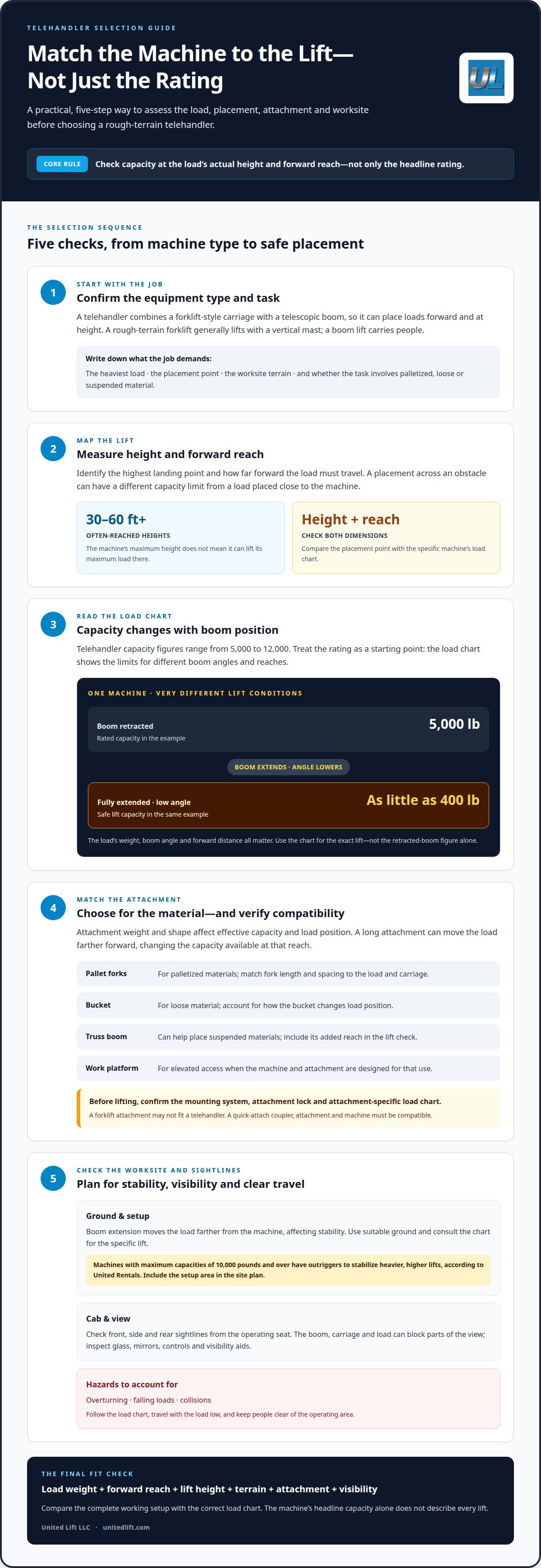
The highest-capacity telehandler forklift isn’t automatically the right choice for your job. A machine rated to lift 5,000 lb with its boom retracted may safely lift as little as 400 lb when the boom is fully extended at a low angle. The load chart, reach and lift height matter as much as the headline capacity.
It’s easy to focus on the weight you need to move, but the worksite and placement point can change which telehandler forklift fits. Choose based on the heaviest load, how far and high it must travel, the ground conditions and the attachments required.
This guide explains how rough-terrain telehandlers differ, how to assess capacity at working reach, and what to consider about attachments and cab visibility. You’ll also learn how to match a machine to construction, agriculture and other job requirements, using practical criteria to narrow your options.
Key Takeaways
- Compare capacity at the load’s actual height and reach, not just the machine’s maximum rating.
- Match the attachment to the material and placement task, since it affects how the machine handles a load.
- Assess cab sightlines and worksite conditions to support clear, controlled material placement.
- Use your job type, ground conditions and load requirements to narrow down the equipment that fits.
Rough-terrain telehandler models and capacity ranges
Choose by load weight, forward reach, lift height and terrain, not capacity alone. Together, these factors determine whether a machine can place the load where the job requires.
A telehandler combines a forklift-style carriage with a telescopic boom. Unlike a conventional forklift, it can place loads forward and at height. A boom lift carries people, while a rough-terrain forklift generally lifts with a vertical mast.
In the United States, purchase or rental costs depend on capacity, reach, configuration and rental period. Compare equipment against the work required rather than choosing by price alone.
Key hazards include overturning, falling loads and collisions. Follow the machine’s load chart, travel with the load low, and keep people clear of the operating area.
U.S. equipment choices include brands such as Hyster, Yale, Toyota, JLG, Genie and Caterpillar. The right model depends on its rated capacity and lift profile.
Lifting Capacity
Telehandler capacity figures range from 5,000 to 12,000, while actual lifting ability changes with boom position. Treat a capacity label as a starting point, not a promise for every placement. The load chart shows the limits at different boom angles and reaches.
For example, a machine rated for 5,000 lb with its boom retracted may safely lift as little as 400 lb when fully extended at a low angle. Match the chart to the load’s weight and forward distance.
Working Height and Lift Reach
Telehandlers can often reach heights of 30 to 60 feet or more. That range doesn’t mean every machine can lift its maximum load at its maximum height. Capacity depends on how far the boom extends and the angle needed to reach the placement point.
Before choosing a model, identify the highest landing point and the required forward reach. Compare both measurements with the machine’s load chart. A load placed close to the machine may have a different capacity limit from the same load placed across an obstacle.
Load Capacity and Stability
As the boom extends, the load moves farther from the machine, changing its stability. Ground conditions and boom position also affect safe lifting. Keep the machine on suitable ground and consult the chart for the specific lift, rather than relying on the retracted-boom rating.
Machines with maximum capacities of 10,000 pounds and over have outriggers to stabilize heavier, higher lifts, according to United Rentals. Include the setup area in your site plan, and use the outriggers as designed for the lift.
Telehandler and forklift attachments
Common telehandler attachments include pallet forks, buckets, truss booms and work platforms. Each affects effective capacity because attachment weight and load position change the lift. Use the load chart for the specific attachment and boom position.
Start with the task. Pallet forks suit palletized materials, while a bucket handles loose material. A truss boom can help place suspended materials, and a work platform supports elevated access when the machine and attachment are designed for that use. A forklift attachment may not fit a telehandler, even if both machines move loads. Match the attachment to the machine’s mounting system and intended job.
Check the mounting interface before choosing an attachment. A quick-attach coupler can make changes more efficient, but the coupler, attachment and machine must be compatible. Confirm how the attachment locks into place and inspect the connection before lifting. For example, a fork carriage that fits one telehandler model may not connect to another model’s mounting system.
Attachment weight and shape also affect reach. A long attachment can move the load farther forward, reducing the capacity available in that position. Follow the machine’s attachment-specific load chart rather than relying on its basic rating. The engine powers the machine, but it does not determine the safe lifting limit.
- Forks: Match fork length and spacing to the load and carriage.
- Bucket: Consider material type and how the bucket changes load position.
- Work platform: Use a compatible platform and the machine’s applicable operating guidance.
- Truss boom: Account for its added reach and the load’s position.
Before selecting a telehandler forklift attachment, write down the load, placement point, required reach and mounting interface. Then compare that setup with the correct load chart. Browse telehandler attachments to explore equipment options for material-handling tasks.
Operator visibility and cab features
Cab sightlines affect how clearly an operator can position loads around construction materials and obstacles. Check visibility from the seat and account for operating weight when planning site access.
Operator Visibility
Look through the front, side and rear sightlines before selecting a telehandler. The boom, carriage and load can block parts of the view, especially during forward placement. Xtreme telehandlers are described as providing 360-degree operator visibility from the cab, but the fitted attachment and load still affect what the operator can see.
From the operating seat, identify blind spots around the tires, boom tip and travel path. Mirrors can help with awareness, while a raised load may still obstruct direct views. Plan construction-site movements so workers remain clear of travel and placement areas.
Cab Features
Assess the controls, seat position and cab glass for the work you handle. A clear forward view helps with pallet placement, while side visibility matters beside a structure. Check that the operator can use the controls comfortably and see the boom and load.
Inspect the glass, mirrors, controls and visibility aids before operation. A cracked window or poorly adjusted mirror, for example, can make nearby obstacles harder to judge. Cab design supports versatility, but it cannot eliminate every blind spot.
In the United States, OSHA classifies telehandlers as Class VII rough-terrain forklift trucks. This identifies the equipment category, not an operator license or training credential.
Before use, inspect the tires, boom, attachment connection, controls and cab glass. Confirm that the load chart is readable before lifting.
Operating weight affects site access and the route surface. Account for both the machine and its load when planning travel.
Choosing a telehandler by job and load
Start with the task, not the machine. On a construction site, a telehandler can place materials at height or over obstacles; in agriculture, it can move supplies to hard-to-reach areas. These applications call for different reach, attachments and operating space.
Write down the load’s weight and dimensions, its pickup point and its destination. Include the route between them. Carrying a load across an open worksite differs from placing materials beyond a wall or in an elevated work area.
Use this job checklist to compare machine capabilities:
- Load: Record the heaviest item and whether its shape needs forks or another attachment.
- Placement: Identify the required height and forward reach, such as setting materials beyond a building edge.
- Terrain: Note whether the route crosses uneven outdoor ground or a finished indoor floor.
- Space: Map turns, access points and the room needed to position and operate the machine.
Then match the task to the equipment type. A standard forklift suits picking up and carrying material between locations. A telehandler adds a telescopic boom for picking, placing and carrying, making it useful when materials must extend forward or reach higher positions. If the job only involves moving loads along a clear warehouse aisle, a telehandler’s reach may not be necessary.
Consider the full operation, not just the delivery point. The machine must reach the load at pickup and at its destination, with an attachment suited to both. For example, moving a palletized load from a staging area to an elevated construction level requires a different setup from handling loose agricultural materials with a bucket.
Use your job list to narrow the requirements, then explore telehandler options that fit the work.
United Lift: Forklifts
United Lift LLC offers telehandlers and forklifts for businesses comparing equipment with job requirements. Once you’ve identified your load, working reach, terrain and attachment needs, explore equipment options with United Lift LLC.
For jobs that require materials to be placed forward or at height, compare telehandler capabilities with the task. For straightforward load pickup and transport, a forklift may be a better fit. United Lift LLC also offers boom lifts and scissor lifts for work requiring elevated access rather than material handling.
Bring your job requirements into the equipment conversation: what you’ll move, where it needs to go and the conditions on site. Contact United Lift LLC to discuss equipment for your work.
Make Your Next Equipment Decision Count
Before choosing a machine, make the decision useful beyond the first lift. Write a brief that separates routine work from occasional exceptions. This can keep a one-off challenge from driving every equipment decision while ensuring unusual tasks are considered.
Use the brief to align the people who schedule material movement with those who operate equipment. A shared view of the job sequence can clarify how equipment fits into daily operations. Revisit the plan when the site layout, materials or project scope changes. The right choice should reflect the work ahead, not assumptions carried over from an earlier phase.
When you’re ready to discuss the next step, contact United Lift LLC about a telehandler forklift. Contact United Lift LLC about telehandlers and move forward with a clearer plan. A practical decision starts with your work, giving you a solid foundation for the job ahead.
Frequently Asked Questions
What is a telehandler forklift and how does it work?
A telehandler forklift is a material-handling machine with a telescopic boom that raises and extends loads. The operator uses the boom and front attachment to pick up materials, move them and place them beyond the machine’s immediate reach. For example, palletized supplies can be lifted over an obstacle and set down at a work location. Its boom distinguishes it from a conventional vertical-mast forklift.
What are telehandlers commonly used for?
Telehandlers move and position materials in construction and agriculture, especially when a load must reach an elevated or obstructed placement point. A construction crew might use one to position supplies near an upper work area; an agricultural operation might move feed or materials around a working site. The key question is whether the job involves placing a load, rather than simply transporting it across a floor.
What are the different types and sizes of telehandlers?
Telehandlers include rough-terrain models designed for outdoor work, with model differences in capacity, boom reach and lifting height. Some machines with maximum capacities of 10,000 pounds and over have outriggers for stabilization during heavier, higher lifts. Rather than choosing by a size label, compare the machine’s dimensions and working capabilities with access routes, available setup space and the intended placement point.
What is the lifting capacity and maximum reach of a telehandler?
Telehandler capacity depends on the model and boom position, so its maximum rating doesn’t apply to every lift. A useful planning figure for height is 30 to 60 feet or more, though reach varies by machine. Consider the load’s destination and boom extension together: the farther the load moves forward, the more important it is to assess capacity at that working position.
What licenses, training, and OSHA rules apply to telehandler operators in the United States?
OSHA classifies telehandlers as Class VII rough-terrain forklift trucks. This identifies the equipment category, not an operator license or training credential.
Which telehandler brands and models are popular in the United States?
U.S. telehandler choices include Hyster, Yale, Toyota, JLG, Genie and Caterpillar. The right model depends on its rated capacity and lift profile.
- Tags: construction equipment, equipment attachments, jobsite safety, load capacity, material handling, rough-terrain equipment, telehandler forklift, telehandler forklifts
