
12k Telehandler Reach and Model Options for Equipment Buyers
Posted by United Lift LLC on
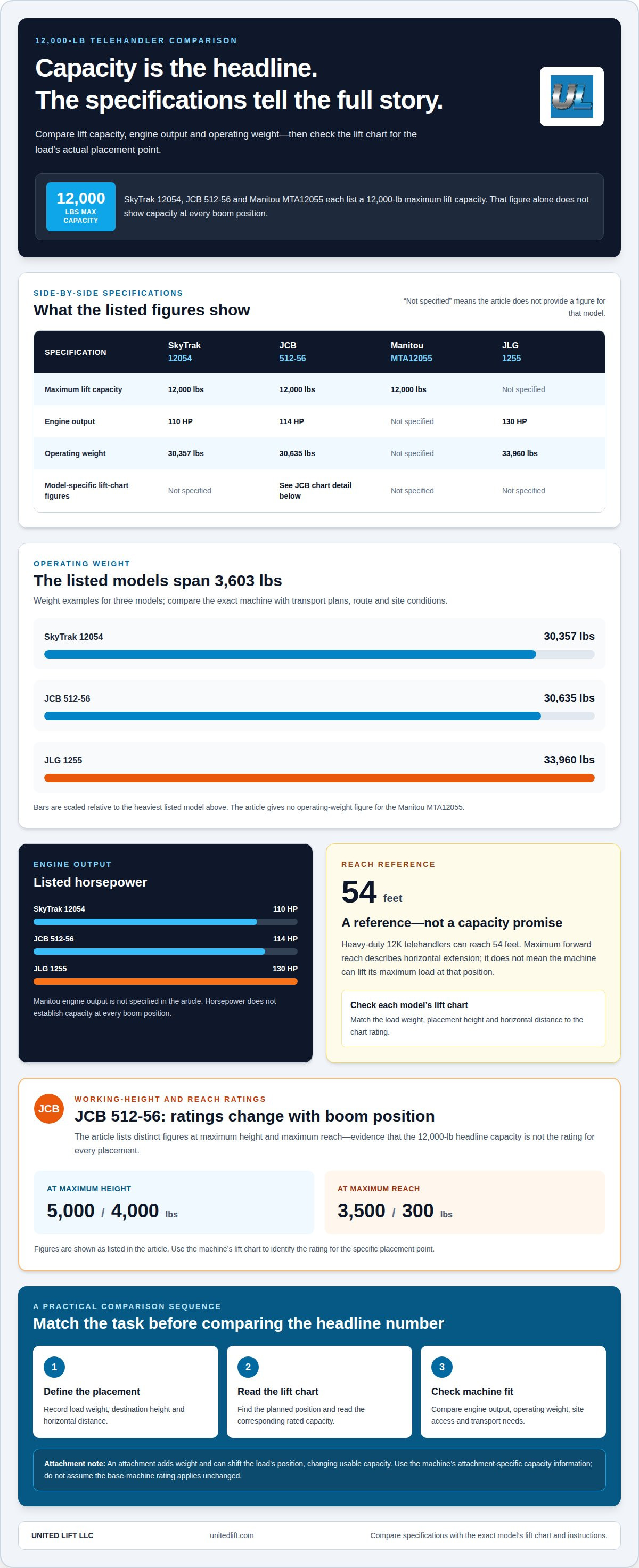
A 12k telehandler with 52-56' reach can lift up to 12,000 lbs and reach 54 feet. The JCB 512-56, SkyTrak 12054, and Manitou MTA12055 each have a maximum lift capacity of 12,000 lbs. But capacity alone won’t show how a machine performs at height or how its weight and engine specifications compare.
Choosing a telehandler means matching the machine to the lift, reach, and jobsite requirements. You’ll want to compare what it can lift at working height, not just its maximum capacity.
This guide compares 12,000-lb telehandler models, including maximum lift height, operating weight, engine power, and other key specifications. Use the details to narrow your options and understand which figures matter most for your work.
Key Takeaways
- Compare rated capacity at the height and reach your lift requires, not just the machine’s maximum capacity.
- Engine output varies across models, so weigh it alongside the lift specifications that match your work.
- Operating weight can differ substantially between 12,000-lb telehandlers; factor it into equipment and site planning.
- Use the full specification picture to narrow your shortlist before comparing equipment options.
Maximum lift height
Maximum lift height tells you how high a telehandler can place a load. Maximum forward reach measures how far the boom extends horizontally. Heavy-duty telehandlers, including 12,000-lb models, can reach 54 feet. That figure describes reach, not the load capacity available at every boom position. A forklift’s capacity label alone won’t show that difference.
The JCB 512-56 lists lift capacity at maximum height as 5,000/4,000 lbs. A telehandler’s capacity can vary with boom position. These figures describe different positions in the machine’s working range. The listed values show why maximum capacity and usable capacity at height or reach are not interchangeable.
Compare the lift chart at the placement point your job requires. First, identify the load’s destination height and horizontal distance from the telehandler. Then find that position on the chart and read the corresponding capacity. A load placed high and close can have a different rated capacity than one positioned farther forward. For the JCB 512-56, the maximum-height and maximum-reach figures make that distinction clear.
Use maximum lift height and maximum forward reach together when assessing a 12k telehandler with 52-56-foot reach. A machine may reach the required height but fall short horizontally, or reach forward while offering less capacity. The 54-foot reach figure gives a useful reference for heavy-duty models. Your actual placement point determines which chart value matters.
Before comparing models, write down the load weight, placement height, and distance from the machine. Match all three to the lift chart, rather than relying on a 12,000-lb headline capacity. For example, the JCB 512-56 lists 5,000/4,000 lbs at maximum height and 3,500/300 lbs at maximum reach. Those distinct ratings help buyers compare the lift envelope against the task.
12,000-Lb telehandler models by manufacturer
The SkyTrak 12054, JCB 512-56, and Manitou MTA12055 each have a maximum lift capacity of 12,000 lbs. Heavy-duty 12K telehandlers can reach 54 feet, giving buyers a useful reference for comparing machines in the 52-to-56-foot range.
Engine output adds another point of comparison. Look at the model name, rated capacity, and engine specification together.
Model and Engine Specifications
Engine specifications can vary by model, so check the listed specifications when comparing machines. The JLG 1255 lists a 130 HP diesel engine. These figures help distinguish engine output, but they don’t establish a model’s capacity at every boom position. Compare each machine’s lift chart with your required load and placement point.
Start your shortlist with the SkyTrak 12054, JCB 512-56, and Manitou MTA12055 when a 12,000-lb maximum capacity is central to the job. Then compare engine output and the rated capacity at your working height and reach. For rental comparisons, focus on the machine’s rated specifications rather than the broad “12K” label alone.
Manufacturer Model Comparisons
Among the named models, SkyTrak, JCB, and Manitou each have a listed 12,000-lb maximum capacity. Engine figures are available for SkyTrak and JCB: 110 HP and 114 HP, respectively. The JLG 1255 lists 130 HP. Compare these figures alongside each model’s lift chart, reach, and height requirements instead of treating engine power as a capacity rating.
Genie belongs in a manufacturer-level comparison, but no specific Genie model or engine figure is included here. Keep the comparison practical: record the exact model, rated capacity, engine output, and lift-chart rating for the intended placement. A 54-foot reach reference helps narrow the field, while model-level ratings guide the final equipment match. You can compare telehandler options as you refine your shortlist.
12K telehandler operating weight
Operating weight matters for transport planning and construction-site access. The SkyTrak 12054 is listed at 30,357 lbs, the JCB 512-56 at 30,635 lbs, and the JLG 1255 at 33,960 lbs. Compare the exact model’s weight with the route, ground conditions, and equipment transport plan.
These figures show a 3,603-lb difference between the lightest and heaviest listed models. That difference can affect planning for loading, transport, and site placement. Use the model’s operating weight, rather than its 12,000-lb lift capacity, when considering the machine itself.
For U.S. construction work, identify the task and worksite, then align operator qualifications and personal protective equipment with applicable OSHA requirements, site rules, and the machine’s instructions. Select protective equipment for the hazards present, and follow the telehandler’s operating instructions.
Machine safety equipment and site PPE serve different purposes. Before work begins, review the telehandler’s safety features and instructions, then identify protective gear required for the task and work area. When preparing the work zone, preserve the operator’s visibility and access to controls, and plan how the load will be handled.
Typical maintenance includes inspecting and maintaining the engine, tires, boom, and hydraulic system. Follow the specific telehandler’s maintenance schedule, and address wear or damage before assigning it to a lift. Fuel use varies with workload, travel, idle time, terrain, and attachments. Maintenance, wear parts, and downtime also affect operating costs, so assess them against the planned work instead of relying on a generic estimate.
For a practical comparison, record each model’s operating weight, intended route, work surface, and maintenance needs. The SkyTrak 12054, JCB 512-56, and JLG 1255 provide listed weight examples for a shortlist. Pair those figures with site access and task-specific safety planning to assess fit before selecting a machine.
Telehandler equipment specifications
Choose an attachment that suits the load and task, and use the machine’s attachment-specific capacity information. An attachment adds weight and can shift the load’s position, changing usable capacity. Never assume the base-machine rating applies unchanged.
Read the complete specification sheet as a set, not as isolated figures. The SkyTrak 12054 is listed at 30,357 lbs, giving buyers one reference for planning machine transport and jobsite access. Match the model’s stated operating weight, maximum capacity, reach, and height to the demands of the work. A 12,000-lb headline rating alone doesn’t describe performance across the entire lift range.
Terrain and travel conditions matter too. A 12K telehandler rental is described with four-wheel drive for maneuverability on rugged or uneven terrain. Treat that as a configuration detail to compare with the jobsite, not a substitute for checking the machine’s other specifications. Consider the access route, surface, and space needed to approach the lift point.
Before choosing a machine, build a comparison sheet with the exact model, rated capacity, operating weight, reach, lift height, engine output, and compatible attachment information. Add the load’s weight, required placement point, and site conditions. This makes it easier to focus on relevant specifications instead of comparing machines by capacity alone.
Use the machine’s load chart for the intended attachment and lift position. Check how the attachment affects the load center and applicable capacity, especially when working at height or extended reach. If the task changes, such as when switching loads or attachments, reassess the setup and rated limits before lifting.
For equipment selection, compare telehandlers and compatible telehandler attachments against your load, placement, and terrain requirements. A clear specification checklist helps you narrow the options and focus on the machine configuration that fits the job.
Select an attachment compatible with the load and task, and consult the machine’s attachment-specific capacity information. Attachments add weight and can shift the load’s position, changing usable capacity. Check the load chart for the intended attachment and lift position.
United Lift: Forklifts
United Lift LLC offers telehandlers for buyers comparing reach, capacity, and equipment specifications. If the job calls for another type of lift, the equipment range also includes forklifts, boom lifts, and scissor lifts.
Include load requirements, placement height, forward reach, and jobsite conditions in your equipment decision. These details help you compare machine types and specifications against the task. If you plan to use an attachment, assess it alongside the telehandler’s rated capacity and load chart.
Turn to United Lift LLC when narrowing equipment options for material handling or elevated work. Contact United Lift LLC to discuss your requirements and find equipment suited to the task.
Move from specifications to the right equipment choice
Use your job’s load, placement point, and site conditions to shape the final equipment decision. A 12k telehandler with 52-56' reach can be a fit for demanding lifts, but the best match starts with the task, not the model name. Bring those requirements into your equipment comparison so you can focus on the specifications that matter for your work.
United Lift LLC offers telehandlers, forklifts, and boom lifts for material handling and elevated work. Whether you have a shortlist or are still comparing options, discuss your telehandler requirements with United Lift LLC.
Contact United Lift LLC about telehandlers and move forward with a clearer equipment plan.
Frequently Asked Questions
What are the load charts and capacities at full reach for 12K telehandlers?
A telehandler’s rated capacity can vary at full reach depending on the boom position and attachment. Read the exact model’s load chart for the boom position and attachment used, since the chart connects those conditions to rated capacity. For a lift near full extension, compare the chart’s corresponding rating with the complete load, including any attachment, before planning the placement.
What are the key dimensions, operating weight, and turning radius of 12K telehandlers with 52-56 ft reach?
Listed operating weights include 30,357 lbs for the SkyTrak 12054, 30,635 lbs for the JCB 512-56, and 33,960 lbs for the JLG 1255. Dimensions and turning radius are model-specific. Use the exact machine’s specification sheet to plan transport clearance, access through gates, and maneuvering space around staging areas or obstacles.
What does it cost to rent a 12K telehandler with 52-56 ft reach, including delivery?
Rental and delivery charges depend on the rental term, delivery route, and equipment arrangement. United Lift LLC sells telehandlers rather than offering short-term rentals. For a purchase, compare the machine’s specifications with the intended workload and ownership needs. Rental quotes and delivery charges do not determine the cost of an equipment purchase.
What site conditions, setup, and safety precautions are required for operating a high-reach telehandler?
Assess ground conditions, slopes, overhead obstructions, travel paths, and the space needed to position the machine. Follow the specific telehandler’s operating instructions and load chart, accounting for the attachment and load placement. Keep people clear of the work area during lifting, and reassess if the surface, route, or lift plan changes.
Which telehandler models have a 12,000 lb capacity and 52-56 ft maximum lift height?
The SkyTrak 12054, JCB 512-56, and Manitou MTA12055 each have a maximum lift capacity of 12,000 lbs. Heavy-duty 12K telehandlers can reach 54 feet, but check each model’s specifications and lift chart for the required height and reach.
What attachments are available for 12K telehandlers, and how do they affect capacity?
Choose an attachment compatible with the load and task. Attachments add weight and can shift the load’s position, changing usable capacity, so consult attachment-specific capacity information and the load chart for the intended lift.
- Tags: 000-lb telehandlers, 12, 12k telehandler 52-56' reach, equipment specifications, JCB 512-56, lifting equipment, Manitou MTA12055, SkyTrak 12054, telehandlers
