
Factors Affecting Forklift Resale Value: What Shapes Your Price
Posted by United Lift LLC on
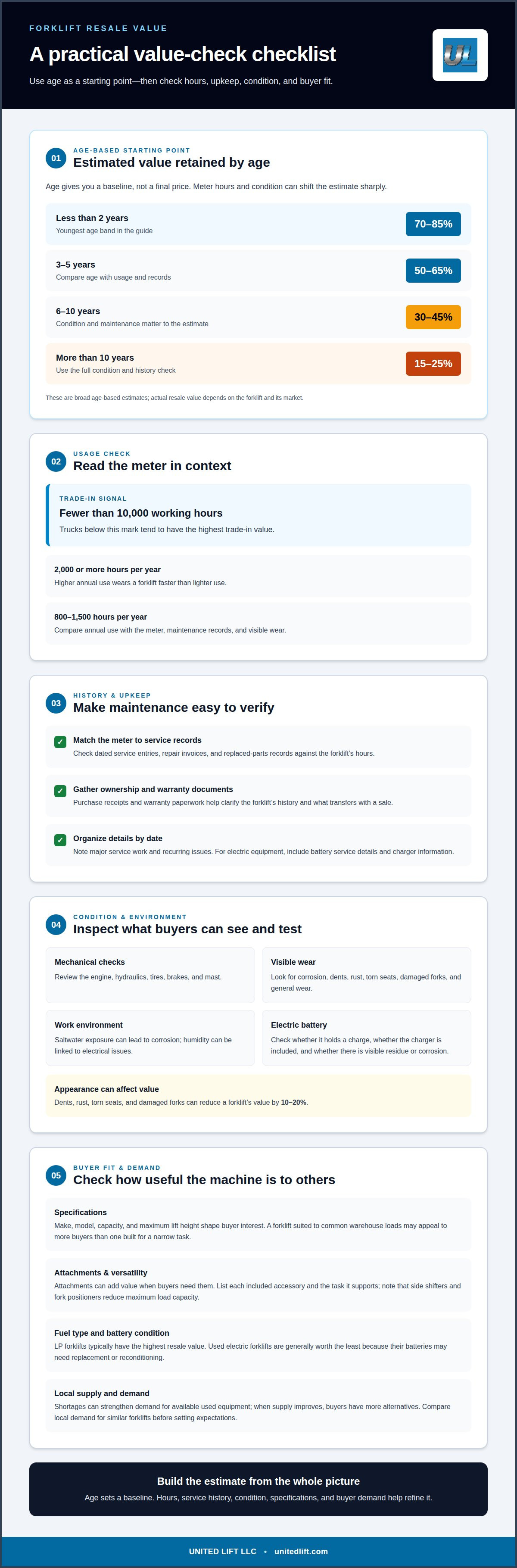
A forklift’s age gives you a starting point for estimating its resale value, but hours and condition can shift the price sharply. The factors affecting forklift resale value include age, operating hours, maintenance history, condition, equipment type, and buyer demand. As a broad age-based estimate, forklifts less than 2 years old retain 70-85% of their value, while those more than 10 years old retain 15-25%.
It’s natural to focus on the purchase price, but the meter hours and service history tell a fuller story. A lower-hour forklift with organized maintenance records and useful attachments may appeal more to buyers than a newer machine showing heavy wear.
This guide explains how age and use shape resale value, when selling or trading in may make sense, and how market conditions and equipment shortages affect demand. You’ll also find practical ways to assess your forklift before deciding what to do next.
Key Takeaways
- Use the forklift’s age and operating hours together to build a more realistic estimate than age alone can provide.
- Gather ownership, warranty, and maintenance documents to help buyers assess the equipment’s history.
- Consider current equipment demand and supply conditions when deciding when and how to sell.
- Compare your forklift’s remaining useful life with its condition and upkeep to judge whether selling or trading in makes sense.
1. How do I know my forklift’s resale value?
Typical used forklift prices in the United States vary with age, capacity, and condition. Age-based estimates offer a useful starting point: forklifts less than 2 years old retain 70-85% of their value, while those aged 3-5 years retain 50-65%. At 6-10 years, estimates fall to 30-45%; over 10 years, they’re 15-25%.
Next, compare operating hours with the forklift’s age. Trucks with fewer than 10,000 working hours tend to have the highest trade-in value. Annual use matters too: a forklift used 2,000 or more hours annually wears faster than one used 800-1,500 hours. Check the meter against maintenance records and visible wear before estimating value.
Make, model, and brand reputation affect resale prices by shaping buyer demand and perceived usefulness. Capacity and maximum lift height matter because they determine the loads a forklift can handle. Match those specifications to material handling needs: a truck suited to common warehouse loads may appeal to more buyers than one built for a narrow task. Attachments can add value when buyers need them, though side shifters and fork positioners reduce maximum load capacity.
Condition and operating environment also shape an estimate. Look for corrosion after saltwater exposure, electrical issues linked to humidity, and battery wear from extreme temperatures or moisture. For electric forklifts, check whether the battery holds a charge and whether the charger is included. Dust, chemicals, excess water, and cold can shorten useful life compared with climate-controlled storage.
Versatility can broaden buyer interest. A forklift suited to both indoor and outdoor work may fit more operations than a highly customized truck. In the United States, diesel or traditional-fuel forklifts may be subject to EPA emissions standards for non-road equipment. Consider this alongside other factors affecting forklift resale value when selling or trading.
2. Is it better to sell or trade in my forklift?
A private sale is listed as returning 80-100% of value; a dealer trade-in, 60-80%; and an auction, 50-70%. These ranges help compare routes, but your forklift’s condition, records, and buyer demand shape the offer.
A private sale may suit sellers prepared to handle buyer questions, arrange inspections, and negotiate directly. A dealer trade-in can simplify replacing equipment, while an auction offers another way to reach buyers. Compare the expected return with the time and effort each option requires.
Prepare proof of ownership, the purchase receipt, and any warranty documentation before listing or trading. These documents help establish the forklift’s history and clarify what transfers with the sale. Some dealers offer used-forklift warranties lasting from 1 to 5 years, but terms differ by seller and equipment.
Maintenance records provide useful detail. Gather dated service entries, repair invoices, and records of replaced parts. A documented history of regular servicing helps buyers understand how the forklift was cared for. Preventive maintenance and repairs made as issues arise can build confidence in its condition.
Make the paperwork easy to follow. Organize records by date, noting major service work and recurring issues. Include battery service details for electric equipment, along with documentation for included attachments. Clear records make it easier to explain the forklift’s operating history without relying on memory.
Before choosing a sale route, arrange an inspection to identify concerns and prepare a detailed maintenance report. Check the engine, hydraulics, tires, brakes, and mast, then compare your findings with the service history. Cosmetic wear, dents, or a dirty exterior can affect buyer perception, while unexplained gaps in records may raise questions.
Use the inspection and records to set a realistic asking price. If maintenance costs approach or exceed the forklift’s resale value, trading it in or retiring it may make more sense than investing further. For a sale, describe its condition plainly and include ownership and service paperwork.
3. Economic conditions and equipment shortages
Used forklift prices surged during the 2021-2022 supply chain disruption. OEM backlogs constrained new-equipment supply, pushing buyers toward used material handling equipment. That period shows how shortages can strengthen resale demand. When replacements are difficult to source, buyers may consider available used units sooner. When supply improves, sellers face more alternatives, so condition, capacity, and readiness matter more. Compare local demand for similar forklifts before setting expectations.
Equipment shortages can shift which specifications buyers prioritize. A warehouse seeking equipment quickly may value a ready-to-operate forklift that fits its load and aisle requirements. A highly specialized unit may attract fewer buyers, even when supply is tight. Consider likely buyer needs, then clearly present the forklift’s capacity, attachments, and operating condition.
Fuel type and battery condition also influence buyer interest. LP forklifts typically have the highest resale value, while used electric forklifts are generally worth the least because their batteries may need replacement or reconditioning. For an electric model, show whether its battery holds a charge and include the charger with the sale when available. Corrosion or powdery residue can signal battery degradation, so document its visible condition.
How much do attachments and included accessories increase resale value? Their contribution depends on whether buyers need them. Clamps, fork extenders, cages, and aerial platforms can make a forklift more useful, while equipment tailored to one application can narrow its appeal. List each included accessory and explain the task it supports.
Appearance gives buyers another clue about care. Dents, rust, torn seats, and damaged forks can reduce a forklift’s value by 10-20%. Before selling, clean the truck, remove personal items, and address visible rust or paint damage. Then photograph it from every angle, including the battery, forks, and attachments. Clear images help buyers assess condition and compare the machine with other available options.
4. Forklift lifespan and resale valuation
A forklift’s useful life is better judged by hours, condition, and service history than calendar age alone. With proper maintenance, most forklifts last 8,000 to 12,000 hours, roughly 5 to 10 years. Use that range to frame expected service life; resale value still depends on condition and buyer demand.
Meter hours help indicate how much working life may remain. A forklift used for steady warehouse shifts can accumulate wear differently from one used intermittently. Look beyond the meter: inspect the mast, hydraulics, tires, and forks, then compare their condition with recorded use. Buyers weigh that evidence against the forklift’s age.
Resale value also reflects the difference between a forklift’s wholesale value and the price a buyer is willing to pay. A machine in good condition with average working hours may sell around wholesale value. Proper upkeep and a clear account of repairs help buyers understand its remaining usefulness instead of judging by age alone.
Capacity affects the pool of potential buyers. A higher-capacity forklift can handle larger loads, but its resale appeal depends on whether buyers need that capability. Maximum lift height, attachments, and suitability for indoor or outdoor work also shape its usefulness. A versatile truck can serve more applications than one customized for a single task.
Use maintenance and operating costs to decide whether to keep or sell. Preventive maintenance can extend lifespan, improve efficiency, and help limit premature equipment failure. If repair needs keep growing, compare the cost of continued ownership with the value of selling or trading in. Focus on working condition, not just model year.
For a practical estimate, record the hour-meter reading, age, capacity, service history, and visible issues. Then compare the machine with similar forklifts and account for its remaining service life. If replacement is part of your plan, compare equipment options for your next material handling needs.
United Lift: Forklifts
After assessing your forklift’s condition and resale outlook, United Lift LLC can help with your next equipment decision. If you’re planning a replacement, explore its forklift options and compare them with your workload, capacity requirements, and operating environment.
United Lift LLC also offers boom lifts, telehandlers, and scissor lifts for different material handling and access needs. Matching the equipment type to the job keeps your next purchase focused on practical requirements, rather than age or resale value alone.
Review your operating needs and decide which equipment category fits your next step. Contact United Lift LLC to discuss your equipment needs.
Make your next equipment move with confidence
Use the factors affecting forklift resale value as a planning tool, not just a final score. A clear view of your equipment’s condition can help you decide whether to keep it, sell it, or plan a replacement. Then define what the next machine must handle, from daily loads to your worksite layout.
United Lift LLC offers forklifts, boom lifts, and telehandlers for different equipment needs. Compare the type of machine you need with the work ahead, and make your next decision with practical requirements in mind.
Contact United Lift LLC today to discuss your next equipment step. A focused plan can help you move forward with confidence.
Frequently Asked Questions
How do I know my forklift’s resale value?
Estimate value by comparing similar forklifts with the same fuel type, capacity, and lift configuration. Note differences in condition, especially the tires, forks, and mast operation. Then seek multiple purchase offers to understand what buyers may pay for your specific machine. Asking prices provide context, but offers better reflect current buyer interest.
Is it better to sell or trade in my forklift?
A private sale may suit you if you can manage buyer inquiries, viewings, and negotiations. Trading in can be practical when you’re replacing equipment and prefer to handle the outgoing forklift as part of that decision. An auction is another option, though the outcome depends on bidding interest. Weigh likely return against the effort and timing involved.
Do electric forklifts hold value better?
Used electric forklifts may generally have lower resale value than LP models because buyers consider potential battery replacement or reconditioning. Battery condition can change that assessment. For example, a buyer comparing two similar trucks will weigh battery performance and charging capability alongside working condition. Include clear battery details when presenting an electric forklift for sale.
What is the average lifespan of a forklift?
With proper maintenance, most forklifts last 8,000 to 12,000 operating hours, roughly 5 to 10 years. That range is a planning guide, not a calendar deadline. A machine used for light, intermittent work may accumulate wear differently from one in demanding daily service. Review its hour meter alongside the operating history and the condition of key components.
How do forklift age and operating hours affect resale value?
Age and meter hours help buyers estimate how much service life remains, but neither tells the whole story. A low-hour reading paired with heavy wear can raise questions about the meter or operating conditions. Compare recorded hours with the forklift’s physical condition and maintenance timeline. A consistent history gives buyers a clearer basis for assessing expected use.
How does equipment condition and maintenance history affect forklift resale value?
Condition shows buyers what needs attention now, while maintenance history helps explain how the forklift reached that state. A written inspection report can separate cosmetic issues from functional concerns and identify items needing follow-up. For example, documenting a visible leak or damaged fork gives buyers a specific issue to assess instead of leaving them to guess about the machine’s overall condition.
- Tags: equipment sales, equipment valuation, factors affecting forklift resale value, forklift maintenance, forklift operating hours, forklift resale, material handling, used forklifts
