
Dual fuel forklift pros and cons: propane or gasoline
Posted by United Lift LLC on
A dual-fuel forklift typically runs on propane (LPG) as its primary fuel and gasoline as a backup. Most models let the operator switch fuels, so gasoline can keep the forklift running when propane runs out. The dual fuel forklift pros and cons involve more than having a backup: fuel costs, emissions, refueling, and operating conditions all matter.
Two fuel options can be appealing when work needs to keep moving. But the right choice depends on where the forklift operates and how your team manages fueling and maintenance.
This guide explains how dual-fuel systems work and compares them with dedicated propane, gasoline, and electric forklifts. You’ll find the practical advantages and trade-offs, including indoor ventilation needs and the added complexity of managing two fuel systems, to help determine which setup suits your operation.
Key Takeaways
- Compare propane, gasoline, and electric forklifts by their emissions and maintenance demands to narrow down the right fuel setup for your worksite.
- Build safe fuel selection and tank-changing steps into operator routines to reduce avoidable interruptions and handling risks.
- Consider where the forklift will operate before relying on gasoline as a backup, especially when work moves between indoor and outdoor areas.
- Factor in the added parts and service needs of two fuel systems when weighing flexibility against maintenance complexity.
What Does A Dual Fuel System Forklift Run On?
A dual-fuel forklift can use two fuel systems, most commonly propane (LPG) and gasoline. Before choosing a setup for a warehouse or job site, compare emissions, fuel access, and maintenance needs.
Compressed Natural Gas
Some dual-fuel forklifts pair natural gas with diesel rather than propane with gasoline. Like other combustion-powered forklifts, a natural-gas model produces exhaust, so indoor use requires attention to ventilation. Its practical advantage depends on access to natural-gas fueling infrastructure at the worksite. Compare that access with the convenience of replacing LPG cylinders or refueling a gasoline unit before choosing this option.
Diesel Fuel
Diesel forklifts use compression-ignition engines and can suit demanding outdoor work, but diesel combustion produces exhaust. Propane burns cleaner than diesel, while electric forklifts avoid combustion emissions during operation. Fuel efficiency varies by forklift and workload, so compare actual operating patterns rather than assuming one fuel always uses less. Diesel also requires managing a separate fuel supply and engine maintenance needs.
Propane, Gasoline, And Electric
Propane can cost less than gasoline or diesel, and LPG forklifts can be refueled by replacing a depleted cylinder. Dual-fuel engines add flexibility but may be less fuel-efficient than engines designed for one fuel. LPG units also have higher maintenance costs than electric forklifts because they contain more moving parts. LPG exhaust includes carbon monoxide and nitrogen oxides, so indoor operation requires adequate ventilation. Gasoline forklifts are better suited to outdoor applications.
Fuel and operating costs depend on fuel prices, workload, and maintenance. Propane can reduce fuel expenses compared with gasoline or diesel, while electric forklifts generally require less maintenance than LPG units.
| Fuel option | Emissions | Fueling and maintenance |
|---|---|---|
| Dual fuel, LPG and gasoline | Combustion exhaust; indoor ventilation matters | Two systems; backup fuel adds flexibility |
| Diesel | Combustion exhaust; dirtier than propane | Diesel supply and engine upkeep |
| Electric | No combustion exhaust during operation | Lower maintenance than LPG |
| Compressed natural gas | Combustion exhaust | Depends on site fueling infrastructure |
A dual-fuel forklift can be a good fit when a job site needs fuel flexibility and can manage both supplies. Consider another option if indoor emissions or simpler maintenance are the priority.
Operator fuel-selection and tank-changing errors
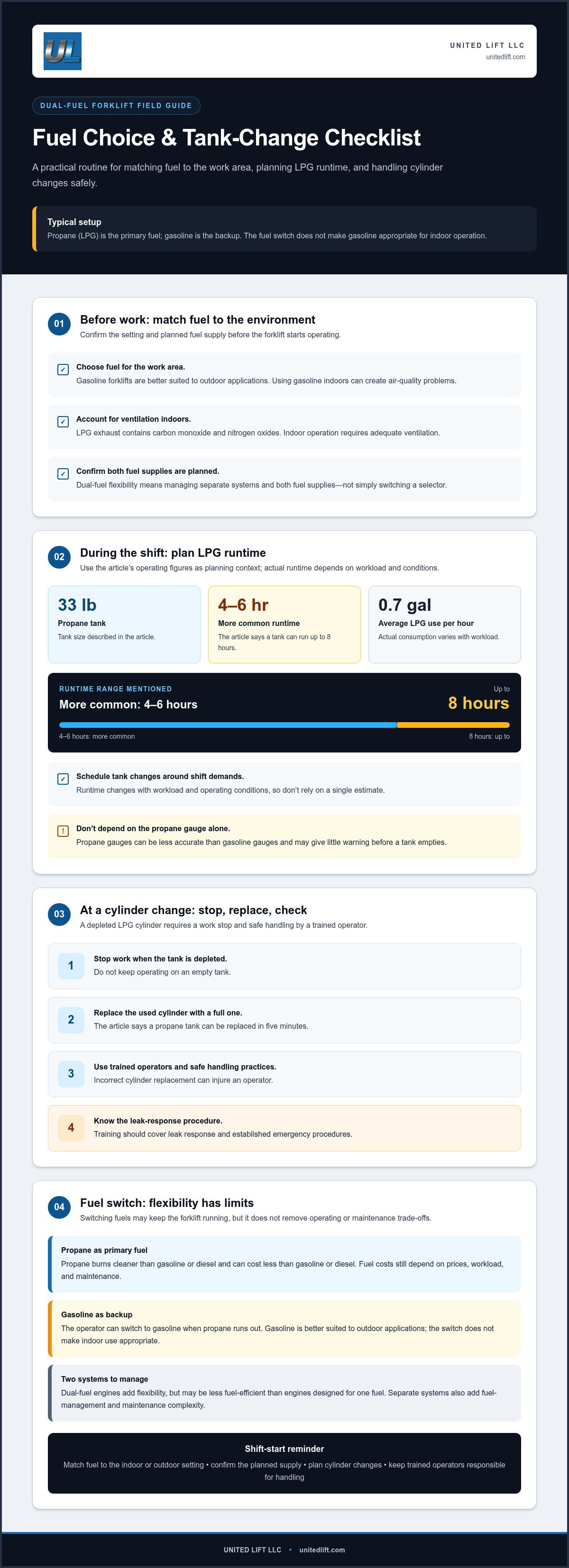
Fuel flexibility helps only when operators choose the right supply for each application. Most dual-fuel forklifts have a switch between propane and gasoline, but using gasoline indoors can create air-quality problems. LPG exhaust also contains combustion byproducts, so indoor operation requires adequate ventilation.
The main disadvantages and safety risks include managing two fuels, unexpected propane depletion, and unsafe tank changes. Incorrectly replacing an LPG tank can injure an operator, while a leak requires following established emergency procedures. Training should cover safe tank handling, leak response, and when to select each fuel.
A 33-pound propane tank can run for up to eight hours, though four to six hours is more common. Average consumption is about 0.7 gallons of LPG propane per hour. Actual runtime depends on workload and operating conditions, so plan tank changes around shift demands rather than relying only on the gauge.
Propane gauges can be less accurate than gasoline gauges and may provide little warning before a tank empties. LPG cylinders have finite capacity, so replacing a depleted tank requires the operator to stop work. A propane tank can be replaced in five minutes, but operators must follow safe handling practices.
To refuel, replace the used cylinder with a full one. Don’t keep operating on an empty tank. The fuel-selection switch lets the operator move between propane and gasoline without changing the cylinder. The time required to switch varies, but selecting gasoline does not make indoor operation appropriate.
For a dual-fuel setup, make the choice before work begins: match fuel to the indoor or outdoor environment, confirm the planned supply, and keep trained operators responsible for tank changes. This reduces avoidable stoppages and helps control emissions across changing applications. For broader planning, compare your needs with material-handling equipment options.
Propane as the primary fuel and gasoline as backup
Dual-fuel forklifts typically use propane as the primary fuel and gasoline as a backup. Propane powers the internal combustion engine during normal work; the operator can switch fuels when propane runs out. Gasoline offers another operating option, but it doesn’t make indoor use appropriate. Fuel choice still needs to match the work area and its ventilation.
Propane burns cleaner than gasoline or diesel, producing fewer pollutants. It can also cost less than gasoline or diesel, which may reduce fuel expenses. The trade-off is added fuel-system complexity: a dual-fuel forklift has separate systems, and the business must manage both fuel supplies. Compare potential fuel savings with the work involved in safely storing and handling each fuel.
Gasoline forklifts are better suited to outdoor applications, not indoor work. If a forklift moves between a warehouse and an outdoor yard, operators need to choose the fuel that suits each environment. Using gasoline indoors where LPG is required can create air-quality problems or non-compliance. A fuel switch doesn’t remove the need to match fuel use to the operating setting.
Plan storage for both fuel supplies before relying on the backup option. LPG cylinders require specific handling and should be stored outdoors in a well-ventilated, secure area away from ignition sources. Gasoline also requires managed on-site storage. Keeping two fuels can take more space and requires following two sets of safety procedures, so account for storage in the site layout.
On many dual-fuel forklifts, switching to gasoline activates a solenoid valve, allowing gasoline to flow into the engine. Treat the switch as a deliberate operating step, not a reason to postpone propane-cylinder replacement indefinitely. The practical drawbacks include added storage demands and a more complex fueling routine; the benefit is a backup supply when propane runs out. For material handling across indoor and outdoor areas, map fuel choice, storage, and operator steps to each application.
Fuel-system maintenance complexity
A dual-fuel forklift has separate propane and gasoline delivery systems, adding components compared with a single-fuel model. That flexibility is useful when the preferred fuel runs out, but each system has parts that can wear or fail. Maintenance planning needs to cover both fuel types, not just the one used most often.
The LPG system includes components such as a vaporizer or regulator and a lock-off valve. These parts need inspection and servicing as part of propane-system maintenance. Changing a propane tank is separate from engine maintenance, so keep safe handling procedures distinct from mechanical checks. A missed inspection can leave a fuel-system issue unnoticed.
Propane has one maintenance advantage over gasoline: it doesn’t leave carbon deposits on the engine. However, LPG forklifts still have higher maintenance costs than electric forklifts because they contain more moving parts. The right comparison depends on what matters most to your operation: fewer combustion-system components or the ability to keep using an internal-combustion model.
Diagnosis can also take more work. A technician may need to trace a problem through two fuel-delivery systems, and dual-fuel maintenance can require specialized training. For example, if an engine runs poorly after the operator switches fuels, diagnosis needs to consider both the selected fuel and its delivery system. The added system makes clear maintenance records and accurate fault descriptions especially useful.
Before choosing, weigh the advantages of a backup fuel against added inspection and troubleshooting needs. Also consider whether electric models suit indoor work and whether propane fits your fueling routine. Match the fuel type to the workload, operating environment, and maintenance capacity. To compare equipment options for your operation, explore material handling equipment.
United Lift: Forklifts
United Lift LLC offers new and used forklifts for businesses weighing fuel flexibility against operating needs. If propane and gasoline don’t suit your indoor work, fueling setup, or maintenance plans, compare forklift options against your workload, operating environment, and material-handling requirements. Consider where the equipment will run, what loads it must handle, and how your team will manage fuel and routine upkeep.
That comparison can help clarify whether a dual-fuel model or another forklift setup better fits the job. United Lift LLC also offers boom lifts, telehandlers, and scissor lifts for other equipment needs. Contact United Lift LLC to discuss forklift options for your operation.
Choose the Setup That Fits Your Next Job
The right fuel choice starts with a clear picture of how your operation needs to work. Before selecting equipment, define your priorities: where the forklift will operate, how it will be fueled, and what maintenance your team can manage. This gives you a practical basis for turning the dual fuel forklift pros and cons into a decision that fits your workflow.
United Lift LLC offers forklifts, boom lifts, and telehandlers for different material-handling and job-site needs. Compare the equipment type with the work ahead, then focus on the option that best matches your operation. A conversation with United Lift LLC can help turn general fuel considerations into a focused equipment decision.
Contact United Lift to discuss forklift fuel options and explore the equipment that fits your work. Take the next step with a clear plan and keep your operation moving forward.
Frequently Asked Questions
What does dual-fuel mean for a forklift, and which fuels can it use?
A dual-fuel forklift has an engine and fuel-delivery system designed to run on two fuel types. Common models pair propane, also called LPG, with gasoline. Other combinations exist, including natural gas and diesel or hydrogen and electricity. Check the specific model’s fuel configuration before planning refueling, since “dual-fuel” doesn’t identify one standard fuel pairing.
What are the main advantages of dual-fuel forklifts?
The key advantage is having a second fuel option if the primary supply runs out or doesn’t suit a particular task. That can help an operation adapt to changing work conditions without relying on a single fuel source. Propane may also cost less than gasoline or diesel. Reviewing the dual fuel forklift pros and cons helps weigh these benefits against managing two supplies and maintaining additional fuel-system components.
How do dual-fuel forklifts compare with propane-only, gasoline, diesel, and electric forklifts?
A dual-fuel model adds a backup option compared with propane-only equipment, but its engine may be less fuel-efficient than a dedicated propane or gasoline engine. Gasoline and diesel forklifts produce combustion exhaust; electric forklifts don’t produce combustion emissions during operation. Propane burns cleaner than gasoline or diesel, though LPG models still require ventilation indoors.
What are typical purchase prices for dual-fuel forklifts in the United States?
Purchase price depends on the model, lifting capacity, and features, so compare equipment with similar specifications. A dual-fuel forklift typically costs more upfront than a comparable gasoline-only or LPG-only model. For a useful ownership comparison, consider purchase cost alongside fuel use, maintenance needs, and the safety procedures required to manage both fuel systems.
What are the emissions and indoor-use rules for dual-fuel forklifts in the United States?
For indoor use, distinguish LPG from gasoline: LPG forklifts can operate indoors with adequate ventilation, while gasoline forklifts are better suited to outdoor applications. LPG combustion produces carbon monoxide, nitrogen oxides, and other byproducts, so ventilation matters. Choose fuel according to the work area, and follow site procedures for indoor air quality and fuel handling.
What maintenance, inspections, and operator training do dual-fuel forklifts require?
Maintenance needs to cover both fuel-delivery systems. For LPG, that includes inspecting and servicing components such as the vaporizer or regulator and lock-off valve. A technician may need to diagnose either system when performance changes. Operators also need training in safe cylinder replacement and emergency procedures for leaks. The dual fuel forklift pros and cons include added maintenance planning, so keep fuel-system work documented.
- Tags: dual fuel forklift pros and cons, dual fuel forklifts, forklift fuel, forklift safety, forklifts, gasoline forklifts, propane forklifts, warehouse equipment
