
Forklift Weight and Warehouse Floor Capacity
Posted by United Lift LLC on
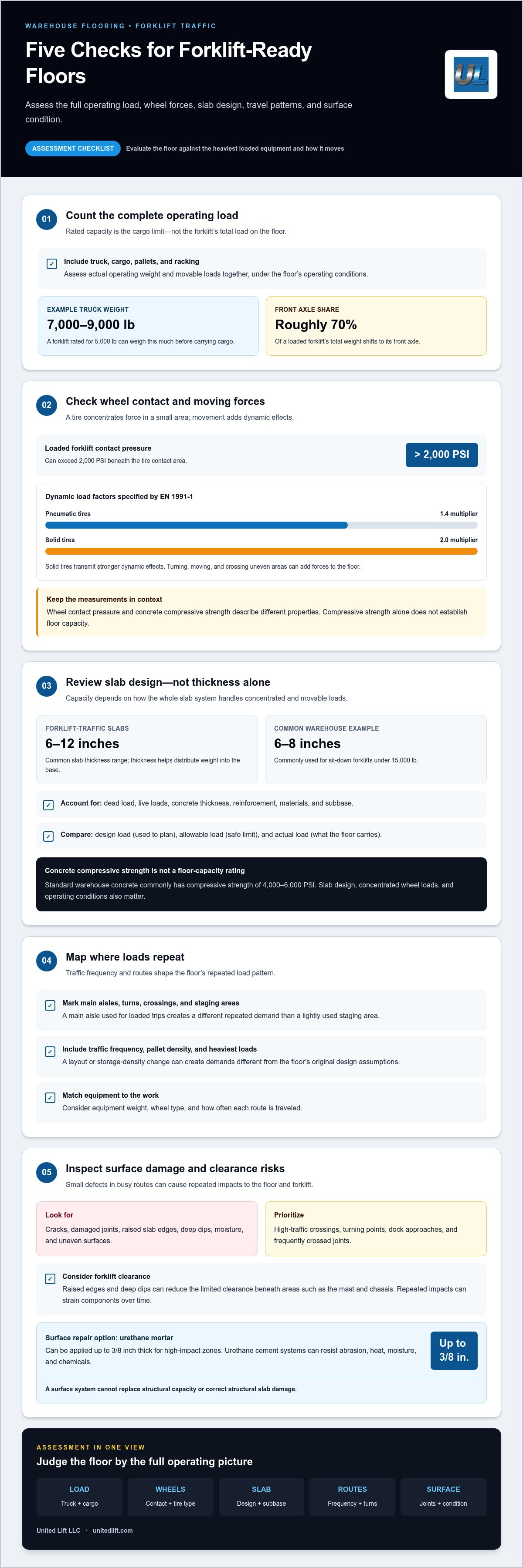
A standard forklift with a 5,000-pound capacity typically weighs 7,000 to 9,000 pounds, while a typical warehouse forklift weighs 7,000 to 10,000 pounds. Heavy-duty forklifts can weigh 30,000 to over 50,000 pounds. These forklift weight considerations for flooring matter because the truck’s weight, its cargo, wheel contact and repeated travel all contribute to the load on a warehouse floor.
Weight is only part of the picture. A forklift can concentrate substantial pressure beneath its wheels, and repeated trips along the same routes can stress weak spots, joints, and uneven surfaces. The floor must suit the heaviest loaded equipment and the way it moves through the facility.
This article explains how forklift weight, loads, wheels, and travel patterns affect floor capacity and damage risk. Learn what floor load capacity means, why tire type and traffic routes matter, and what to consider when choosing warehouse flooring for forklift use.
Key Takeaways
- Assess floor capacity against the heaviest loaded forklift and the concentrated loads beneath its wheels, not just the truck’s rated capacity.
- Account for tire type when evaluating floor loads; solid and pneumatic tires can produce different dynamic effects.
- Watch for uneven surfaces and damaged joints, which can reduce clearance and expose forklift components to repeated impacts.
- Map common travel routes and consider equipment weight, wheel type, and traffic frequency when choosing flooring.
What flooring type works best for logistics warehouses with forklift traffic?
Choose a floor system that can handle concentrated wheel loads and repeated traffic. Concrete strength, slab design, joints, and surface condition all matter.
Forklift Wheel Loads on Concrete
Wheel point load is the force concentrated where a tire meets the concrete slab. A loaded forklift can exert contact pressure exceeding 2,000 PSI, while standard warehouse concrete commonly has compressive strength of 4,000 to 6,000 PSI. These measurements describe different properties, so compressive strength alone doesn’t establish floor capacity. Cracks and damaged joints can jolt cushion tires repeatedly, accelerating tire wear.
Slab Thickness and Forklift Capacity
Slab thickness helps determine how a floor distributes forklift weight into its base. Forklift-traffic slabs commonly range from 6 to 12 inches; standard warehouses with sit-down forklifts under 15,000 pounds commonly use 6-to-8-inch slabs. A 5,000-pound-capacity forklift can weigh 7,000 to 9,000 pounds before carrying cargo. Loaded weight, wheel loads, reinforcement, and the subbase all affect the required design.
Floor Capacity and Slab Design
Floor load capacity is the load a slab can support under its design conditions. Calculations account for the slab’s dead load and movable live loads, including forklifts, cargo, and racking. Concrete thickness, reinforcement, materials, and overall design affect capacity. Concentrated wheel loads need particular attention, while excessive deflection can disrupt equipment or damage stored goods. Traffic frequency and travel routes also shape the load pattern.
Floor Materials, Repairs, and Compliance
Urethane cement flooring can help resist abrasion, heat, moisture, and chemicals, but a surface system cannot replace structural capacity. OSHA guidance emphasizes safe, clean, slip-resistant walking-working surfaces; applicable building-code requirements and load ratings relate to slab design. Repair costs depend on the damaged area, repair depth, reinforcement, and selected system. To assess an existing floor, review its design information and inspect cracks, joints, moisture, and flatness in relation to the heaviest loaded forklift.
What is Floor Load Capacity?
Floor load capacity is the weight a warehouse floor can support under operating conditions. An assessment considers concentrated tire pressure, dynamic forces, and actual traffic.
Tire Pressure and Dynamic Loads
Dynamic load factors account for extra forces as a forklift moves, turns, or crosses uneven areas. EN 1991-1 specifies multipliers of 1.4 for pneumatic tires and 2.0 for solid tires. Solid tires transmit stronger dynamic effects, while pressure at each tire contact point concentrates force on a small floor area. That distinction matters in industrial environments where repeated travel can stress the slab.
Allowable, Design, and Actual Loads
Design load is the load used to plan a floor; allowable load is the limit it can safely support. Actual load describes what the floor carries, including equipment, pallets, and racking. Compare all three during an assessment. A floor designed for one layout may face different demands after storage density or traffic changes. Uneven conditions can further concentrate stress and affect capacity.
Traffic Patterns and Load Weights
Traffic patterns show where forklift loads repeatedly cross or turn on the warehouse floor. Include travel routes, pallet density, and the heaviest loads in the assessment. A main aisle used for loaded trips places a different repeated demand on the floor than a lightly used staging area. Choosing equipment suited to the work can also help align operating weight with the facility’s needs; explore forklift options for different material-handling tasks.
Forklift Axle Loads and Floor Loading
Axle-load distribution describes how a forklift’s total weight transfers through its axles and tires. Roughly 70% of a loaded forklift’s total weight shifts to its front axle, concentrating much of the load near the front wheels. To estimate loading with a pallet, add the truck’s operating weight to the pallet load, then account for axle distribution and tire contact area. For maximum-load planning, use the rated capacity as the cargo limit, not the truck’s total floor load. Actual weight and travel conditions also affect maintenance costs.
Floor damage and forklift clearance or component impacts
Cracks, broken joints, and raised slab edges can turn routine forklift traffic into repeated impacts. Solid forklift wheels transfer 100 percent of kinetic impact into the floor, so damaged areas can worsen under repeated passes. Control joints are natural weak points, and filling them creates smoother transitions for forklifts and carts while helping protect slab edges. Inspect high-traffic crossings and turning points for damage.
Forklifts have a low center of gravity and limited clearance beneath areas such as the mast and chassis. A raised floor edge or deep dip can reduce that clearance and cause contact with the warehouse floor. Sudden impacts can strain forklift components over time and may affect machine stability. For example, a damaged joint beneath the mast can jolt the truck each time it crosses.
Urethane mortar can be applied at thicknesses up to 3/8 of an inch. That makes it a flooring option to consider for high-impact zones, such as dock approaches or frequently crossed joints. Urethane cement systems also resist abrasion, heat, moisture, and chemicals. Select a system based on the facility’s exposure and traffic needs, rather than assuming a surface layer can correct structural slab damage.
Impact and abrasion resistance matter where loaded forklifts repeatedly brake, turn, or travel along the same route. These movements can wear the surface and expose concrete around joints. A durable system needs to withstand actual traffic patterns and operating conditions. Distribution areas with frequent turning may experience different wear from straight-through aisles, so assess each zone separately.
Use a simple floor review to connect damage with equipment impacts: note cracks, joint edges, dips, and spots where forklifts jolt or lose clearance. Compare these points with regular travel paths, then prioritize damaged transitions and high-impact areas. This helps distinguish surface wear from slab problems that affect forklift movement. Addressing joint transitions and worn zones can support smoother, safer travel through the facility.
Forklift travel patterns and equipment weight
Floor demand depends on the forklift’s weight and where it travels. A structural assessment should reflect loaded routes, turning areas, and repeated passes, not just the vehicle’s capacity.
Electric forklifts can weigh between 8,000 and 15,000 pounds, depending on size. Their operating weight affects ground stability and maneuverability, while cargo adds load during work. A route used for loaded trips puts different demands on cement than one used mainly for empty returns. Map both directions and note where forklifts turn, stop, or cross joints.
Frequency matters, too. Forklifts traveling over uneven floors can experience repeated shocks across thousands of cycles per week, accelerating wear. The same repeated movement puts recurring stress on aisles and turning points. Mark high-use routes and compare them with visible cracks, uneven areas, and joint damage. This helps connect equipment movement with warehouse floor condition.
Consider how travel patterns might change as operations shift. A new storage layout, denser pallet placement, or different equipment can redirect traffic and concentrate loads elsewhere in the facility. Floor capacity planning should account for future expansion and changing operational needs. A structural review based on actual routes helps identify where the floor faces repeated, concentrated demands instead of treating the entire slab as equally loaded.
Match the forklift to its work and the facility’s routes. Consider operating weight, expected cargo, wheel type, turning space, and travel frequency together. For example, a heavier truck assigned to a frequently used aisle creates different floor demands from lighter equipment used occasionally. These forklift weight considerations for flooring can guide equipment selection and route planning.
Review forklifts for warehouse operations with United Lift LLC and your travel routes and typical loads in mind. That gives you a practical starting point for matching equipment capacity to the work and facility conditions.
United Lift: Forklifts
United Lift offers forklifts for warehouse and material-handling operations. When choosing equipment for a facility, consider the truck’s operating weight, expected loads, wheel type, and regular travel routes alongside floor capacity. This helps narrow the options to equipment suited to the work and floor conditions.
United Lift carries new and used forklifts, along with boom lifts, telehandlers, and scissor lifts. To choose a forklift, start with the tasks it must handle, such as moving loaded pallets through established aisles. Compare those needs with your floor assessment and operating patterns before making a selection.
Contact United Lift to discuss forklift options for your operation.
Plan Your Next Equipment Decision
Make equipment and layout decisions with the facility’s operating conditions in view. As routes, loads, and storage plans change, revisit how those demands interact with the floor. Treat forklift weight considerations for flooring as an ongoing planning factor, not a one-time selection detail. This keeps equipment choices aligned with the work the warehouse needs to handle.
United Lift offers forklifts, boom lifts, and telehandlers for material-handling and access needs. If you’re comparing forklift options with your operation’s demands, bring those priorities into the conversation. A clear picture of your tasks and floor conditions can help focus the decision.
Contact United Lift for forklift advice and take the next step with confidence.
Frequently Asked Questions
How Much Does a Forklift Weigh?
A typical warehouse forklift weighs 7,000 to 10,000 pounds. A standard forklift with a 5,000-pound capacity commonly weighs 7,000 to 9,000 pounds before adding its cargo. Heavy-duty forklifts can weigh 30,000 to over 50,000 pounds. For floor planning, use the machine’s actual operating weight and expected load, since the capacity rating describes what it can lift, not its total weight.
How much does a forklift weigh, including common models and load capacity?
Electric forklifts can weigh 8,000 to 15,000 pounds, depending on size. A 5,000-pound capacity model may itself weigh 7,000 to 9,000 pounds, before carrying a pallet. Heavy-duty machines may weigh 30,000 to over 50,000 pounds. Compare equipment weight with rated lifting capacity and the cargo expected in your operation. Similar capacity ratings don’t mean two forklifts impose identical floor loads.
How do forklift axle loads and wheel loads affect floor loading?
Axle and wheel loads show where a forklift concentrates its weight on the floor. Roughly 70% of a loaded forklift’s total weight shifts to its front axle. A standard 5,000-pound-capacity forklift, fully loaded, is described as concentrating approximately 750 PSI at each front tire contact point. This helps explain why checking only total vehicle weight can miss the localized pressure beneath front wheels.
What floor load capacity is required for forklifts in warehouses?
Required floor capacity depends on the heaviest loaded forklift, its wheel loads, and how traffic moves through the warehouse. Include cargo weight and other existing loads, such as storage systems, in the assessment. A route used repeatedly by loaded trucks creates different demands from an area with occasional empty passes. Compare expected operating conditions with the floor’s design capacity, not just a general floor rating.
What are typical concrete slab thickness and strength requirements for forklift traffic?
Forklift-traffic concrete slabs in the United States typically range from 6 to 12 inches thick. Standard warehouse floors commonly use concrete with compressive strength of 4,000 to 6,000 PSI. A 6-to-8-inch slab is commonly used in standard warehouses with sit-down forklifts under 15,000 pounds. These figures are design references, not a stand-alone capacity test: reinforcement, base conditions, joints, and loads also affect performance.
How do forklift tire type and tire contact pressure affect flooring?
Tire type affects how moving forces reach the floor. EN 1991-1 specifies dynamic load multipliers of 1.4 for pneumatic forklift tires and 2.0 for solid tires. Contact pressure also concentrates force beneath each wheel, while turns and crossings add repeated stress. Match tire selection to the floor surface and traffic conditions, and pay close attention to joints and damaged areas along frequent routes.
- Tags: floor load capacity, forklift safety, forklift weight, forklift weight considerations for flooring, industrial flooring, material handling, warehouse flooring, warehouse operations
