
2026 Lumber Yard Forklift Buying Guide
Posted by United Lift LLC on
Could your current fleet survive the 2026 CARB regulations while still moving seven tons of cedar across a debris-strewn yard? You already know that a standard warehouse lift won't cut it. A narrow carriage leads to warped boards, and a single stray nail can sideline a machine for hours. Finding the best forklift for lumber yard operations is about more than just raw lifting power. It's about protecting your inventory and your bottom line in an environment where 24/7 uptime is the standard.
We're here to help you identify a machine that handles long loads with total stability. You'll learn why the "Lumber-Specific Trifecta" of wider carriages, specialized forks, and high-ply pneumatic tires is non-negotiable for today's operations. This guide also covers the practical shift toward high-capacity electric models and how to navigate equipment financing rates that currently sit between 6% and 14% for qualified buyers. We'll break down everything you need to balance raw power with fuel efficiency so your yard stays productive and compliant.
Key Takeaways
- Solve the "long load problem" with wide carriages and specialized forks that protect your wood inventory from warping and damage.
- Identify the best forklift for lumber yard environments by accurately converting board feet to weight and over-speccing your lift capacity.
- Compare the raw torque of traditional diesel engines against the latest 80V and 90V electric pneumatics for 24/7 yard operations.
- Learn how to find high-value used inventory from leading brands like Hyster, Toyota, and Caterpillar to maximize your equipment budget.
- Understand how to leverage capital equipment financing to overcome high entry costs and scale your fleet without draining cash flow.
The Unique Challenges of Wood and Lumber Material Handling
Lumber yards don't operate like standard distribution centers. You're dealing with shifting terrain, abrasive dust, and loads that defy standard physics. Finding the best forklift for lumber yard work starts with acknowledging that your environment is actively trying to break your equipment. While a forklift overview provides the basics of material handling, wood handling adds layers of complexity that warehouse managers never see. Standard warehouse configurations fail because they treat every load like a compact, 48 inch pallet. Lumber doesn't play by those rules.
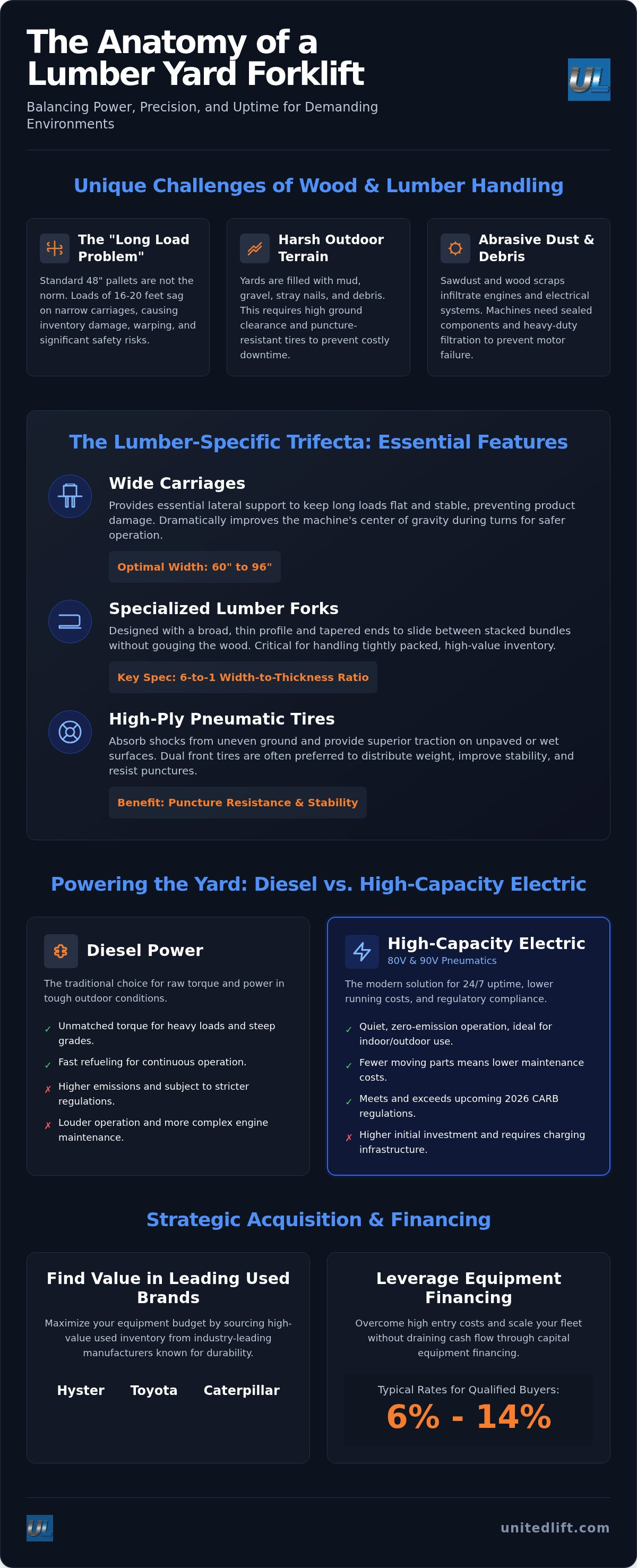
The "Long Load Problem" is the most immediate hurdle. When you pick up a 20 foot bundle of pressure treated pine on a narrow carriage, the ends sag. This isn't just a safety issue; it's a financial one. Sagging leads to warping or snapped boards, which directly eats into your margins. You need lateral support that standard lifts can't provide. Beyond the load itself, the sheer volume of debris in a sawmill or retail yard creates constant mechanical stress. Sawdust, wood scraps, and moisture are always present, waiting to infiltrate your engine or electrical systems. To manage these materials effectively and protect your equipment, you can learn more about Book Your Dumpster USA for reliable waste disposal services.
Navigating Harsh Outdoor Terrain
Mud, gravel, and wood cuttings are the norms for outdoor yards. If your machine lacks proper ground clearance, you'll bottom out before the first shift ends. High ply pneumatic tires are essential here. They absorb the shocks of uneven ground and provide the traction needed for wet, unpaved surfaces. Many operators prefer dual front tires for several reasons:
- Weight Distribution: Duals spread the weight of heavy bundles, preventing the machine from sinking into soft soil.
- Lateral Stability: They provide a wider footprint, which is critical when carrying 16 foot loads across a slope.
- Puncture Resistance: Heavier plys help resist the nails and wood shards common in busy yards.
Dust is another silent killer. Sawdust finds its way into every crevice. You need machines with sealed components and heavy duty filtration systems to prevent motor failure. Brands like Hyster and Toyota often design their outdoor models with these specific environmental hazards in mind, ensuring the radiator and engine remain clear of debris.
Protecting the Product: Preventing Warping and Damage
Precision is vital in a sawmill. Wood is flexible and surprisingly fragile. If your lift lacks a wide carriage, you're putting too much stress on the center of the load. This causes the "smile" effect where the ends of the lumber dip down. Over time, this ruins the grade of the wood. The best forklift for lumber yard use balances high speed travel with hydraulic systems that offer smooth, precise control. A dropped load of premium hardwood can cost thousands of dollars in a single second. You aren't just moving weight; you're managing a flexible, high value inventory that requires specialized handling to remain sellable.
Essential Features for Every Lumber Yard Forklift
Selecting the best forklift for lumber yard duty requires looking beyond the basic lifting capacity. You're moving loads that are often 16 to 20 feet long, which creates unique physics challenges that a standard warehouse lift isn't built to handle. To keep your yard efficient and your inventory undamaged, you need a specific set of features designed for the lateral stress and environmental hazards of wood handling. High-capacity machines from brands like Hyster, Yale, and Toyota are often the go-to choices because they offer the specialized attachments required for these heavy-duty tasks.
The Anatomy of a Lumber Fork
Lumber forks are distinct from the standard forks you see in a grocery warehouse. They're designed with a broader, thinner profile to slide easily between tightly stacked bundles. Tapered ends are the standard for wood handling; unlike blunt warehouse forks, they won't gouge the lumber or catch on the strapping as you enter a stack. The optimal lumber fork maintains a 6-to-1 width-to-thickness ratio to ensure it's strong enough for heavy lifts but slim enough for tight clearances. This thin profile is critical because standard forks are often too thick to fit into the gaps provided by wood spacers or bolsters.
Why Carriage Width Matters
Carriage width is your primary defense against product damage and tip-overs. When you carry a 20-foot bundle on a narrow 48-inch carriage, the ends of the load sag and bounce. This movement can snap the bands or permanently warp the boards. A wide carriage, typically 60 to 96 inches, provides the lateral support needed to keep the load flat and stable. It also drastically improves the machine's center of gravity during turns, which is a key part of staying within OSHA forklift safety guidelines. For a deeper look at general equipment specifications, you can read The Ultimate Forklift Buying Guide for Industrial Success in 2026.
Beyond the forks and carriage, you should prioritize side-shifters and hydraulic fork positioners. These allow the operator to adjust the spacing of the forks from the seat, reducing fatigue and preventing injuries caused by manually hauling heavy lumber forks. For the ground, solid-pneumatic tires are the industry standard. They offer the traction of air-filled tires but are puncture-proof, saving you from costly downtime in a yard filled with nails and wood shards. High-visibility masts round out the essential list, ensuring the operator can see past oversized bundles to avoid obstacles. If you're ready to upgrade your equipment, you can view our current inventory of lumber-ready forklifts to find a machine with these exact specs.
Powering the Yard: Diesel vs. High-Capacity Electric
The debate over the best forklift for lumber yard operations used to be a one-sided conversation. Diesel was the only logical choice for heavy lifting on unpaved ground. However, as we move through 2026, high-voltage electric models are challenging that long-standing status quo. Choosing between internal combustion (IC) and electric now requires a deep look at your specific shift patterns, climate, and long-term maintenance budget. You aren't just buying a machine; you're choosing the energy infrastructure that will power your business for the next decade.
The Case for Diesel and Propane
For many yards, the internal combustion engine remains the reliable workhorse. Diesel forklifts from brands like Hyster and Yale provide the raw torque necessary to pull heavy bundles through thick mud or deep gravel. One of the biggest advantages is 24/7 uptime. You don't have to wait for a battery to charge; you simply refill the tank and get back to work. This is critical for improving lumberyard efficiency during peak seasons when every minute of downtime costs money. Diesel's dominance is especially clear in three areas:
- Extreme Climates: IC engines generate their own heat, maintaining performance in sub-zero northern winters where batteries might struggle.
- Remote Locations: If your yard lacks a robust electrical grid, it's often easier to manage a fuel tank than to install high-voltage charging stations.
- Familiarity: Most on-site mechanics already have the tools and expertise to service diesel and propane engines.
The Electric Revolution in Wood Handling
Modern 80V and 90V electric pneumatic forklifts are no longer limited to indoor warehouses. These machines are built with the same heavy-duty chassis and high-ply tires as their diesel counterparts. The switch to lithium-ion technology has removed the old headaches of battery watering and long equalization charges. Instead, you can use opportunity charging during lunch breaks to keep the fleet running through multiple shifts. Electric motors deliver peak torque instantly from zero RPM, whereas diesel engines must climb a specific power band to reach their maximum pulling force.
The total cost of ownership (TCO) is where electric models shine. You'll face a higher initial price tag, but you'll skip the costs of oil changes, air filters, and transmission repairs. There are also fewer moving parts to break during a 24/7 operation. Beyond the numbers, the reduction in noise and vibration is a major safety win. Operators can hear approaching traffic and communicate more clearly with spotters, reducing the risk of accidents in crowded yards. As environmental regulations tighten, making the switch now can help you stay ahead of future compliance requirements while cutting your daily energy spend.
Sizing Your Fleet: Capacity and Load Considerations
How much does your heaviest bundle actually weigh? Guessing is a dangerous game in a lumber yard. Sizing your fleet correctly is about more than just matching a spec sheet to a pallet. You're dealing with varying densities, moisture levels, and load centers that shift as you move. Identifying the best forklift for lumber yard work requires a deep dive into the specific species you handle and how high you need to stack them. If you buy a machine that's rated exactly for your average load, you're asking for mechanical failure and safety risks.
Calculating Your Required Capacity
Weight variables in wood handling are notoriously tricky. A bundle of kiln-dried pine is significantly lighter than green or pressure-treated lumber. Moisture content can add thousands of pounds to a single load. For example, green Douglas Fir can weigh nearly twice as much as its dried counterpart. You also have to account for de-rating. As you lift a load higher into a racking system, the forklift's effective capacity drops. This is why we recommend the 20% Rule. Always select a lift with a rated capacity at least 20% higher than your heaviest anticipated bundle. This buffer protects your hydraulic systems and ensures the machine stays stable during high-lift maneuvers.
Load centers are the next piece of the puzzle. Most standard forklifts are rated at a 24 inch load center. Because lumber bundles are wide and deep, your actual load center might be 36 or 48 inches. This extension drastically reduces what the machine can safely pick up. If you don't account for this, a 10,000 pound capacity lift might only be able to safely handle 7,000 pounds of lumber. Always check the load chart on the machine before committing to a purchase.
Telehandlers for Lumber Applications
Sometimes a straight-mast forklift isn't the right tool for the job. Telehandlers from brands like Hyster or SkyTrak offer a distinct advantage when you need reach over raw vertical lift. These machines are perfect for loading flatbed trailers from one side, which saves significant time and space in tight yards. They also excel at double-stacking bundles in areas where a standard mast can't navigate. While a traditional forklift is often faster for short-distance shuttling, the telehandler is the king of versatility for yard organization and trailer loading.
United Lift LLC maintains an extensive inventory of both high-capacity forklifts and telehandlers to meet these diverse needs. Whether you need the precision of a Yale straight-mast or the reach of a SkyTrak, we can help you find the right fit for your specific acreage and inventory type. Browse our high-capacity lumber forklifts and telehandlers to see what we have ready for national delivery today.
Strategic Acquisition: New vs. Used and Financing
Buying a high-capacity lift is a major capital investment that impacts your operations for years. Whether you're expanding a sawmill or replacing an aging unit, you need a strategy that protects your cash flow. Finding the best forklift for lumber yard duty often involves weighing the immediate costs against long-term reliability. You don't have to settle for an underpowered machine just to stay within budget. By exploring both new and pre-owned options, you can secure the lifting power you need while keeping your capital working for you.
The Benefits of Pre-Owned Heavy Equipment
Used machinery is a practical way to bypass the steep depreciation that hits new equipment the moment it leaves the lot. You can often find premium models from Hyster, Toyota, or Caterpillar at a significant discount compared to current list prices. Immediate availability is another huge factor in the used market. While new machine lead times can sometimes stretch for months, pre-owned inventory is usually ready for national delivery right away. When you're inspecting a used lumber forklift, pay close attention to these specific areas:
- Mast and Carriage: Look for excessive wear in the rollers or bowing in the carriage from heavy, off-center loads.
- Hydraulic Health: Check for leaks and ensure the tilt and side-shift functions operate smoothly under pressure.
- Hour Meter vs. Condition: A machine with higher hours that's been serviced regularly is often a better bet than a low-hour unit that's been neglected.
Financing and Tax Strategy
Most businesses leverage capital equipment loans to keep their cash reserves liquid. For well-qualified borrowers in 2026, equipment financing rates typically fall between 6% and 14% through banks or specialized lenders. Choosing between a lease and a purchase depends on your long-term plans. A lease might offer lower monthly payments and easier upgrades, while a purchase allows you to build equity in a machine that might last 15 years or more.
The Section 179 tax deduction allows a business owner to deduct the full purchase price of qualifying equipment up to $1,160,000 in the year it's put into service. This provides an immediate boost to your bottom line by reducing your taxable income right when you've made a major investment.
At United Lift LLC, we specialize in high-capital industrial machinery and facilitate business financing to help you overcome high entry costs. We offer support 7 days a week to ensure your fleet stays operational and your questions get answered quickly. Browse our current inventory of heavy-duty forklifts to see which machines we have ready for your yard today.
Build Your 2026 Lumber Fleet Today
Choosing the best forklift for lumber yard operations requires a balance of specialized hardware and smart financial planning. You've learned how wider carriages prevent product sagging and why over-speccing your capacity is the only way to account for moisture-heavy bundles. Whether you're transitioning to high-voltage electrics or sticking with the raw torque of diesel, your equipment must be as resilient as the terrain it traverses. Proper planning now prevents costly downtime and inventory loss throughout the coming year.
United Lift LLC is ready to help you implement these strategies with a massive national inventory of Hyster, Yale, and Toyota machines. We specialize in high-capital industrial machinery and provide financing facilitation for both new and pre-owned units to help you maximize your Section 179 deductions. With national delivery on all heavy equipment and expert support available 7 days a week, we ensure your yard stays productive year-round.
View Our High-Capacity Forklift Inventory for Lumber Yards
Let's get your yard moving with equipment that's built for the challenge.
Frequently Asked Questions
What is the best forklift capacity for a standard lumber yard?
Most lumber operations find that a capacity of 8,000 to 12,000 lbs is the ideal range for handling standard bundles. You should always select a machine rated at least 20% higher than your heaviest load to account for moisture weight and extended load centers. High-capacity models ensure you aren't straining the hydraulic system during multi-shift operations.
Why are pneumatic tires better than cushion tires for wood yards?
Pneumatic tires provide the ground clearance and traction necessary for unpaved, uneven terrain. Cushion tires are designed for smooth warehouse floors and will get stuck or damaged in the gravel and mud of a sawmill. For the best forklift for lumber yard environments, solid-pneumatic tires are the gold standard because they offer the same traction but are puncture-proof against nails and wood shards.
Can I use an electric forklift in an outdoor lumber yard?
Yes, modern 80V and 90V electric pneumatic forklifts are specifically built for outdoor use. These machines feature sealed components to prevent sawdust infiltration and high-ply tires for rough terrain. Lithium-ion technology allows for opportunity charging during breaks, making them a viable alternative to diesel for multi-shift wood handling operations.
What are lumber forks and why are they necessary?
Lumber forks feature a thinner and wider profile than standard warehouse forks. This design allows the operator to slide into tight stacks of wood bundles without gouging the product or snagging the banding. Their broad surface area also provides better lateral support, which prevents long boards from sagging or warping during transport.
How much does a heavy-duty lumber forklift cost?
Pricing for heavy-duty lifts varies significantly based on lifting capacity, fuel type, and whether the machine is new or used. A new high-capacity diesel lift represents a significant capital investment, while pre-owned models from brands like Hyster or Toyota can offer substantial savings. It's best to evaluate your specific duty cycle and capacity needs to determine the total cost of ownership for your fleet.
Is it better to buy a new or used forklift for a sawmill?
The choice depends on your budget and how quickly you need the machine. New forklifts offer the latest technology and full warranties, but used equipment provides immediate availability and avoids steep initial depreciation. Sawmills often find great value in well-maintained used lifts that are ready for national delivery without the long lead times associated with new factory orders.
What maintenance is required for forklifts operating in high-dust environments?
Sawdust is highly abrasive, so you must prioritize air filter replacements and radiator cleanings. Regularly inspect hydraulic seals and grease all pivot points to prevent wood debris from causing premature wear. In a 24/7 lumber operation, a daily blow-out of the engine compartment can prevent overheating and extend the life of your machine's critical components.
Does United Lift provide financing for lumber yard equipment?
Yes, United Lift facilitates business financing for both new and pre-owned heavy equipment. We understand the high capital barriers of the industry and work to structure agreements that protect your cash flow. Our team is available 7 days a week to help you navigate the application process and secure the machinery your yard needs to grow.
- Tags: best forklift for lumber yard, CARB regulations, diesel forklift, electric forklift, equipment guide, forklift, forklift financing, lumber yard, material handling
