
Best Forklifts for Manufacturing: 2026 Industrial Guide
Posted by United Lift LLC on
Did you know that an aging forklift can cost your facility more in unscheduled downtime than the price of a brand-new machine within just three years? You're likely dealing with rising energy costs and the constant pressure to find the best forklift for manufacturing plant operations to keep production lines moving. Maintenance bills pile up. Load capacities fall short. These issues stall your growth. We understand that you need equipment that works as hard as your crew does.
Choosing the right machine means looking beyond the sticker price to find a balance between high-cycle durability and low operating costs. This 2026 industrial guide compares top models from brands like Hyster, Yale, and Toyota to help you maximize your ROI. We'll explore power sources, tire configurations, and safety features designed to protect your team and your bottom line for the next decade. By the end, you'll know exactly which machine fits your workflow and how to leverage Section 179 tax benefits for your purchase.
Key Takeaways
- Learn how to evaluate your plant's specific duty cycles to ensure your equipment handles multi-shift operations without unexpected downtime.
- Compare the total cost of ownership between electric and internal combustion models to identify the best forklift for manufacturing plant environments in 2026.
- Discover how prioritizing ergonomics and integrated safety features can reduce worker compensation claims while boosting overall operator productivity.
- Explore the unique strengths of leading brands like Hyster, Yale, and Toyota to find the right fit for your facility's specific workflow.
- Identify financing strategies and pre-owned options that allow you to scale your fleet while staying within your capital expenditure limits.
Identifying Your Manufacturing Plant Requirements
Manufacturing environments aren't standard warehouses. In a distribution center, you're moving uniform pallets from point A to point B. In a production plant, your powered industrial truck is a critical part of the assembly line. It handles raw steel, delicate components, and heavy machinery. Finding the best forklift for manufacturing plant operations requires looking at your specific duty cycles. If your plant runs three shifts, you can't afford downtime. You need a machine built for a 100% duty cycle, often with quick-swap industrial batteries or fast-charge lithium options.
Does your layout allow for wide turns? Plant layout dictates your chassis size. Narrow aisles require reach trucks or 3-wheel electrics. Open bays allow for larger, high-capacity Hyster or Caterpillar models. You also need to evaluate specialized attachments. Moving raw materials often requires paper roll clamps, bale clamps, or rotators rather than standard forks. United Lift stocks a variety of equipment attachments to customize your fleet for the job at hand. We also provide specialized financing for these high-capital industrial machines to keep your cash flow steady.
Floor Conditions and Load Profiles
Is your floor ready for cushion tires? Your floor surface dictates your tire choice and chassis stability. Smooth, sealed concrete in a clean-room environment is perfect for cushion tires, which is essential for facilities that distribute sensitive medical supplies. For those in the dental industry, you may visit Orthodentalusa Corp to find high-quality orthodontic brackets that require these types of controlled, clean-room logistics. However, many metal fabrication plants have floors covered in shavings or industrial debris. These environments require solid pneumatic tires or specialized compounds to prevent frequent flats. You must also calculate your maximum load center for non-standard parts. Manufacturing loads are rarely centered like a grocery pallet. Irregularly shaped components shift the center of gravity, which reduces your lift's rated capacity. Load stability is even more critical in high-vibration production zones where shifting cargo leads to spills and line stoppages.
Indoor Air Quality and Noise Standards
Safety is about more than avoiding collisions; it's about the air your team breathes. OSHA and EPA standards for indoor internal combustion usage are strict. High carbon monoxide levels from propane lifts can shut down a production line quickly. Selecting the best forklift for manufacturing plant use often comes down to choosing between electric and internal combustion power based on ventilation. This is why electric models from brands like Toyota or Yale are the default for food and pharmaceutical manufacturing. Similar to how high-volume food service environments rely on Southern Select Equipment for specialized performance, industrial plants use electric lifts to maintain air quality. These machines produce zero emissions and operate with minimal noise. Constant engine roar increases operator fatigue and masks important safety alarms. Quiet electric motors improve communication on the plant floor. If you require the power of internal combustion for heavy raw materials, we recommend low-emission LPG models equipped with modern catalytic converters.
Power Sources: Electric vs. Internal Combustion in 2026
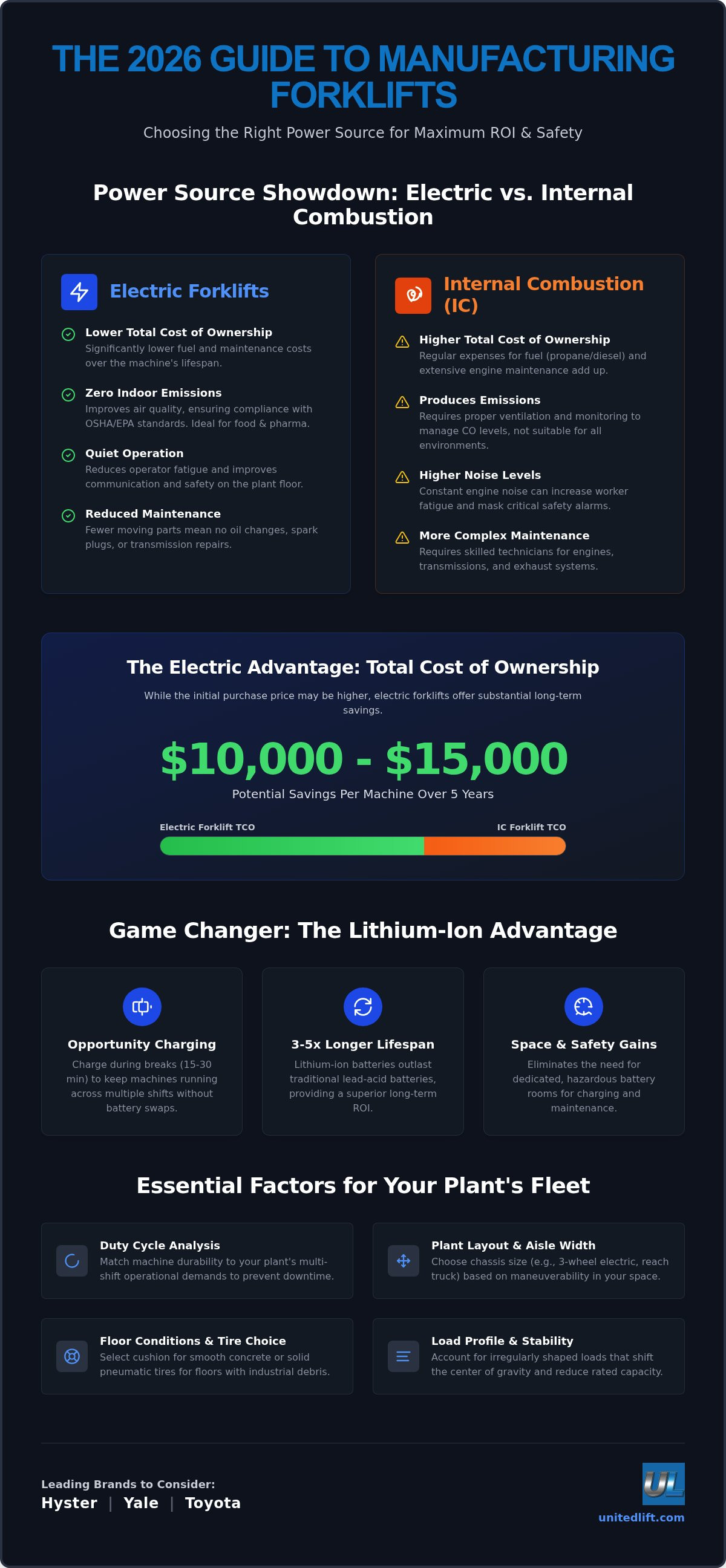
The debate between electric and internal combustion (IC) has shifted dramatically. In 2026, the best forklift for manufacturing plant operations is increasingly an electric one. Why? Because the total cost of ownership (TCO) tells a compelling story. While the upfront cost of an electric model is often higher, it can save your facility between $10,000 and $15,000 over a five-year period compared to IC models. These savings come from lower energy costs and significantly reduced maintenance requirements. Electric motors have fewer moving parts than internal combustion engines. You won't deal with oil changes, spark plugs, or complex transmission repairs.
Infrastructure needs differ between the two power types. IC forklifts require a secure area for propane tank storage or a diesel fueling station. Electric lifts need a dedicated charging setup. However, the footprint for charging has shrunk. You no longer need massive battery rooms if you choose the right technology. Compliance is also easier. Following OSHA safety standards for indoor air quality is simpler when you aren't managing exhaust fumes in tight production aisles.
The Rise of Lithium-Ion in Industrial Settings
Lithium-ion technology has changed the workflow for multi-shift plants. Unlike traditional lead-acid batteries that require eight hours to charge and eight hours to cool, lithium batteries allow for opportunity charging. Your operators can plug in the machine during a 15-minute break or a 30-minute lunch. This keeps the machine running across two or even three shifts without a battery swap. You also save valuable floor space. You can eliminate dedicated battery rooms and the hazardous watering maintenance required for lead-acid cells. Over the long term, lithium-ion offers a superior ROI because these batteries typically last three to five times longer. If you're looking to upgrade your power strategy, you can browse our inventory of industrial batteries to see which tech fits your current fleet.
When Internal Combustion (IC) Still Makes Sense
Electric isn't always the answer. Internal combustion remains the powerhouse for heavy-duty applications. If your manufacturing process involves moving heavy steel or lumber from an outdoor yard into a plant, IC is often the better choice. Pneumatic-tire IC lifts handle uneven terrain and extreme weather that can challenge sensitive electronics. Choosing the best forklift for manufacturing plant usage requires a cold look at your utility rates and shift schedules. IC models also serve well as low-hour backup machines. If you only need a lift for two hours a day, the lower initial purchase price of a propane unit makes financial sense. Refueling speed is another factor. You can swap a propane tank in two minutes. For a 24/7 operation that hasn't yet invested in fast-charging infrastructure, that speed keeps the line moving.
Top Forklift Categories for Manufacturing Plants
Selecting the right equipment category is the first step toward optimizing your production flow. Not all forklifts are built to handle the rigors of a production line. The evolution of warehouse logistics shows that modern machines are now more integrated into the manufacturing process than ever before. You need a chassis that can navigate tight spaces without sacrificing the lift capacity required for heavy raw materials. Finding the best forklift for manufacturing plant use starts with matching the machine's footprint to your specific aisle widths and floor conditions.
Operator efficiency often comes down to the choice between sit-down and stand-up models. Sit-down forklifts are excellent for long transport runs across a large facility. They keep the operator comfortable during extended travel. However, if your workflow requires the operator to get on and off the machine frequently to check labels or adjust loads, a stand-up model is often more efficient. These units offer better visibility when backing up and allow for faster entry and exit. Mast visibility is another critical factor. In a crowded plant, a high-visibility mast prevents collisions by allowing the operator to see floor-level obstacles and overhead lines clearly. For a deeper breakdown of these categories, see The Ultimate Forklift Buying Guide for Industrial Success in 2026.
Cushion Tire Forklifts for Smooth Concrete
Cushion tire models are the standard workhorses for indoor manufacturing. These machines feature a smaller frame than their pneumatic counterparts, which gives you a significantly tighter turning radius. This maneuverability is essential when you're weaving between expensive production machinery or navigating narrow sub-assembly aisles. While some worry about tire durability, high-quality cushion tires from brands like Hyster and Yale are built to last. They resist "chunking" even when they encounter occasional metal shavings or sharp industrial debris common in fabrication shops. Their solid construction provides a stable lifting platform, which is vital for the precision placement of heavy components.
Reach Trucks and Narrow Aisle Solutions
Is your parts department running out of room? Many plants are maximizing their existing footprint by moving toward high-density vertical storage. Reach trucks are the best forklift for manufacturing plant environments that prioritize rack space. These machines allow you to stack pallets two deep, effectively doubling your storage capacity in the same square footage. Stand-up reach trucks give your team better sightlines in narrow aisles and faster cycle times. Some modern facilities even integrate wire-guidance systems. This technology locks the steering while the truck is in the aisle, allowing the operator to focus entirely on the lift and placement. This level of precision reduces product damage and increases safety in high-traffic zones.
Key Features to Prioritize for Plant Safety and ROI
Safety and efficiency are two sides of the same coin on a busy production floor. When you invest in the best forklift for manufacturing plant use, you're buying more than a tool; you're buying insurance against downtime and injury. Modern features like integrated weighing scales allow your operators to track raw material usage in real-time. This eliminates the need to drive back and forth to a stationary floor scale, which saves hours of labor over a single month. You should also look for machines with easy-access service panels. A technician who can reach the hydraulic pump or battery terminals in seconds will bill you for fewer hours. For non-critical support roles, such as moving empty bins or light packaging, consider Economy Lifts. These provide the reliability you need without the premium price tag of a high-cycle production machine.
Protecting your bottom line also means avoiding heavy fines. As of 2026, the maximum OSHA penalty for a serious violation is $16,550. If a violation is deemed willful or repeated, that number jumps to $165,514. Investing in features that prevent accidents isn't just about safety; it's a financial necessity. A machine that includes automated safety checks and clear digital documentation helps you stay compliant with 29 CFR 1910.178 standards. Ready to upgrade your fleet's safety? Explore our selection of premium forklifts equipped with the latest safety technology.
Advanced Safety and Telematics Integration
Plant safety is a top priority when you consider that OSHA estimates forklifts are responsible for approximately 85 fatalities and 34,900 serious injuries annually. Modern telematics systems help you avoid being part of that statistic. Telematics is a data-driven tool for reducing fleet downtime by monitoring equipment health and operator behavior in real-time. These systems track impacts and restrict machine usage to authorized personnel only. Some units even feature automatic speed reduction. When the lift enters a high-traffic pedestrian zone, the machine slows down automatically to prevent accidents. This level of control is essential for the best forklift for manufacturing plant environments where pedestrians and heavy machinery share the same narrow aisles.
Ergonomics and Operator Productivity
Fatigue is the enemy of safety and output. If your operators are uncomfortable, their productivity drops significantly by the second half of a shift. High-quality suspension seats and adjustable armrests aren't luxuries; they're essential tools for reducing worker compensation claims related to repetitive strain. Finger-tip hydraulic controls offer much more precision than traditional manual levers. This allows for smoother placement of delicate manufacturing components. Noise reduction is another factor to consider. Quieter electric models or low-decibel IC engines improve overall plant communication. This makes it easier for team members to hear warnings and instructions over the hum of the production line, creating a safer and more focused work environment.
Selecting Your Fleet: Brands and Financing Strategies
Building a cohesive fleet requires a strategic mix of premium power and budget-friendly support units. Choosing the best forklift for manufacturing plant operations involves more than just comparing specs; it's about selecting a brand ecosystem that supports your uptime. You need parts that are easy to find and a chassis that local technicians understand. United Lift serves as your national partner, providing access to top-tier brands and the specialized financing needed to secure them. We focus on helping you scale without draining your operational cash.
Don't assume every machine in your plant needs to be brand new. While your primary production line requires the latest high-cycle technology, secondary roles can often be filled by pre-owned equipment. Using a reliable used lift for low-hour tasks like moving recycling bins or unloading occasional supply trucks is a smart way to maximize your budget. We specialize in both new and used inventory to ensure you get the exact level of performance your workflow demands. Our team handles the logistics of national shipping and support, making fleet expansion simple regardless of your location.
Leading Brands for Heavy Industrial Use
Hyster and Yale remain the industry standards for high-capacity, 24/7 manufacturing environments. These machines are engineered for grueling duty cycles, offering the structural integrity needed for constant lifting in multi-shift plants. If you prioritize long-term asset value, Toyota is hard to beat. Their forklifts are world-renowned for reliability and consistently command the highest resale values in the secondary market. For plants with outdoor material yards or uneven terrain, Caterpillar offers the rugged durability required to move heavy loads through rain or mud. Selecting the best forklift for manufacturing plant use often involves mixing these brands to match specific departmental needs.
Financing and Fleet Investment Strategies
How you pay for your fleet is just as important as the brand you choose. For the 2026 tax year, the Section 179 deduction allows businesses to expense up to $1,220,000 in equipment purchases. This tax incentive makes it significantly easier to upgrade aging, high-maintenance fleets with modern, efficient models. You must also decide between leasing and buying. Purchasing provides long-term ownership and depreciation benefits. Leasing, however, preserves your working capital for raw materials or production line upgrades. United Lift facilitates this process by offering specialized financing for high-capital industrial machinery. We help you navigate these options to ensure your equipment investment aligns with your plant's growth projections. Consult with a material handling expert today to determine your ideal fleet size and mix.
Future-Proof Your Manufacturing Operations
Ready to optimize your production line? You've seen how the right power source and chassis type can transform your facility's efficiency. Transitioning to lithium-ion or selecting a specialized narrow-aisle model isn't just about moving pallets; it's about maximizing every square foot of your production floor. Finding the best forklift for manufacturing plant success requires balancing these technical needs with a smart financing strategy that preserves your working capital. Whether you're looking for the high-cycle durability of a Hyster or the legendary resale value of a Toyota, the right choice will pay dividends for years.
United Lift is here to facilitate your next fleet upgrade. We're an authorized dealer for top brands like Hyster, Yale, and Toyota, offering both new and pre-owned solutions to fit any budget. We provide national shipping and specialized financing options to get your equipment on the floor quickly. Our expert support team is available seven days a week to ensure you find the perfect match for your specific requirements. Browse Our Inventory of New and Used Forklifts for Your Plant today and start building a more reliable operation. We're ready to help you move your business forward.
Frequently Asked Questions
What is the best forklift for a manufacturing plant with very narrow aisles?
Reach trucks or 3-wheel electric models are the top choices for tight spaces. These machines offer a much smaller turning radius than standard 4-wheel units, allowing them to navigate rows as narrow as 8 to 10 feet. If you are looking for the best forklift for manufacturing plant layouts with high-density storage, these specialized chassis maximize your footprint without slowing down your production speed.
How much capacity do I need for a standard manufacturing forklift?
Most plants find that a 5,000-lb capacity forklift handles the majority of standard palletized raw materials. However, you must always calculate your maximum load center for irregular items. If you're lifting long steel beams or heavy machinery components, the effective capacity drops as the load center moves forward. Always spec your machine for your heaviest anticipated load to ensure safe operation and prevent tip-overs.
Is an electric forklift powerful enough for heavy industrial manufacturing?
Modern electric forklifts are definitely powerful enough to match or exceed the performance of internal combustion units. High-voltage systems provide consistent torque and fast lift speeds even under full load. With the shift to lithium-ion batteries, these machines can run continuously through multiple shifts using opportunity charging. This makes them a primary contender for the best forklift for manufacturing plant environments that prioritize indoor air quality.
How do I choose between cushion and pneumatic tires for my plant?
Choose cushion tires if your plant has smooth, sealed concrete floors and requires a compact machine footprint. They're made of solid rubber and allow for a tighter turning radius in narrow aisles. Pneumatic tires are the better choice if your facility has rough floors, outdoor material yards, or transitions between buildings. They provide superior traction and a smoother ride over cracks and industrial debris.
What are the main advantages of a Hyster forklift for manufacturing?
Hyster forklifts are built with heavy-duty steel frames and robust drive trains designed for high-cycle environments. They excel in 24/7 operations where machines rarely get a break from the production line. Their focus on structural durability means fewer repairs over a ten-year lifespan. This makes them a top choice for plants moving heavy raw materials or working in demanding, high-heat fabrication settings.
Can I use a used forklift for a three-shift manufacturing operation?
You can use a used forklift for multi-shift operations, but it requires a strict maintenance schedule and extra battery sets. For high-cycle production lines, a new machine is usually safer to avoid unplanned downtime that stalls the entire plant. However, a well-maintained used lift is an excellent, cost-effective option for secondary tasks or as a reliable backup unit when your primary fleet is undergoing service.
What safety features are mandatory for forklifts in a manufacturing environment?
OSHA requires several specific safety features, including functional horns, backup alarms, and overhead guards. You must also have visible warning lights, such as blue spots or red perimeter lights, in high-traffic pedestrian areas. Every machine must have a secure seatbelt or operator restraint system. Modern plants often add telematics and impact sensors to comply with the latest 2026 digital documentation and safety standards.
How does Section 179 work for forklift purchases in 2026?
In 2026, the Section 179 tax deduction allows you to deduct the full purchase price of qualifying equipment up to a limit of $1,220,000. This applies to both new and used forklifts purchased and put into service during the current tax year. It's a powerful tool for reducing your overall tax liability while upgrading your fleet to more efficient technology. Consult your tax professional to confirm your eligibility.
- Tags: best forklift for manufacturing plant, Electric Forklifts, Forklift Safety, Forklifts, Hyster, Industrial Equipment, Manufacturing, Material Handling, Section 179, Toyota, Yale
