
JLG vs. Genie Telehandler: The Ultimate Comparison for 2026
Posted by United Lift LLC on
Choosing the wrong telehandler doesn't just slow down your project; it bleeds your bottom line. When you're comparing a JLG vs Genie telehandler, you aren't just picking a color. You're deciding which engineering philosophy will keep your crew moving for the next five years. It's a high-stakes decision that impacts your daily productivity and your long-term equity.
Have you ever felt the frustration of equipment that looks great on a spec sheet but struggles with your specific terrain? It's hard to feel confident when both brands claim the top spot. You need a machine that delivers on its promises without the headache of constant repairs or expensive downtime. We understand that your time is money, and you need equipment that stays on the job.
This guide breaks down exactly how these brands compare in 2026. You'll get a clear understanding of brand-specific strengths, from operator comfort to high-reach stability. We also look at the latest technology trends, current resale values, and how financing can help you maximize your tax benefits this year. Let's find the right machine for your specific requirements.
Key Takeaways
- Identify whether JLG’s high-capacity versatility or Genie’s user-centric design better fits your specific project demands.
- Compare 2026 specs for compact and mid-range models to find a JLG vs Genie telehandler that handles your exact load and terrain.
- Discover how JLG’s 360-degree visibility contrasts with Genie’s spacious cab layouts to improve operator comfort and safety.
- Understand long-term value factors, including JLG’s resale performance and Genie’s fleet-wide parts commonality.
- Get the facts on financing and tax benefits that can help you secure high-value equipment while protecting your cash flow.
The Heavyweight Rivalry: Understanding the JLG and Genie Legacy
A telescopic handler acts as the ultimate multi-tool on any modern job site. It's essentially a hybrid of a crane and a forklift, offering the reach of the former and the lifting power of the latter. This unique combination makes these machines the "Swiss Army Knives" of construction, agriculture, and industrial logistics. When you're weighing a JLG vs Genie telehandler, you aren't just comparing brands. You're choosing between two distinct engineering legacies that prioritize different operational goals. Understanding these philosophies is the first step toward picking a machine that maximizes your daily productivity.
This comparison matters because telehandlers are often the highest-utilized assets in a fleet. If the machine's design doesn't match your specific job site requirements, you'll see it in your project timelines and maintenance costs. JLG and Genie have spent decades refining their equipment to solve specific problems for operators. While both brands offer reliable solutions, their approaches to power, simplicity, and versatility vary significantly.
The JLG Approach: High Capacity and Innovation
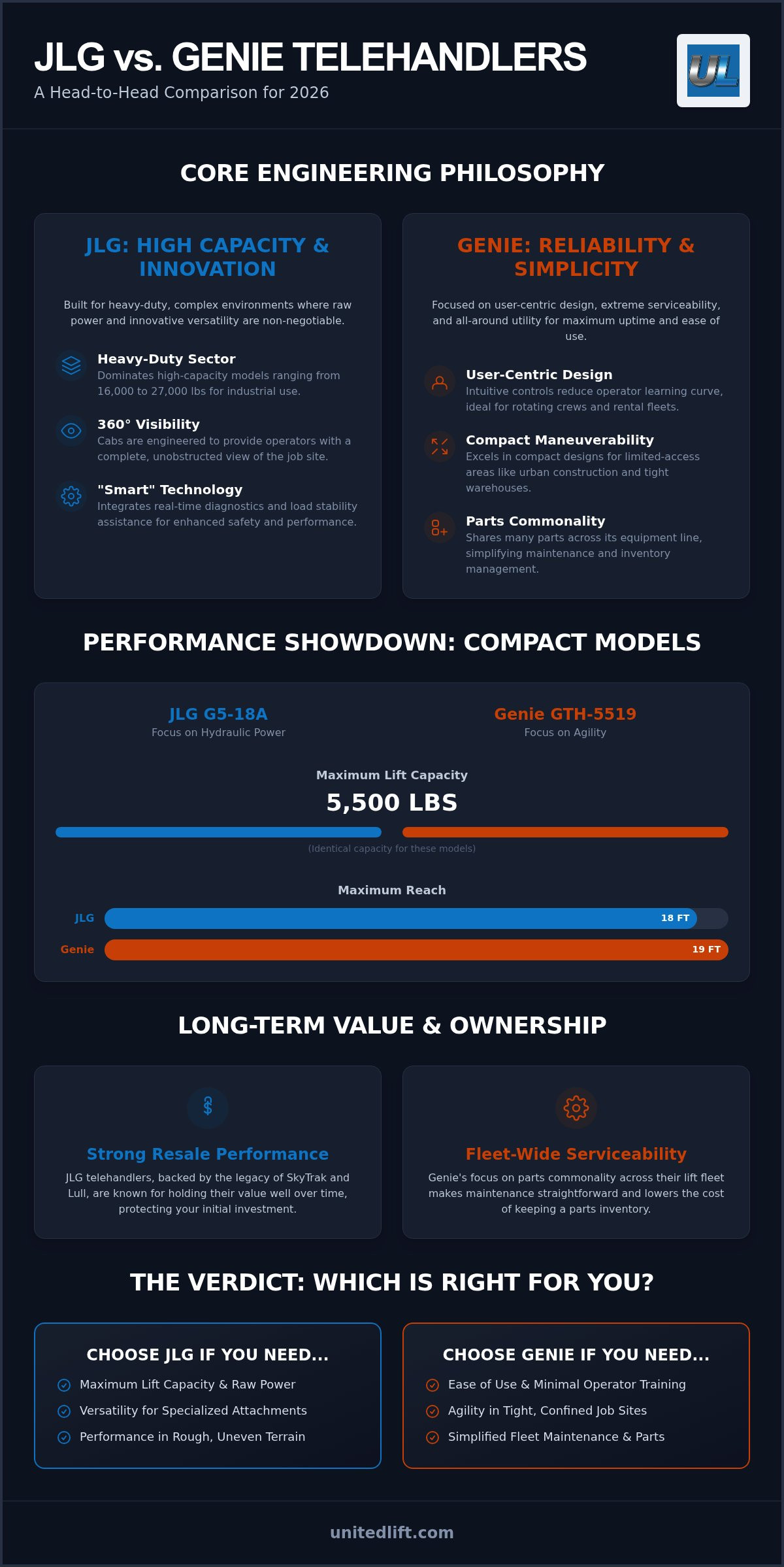
JLG has built its reputation on "innovative versatility." They don't just build lifts; they build heavy-duty solutions for complex environments. JLG dominates the heavy-duty sector with high-capacity models that range from 16,000 to 27,000 lbs. These units are specifically designed for heavy industrial use where raw power is a non-negotiable requirement. Their legacy is deeply rooted in the industry through the acquisition of the SkyTrak and Lull brands. This history gives them a unique edge in rough-terrain performance and specialized load placement.
When you step into a JLG cab, the focus on visibility is immediate. They prioritize a 360-degree view to ensure operators can see every corner of the site. Their 2026 models integrate advanced "Smart" technology, providing real-time diagnostics and load stability assistance. If your job requires specialized tasks, JLG's massive range of attachments, from pipe grapples to trash hoppers, makes them incredibly adaptable. They're built for the owner who needs one machine to do the work of three.
The Genie Approach: Reliability and Simplicity
Genie, a member of the Terex family, takes a different path by focusing on "user-centric design" and extreme serviceability. The Genie GTH series is built for all-around utility and ease of operation. While JLG pushes the envelope on high-capacity power, Genie often excels in compact designs. These machines are ideal for limited-access work areas where maneuverability is more important than massive lift capacity. They're the go-to choice for urban construction and tight warehouse environments.
The brand is famous for its intuitive controls. They aim to reduce the operator learning curve as much as possible. If you manage a rotating crew, Genie's simplicity means you'll spend less time on training and more time moving material. Their engineering focuses on "commonality," which means many parts are shared across their entire lift equipment line. This makes maintenance straightforward and keeps your parts inventory manageable. Genie machines are designed to be predictable, reliable, and easy to keep on the job site day after day. To ensure your team is operating at peak safety, you can discover A1 Crane Academy for professional operator certification.
Performance Showdown: Lift Capacity, Reach, and Specs
Raw numbers on a spec sheet only tell half the story. When you're evaluating a JLG vs Genie telehandler, you have to look at the reach-to-weight ratio. Stability at full extension is where engineering differences become most obvious. Both manufacturers have updated their 2026 lineups to include Tier 4 Final engines, ensuring your fleet meets modern emissions requirements without sacrificing the torque needed for rough terrain. While both brands offer impressive lift heights, the way they distribute weight during a lift can change how your operator feels behind the joystick.
Compact Telehandler Performance
Compact models are the backbone of residential construction and tight warehouse environments. The Genie GTH-5519 is a staple in this category, offering a 5,500 lb lift capacity and a 19 ft reach. It's built for agility, featuring a tight turning radius that allows it to navigate narrow alleys that larger machines can't touch. JLG counters this with the G5-18A, which matches the 5,500 lb capacity but focuses heavily on hydraulic flow rates. If you plan on running demanding attachments like sweepers or specialized buckets, JLG often provides the extra hydraulic muscle needed to keep those tools performing at peak levels. You can browse our current telehandler inventory to see how these compact units compare in person.
High-Reach and High-Capacity Capabilities
Heavy industrial sites demand a different level of muscle. JLG currently dominates the high-capacity sector with units like the 1075, which offers a massive 75 ft lift height and a 10,000 lb capacity. This machine is designed for those who need to reach the top of multi-story structures without moving the base of the unit constantly. Genie's GTH-1256 is a formidable rival in this space, providing a 12,000 lb lift capacity and a 56 ft reach. While the JLG 1255 offers a similar 12,000 lb capacity, Genie’s GTH-1256 provides that extra foot of vertical reach that can make a difference on a crowded job site.
Power is useless without control. Stability systems vary between the two, with JLG often utilizing advanced axle stabilization technologies to keep the machine level on uneven ground. Genie frequently relies on robust outriggers for their high-reach models, providing a rock-solid foundation for vertical lifts. Adhering to OSHA safety standards is critical when operating at these heights, and both brands include integrated load charts and stability indicators to help operators stay within safe limits. Whether you prioritize the specialized reach of a JLG or the vertical lifting power of a Genie, the right choice depends on your most frequent load requirements and the typical terrain of your job site.
Engineering and Operator Experience: Navigating the Cab
A machine's specs mean nothing if the operator can't use them effectively. When you're comparing a JLG vs Genie telehandler, the cab environment is where you'll see the biggest impact on daily fatigue and site safety. JLG designs their cabs with a heavy emphasis on 360-degree visibility, using expansive glass and lower boom pivot points to minimize blind spots. Genie takes a different approach, prioritizing spaciousness and "commonality." If your team already operates Genie boom lifts, they'll find the controls and layout in a Genie telehandler very familiar. This consistency reduces the time spent hunting for switches when switching between different equipment types.
Serviceability is another area where these brands diverge. JLG provides excellent access to the engine and hydraulic components, but Genie's layout is often cited as being slightly more intuitive for routine daily maintenance checks. Both brands have fully embraced telematics for 2026. JLG’s ClearSky Smart Fleet provides deep data on machine health and location, while Genie’s Lift Connect focuses on simplified fleet management. These systems allow you to track engine hours and fuel levels from your phone, which significantly reduces the risk of unexpected downtime on a busy job site.
Control Systems and Ease of Use
Genie is a favorite for rental fleets because of its single-joystick control system. It's incredibly easy for new operators to learn because one hand controls all primary boom functions. JLG uses a more traditional precision-mapped setup that offers finer control for delicate tasks. If you're placing heavy loads into tight steel framing, you might prefer JLG's high-resolution feedback. For 2026, both manufacturers have upgraded their HVAC systems and noise reduction features. These improvements are essential for operator safety, especially when working in environments that trigger OSHA's Heat NEP inspections at an 80°F heat index.
Safety Features and Site Awareness
Safety technology is no longer an optional luxury. JLG offers an optional multi-reverse camera system and integrated sensors to alert operators of obstacles behind the machine. Genie focuses on an active load sense system that helps prevent the machine from tipping by restricting functions when a load becomes unsafe. A longitudinal stability indicator (LSI) is now a standard feature on these machines. An LSI is a safety device that monitors the load's center of gravity and warns the operator if the machine is approaching its forward stability limit. These advancements ensure that your crew stays protected even on the most crowded job sites.
Long-Term Value: Maintenance, Parts, and Resale Performance
Buying a machine is an investment in your company's future equity. When you evaluate a JLG vs Genie telehandler, you have to think about the day you'll eventually sell it. Total Cost of Ownership (TCO) includes everything from hydraulic fluid costs to the time your mechanic spends hunting for parts. Both brands have massive national supply chains, but their performance on the used market can vary based on regional demand and brand recognition. A lower purchase price today means nothing if the machine loses its value twice as fast as the competition.
JLG telehandlers often command a premium on the used market. Industry data shows that both brands maintain a solid 5-year retention rate of approximately 44%. However, the sheer volume of JLG units in the field often makes them easier to liquidate quickly. Used telehandlers typically range from $28,000 to $110,000 depending on hours and condition. This makes the pre-owned market an excellent strategy for businesses that want high-quality machinery without the "new equipment" price tag. We specialize in sourcing reliable used units that have been thoroughly inspected for site readiness.
Resale Stability and Fleet Liquidity
JLG's history with the SkyTrak line has created a massive secondary market. This brand recognition means you'll likely have an easier time with trade-ins or private sales down the road. Buyers know what to expect from a JLG boom or a SkyTrak frame. Genie holds its own, especially with compact models that are highly sought after for urban construction projects. If you're looking for more tips on making high-value equipment decisions, check out The Ultimate Forklift Buying Guide for Industrial Success in 2026. Understanding these market trends helps you choose a fleet that stays liquid.
Financing and Tax Advantages for 2026
Maximizing your capital means using every tool available to your business. Section 179 allows many businesses to write off 100% of the purchase price of eligible equipment in the year it’s put into service. This tax benefit applies to both new and used machinery, which can significantly lower your effective cost. United Lift provides in-house financing options to facilitate these high-value transactions. We ensure you can get the equipment you need without draining your cash reserves. Whether you choose to lease for lower monthly payments or buy to build long-term equity, we can help you navigate the best path for your operation. You can contact our team today to discuss current financing options and inventory availability.
The Verdict: Selecting the Best Telehandler for Your Operation
Don't settle for a generic "it depends" answer. Your decision between a JLG vs Genie telehandler should be based on your primary operational goal for the next five years. Both brands offer Tier 4 Final engines and meet modern safety requirements, but they serve different masters. One brand prioritizes raw, high-capacity muscle and market liquidity. The other focuses on intuitive simplicity and tight-access agility. Choosing the right one requires a cold look at your typical job site and your operator's skill level.
Choose JLG if your work involves heavy industrial lifting, specialized attachments, or if you plan to trade the machine in for a newer model in the near future. Their dominance in the high-capacity sector and the massive recognition of the SkyTrak nameplate make them a powerhouse for resale value. Choose Genie if you manage a rotating crew that needs a machine with a shallow learning curve. Their compact GTH series is the industry standard for urban construction where every inch of turning radius counts. Integrating Genie telehandlers into a fleet that already uses Genie boom lifts simplifies your parts inventory and maintenance training.
Application-Based Recommendations
Your specific industry dictates which engineering trade-offs make sense. We recommend different models based on these common scenarios:
- Best for General Construction: The Genie GTH series excels here. These machines are agile, easy to transport, and perfect for moving palletized material around a busy site.
- Best for Heavy Industrial and Steel: JLG High-Capacity models are the winners. When you're lifting 12,000 lbs or reaching up to 75 feet, JLG's stability systems provide the confidence your operators need.
- Best for Agriculture and Landscaping: Compact JLG units, like the G5-18A, offer superior hydraulic flow for attachments. This makes them more versatile for tasks beyond simple material handling.
How United Lift Simplifies the Decision
The "Dealer Factor" is just as important as the brand on the side of the boom. A telehandler is a high-capital investment that needs to stay in motion to be profitable. We act as a no-nonsense expert to help you match your job site specs to the right machine. Whether you need a new unit to take advantage of Section 179 tax benefits or a reliable pre-owned machine to protect your cash flow, we have the inventory to support your goals. We provide national shipping and support seven days a week to ensure your equipment is always ready for the next lift.
While telehandlers handle the lifting, other site tasks require specialized earthmoving machinery. For those seeking reliable rental options, visit Tow-All Rentals Ltd to see their selection of construction equipment.
Before you sign a purchase order, run through this final checklist. Verify your maximum load weight, your required vertical reach, and the typical terrain of your job sites. If you need a machine that balances these factors with competitive financing, we're ready to help. Browse our current inventory of JLG and Genie telehandlers to find the perfect match for your 2026 projects.
Equip Your Job Site for a Productive 2026
Your fleet is the backbone of your operation. Whether you choose the high-capacity muscle of a JLG or the intuitive agility of a Genie, you're investing in a machine designed to meet the rigorous demands of 2026. JLG often provides superior resale stability and specialized reach, while Genie focuses on compact footprints and ease of use for rotating crews. Both brands have fully transitioned to Tier 4 Final engines, ensuring you stay compliant while maintaining peak performance on any terrain.
Selecting the right JLG vs Genie telehandler is a high-capital decision that requires the right partner. We offer financing for all credit types and provide national delivery on all heavy equipment to keep your projects on schedule. Our expert support team is available 7 days a week to answer your technical questions and help you navigate our current inventory. Don't let equipment delays slow your progress.
View Our National Inventory of JLG & Genie Telehandlers today and find the perfect match for your next project. We're ready to help you grow your business with reliable machinery that works as hard as you do.
Frequently Asked Questions
Which telehandler has a better resale value, JLG or Genie?
Both brands are top performers on the used market. Industry data shows a 5-year retention rate of approximately 44% for both manufacturers. JLG often commands a slight premium because of its widespread brand recognition and the massive secondary market for its SkyTrak models. This makes them a very liquid asset if you decide to upgrade your fleet later.
Can I use JLG attachments on a Genie telehandler?
You typically cannot swap attachments between these brands. Coupler designs and hydraulic requirements are usually specific to the manufacturer. Using the wrong attachment can lead to safety risks or equipment damage. Always verify compatibility with a qualified dealer before you attempt to use a tool from a different brand on your machine.
Is a JLG telehandler easier to maintain than a Genie?
Both manufacturers prioritize serviceability in their 2026 designs. Genie is known for using common parts across its entire lift line, which simplifies inventory for fleet managers. JLG provides excellent access points for engine and hydraulic systems, making routine checks straightforward for your mechanics. Neither brand has a significant maintenance advantage over the other in terms of total labor hours.
What is the most popular compact telehandler model for tight job sites?
The Genie GTH-5519 is a favorite for urban construction and landscaping due to its 19-foot reach and agile turning radius. The JLG G5-18A is its primary rival, offering a similar footprint with high hydraulic flow for powering specialized tools. Comparing a JLG vs Genie telehandler in this category often comes down to whether you prioritize reach or attachment versatility.
Does United Lift offer financing for used telehandlers?
Yes, we provide in-house financing for our entire inventory. This includes both new and pre-owned machines. Our team works with all credit types to help you secure the equipment you need while protecting your cash flow. We understand that high-capital transactions require flexible solutions to keep your business moving forward.
What are the main differences between SkyTrak and JLG telehandlers?
JLG manufactures both lines, but they serve different purposes. SkyTrak is built for simple, rugged, rough-terrain performance with a focus on ease of use and mechanical reliability. JLG-branded telehandlers often include more advanced integrated technology, higher reach capacities, and specialized features for heavy industrial applications. SkyTrak is the go-to for general masonry and framing work.
How does Section 179 apply to my telehandler purchase in 2026?
Section 179 allows you to write off the full purchase price of qualifying equipment in the year you buy it. This applies to both new and used machinery. It's a powerful tool for lowering your effective cost when choosing between a JLG vs Genie telehandler for your business. We recommend consulting with your tax professional to confirm your specific deduction limits for the year.
Which brand offers better cab visibility for the operator?
JLG generally leads the industry in cab visibility. Their design uses expansive glass and a lower boom pivot point to give operators a clear view of the job site. Genie focuses more on cab spaciousness and providing a consistent control layout that matches their other lift equipment. If your site is crowded and requires constant awareness, JLG's 360-degree visibility is a major benefit.
- Tags: Construction Equipment, Equipment Review, Genie, Heavy Machinery, JLG, JLG vs Genie, JLG vs Genie telehandler, Operator Comfort, Resale Value, Telehandler
